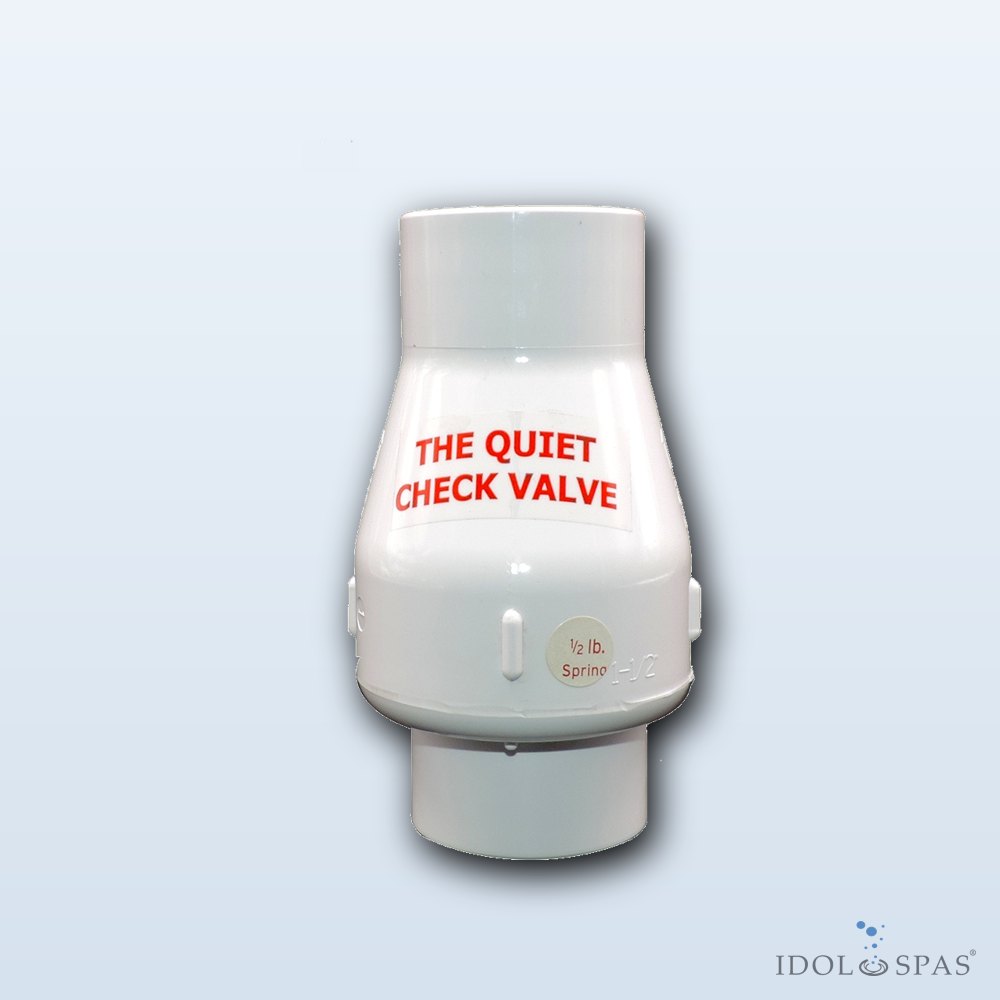
A check valve is a simple mechanical part that lets water flow in only one direction. In pool piping it sits at points where reverse flow would cause a problem — and its failure often shows up as a mysterious drop in water level or unexpected equipment behaviour, not as an obvious fault.
Where check valves are used in a pool
- After a salt cell or a dosing station — prevents highly concentrated chemical water from flowing back toward the pump or into another part of the circuit.
- On the supply to a heat pump or heater — prevents water from freely flowing through a bypass when the pump is off.
- On the line to an automatic vacuum or water feature — maintains flow direction even as system pressure fluctuates.
- Before a check valve for roof-mounted solar heating — prevents unwanted water draining from the panels back into the pool after the pump switches off.
How a check valve fails
The most common cause is debris or scale catching on the flap, preventing it from closing fully — the valve then lets water pass in both directions instead of just one. The second cause is mechanical wear of the spring or flap after years of use, when the valve loses the force needed to seat fully. More rarely, mechanical damage occurs from water freezing inside the housing.
Signs of a faulty check valve
- Water slowly drains from the pool through a bypass even with the pump off (typically for chemistry or solar heating).
- Increased chemical consumption with no clear reason — dosed product partly flows back instead of into the pool.
- An unusual clacking or knocking sound in the piping as the pump starts and stops.
Checking and replacing
Most check valves have an arrow on the body showing the correct installation direction — this must be respected during replacement, since a reverse-installed valve either blocks flow entirely or doesn’t perform its function at all. The valve is usually fitted onto a glued or threaded pipe connection, so replacement requires briefly stopping flow and closing adjacent valves.
FAQ
Does every pool need a check valve?
Not everywhere is it necessary — it’s only needed where unwanted reverse flow actually causes a problem (chemistry, solar heating, a heat pump). For a simple pump-filter circuit, it’s usually unnecessary.
How do I tell a clogged valve from a fully broken one?
Through disassembly and visual inspection — scale deposits can often simply be cleaned off and the valve keeps working, while a mechanically worn spring or a cracked flap requires replacing the whole part.
Can a check valve be repaired, or is it always replaced whole?
For most common types, the whole part is replaced — it’s a cheap component and repairing individual internal parts usually isn’t worthwhile.
Check valves and circulation-circuit accessories are in the structural parts category. More articles on pool technology are in the Guides section.