FLO on the display is one of the most common error messages on hot tubs with Balboa and Gecko control systems. It means the unit cannot detect sufficient water flow through the heater, so it switches off heating for safety reasons. The good news: in most cases the cause is a clogged filter, a low water level or an airlocked pump — and you can fix those yourself. This guide takes you through 7 steps, from the cheapest cause to the most expensive.
What the FLO error means and why it appears
Between the circulation pump and the heater there is a flow switch (a pressure switch on older systems). When the pump is running and water is flowing, the switch closes and the control unit knows it can heat safely. If that signal does not arrive — or, conversely, arrives while the pump is stopped — the unit displays an error and locks out the heater so that the heating element does not burn out by running dry.
Depending on the system and the type of fault, the error appears in several variants:
| Code | System | Meaning |
|---|---|---|
| FLO (flashing, alternating with the temperature) | Balboa | The pump is running but the switch detects no flow — typically the filter, water level or an airlock. |
| FLO (lit continuously) | Balboa | The switch reports flow even though the pump is stopped — a stuck or faulty switch. |
| FL1 | Balboa | Flow/pressure switch open while the pump is running — insufficient flow. |
| FL2 | Balboa | Switch permanently closed (even with the pump off) — a faulty switch or a short in the wiring. |
| FLO | Gecko | Switch open — the system sees no flow. |
| FLC | Gecko | Switch closed at a time when it should not be — usually a faulty switch. |
On some panels, instead of text you will see only three flashing dots, or the codes FL or PS. The meaning is the same: a problem in the flow circuit.
Before you start: safety first
A hot tub combines water with a 230/400 V supply. Before any work on the pump, switch or wiring, switch off the circuit breaker and the RCD in the consumer unit — switching the hot tub off at the control panel is not enough. Only a person with electrical qualifications may touch live terminal blocks or the control unit. Steps 1 to 4 below carry no risk; in steps 5 to 7 you are working with the electrical installation.
Step 1: Clean or replace the cartridge filter
A clogged filter is the cause of most FLO errors. A cartridge full of limescale, cosmetics and grease puts up so much resistance to the flow that the switch does not close.
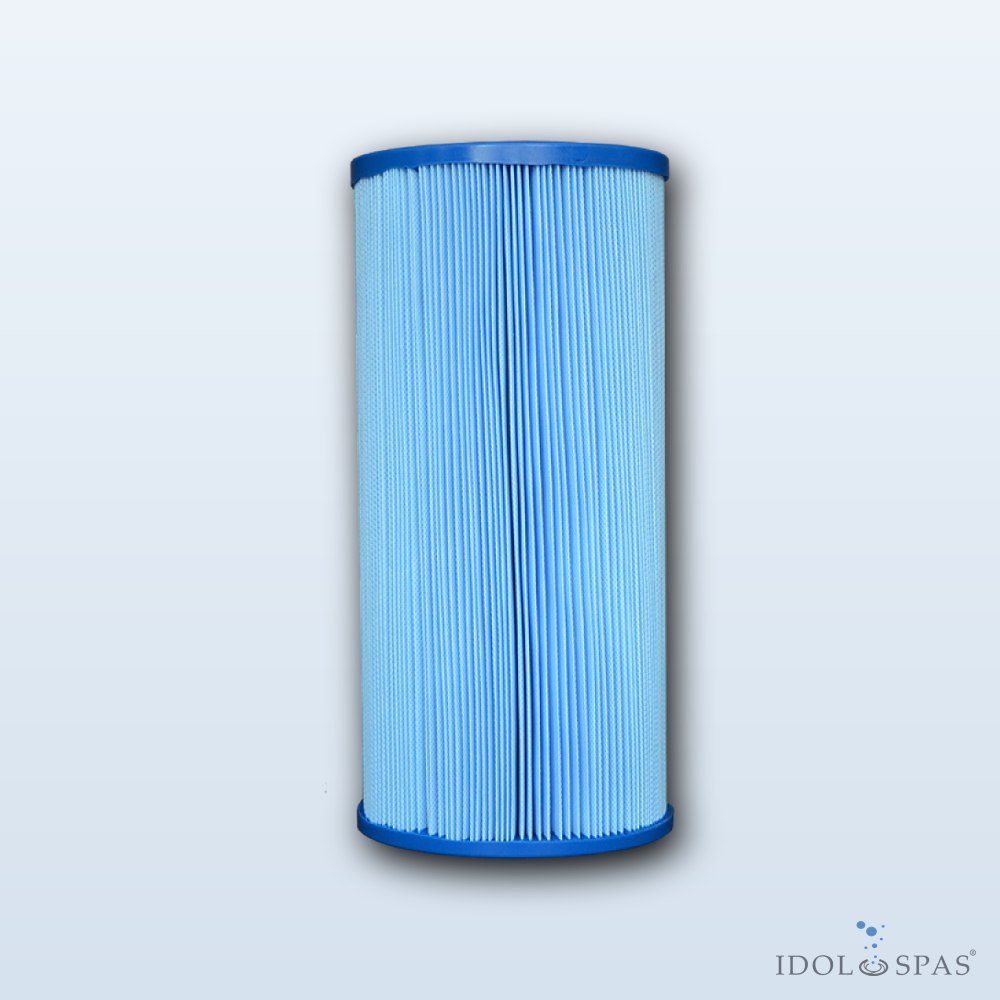
Quick test: remove the filter and let the hot tub run without it for 10–15 minutes. If the error disappears, you have your answer. Rinse the cartridge thoroughly with a hose between all the pleats, and once a month also leave it to soak overnight in a filter cleaner solution (water alone will not wash out grease). A filter older than 1–2 years can no longer be saved by cleaning — the pleats have compacted and will not let water through, even if it looks clean.
You will find replacement cartridges in the hot tub filtration category — what matters is the diameter, the length and the type of thread or opening. A common size for smaller hot tubs is, for example, the 121 × 254 mm cartridge filter (Pleatco PSG23-M); measure your original cartridge before ordering.
Step 2: Check the water level
When the level drops below the skimmer intake (evaporation and water splashed out over a weekend of bathing are enough), the pump starts drawing in air and the flow drops. Top up the water so that the level is at least 5 cm above the highest suction opening, ideally up to the middle of the skimmer — the exact mark is given in your hot tub’s manual. After topping up, let the filtration run for a few minutes and watch whether the error disappears.
Step 3: Bleed the system (airlock)
Did the error appear right after changing the water? Then there is almost certainly an air pocket in the pipework or in the pump. You will recognise it by gurgling, weak jets or a pump that “hums but runs dry”.
- First try pulsing: switch the jet pump on at high speed for 10–20 seconds, switch it off, wait, and repeat 3–4 times. The air is usually pushed out through the jets.
- If that does not help, switch off the hot tub, open the service panel and slowly loosen the union nut on the pump outlet by half a turn. As soon as the air stops hissing and a steady trickle of water starts to come out, tighten the nut by hand.
- Next time you fill the hot tub, put the hose into the filter housing — the water then fills the pipework from below and air does not get into the system at all.
Step 4: Check the suction and the shut-off valves
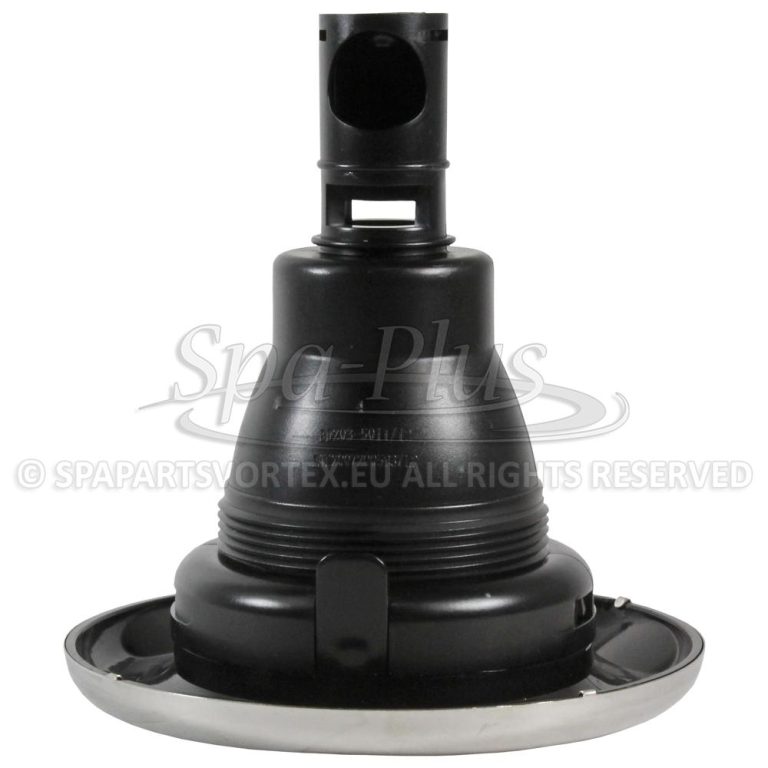
Go through the entire suction side: the suction covers on the floor and walls must not be blocked by debris, and the skimmer basket must be empty. After servicing or winterising, also check the shut-off (gate) valves at the pumps — a single one left half closed is enough for the flow to drop below the switch’s closing threshold. The valves should be pulled fully up, i.e. open.
Step 5: Test the flow switch
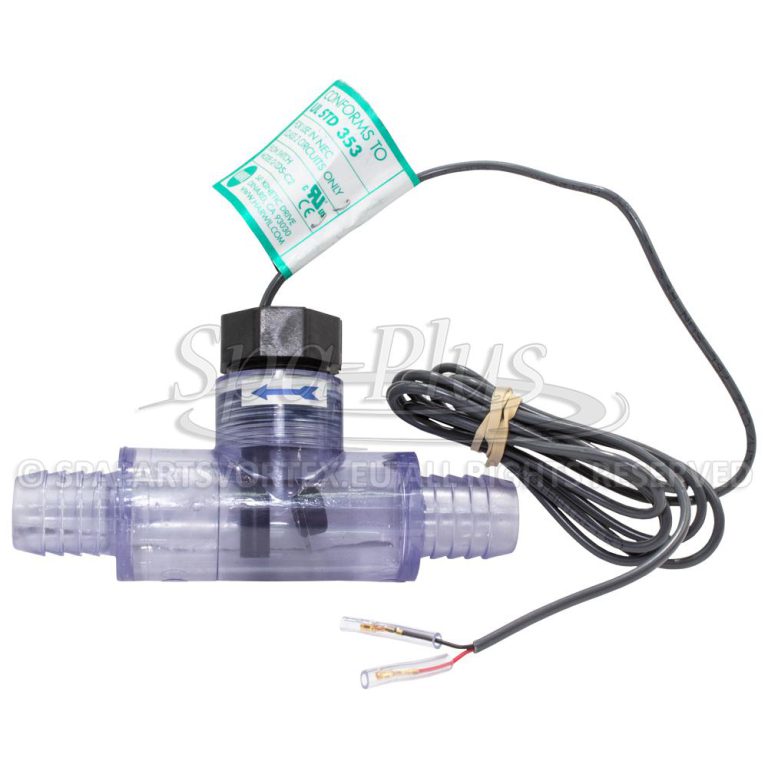
If water is demonstrably flowing (the jets are at full power) and the error persists, the switch itself is next. The most common type has a paddle that the flow of water pushes over, thereby closing the contact. Over time the paddle becomes coated in limescale or cracks.
Diagnosis with a multimeter: switch off the circuit breaker, disconnect both wires of the switch and set the meter to continuity. At rest the circuit should be open; when you push the paddle over by hand (or when water is flowing) it should be closed. Replace a switch that is permanently closed or permanently open.
Bypass test: switch off the circuit breaker, disconnect both wires from the switch and join them with a short jumper. Switch the power back on — if the FLO error disappears, the switch is faulty, not the electronics.
Warning: bypassing is strictly a short-term diagnostic test lasting a matter of minutes, and only under your supervision. A bridged switch disables the heater’s only protection against running without water — a hot tub with a permanently bypassed switch can overheat the water, destroy the heating element and even cause a fire. Remove the jumper immediately after the test.
You will find a replacement Harwil flow switch as well as other switches, sensors and wiring in the hot tub electrics and cables category. When choosing, compare the connection type (thread, hose barb) and the pipe bore — the most common are 3/4″ and 1″.
Step 6: Check the circulation pump
The system also reports FLO when the circulation pump is not running at all or is only running dry. The circulation pump is the small, quiet one that runs practically non-stop — do not confuse it with the large jet pumps.
What to check:
- Is it running at all? Put your hand on it — it should vibrate gently and feel lukewarm. A cold, silent pump is either not receiving power or has burnt out.
- Humming but not pumping? A seized rotor (limescale, debris) or worn bearings. After disconnecting the power and closing the valves, the pump can be separated at the union nuts and you can try turning and cleaning the impeller.
- Age: wet-rotor circulation pumps run 8,000+ hours a year; after 5–10 years of operation, wear is to be expected.
Replace a faulty unit with the same type — what matters is the output, the port diameter and the orientation of the suction. In the hot tub pumps category we keep common models in stock, for example the Laing E10 Fixed Speed 65 W (a classic in American hot tubs) or the LX WTC50M with centre suction, common in hot tubs made in Asia. You will find the rating plate with the type directly on the body of the original pump.
Step 7: The control unit
Have you gone through all six steps and the error persists? That leaves the electronics: a faulty relay that does not switch the circulation pump, a dry joint on the board or a faulty input from the switch. Checking whether there is voltage at the pump output is a job for an electrician or a service technician.
On Balboa and Gecko systems, the fault is fixed by replacing the board or the entire spa pack — you will find a complete overview in the Balboa and Gecko control systems category. Before ordering, copy down the exact board designation (e.g. Balboa GS510SZ, Gecko in.ye-5) from the label inside the box — the units are not interchangeable.
When to leave the fault to a service technician
Call a professional if the error keeps coming back even after replacing the switch, if the hot tub is also tripping the RCD, or if overheating codes (OH, HL) appear. The combination of FLO and a tripping RCD can indicate a breakdown of the heating element’s insulation — and that is no longer a job for home diagnostics.
How to prevent the FLO error
Practically all recurring FLO errors can be prevented with basic maintenance:
- Filter: rinse every 2 weeks, degrease chemically once a month, replace after 12–24 months. It pays to have a second cartridge and alternate them — one dries while the other filters.
- Water level: check once a week, especially in summer, when evaporation can easily account for 2–3 cm a week.
- Water: a complete change every 3–4 months and ongoing pH care (7.0–7.4) will limit limescale deposits on the switch paddle and the pump rotor.
- Filling: always with the hose in the filter housing, not over the edge — this way you avoid airlocks.
Conclusion: you can solve most FLO errors over a weekend
Work from the cheapest cause upwards: filter → water level → air → suction → switch → pump → electronics. The first four steps cost nothing, a flow switch can be had from around €150 and a circulation pump from around €165. All the parts in this guide — filters, flow switches and circulation pumps — are dispatched from stock within 48 hours, with free delivery on orders from €200. If you are unsure how to identify a part, send us a photo of the label — as the manufacturer of IDOL SPAS hot tubs with our own service department, we can help you choose for any brand.
Frequently asked questions
Can I use the hot tub while it is showing the FLO error?
In the short term, yes — with the FLO error the system has switched off the heating, so the water is simply cooling down. However, if the display shows FL2 or FLC (switch permanently closed), it is better to disconnect the hot tub: there is a risk that the heater will run without water flowing. In both cases, deal with the problem as soon as possible.
Why does the hot tub show FLO right after a water change?
It is almost always an airlocked pump. You can push the air out by pulsing the jet pump (switching it on for 10–20 s and off several times), or by slowly loosening the union nut on the pump outlet until water starts to come out. Next time, fill with the hose placed in the filter housing.
Is it safe to bypass the flow switch permanently?
No. Bypassing serves only as a short-term diagnostic test lasting a matter of minutes. A bridged switch disables the heating element’s protection against running without water — a hot tub with a permanently bypassed switch can overheat the water, destroy the heater and even cause a fire. Always replace a faulty switch with a new one.
What is the difference between the FLO, FL1, FL2 and FLC codes?
On Balboa, a flashing FLO or FL1 means insufficient flow with the pump running (filter, water level, air), while a continuously lit FLO or FL2 means a stuck or faulty switch that reports flow even with the pump off. On Gecko, FLO corresponds to an open switch (no flow) and FLC to a switch that is closed at a time when it should not be.
How much does fixing the FLO error cost?
The first four steps (cleaning the filter, topping up the water, bleeding the system, checking the valves) are free. A new filter cartridge costs roughly €20–70, a Harwil flow switch from around €150 and a circulation pump from around €165 (LX WTC50M) up to around €560 (Laing E10). The most expensive option is replacing the control board.