
Sitting in 37°C water while snow swirls around you — that’s exactly the experience most owners buy a hot tub for. Winter, paradoxically, is the best season for a hot tub: the contrast between freezing air and hot water is the most intense wellness experience you can get at home. The price is higher electricity consumption and a few rules you shouldn’t break. This article covers what winter operation really involves, how to save tens of euros a month, and what you should never do.
Why Is Winter the Best Season for a Hot Tub?
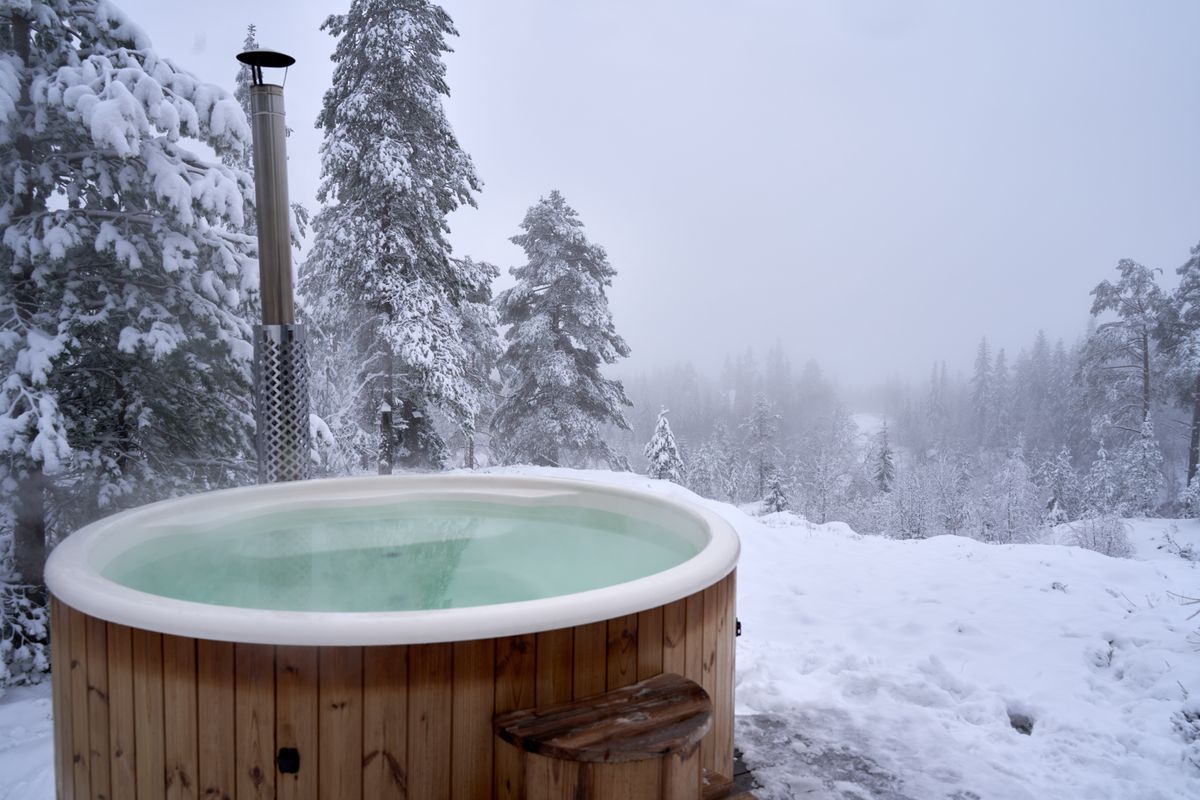
In Scandinavia, people have been bathing in hot water outdoors for centuries — alternating heat and cold is the foundation of the Nordic bathing tradition that today’s popularity of sauna culture and cold exposure grew out of. A hot tub brings this ritual to your terrace: steam rising into freezing air, snow settling on the headrests, and water that warms you to the bone within a minute.
The temperature contrast is more than aesthetics, though. Warm water relaxes the muscles and dilates blood vessels, while cold air on the face and shoulders stimulates the body. It’s exactly this combination that makes a winter soak a more intense experience than a summer one — in July, 37°C water mostly just warms you up, while in January, you actually savour it. We covered the health effects of alternating heat and cold in more detail in our article on hot tub vs. sauna.
A practical bonus: a winter evening at the hot tub is a social occasion in itself. Half an hour in the water with a view of a snow-covered garden has an atmosphere no living room can match.
What Does Winter Operation of a Hot Tub Involve?
Physics is unforgiving: the bigger the difference between water temperature and the surrounding air, the faster the water loses heat and the longer the heater has to run. While in summer a hot tub only has to fight against 25°C air, in January it’s battling a difference of over 40°C. Electricity consumption in the winter months typically climbs to double the summer figures — for specific numbers in kWh and euros, including a table, see our article on hot tub running costs.
The key element of winter operation is the thermal cover. Most heat escapes not through the walls but through the surface — via evaporation and radiation. A quality thermal cover with a tapered 10/5 cm (or thicker) profile, an intact vapour barrier, and a tight seal all around is the single thing that saves money in winter every hour you’re not bathing. A waterlogged or cracked cover, by contrast, loses most of its insulating value and is the most common cause of unexpectedly high bills.
The second winter duty is checking the water level. Evaporation and water carried out on swimsuits make the level drop faster than you’d expect — and if it falls below the pump intake, the system can suck in air and trigger an FLO error. Topping up with a hose is uncomfortable in freezing weather, so check the level at every bath and top up smaller amounts more often.
How to Run a Hot Tub Economically in Winter
The biggest mistake is thinking you’ll save money by significantly lowering the temperature between baths. If you use the hot tub regularly (twice a week or more), it pays to keep the temperature stable at around 35–37°C. Reheating the water from 30 to 37°C means feeding a mid-size hot tub over 10 kWh of energy and waiting several hours — you’ll burn through most of the “savings” from the lower temperature on repeated reheating, and you can forget about a spontaneous evening soak.
A maintenance mode with the temperature lowered to 30–32°C only makes sense once you know you won’t be bathing for a week or more — say, while on holiday. But never switch the hot tub off completely in freezing weather (see why below).
Other energy-saving measures that genuinely work in winter:
- Insulating base pad — a base standing on frozen paving loses heat through conduction. Extruded polystyrene or a special thermal pad under the hot tub significantly reduces this loss. Best addressed during installation.
- Shelter from wind — wind carries heat away from the cover and any exposed surface several times faster than still air. Placing the hot tub against the house wall, a fence, or a pergola with windscreen panels can cut losses by tens of percent compared with a hot tub standing freely in the open.
- Keep the thermal cover open as briefly as possible — just before bathing, not “for airing out”. A floating thermal blanket laid directly on the surface under the main cover adds an extra layer against evaporation.
- Use air jets (bubbles) sparingly — they blow freezing air into the water and can cool it by 1–2°C during a bath, which the heater then has to make up.
- Off-peak electricity rate — if you have a dual-tariff plan, schedule filtration cycles for the cheaper hours.
Winter Checklist: What to Watch and How Often
| Task | How Often in Winter | What to Watch Out For |
|---|---|---|
| Checking the water level | At every bath | Level always above the intake; top up in smaller amounts |
| Testing water chemistry (pH, disinfectant) | 2–3× a week | Warm water consumes disinfectant faster |
| Condition of the thermal cover | 1× a week | Brush off snow, check for waterlogging and a tight seal |
| Cleaning the filter | Every 1–2 weeks | Rinse with lukewarm water, let it dry somewhere warm |
| Freeze protection function | 1× a month | Verify the pump starts automatically in frost |
| Surroundings of the hot tub (steps, terrace) | Before every bath | Sweep away snow, use anti-slip grit, never salt near the shell |
| Water change | Every 3–4 months | Plan for a day with above-freezing temperatures |
Safety: What to Watch Out for in Winter
The biggest winter risk isn’t in the water but on the way to it. Wet steps and a wet terrace freeze over almost instantly in frost — water carried out on the feet of the previous bather turns into an ice sheet within minutes. Check the steps before bathing, sweep away snow, and use anti-slip mats designed for outdoor use. Chemical salt de-icer has no place near the hot tub shell or on a wooden terrace.
Think through the path between the house and the hot tub: sturdy slippers with a non-slip sole, a bathrobe on a hook by the hot tub, and a dry towel within reach. The way back is more critical than the way there — you’re wet and your body loses heat fast. A distance of just a few metres from the door is ideal.
In the water itself, two rules apply. First, a hat: the head is the only unprotected part of the body, and a significant amount of heat escapes through it in frost — a knitted hat is both an iconic and a practical accessory for a winter soak. Second, hydration: hot water makes you sweat even when you can’t feel it in the water. A glass of water before and after the bath is the minimum; save alcohol combined with hot water and frost for another time. Keep winter baths to 15–25 minutes.
What to NEVER Do in Winter
Never switch off the hot tub in frost while there’s water inside. This is the most expensive mistake an owner can make. Water in the pipes, pumps, and heater element freezes within hours — ice expands in volume by around 9% and splits pipes, pump housings, and the heat exchanger. The result is a repair bill running into the thousands of euros, often requiring the entire cabinet to be dismantled, since cracked joints tend to be hidden inside the insulation.
Modern hot tubs have freeze protection — an automatic safeguard that starts the pump and heater on its own when the water temperature drops. It only works, however, while the hot tub is connected to power. A power outage lasting more than a few hours during severe frost needs to be dealt with actively: a closed thermal cover typically keeps the water warm for one to two days; for a longer outage, contact a service technician.
If you genuinely don’t want to run the hot tub over winter, the only correct approach is complete winterizing: draining, blowing out all circuits (jets, heater, pumps), vacuuming out residual water, and covering it. Residual water at the lowest point of the piping is enough to cause damage — so it’s worth having winterizing done by a service technician, or following the manufacturer’s manual exactly.
Maintenance and Chemistry: Does It Work Differently in Winter?
A common misconception holds that “less chemistry is enough” in winter. The opposite is true. What matters isn’t the outdoor frost but the water temperature — and that stays at 35–38°C. Disinfectant gets used up faster in warm water: chlorine breaks down noticeably faster at higher temperatures, and microorganisms thrive better in the warmth, so disinfectant consumption is higher than in cooler pool water. That’s why you should test the values 2–3 times a week just as carefully as in summer; find the full procedure in our article on hot tub chemistry step by step.
The only thing winter genuinely slows down is testing done outdoors — both drop testers and test strips are calibrated for room temperature, so bring a water sample inside to evaluate it. Granular chemicals dissolve without any trouble in the hot tub’s warm water.
Changing the water in winter takes planning, not postponing. Even in winter, water gets exhausted after 3–4 months (chemical consumption rises, the water foams and loses its sparkle), and putting the change off until spring isn’t worth it. Pick a day with above-freezing temperatures, ideally in the morning: drain, wipe down quickly, refill immediately, and start heating. Keep the whole process to a matter of hours — an empty hot tub must not stand overnight in frost. During hard freezes below −5°C, postpone the change until the next thaw; keep the water in shape until then with shock disinfection.
Frequently Asked Questions
What temperature should I set on the hot tub in winter?
With regular use, keep a stable 35–37°C. Briefly lowering the temperature between baths saves very little, because reheating is energy-intensive and takes hours. A maintenance mode of around 30–32°C only makes sense for a break longer than a week.
How much extra does it cost to run a hot tub in winter?
Expect roughly double the summer consumption — for a well-insulated acrylic hot tub with a thermal cover, typically around €40–60 a month in electricity, with poorly insulated models costing considerably more. What matters most is the quality of the thermal cover, the insulation, and a sheltered location.
Can a hot tub freeze while it’s switched on?
Not under normal operation — the heater maintains the temperature, and freeze protection starts the pump whenever the water temperature drops toward the risk threshold. The danger arises during a power outage or a fault: a closed thermal cover keeps the heat in for about one to two days, after which you need to drain the water or arrange a backup power source.
Can a hot tub be switched off and left unused in winter?
Yes, but only after complete winterizing: draining the water, blowing out all circuits, vacuuming residual water out of the pipes and pumps, and covering it. Simply switching it off with water still inside means, in frost, virtually certain destruction of the pipes and pumps.
How long should you bathe in a hot tub in winter?
Ideally 15–25 minutes. Hot water combined with freezing air is more intense on the circulatory system than a summer bath — drink water before and after bathing, wear a hat, and end the bath if you feel dizzy or faint.
Winter tests the quality of a hot tub more than any other season — a well-insulated model with a quality thermal cover gets through the freezing months at costs that won’t surprise you, and rewards you with baths you won’t forget. If you’re still choosing a hot tub and year-round operation is a priority for you, take a look at our range of hot tubs and pay particular attention to insulation and thermal cover specifications.
