
You fill your pool with beautifully clear well water, add chlorine — and a few hours later you’re staring at a brown, rusty, or greenish-brown lagoon. Algae aren’t to blame; it’s dissolved iron and manganese that the chlorine has oxidized and made visible. The good news: if you test the water beforehand and follow the right sequence of steps (pH first, then a metal remover, and only then chlorine), you can fill from a well without any trouble. And even if the water has already turned brown, you don’t need to drain it.
Why does well water turn brown in a pool?
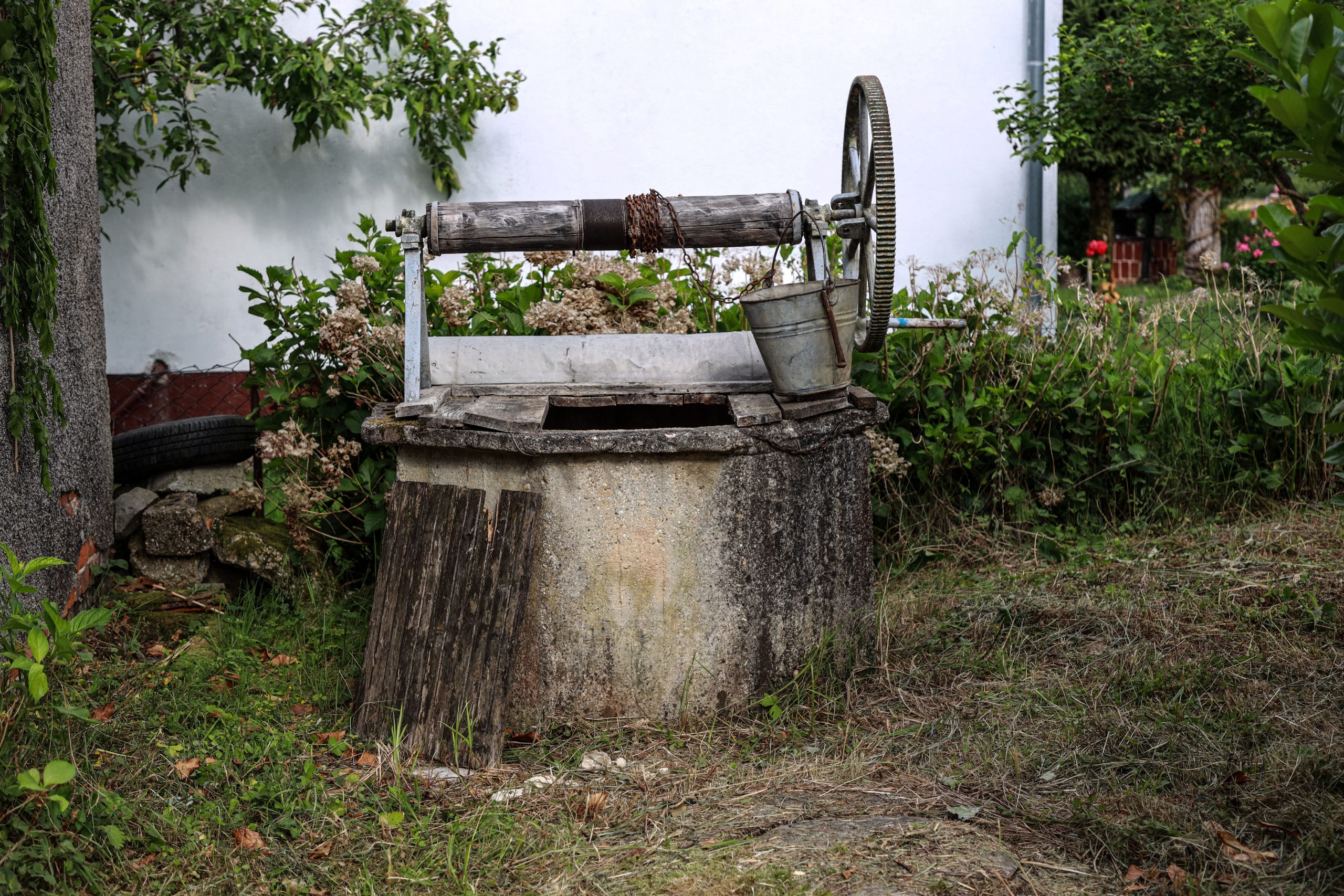
Groundwater flows through rock formations without contact with air. As a result, iron and manganese exist in it in a dissolved, divalent form — the water looks clear and perfectly fine. That’s exactly how it comes out of the pump and into your pool.
But as soon as you add chlorine (or simply let the water aerate for a few days), the dissolved metals oxidize into insoluble trivalent compounds. Iron forms rust-brown flakes of iron hydroxide, while manganese leaves dark brown-black deposits. The water turns brown, yellow, or takes on a greenish-brown tint, and a fine colored film appears on the floor and walls.
In simple terms, it’s the same process that rusts a nail. Chlorine just does in hours what air would take weeks to accomplish. The more chlorine you add at once, the faster and more dramatic the “brown surprise” will be.
Brown or green? Metals vs. algae
A greenish tint after chlorinating is deceiving — it looks like algae, but it’s often iron in a transitional oxidation stage, or copper. Quick test: algae-laden water is cloudy and the walls feel slippery, while metal-tinted water stays transparent (just discolored), and after shock chlorination the color deepens instead of disappearing. For a detailed diagnosis, see our article on green pool water.
How to spot risky water in advance
A lab analysis is the most reliable option. An abbreviated drinking-water analysis under Czech decree No. 252/2004 Coll. costs roughly €40–80 at accredited labs and always covers iron, manganese, hardness, and pH. For pool purposes, a targeted test for metals and hardness alone is usually enough, and it tends to be cheaper.
At home, you can get a quick read even before sending off a sample:
- Glass test: Fill a clear glass with well water and let it sit in the open air for 24–48 hours. If it turns yellow, turns brown, or a rusty sediment settles at the bottom, it contains iron.
- Chlorine test: Add a few drops of a chlorine product to a bucket of water. A yellow or brown tint within a few hours indicates iron; a gray or black tint indicates manganese.
- Indirect clues: rusty stains on bathroom fixtures, a bitter metallic taste, dark deposits in your kettle, or laundry that comes out with a yellowish tinge.
- Drop and strip test kits: iron testers sold for aquariums and pools can detect concentrations from around 0.1 mg/l — accurate enough for a rough decision.
What are the iron and manganese limits for a pool?
There’s no binding standard for filling a pool with well water, so practice relies on drinking-water limits and pool-chemical manufacturers’ recommendations. Czech decree No. 252/2004 Coll. sets drinking-water limits of 0.2 mg/l for iron and 0.05 mg/l for manganese; the WHO notes that iron already becomes sensorially noticeable (color, turbidity) from around 0.3 mg/l. For pools, the thresholds are similar:
| Parameter | Ideal for filling | Increased risk | Don’t fill without treatment |
|---|---|---|---|
| Iron (Fe) | up to 0.3 mg/l | 0.3–1 mg/l — metal remover required | above 1 mg/l |
| Manganese (Mn) | up to 0.05 mg/l | 0.05–0.3 mg/l — metal remover required | above 0.3 mg/l |
| Hardness (Ca + Mg) | 1–2.5 mmol/l | 2.5–3.5 mmol/l — watch for scale | above 3.5 mmol/l (soften or dilute) |
| pH after filling | 7.0–7.4 | 6.5–7.0 and 7.4–7.8 — adjust | outside 6.5–7.8 |
Manganese is trickier than iron: it takes only a tenth of the concentration to discolor the water, and its deposits are darker and harder to remove. If your analysis shows both above the “increased risk” threshold, consider pre-filtration (an iron-removal filter on the well) — sequestrants alone can’t handle high concentrations.
Well water also tends to be hard — and hardness means scale on the liner, in the heating coil, and in the filtration system. We cover what to do about it in detail in our article on water hardness and scale.
How to fill a pool with well water, step by step
The order of steps matters more with well water than with tap water. The golden rule: treat the metals before chlorine ever enters the picture.
- Test the water beforehand. Get a lab analysis, or at least run the home tests from the previous section. Based on the result, decide whether to fill directly, through a pre-filter, or bring in water from elsewhere instead.
- Fill slowly and through the filtration system. Wells often have limited yield — fill in stages (e.g., 2–3 hours of pumping, then a pause) so you don’t run the well dry or stir up sediment from the bottom of the borehole, which is richest in metals. If your setup allows it, route the water through the pool’s filtration system while filling; a suitable inline pre-filter on the hose will catch sand and coarse debris.
- Start the filtration and adjust the pH to 7.0–7.4. Correct pH is the precondition for everything that follows — at high pH, metals precipitate faster and less predictably, and chlorine loses effectiveness.
- Dose a metal remover (sequestrant). Chelating-agent products “lock” dissolved iron and manganese into stable complexes that chlorine can’t oxidize. Dose according to your pool volume and let the filtration run for 12–24 hours. This step must happen before the first chlorination — once the metals have precipitated, a sequestrant can no longer redissolve them.
- Only now add chlorine. Start with a lower dose rather than shock chlorination right away. Watch for any color change — a slight yellowing means some metals are still unbound, and it’s worth adding more sequestrant.
- Run the filtration continuously for 24–48 hours, then backwash the filter. With sand filtration, the sand traps the metal flakes; cartridges clog faster — we cover the differences in our article on sand vs. cartridge filtration.
What to do if the water has already turned brown
First of all: don’t drain it. Brown water after chlorination looks catastrophic, but it’s a fixable situation — and refilling from the same well would just produce the same result again. Here’s the procedure:
- Check and adjust the pH to 7.0–7.2. A slightly lower pH helps with the steps that follow.
- Apply a flocculant. The precipitated metal microparticles are often too fine for the filter to catch on its own; a flocculant binds them into larger clumps that the sand filter traps, or that sink to the bottom. With cartridge filtration, use a flocculant carefully and in gel/pillow form — a liquid one can gum up the cartridge.
- Filter continuously and backwash whenever the pressure rises. Plan on 2–5 days of filtration running.
- Vacuum the deposits off the bottom slowly, ideally straight to waste, so the clumps don’t get pulled back into circulation.
- Add a sequestrant for the remaining dissolved metals so the problem doesn’t repeat with the next chlorination.
- Be patient. The water clears gradually — it will look noticeably better each day. Draining should only be a last resort for extreme concentrations, when the water still isn’t clearing even after a week of flocculation.
Don’t scrub iron and manganese stains off a liner or acrylic surface with a wire brush — use a dedicated metal-stain remover and a soft sponge.
Well, tap water, or a delivery tanker: which is worth it for filling?
Filling a 30 m³ pool from the tap, at a typical water/sewage rate of €4–6/m³, costs roughly €120–180. A well is practically free (just the electricity for pumping — a few cents’ worth), but it carries the risk of metals, hardness, and limited yield. A delivery tanker is the most expensive option, but it comes with guaranteed drinking-water quality.
| Source | Approximate cost for 30 m³ | Main advantage | Main risk |
|---|---|---|---|
| Tap water | €120–180 | stable, treated water | cost; large withdrawals may need reporting to the water utility |
| Well | practically just electricity (under €4) | near-zero cost | iron, manganese, hardness, well yield |
| Delivery tanker | roughly €160–320, depending on distance | speed, verified quality | highest cost; seasonal booking availability |
A practical compromise: fill the initial volume from the tap or a tanker, and use the well only for topping up. One catch to watch for — if you discharge well water into the sewer system, your municipality may charge a sewage fee; check in advance.
Topping up evaporation with well water: yes, but with care
In summer, a pool can easily lose 3–5 mm of water a day to evaporation, and topping up with well water is tempting. The catch is that only pure water evaporates — the metals and minerals in the pool stay behind, and every top-up adds more. Iron concentration and hardness both creep upward over the course of the season as a result.
The solution is simple: top up with small amounts regularly rather than one large volume at once, dose a maintenance amount of sequestrant once a month, and test hardness and metals with a tester monthly. If the readings keep climbing, replace part of the water with tap water.
FAQ: common questions about filling a pool with well water
Can I fill my pool with well water even if it’s “high in iron”?
Up to around 1 mg/l of iron, yes — with a metal remover dosed before chlorination and sand filtration, you can manage it. Above 1 mg/l, it’s worth installing an iron-removal filter beforehand, filling from another source, or at least planning on several days of flocculation and filtration after filling.
How long does it take for brown water to clear up?
With the right approach (pH, flocculant, continuous filtration, vacuuming to waste), usually 2–5 days. Manganese clears more slowly than iron. If there’s no improvement after a week, get a lab analysis — the cause could be extremely high metal concentrations or humic substances.
Does shock chlorination help against iron?
Quite the opposite — it speeds it up. Shock chlorination rapidly oxidizes iron and manganese, and the water turns even browner. This can actually be used deliberately: the metals precipitate all at once and you filter them out afterward. But without flocculation ready to go and powerful filtration, it’s a risky approach — dosing a sequestrant before chlorinating is the safer route.
Is iron-rich water harmful to health when swimming?
At the concentrations typically found in wells, it isn’t a health risk for swimming — the drinking-water limit (0.2 mg/l under Czech decree No. 252/2004 Coll.) is set mainly because of taste and color. The real problem is aesthetic and technical: stains on the liner, discolored hair and swimwear, clogged filtration, and higher chlorine consumption.
Do I always need to add a sequestrant when topping up with well water?
Yes, a maintenance dose every 3–4 weeks, if your well water contains metals. Sequestrants gradually break down in the pool under the effects of chlorine and UV, so their effect isn’t permanent. Follow the manufacturer’s dosing instructions and check with a tester monthly.
Well water can cut hundreds of euros off your pool season — all it takes is testing it beforehand and following the sequence: pH, metal remover, and only then chlorine. Everything you need, from testers to sequestrants, flocculants, and complete pool chemistry, is available in our water treatment category. And if you’re wondering which filtration handles metals best, start by comparing sand and cartridge filtration.
