
An app on your hot tub does not save money by looking good. It saves it in two very specific ways: it can shift heating into the hours when electricity is cheaper, and it can shorten and reschedule filtration cycles to match how you actually use the tub. The third benefit is not financial but often matters more — a warning about a fault or a drop in temperature reaches your phone before a minor issue turns into a service call. The rest of the features are convenience.

One distinction matters. Pool automation is a different discipline — it deals with chemical dosing, ORP measurement, filtration control and covers; that is covered in a separate article, Smart pool and automation. Unlike a pool, a hot tub has its own control unit, which today already heats, switches pumps and watches the temperature on its own. Smart control simply adds remote access and scheduling on top. This article is about exactly that layer.
What smart hot tub control actually does
Setting temperature and filtration cycles remotely
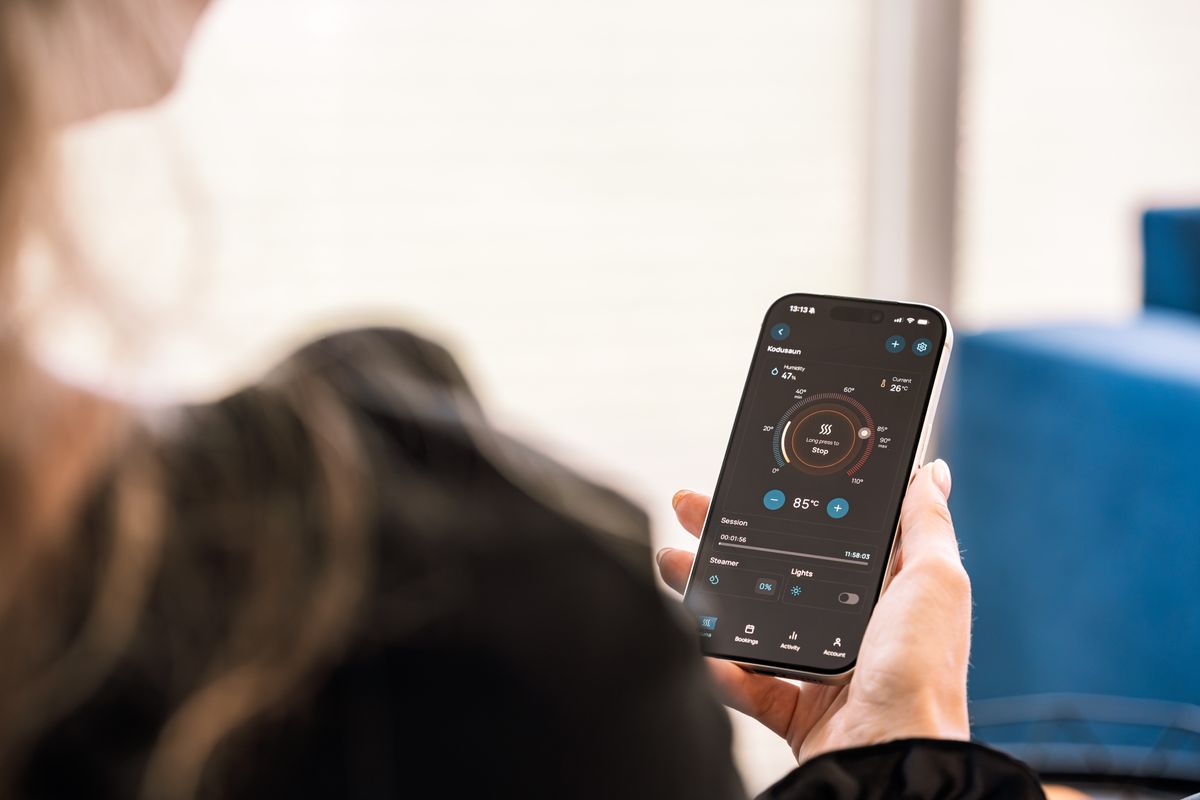
The foundation everything else rests on. In the app you see the current water temperature, the target temperature and the status of the pumps and heater. You can switch from economy mode to standard, change the target temperature by two degrees or move a filtration cycle to a different time of day — from the sofa, from the office, from the car.
The practical effect: most owners keep their hot tub at operating temperature all the time simply because otherwise it would not heat up in time. With an app you can run it permanently 2–3 °C lower and bring it up to full temperature on a schedule, or with a single tap a few hours ahead.
Scheduling heating for cheap hours
This is where the real money is. If you have a dual-tariff rate or a spot price contract, the scheduler can move heating and filtration into a low-price block. The principles and pitfalls of spot optimisation are covered in Hot tub and pool on spot-price electricity — smart control is the tool that lets you actually realise those savings, not just calculate them.
The second option is linking it to your own generation. Anyone with solar PV wants to heat at midday from surplus power, not in the evening from the grid. The combination of a hot tub and a PV system, complete with realistic figures, is described in Solar PV for a pool and hot tub.
Alerts for faults and temperature drops
Notifications are the feature you do not appreciate until you need them. The app can send a push message when the control unit reports a fault, when the temperature falls below a set threshold, or when the connection to the module is lost.
Fault messages appear with the same codes as on the hot tub display, so you can look them up straight away in the overview of Balboa error codes. The difference is timing: you read the code on the display only once you walk up to the tub, whereas the code on your phone is there immediately.
Keeping watch while you are away
A week’s holiday is the riskiest period of the year for both a hot tub and a pool — precisely because nobody is looking. The recommended routine before you leave is summarised in Pool and hot tub while you are on holiday; the app adds ongoing monitoring and the option to switch the heating on the day before you get back.
What smart control systems are available
Integrated Wi-Fi modules from control unit manufacturers
The cleanest route. Manufacturers of control units — Balboa with its bwa™ system, Gecko with in.touch, and others depending on the brand of tub — offer a module that connects directly to the control board and talks to it in the board’s own protocol.
The advantage: the app sees exactly what the display sees. Temperatures, modes, individual pumps, error codes, the filtration schedule. Nothing is simulated. The drawback: you need a board the module supports.
Retrofit modules for an existing hot tub
Most hot tubs from roughly the last ten years can be retrofitted. The key point, though, is compatibility with the specific control board, not with the brand of the tub — one manufacturer may use different boards and different connectors across models and model years.
Before you order anything, open the equipment bay and read off the board’s type designation and the software version shown on the display. Without that, buying is a lottery.
Universal smart plugs and relays
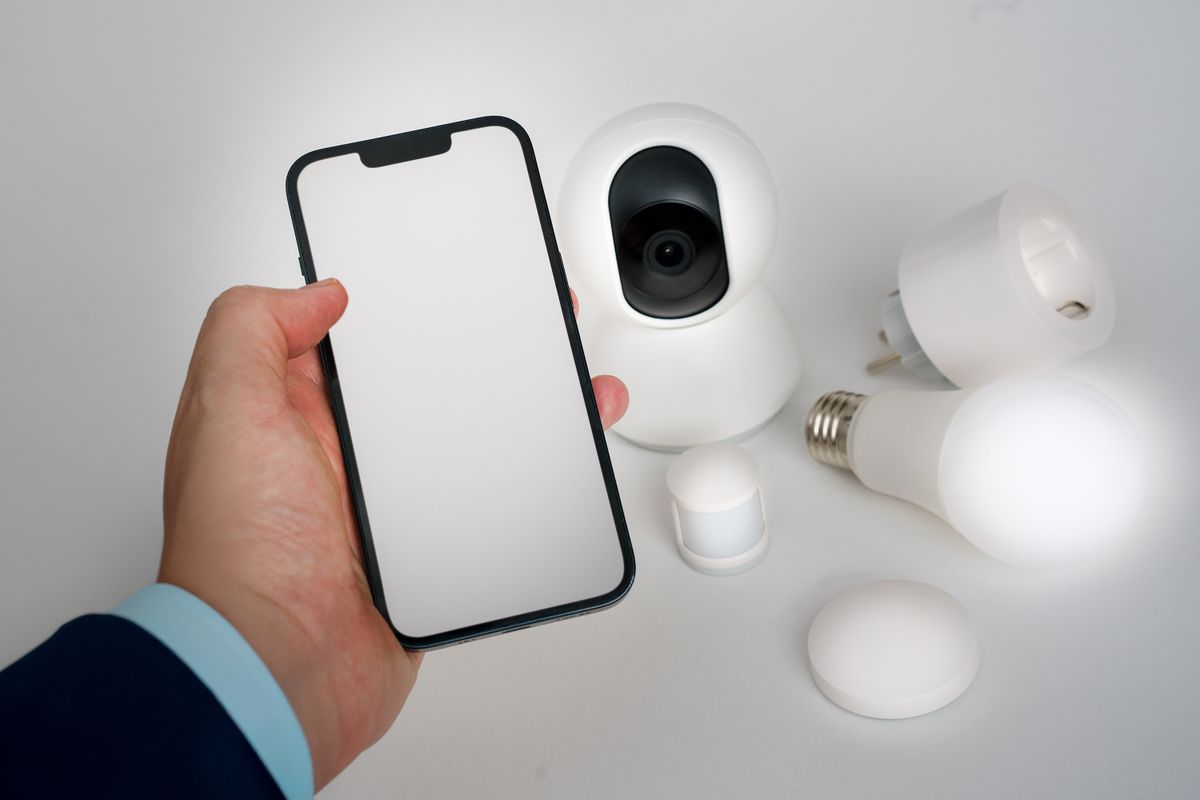
A cheap solution that we do not recommend using with a hot tub in the way it is commonly marketed. A smart plug can do exactly one thing: cut the power. But with the power cut, the hot tub’s freeze protection is not running, the temperature is not being monitored and the circulation pump is not turning.
In winter that is a direct route to water freezing in the pipework and a cracked pump housing — a repair running into hundreds or thousands of euros, not a saving. What to do instead is described in Hot tub in winter. Smart energy metering on the supply, by contrast, is useful as long as it only measures and does not switch; and if you are dealing with the connection itself, see hot tub electrical installation.
Temperature sensors and floating water monitors
A separate category that does not communicate with the control unit at all. A floating probe measures temperature — and on pricier models ORP and pH too — and sends the data via Bluetooth or a Wi-Fi gateway to an app, together with dosing recommendations.
Treat them as a trend, not as a replacement for testing. The accuracy of cheap probes drifts and calibration is essential; your reference value comes from a classic test as described in How to test water properly. They are mainly useful as trend monitors — when the pH falls three days in a row, you know about it sooner than from a strip once a week.
What to check before buying a module
Four points that most disappointments come down to.
- Control board model and firmware version. Not the brand of the tub, not the year of manufacture. The specific type designation of the board, and whether the module manufacturer lists it as supported.
- Wi-Fi coverage in the garden. A hot tub is typically 15–25 m from the router, often behind a wall or the glass of a terrace. Measure the signal strength with your phone right by the equipment bay; if the signal is weak, budget for a repeater or an access point, or for a module that creates its own local network.
- Dependence on the manufacturer’s cloud. Most apps send commands via the manufacturer’s server. Ask what happens during an internet outage: good systems offer a local mode within the home network, while with the rest the hot tub itself keeps running (it goes on heating and filtering according to the last settings) but control from your phone drops out.
- Updates and support. A module is a computer. Find out how long the manufacturer issues updates, whether the app requires registration, and whether the module can later be paired with a different phone without a service visit.
How much it really saves: a worked example
Let us take a hot tub for 4–5 people in year-round operation. We work from the framework set out in detail in Hot tub running costs, and we state every assumption openly — your figures will differ according to insulation, cover and climate.
Assumptions: annual consumption 2,800 kWh, of which roughly 2,100 kWh is heating and holding temperature and 500 kWh is filtration and circulation; electricity at €0.22/kWh at peak and €0.15/kWh in the cheap block; circulation pump 0.2 kW.
Saving 1 — shifting the heating. If you manage to move half the heating, that is about 1,050 kWh, into the cheaper block with a difference of €0.07/kWh, the saving works out at roughly €76 a year.
Saving 2 — optimising filtration. Cutting the filtration cycle from 8 to 5 hours a day with a 0.2 kW pump means 0.6 kWh a day, so 219 kWh a year, which at an average €0.19/kWh is about €42 a year. The condition: water hygiene has to tolerate the reduction, which with a lightly used tub it usually does, and with a rental tub it definitely does not.
Together €100–120 a year against a module price of roughly €120–320. The payback therefore works out at 1.5 to 3 years — assuming you actually set the scheduler up and leave it running. A module that hangs on the wall as a remote control saves nothing.
Security and privacy
A module in your hot tub is a device connected to your home network and to the internet. The same rules apply to it as to a camera or a thermostat.
- A strong, unique password for your account in the app; never the same one as for your email. If the app offers two-factor authentication, switch it on.
- Change the module’s factory password if it creates its own Wi-Fi network with a default key at first start-up.
- A separate network for IoT. Most routers today can run a guest or second SSID. That is where smart devices belong — if someone gets into one of them, they cannot see your computers and drives.
- Share access thoughtfully. With a rental hot tub it makes sense to set up a separate user account with limited rights rather than handing over the main account.
What an app will not replace
This is the most common misconception among new owners. Smart control manages energy and time — it does not touch chemistry or mechanics.
The water still has to be tested and dosed by hand; disinfectant does not top itself up. The filter cartridge still has to come out, be rinsed and left to dry; the procedure and intervals are in the article Cleaning a hot tub filter. And if you let the filter clog, the app will show you a nice graph of falling flow, but nobody is going to wash the cartridge for you.
Overview: feature, benefit and what you need for it
| Feature | Benefit | Equipment needed |
|---|---|---|
| Remote temperature change | Lower holding temperature between soaks | Wi-Fi module compatible with the control board |
| Heating scheduler | Shifts consumption into cheap hours, €60–80/year | Module with a schedule + dual tariff or spot pricing |
| Filtration cycle control | Shorter pump run time, €32–48/year | Module from the control unit manufacturer |
| Error code notifications | Action before it freezes or the heater is damaged | Module with push alerts + stable signal |
| Temperature monitoring while away | Peace of mind on holiday, freeze protection | Module + a back-up contact on site |
| Energy metering | Real data instead of guesswork | Smart meter on the supply (metering only, no switching) |
| pH and ORP probe | Water quality trend between tests | Floating monitor + gateway, manual calibration |
| Linking to solar PV | Heating from surplus instead of from the grid | Module with an external input or PV integration |
Frequently asked questions
Does smart control work with an older hot tub too?
Often yes, but what decides is the control board, not the age of the shell. For Balboa and Gecko boards from roughly the last ten years a module is usually available; for older units or boards from smaller manufacturers there may be none at all. Always copy down the board’s type designation from the equipment bay and check it with the module supplier in advance.
What happens if the internet or the manufacturer’s cloud goes down?
The hot tub carries on according to its last saved settings — it heats, filters and watches the temperature, because the control unit handles all of that locally. Only remote control and notifications drop out. Some systems offer a local mode in which you can still operate the tub within your home Wi-Fi without internet; ask about that before you buy.
Can I control my hot tub with an ordinary smart plug?
We do not recommend it. A plug can only cut the power, which disables freeze protection and circulation. Outside winter that is a risky compromise; in winter it is a direct route to burst pipework. On top of that, most hot tubs have a hard-wired supply through a circuit breaker and an RCD, where an ordinary plug does not even fit.
Will I save more with a scheduler or with a better thermal cover?
In the vast majority of cases, with the cover. Heat loss through the water surface accounts for the largest share of an outdoor hot tub’s consumption, and an old waterlogged cover is without question the first investment to make — see hot tub thermal cover. Smart control makes sense as a second step, once you are optimising when you heat rather than how much heat escapes.
Can I install the module myself?
Fitting the module itself is usually simple — a connector into the board and pairing in the app. But it means working inside the cabinet, where the mains side is too. If you are not confident you can tell what is what, leave it to a service technician; an hourly rate is an order of magnitude cheaper than a new control board.
Smart control does not turn a hot tub into a different product — it turns it into a product you stop monitoring and start using. If you are still choosing and want the module factory-fitted, take a look at our range of hot tubs; for retrofitting an existing shell and for the equipment around it, there is the technology category. More articles on operation and savings can be found in the Guide section.
