
Water aerobics is one of the few ways to train both fitness and strength with practically no strain on your joints — and you don’t need a lap pool or classes at a fitness centre. An ordinary garden pool 6–8 metres long, chest-deep water and half an hour of your time are enough. The water’s buoyancy takes up to roughly 90% of your body weight off your frame, while its resistance makes your muscles work harder than on dry land. The result is a workout that is effective yet gentle.
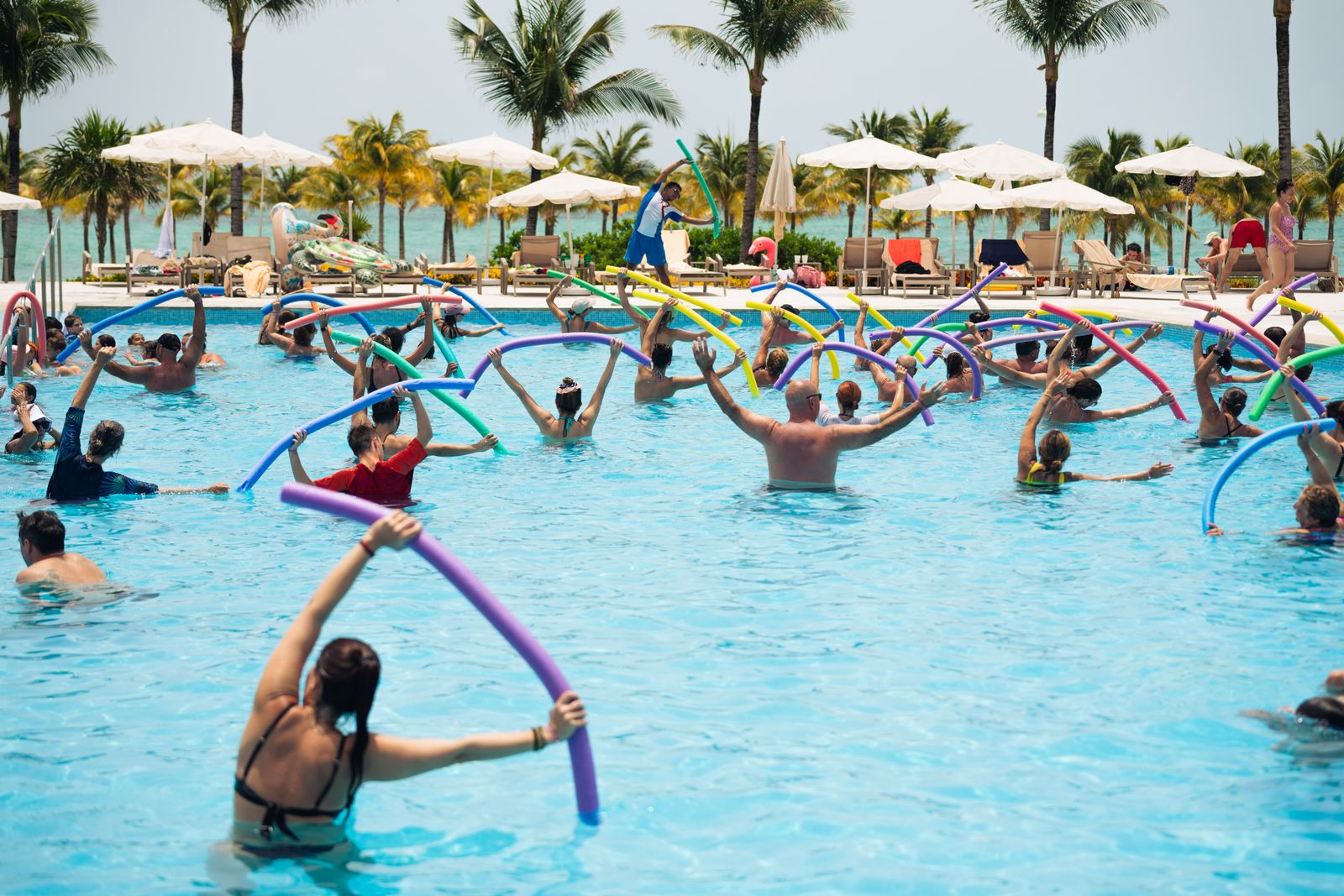
Why exercise in water rather than on dry land?
The effectiveness of exercising in water comes down to two physical phenomena that complement each other. The first is buoyancy: immersed up to the neck, water carries approximately 90% of your body weight, up to the chest around 70%, and up to the waist roughly half. With every step, jump or lunge, your joints, spine and tendons therefore absorb only a fraction of the usual load.
The second phenomenon is the resistance of the medium. Water is orders of magnitude denser than air — it is commonly said to resist movement roughly 12 times more. Every movement of your arms or legs thus works like strength training with a light load, and evenly in all directions. The faster you move, the more resistance the water provides; you control the intensity yourself through your tempo, without changing any weights.
Added to this is hydrostatic pressure, which supports venous return and provides mild relief for swollen legs, and the cooling effect of water, which keeps you from overheating during exercise. That is why exercising in water has long been recommended for seniors, people who are overweight, those with osteoarthritis or recovering from injuries — movement that would hurt or be unsafe on dry land becomes manageable in water. Any health limitations should still always be discussed with a doctor or physiotherapist; water reduces the load, it does not remove it.
A bonus that gets less attention: water is an unstable environment, so with every exercise the deep core muscles that constantly balance the body are working too. You are incidentally training balance and stability — abilities that decline fastest with age and are difficult and risky to train on dry land.
Is an ordinary 6–8 metre pool enough for water aerobics?
Yes — and that is the main point. While fitness swimming requires either a long pool or a counter-current system (we covered it in detail in our article on the swim spa as a home gym), water aerobics is done in place or over a few metres. The ideal depth is one where the water reaches your chest to your shoulders — for most exercises that means 1.2–1.5 m. In the deeper part of the pool you can add aqua jogging with a flotation belt, and by the wall, strength exercises with support.
Exercises you can realistically do in a home pool
- Aqua jogging — running in water on the spot or over short distances. In shallower water you push off the floor; in deep water with a flotation belt you run “in mid-air” with no impact at all. A great cardio foundation.
- Jumping jacks — in water you land softly, while your arms and legs have to overcome resistance in both directions of the movement.
- Lunges and squats — buoyancy takes the load off the knees, so even people who struggle with lunges on dry land can manage them. Hold on to the pool edge for stability.
- Kicks forward, backward and to the sides — they strengthen the glutes and thighs, and combined with wall support they suit complete beginners too.
- Noodle work — pushing a noodle under the surface strengthens the arms, chest and core; a noodle under the knees in a “seated” position on the surface engages the abs beautifully.
- Kickboard work — pushing a board under the surface and sweeping it through the water from side to side is a demanding exercise for the arms and torso.
- Strength work at the pool wall — push-ups on the edge, pull-ins, leg raises with your back to the wall. The wall serves as both solid support and “equipment”.
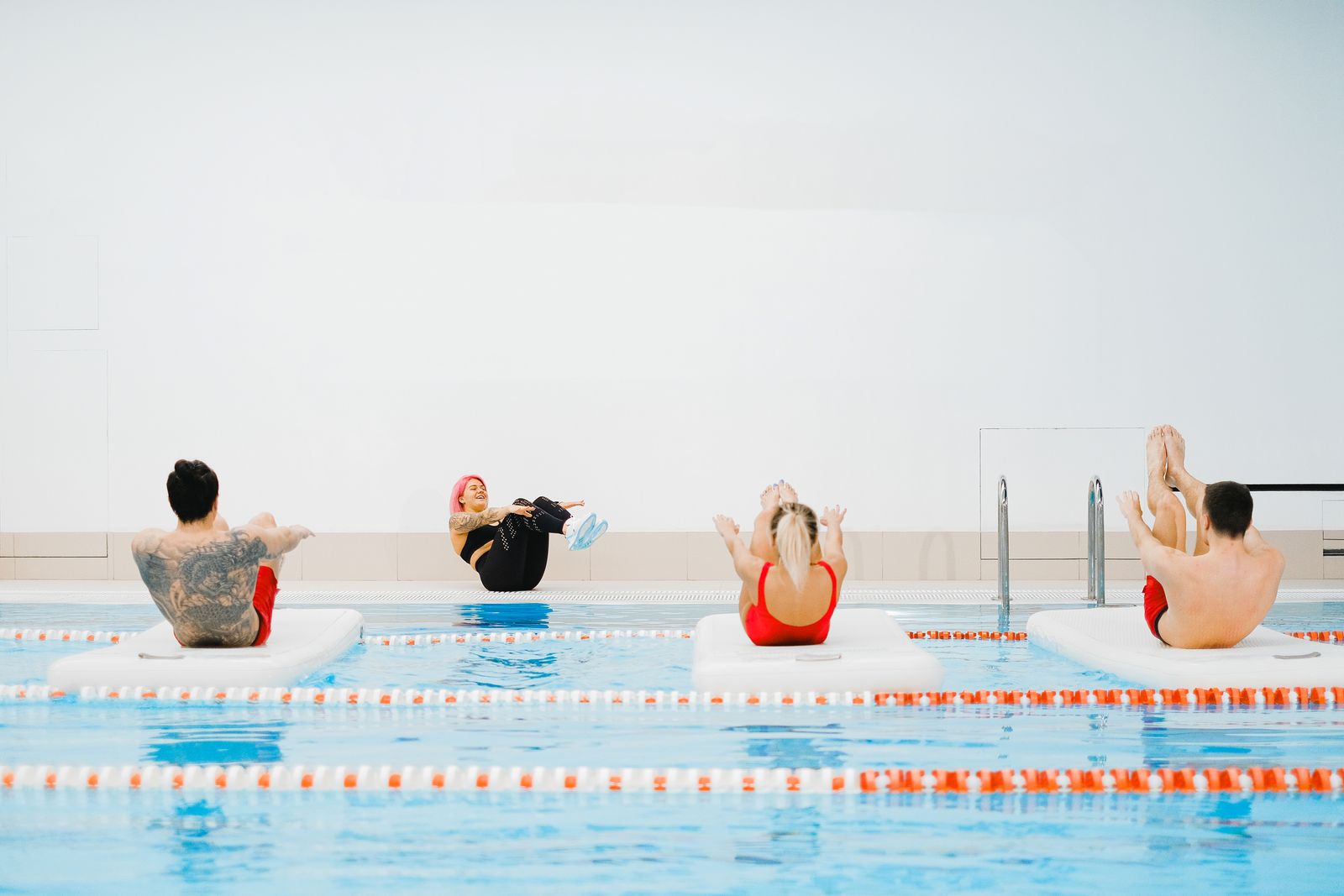
What does a sample 30-minute workout look like?
The following plan is designed for a 6–8 m pool and chest-deep water. Between blocks, allow yourself 30–60 seconds of easy walking in the water. You control the intensity through your tempo: if you can only manage short sentences during the cardio blocks, you are in the right zone.
| Phase | Time | Content |
|---|---|---|
| Warm-up | 5 min | Brisk walking in the water forwards and backwards, arm circles under the surface, gentle half-squats |
| Cardio block 1 | 6 min | Alternate every minute: aqua jogging on the spot × jumping jacks |
| Strength block — legs | 5 min | Alternating lunges on both legs, kicks forward and to the sides holding the edge (3 sets of 12–15 reps) |
| Cardio block 2 | 5 min | Sprints in the water across the width/length of the pool, easy walking back as an active rest |
| Strength block — arms and torso | 5 min | Pushing a noodle under the surface, sweeping a kickboard through the water, push-ups on the pool edge |
| Stretching | 4 min | Stretching the calves, thighs and shoulders with wall support, calm breathing |
To start, two to three workouts like this per week are enough. Once the plan stops being challenging, extend the cardio blocks, pick up the tempo or add resistance gloves — in water, progress is a matter of movement speed, not heavier iron.
How to vary the workout so it doesn’t get stale?
The same plan stops being fun — and stops working — after a few weeks. The simplest variation is an interval version: 30 seconds at maximum tempo (water sprints, fast jumps), 30 seconds of easy walking, 10–15 rounds in total. The second route is to give each workout a different focus — one session mostly legs and cardio, the next arms and torso with the noodle and kickboard.
Music with a steady beat helps too, as does training in pairs: a partner in the neighbouring “lane” keeps the pace and takes care of safety at the same time. Anyone who wants guidance will find dozens of water aerobics video lessons online — a phone at the pool edge, at a safe distance from the water, is all it takes.
What equipment is useful and how much does it cost?
Water aerobics is one of the cheapest sports there is — you can cover the basics with no equipment at all. A few accessories, however, add variety to the workout and let you target specific muscle groups. Prices are indicative.
| Accessory | What it’s for | Indicative price |
|---|---|---|
| Pool noodle | Strengthening the arms and torso, support for ab exercises | €4–10 |
| Aqua dumbbells (foam, pair) | Resistance training for the arms, shoulders and back | €12–32 |
| Aqua jogging belt | Flotation for zero-impact running in deep water | €20–60 |
| Resistance gloves | Larger palm surface, more resistance for arm work | €8–20 |
| Non-slip water shoes | A secure push-off from the floor, foot protection on liner and tiles | €12–32 |
The kickboard you already have at home for swimming with the kids will serve perfectly here too. A complete set therefore costs roughly €60–140 — and lasts for years.
What water temperature is ideal for exercise?
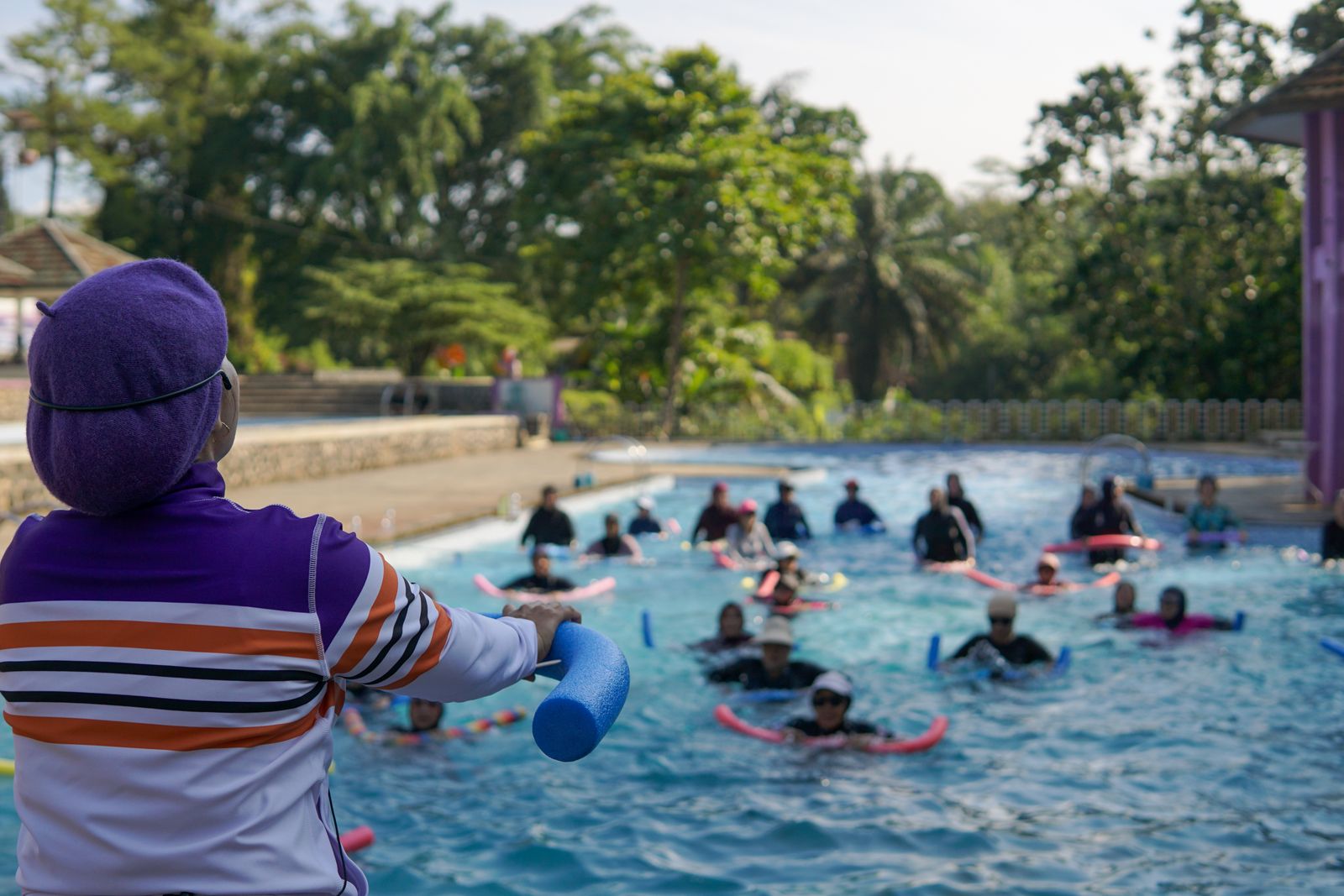
For active exercise the optimum is 26–28 °C. Colder water (below 25 °C) needlessly tightens the muscles and forces the body to generate heat instead of exercising; warmer water (above 30 °C) hampers heat dissipation, and intense training then carries a risk of overheating. If you share the pool with children or use it mainly for relaxation, 28 °C is a sensible compromise. You’ll find a detailed overview of temperatures for different purposes in our article on the ideal water temperature for pools and hot tubs.
What should you watch out for when exercising in a pool?
Exercising in water is safe, but a few rules apply without exception. Never do an intense workout alone — fatigue, cramp or sudden nausea are riskier in water than on dry land. It is enough for someone in the household to be within earshot.
The second often underestimated point is hydration. In water the sensation of thirst arrives later and you don’t notice sweat on wet skin, yet your body loses fluids just as it would in the gym. Keep a water bottle at the pool edge and drink between blocks. Also: enter the pool gradually, don’t exercise on a full stomach or after alcohol, and on liner or tiles you’ll appreciate non-slip water shoes.
Getting the most out of your training: recovery and year-round use
If you have a hot tub next to the pool, you have an ideal recovery routine: after stretching, move to the warm water, where the hydromassage releases the worked muscles and the heat supports circulation. Why warm water works after exertion, and how it relates to sleep, is covered in our article on hot tubs, sleep and recovery.
The weak point of a garden pool is seasonality — without an enclosure and heating, the training season shrinks to 4–5 months. Anyone who wants to train in water all year round should consider a swim spa: a heated tank that combines exercise space, a swim current and year-round operation. A comparison of the two options, including costs, is in our article swim spa vs. pool.
Frequently asked questions (FAQ)
Will water aerobics help me lose weight?
Water aerobics is a fully fledged cardio workout, and with regular training you burn an amount of energy comparable to brisk walking or light jogging — with the difference that your joints take no impact. As with any form of exercise, though, the result depends on consistency and overall energy balance, not on the type of exercise itself.
Is water aerobics suitable for seniors and people with painful joints?
Yes — it is precisely for them that exercising in water has long been recommended: buoyancy takes the load off the joints and spine, the water cushions falls, and everyone controls the resistance through their own tempo. With osteoarthritis, a joint replacement or after an injury, it is advisable to discuss specific exercises with a doctor or physiotherapist in advance.
How often and how long should I exercise?
For a noticeable effect, 2–3 workouts per week of 30–45 minutes are enough. Post-exercise muscle soreness is milder in water than on dry land, so you can train more often — but still give your body at least one rest day between the harder sessions.
Can I exercise in an above-ground pool?
Yes, provided it has sufficient water depth (ideally 1.2 m or more) and a stable structure. During exercises with support, lean on the top rail only lightly — the wall of an above-ground pool is not built for full body weight. Do jumps in the middle of the pool, not by the wall.
Does exercising affect the pool water quality?
More intense movement means more sweat and impurities in the water, and therefore slightly higher demands on filtration and disinfection. After a workout, let the filtration run a little longer and check the water values regularly — showering before entering the pool reduces the load considerably.
Water aerobics is the simplest way to make your pool more than just a place to cool off — a home gym with no risk to your joints and no further investment in equipment. You’ll find noodles, dumbbells, kickboards and other pool accessories in our pool equipment category.
