
A pool that stretches across the whole garden is no longer the measure of luxury. 2026 belongs to plunge pools, cocktail pools and other small pools — compact bodies of water up to roughly 6 metres long that fit even smaller plots, cost a fraction of a full-size pool, and thanks to cheaper heating stay in use for a much larger part of the year. Industry trend reports consistently name them the fastest-growing category of the pool market.
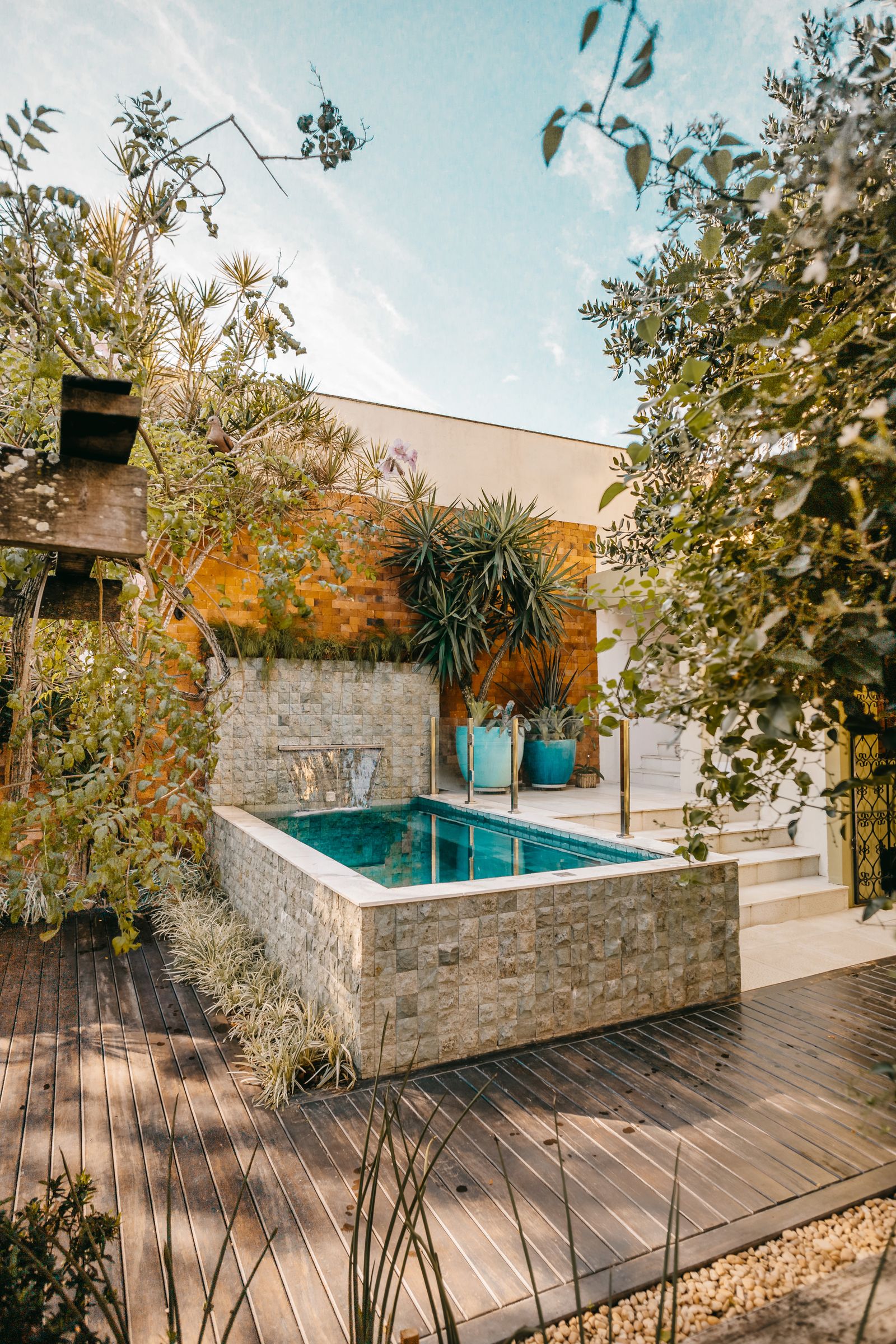
What Is a Plunge Pool and a Cocktail Pool?
A plunge pool is a small, usually deeper pool designed primarily for dipping, cooling off and relaxing — not for swimming laps. Typical dimensions run around 2×3 to 3×5 metres at a depth of 1.2 to 1.5 metres. It began as a compromise for plots too small for a classic pool, and has since grown into a design feature in its own right.
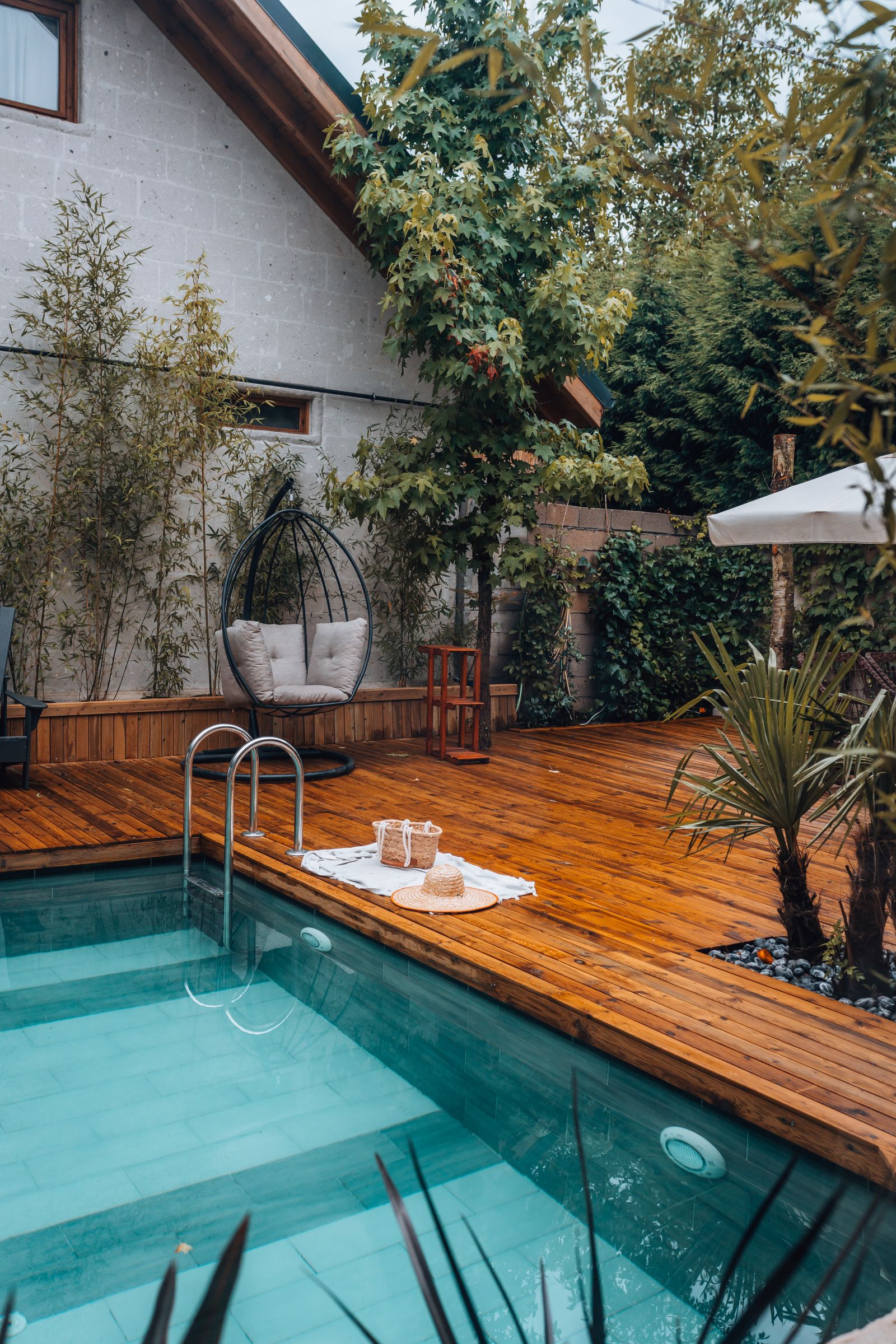
A cocktail pool is its social counterpart: shallower (often just 1 to 1.2 metres), with a built-in bench around the perimeter and sometimes a small table in the middle. The name says it all — it’s a pool for sitting, chatting and holding a glass, not swimming. In the US, the term covers pools up to roughly 6 metres long.
The line between the two terms is blurry. What matters is that both involve a water volume of typically 5 to 15 m³ — a third to a fifth of a standard family pool. And it’s precisely this small volume that delivers most of the benefits.
Why Are Small Pools Growing Right Now?
This isn’t a passing fad but the convergence of several long-term factors confirmed by industry analyses. The Understanding the U.S. Pool Market in 2026 report from Pool Magazine states that around 60,000 new in-ground pools are built each year in the US — and plunge pools and cocktail pools are, percentage-wise, the fastest-growing segment. The British Guncast 2026 Swimming Pool & Wellness Trends Report describes the same shift in Europe: compact wellness installations are growing mainly in urban areas, where space is the most expensive commodity.
The main reasons repeat across markets:
- Smaller plots. New developments come with smaller gardens — an 8×4 metre pool simply doesn’t fit on a roughly 400 m² plot, while a 3×4 metre plunge pool does.
- Lower upfront cost. Less excavation, less concrete, less equipment. A turnkey plunge pool typically costs a third to half as much as a full-size pool.
- Lower running costs. Heating and maintaining 8 m³ of water takes an order of magnitude less energy and chemicals than 40 m³. A smaller volume also means a smaller pump and filtration system.
- Faster build. A prefabricated plunge pool can be installed within days, while building a classic in-ground pool takes weeks to months.
- A shift from sport to wellness. Most owners actually use their pool for cooling off and relaxing, not for training. A small pool matches this real-world use much better.
What Types of Small Pools Are There?
The term “small garden pool” today covers several distinct categories — from a masonry plunge pool to a seasonal above-ground pool. They differ in price, how demanding the build is, and how long a season they offer.
| Type | Typical dimensions | Approximate price | Heating | Year-round use |
|---|---|---|---|---|
| Plunge pool (in-ground / prefab) | 2×3 to 3×5 m, depth 1.2–1.5 m | €12,000–€28,000 | heat pump, inexpensive thanks to the small volume | yes, with heating and a cover |
| Cocktail pool | up to 6×3 m, depth 1–1.2 m, bench | €16,000–€36,000 | heat pump, often combined with massage jets | yes, with heating and a cover |
| Swim spa | 4–6×2.3 m, depth 1.3–1.5 m | €20,000–€60,000 | integrated, insulated shell | yes, built for year-round use, including winter |
| Round above-ground pool | diameter 3–4.6 m, depth 1–1.2 m | €600–€3,200 | optional (solar cover, small heat pump) | no, seasonal (May–September) |
Treat the prices as an approximate range for 2026 — the exact amount depends on the terrain, cladding, equipment and level of automation. The swim spa deserves special attention: it combines a swim current for swimming with a hot-tub-style massage zone, and thanks to its insulated construction, it’s the only category designed from the outset for uncompromising year-round outdoor use.
Cold Plunge: The Sub-Trend Driving Wellness
The cold plunge is a chapter of its own — a small tank of deliberately chilled water at around 7 to 15°C, used for cold exposure and recovery. Guncast’s 2026 report ranks it among the fastest-growing wellness features: it’s typically installed next to a sauna or hot tub as part of contrast therapy, i.e. alternating heat and cold.
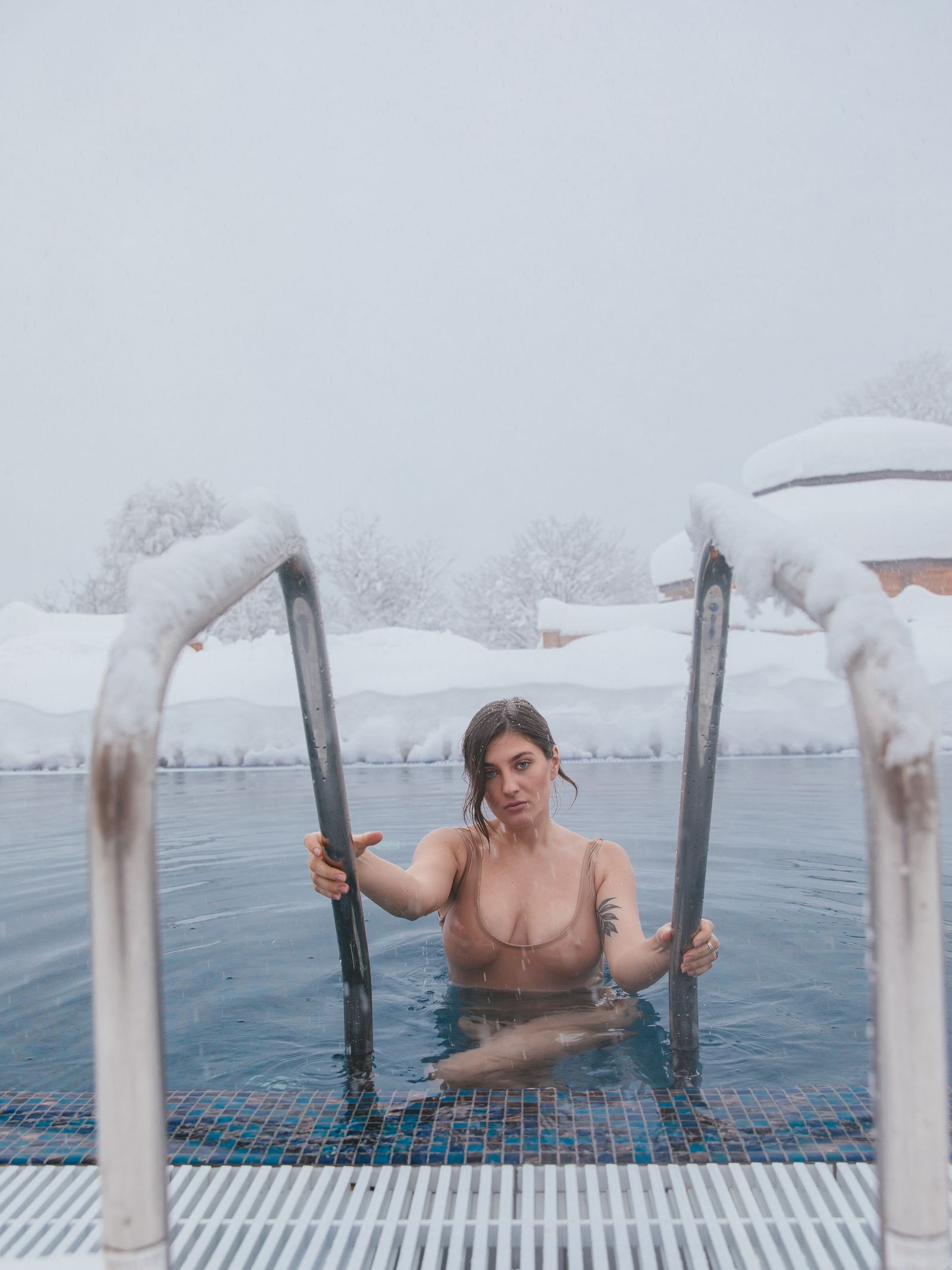
For home use, a tank of a few hundred litres with a chiller unit is enough — or simply an unheated plunge pool, which serves as a cold-exposure bath on its own during the cold months. That, incidentally, is an elegant argument for the plunge pool as such: refreshment in summer, cold exposure in winter, one and the same pool all year round.
What to Consider When Choosing a Small Pool
A small pool isn’t just a shrunken big pool — some parameters behave differently, and it pays to think them through in advance.
Depth Determines the Use
Up to 1.2 metres, you’re looking at a pool for sitting and wading; from 1.3 to 1.5 metres you can comfortably stand submerged up to the shoulders. If you want a genuine “plunge” or cold-exposure experience, choose a greater depth and a smaller footprint rather than the other way around.
Size the Filtration to the Volume, Not to Habit
A common mistake is fitting a small pool with an oversized pump “just to have a margin.” The result is needless energy use and a flow that feels unpleasant in such a small volume. The rule of thumb is to filter the whole volume through roughly every 4 hours — for 8 m³, a pump with a real flow rate of around 2 m³/h is enough. A smaller volume also reacts faster to mistakes in water chemistry, so regular testing matters even more than with a large pool; you’ll find the basic products in the pool chemistry category.
Cheap Heating = a Longer Season
This is where small pools win most decisively. Heating 8 m³ of water by 10°C means supplying roughly 93 kWh of heat — with a heat pump (COP around 4), that’s about 23 kWh of electricity, or roughly €5.60 at a price of around €0.24/kWh. For a 40 m³ pool, it’s five times that. In practice, this means you can afford an April-to-October season for a plunge pool for the cost of heating a large pool for just a few summer weeks. A cover is an essential add-on — without a solar cover or roller shutter, most of the heat is lost to evaporation overnight.
Material Affects Both Price and Build Speed
With small pools, you’ll most often encounter three variants. A prefabricated shell made of fibreglass or polypropylene is the fastest — the shell arrives finished and a crane sets it in place in a single day. A concrete (masonry) pool allows any shape and the most luxurious finishes, but the build takes longer and the price climbs. A stainless-steel shell is the premium option with practically unlimited lifespan, typical of design-led plunge pools and cold plunge installations.
It’s also worth thinking about placement: a small pool tolerates proximity to the house and terraces better than a large water surface, and connecting it directly to a terrace makes it a natural centrepiece of the garden. A shorter distance to the house also cuts the cost of electricity and water connections and simplifies any future roofing.
Don’t Forget Permits and Structural Load
Depending on its scope, an in-ground pool may require a building notification; a prefabricated plunge pool set in place by crane usually falls under a simpler regime but still needs a reinforced foundation slab. A swim spa weighing over 10 tonnes (with water) requires a load-bearing assessment, especially if placed on a terrace.
Who Is a Small Pool Right For — and Who Isn’t It For?
A small pool makes sense if:
- you have a plot where a classic pool won’t fit, or you don’t want to sacrifice the whole garden to it,
- you want a pool mainly for cooling off, relaxation and wellness, not for fitness swimming,
- you want as long a season as possible at reasonable running costs,
- you prefer a quick installation without months of building disruption,
- cold exposure and contrast therapy appeal to you.
Consider a different solution if:
- you want to regularly swim laps — then choose a swim spa with a swim current, or a classic pool from 7 metres in length,
- you have a large family with children who will mainly use the pool for play — a bigger shallow area will bring more joy,
- your budget is up to €4,000 — there, the solution is a quality above-ground pool, not a compromise “mini construction.”
Frequently Asked Questions (FAQ)
What’s the Difference Between a Plunge Pool and a Hot Tub?
A hot tub is an insulated shell with massage jets and water usually at 36–38°C, designed for a warm massage. A plunge pool is bigger, deeper, has no massage system, and holds water at normal pool temperature — it’s used for dipping, cooling off and swimming on the spot. The swim spa combines both concepts.
How Much Does Running a Plunge Pool Cost Per Year?
For a volume of around 8 m³, budget roughly €200 to €480 a year for electricity for filtration and the heat pump (running April–October), and €80 to €160 for water chemistry. The exact amount depends on the target temperature, the cover, and the price of electricity.
Can a Plunge Pool Be Used in Winter?
Yes, in two ways: either you heat it with a heat pump designed for winter operation and use it as a warm bath, or you leave it unheated and it serves as a cold plunge for cold exposure. Either way, the equipment must be protected against freezing.
Do I Need a Building Permit for a Small Pool?
In the Czech Republic, a pool up to 40 m² of built-up area at a family house usually requires neither a permit nor a notification, which small pools meet with a large margin. Always check the current conditions with your local building authority, though — setbacks from the plot boundary and protection zones also play a role.
Is a Cocktail Pool Suitable for Children?
Thanks to its shallow depth (1–1.2 m) and perimeter benches, it’s easier to oversee and safer for children than a deep pool, though adult supervision is always necessary. Quick heating is another advantage — children will appreciate the 28–30°C temperature, which the small volume reaches easily.
The trend is clear: the pool of 2026 isn’t the biggest, but the most cleverly used. If you’re considering your own water feature — from an above-ground pool to a swim spa — browse the range in our pools category, and find more comparisons and guides in our Guides.
