
The biggest heat thief in your pool isn’t cold ground or wind — it’s evaporating water. According to the U.S. Department of Energy, evaporation accounts for roughly 70% of all pool heat loss, and simply covering the surface can cut it by up to 95%. In practice that means a 50 to 70% saving on heating costs — so a solar cover costing a couple hundred euros usually pays for itself within the first season.
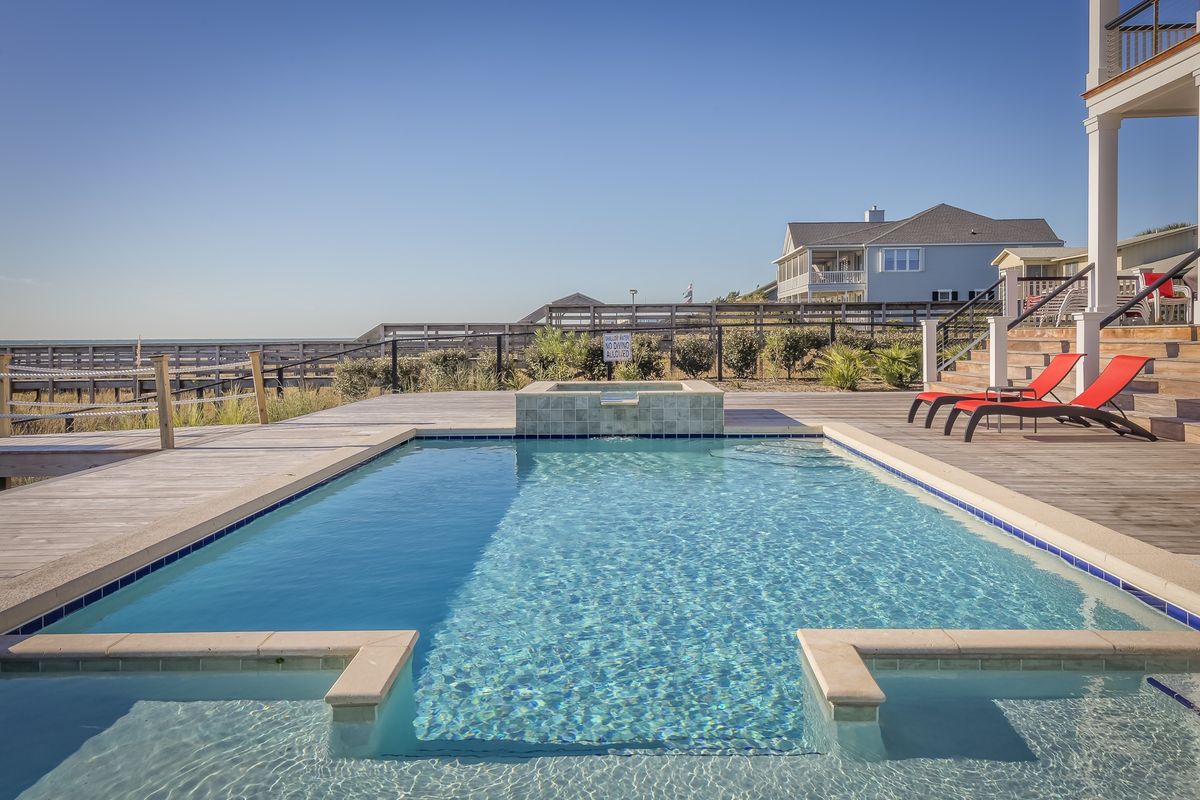
Why does a pool lose heat mainly through evaporation?
When one litre of water evaporates from the surface, it carries away roughly 0.68 kWh of heat. That’s the physics of latent heat — and it’s unforgiving. An uncovered pool in summer typically evaporates 3 to 5 millimetres of water a day; for an 8 × 4 metre pool, that’s 96 to 160 litres. Every single day.
And evaporation is far from over at sunset. In fact, a pool loses the most heat at night, when the air is cooler and drier than the water. That’s why even a simple evening cover has such a major effect — it stops losses exactly when they’re greatest. Conduction into the ground and radiation together account for only a minority of losses; anyone focused on savings has to start at the surface.
The U.S. EPA states in its water-saving materials that covering a pool cuts evaporation by up to 95%. The Department of Energy (energy.gov) adds a 50-70% saving on heating costs for outdoor pools. No other pool investment at a similar price offers numbers like that.
What types of pool covers and enclosures are there?
The market offers solutions ranging from a cover for under eighty euros to a sliding enclosure priced like a small car. They differ not just in price but in what they actually do: some just retain heat, others extend the season by months or protect children and pets.
| Cover type | Approximate price (8 × 4 m pool) | Main benefit | What to watch out for |
|---|---|---|---|
| Solar bubble cover | €60-240 | Reduces evaporation, passively warms the water by a few degrees during the day | Lasts 2-4 seasons, not a safety feature |
| Winter cover / mesh net | €80-400 | Protects the water and liner outside the season, less debris in spring | Doesn’t heat, needs anchoring; unusable during the season |
| Slatted roller cover | €4,800-16,000 | Push-button convenience, excellent insulation, elegant look | Higher price, doesn’t create space above the water for swimming in the rain |
| Low sliding enclosure | €2,400-7,200 | Greenhouse effect, extends the season by weeks to months, clean water | You can’t swim laps under it, needs storage space |
| High sliding enclosure | €8,000-24,000+ | Swimming even in rain and cold, the biggest season extension, safety | Highest investment, dominates the garden visually, often requires a building notification |
These types aren’t mutually exclusive, either. A very common and sensible combination is a low enclosure plus a solar cover underneath — the cover holds heat right at the surface, while the enclosure adds an insulating air layer and a greenhouse effect.
How many extra degrees and weeks of season can you gain?
A solar bubble cover works like a miniature greenhouse laid straight on the water: during the day it lets sunlight through to the water, and at night it blocks evaporation. The result is water that’s several degrees warmer than it would be uncovered — for free, without a single kilowatt-hour.
A low enclosure typically pushes the start of the season back to April and the end to October — realistically, six to ten extra weeks of swimming. A high enclosure combined with a heat pump can enable near year-round swimming in mild winters. We cover how powerful a heat pump you need for that and what it costs to run in our article on heat pumps for pools and hot tubs.
A simple rule applies here: the more expensive the heating, the faster a cover pays for itself. A pool heated by an electric heating coil with no cover is economic nonsense; a pool with a heat pump and a cover, by contrast, is surprisingly cheap to run.
Sample calculation: how much does a solar cover really save?
Let’s work through a concrete scenario with clearly stated assumptions:
- an 8 × 4 m pool (32 m² of surface, roughly 45 m³ of water), temperature 27-28°C,
- season May-September, heated by a heat pump with an average coefficient of performance (COP) of 5,
- electricity price of €0.24/kWh,
- without a cover, the heat pump uses roughly 300-400 kWh of electricity a month to maintain temperature (a typical value for a Central European summer — more in a cool May or September, less in July).
Taking a mid-point value of 350 kWh a month and a conservative 60% saving (the lower-to-middle end of the 50-70% range from energy.gov), the cover saves around 210 kWh a month, or about €50. Over a five-month season that’s roughly €250 — meaning a quality solar cover priced at €120-200 pays for itself before the first season is even over. On top of that, add the hundreds of litres of water no longer evaporating and lower chemical consumption.
For a low enclosure costing, say, €4,800, the payback purely through energy savings is naturally much longer — at the same saving rate, it works out to several years. Its value, though, lies elsewhere: in a longer season, cleaner water, and less maintenance work. For the full picture of both purchase and running costs of a pool, see our article Pool cost: a realistic budget.
How does a cover help with water chemistry and cleanliness?
A covered surface means less leaves, dust, pollen and insects in the water — the filtration runs for less time and you don’t need to clean the skimmer daily. That’s the visible effect. The invisible one may be even more important: UV radiation breaks down free chlorine. On a hot day, sunlight can strip a large share of unstabilised chlorine from an uncovered surface within a few hours.
Covering the pool therefore directly saves on disinfection — chlorine lasts longer in the water and you dose less of it. Less evaporation also means less top-up of fresh water, so pH and hardness swing around less. You’ll find everything you need for water maintenance in our water treatment category.
One warning: after shock-chlorinating, leave the pool uncovered for a few hours. A high chlorine concentration under the cover could speed up its ageing, and the aggressive fumes need to vent out.
Is an enclosure also a safety feature?
This needs a distinction. A solar cover is not a safety feature — it won’t hold the weight of a child or an animal, and falling onto it can actually be more dangerous than falling into open water, since it wraps around the body. If you have small children at home, a cover must never replace supervision or a barrier.
A solid sliding enclosure and a quality slatted cover with sufficient load capacity, by contrast, act as a real physical barrier: lockable segments keep children and pets away from the water. For roller covers, ask about certified load capacity (e.g. under the French standard NF P90-308, which defines requirements for pool safety covers). For families with children, the safety function is often a stronger argument than the energy savings.
How should you use a cover for the savings to actually work?
Even the best cover only saves energy when it’s actually on the water. The golden rule: cover it whenever you’re not swimming — especially overnight, when the temperature gap between water and air is greatest. A cover put on at eight in the evening and taken off at ten the next morning covers the vast majority of loss hours.
Get a reel for the cover. It sounds like a dispensable extra, but experience is clear: manually rolling up a wet, heavy cover discourages most owners within a few weeks, and the cover ends up folded in a corner of the garden. A reel cuts covering and uncovering down to half a minute — and only a cover you actually use saves anything.
And one more often-overlooked detail: set the heating to run mainly during the day, when the outside air is warmer and the heat pump works more efficiently. The combination of “heating by day, cover by night” is the most energy-efficient regime you can run on an outdoor pool.
How to choose: cover, roller, or enclosure?
The decision boils down to three questions. First, budget: under €400, a cover is your only option — and it’s an excellent one, since nothing beats its price-to-savings ratio. Second, season length: if you want to swim from spring to autumn, you need an enclosure with a greenhouse effect. Third, safety and comfort: children in the family and reluctance to roll the cover daily both argue for a slatted roller or a solid enclosure.
Whatever you choose, one rule applies universally: the cheapest kilowatt-hour is the one that never escapes the pool in the first place. Covering the surface is the first step worth taking, even before investing in more powerful heating.
Frequently asked questions (FAQ)
Do you lay a solar cover bubbles-up or bubbles-down?
Bubbles down, facing the water. The bubbles act as insulating air cushions while also increasing the contact area through which the cover transfers captured solar heat to the water. The cover is cut to the exact shape of the water surface, not the pool’s outer dimensions.
By how many degrees does a solar cover warm the water?
Depending on the weather and the pool’s orientation, it typically raises the water temperature by a few degrees Celsius compared with an uncovered pool — part of the effect comes from passive solar gain during the day, but a larger part comes from preventing nighttime evaporative losses. A cover doesn’t replace active heating, though; it and a heat pump complement each other very well.
How long does a solar bubble cover last?
Typically 2 to 4 seasons. Its lifespan is shortened by UV radiation, high chlorine concentrations, and storage in direct sunlight. So roll it up when not in use and cover it with a protective sheet, and leave it off for a few hours after shock chlorination.
Do I need a building permit for a pool enclosure?
Low mobile enclosures can, in most cases, do without a permit; for tall, fixed structures, a building notification may be required depending on the location and size. The rules vary depending on the specific situation of the plot — check the conditions with your local building authority before you buy.
Does a cover also work on above-ground and inflatable pools?
Yes, and proportionally it matters even more — a smaller volume of water cools faster, so covering an above-ground pool at night can decide whether the water is usable the next morning. Solar covers are also sold in round sizes made specifically for above-ground pools.
You’ll find solar covers, winter covers, reels and complete enclosures in our pools and accessories category, and heat pumps and other heating technology in the pool technology section. And if you’re planning a pool from the ground up, browse more guides in our Guide.
