
A smart pool is no longer just a gadget for enthusiasts — well-chosen automation saves hours of work, tens of percent on electricity costs, and a lot of chemicals. The key is choosing based on the benefit-to-cost ratio: automatic chemical dosing and a variable-speed pump make the most sense, while some apps are more flashy than useful. This guide ranks five technologies that genuinely pay off in 2026, gives ballpark prices, and flags what to watch out for when buying.

What does a “smart pool” actually mean?
A smart pool is an ordinary pool enhanced with technology that measures, regulates, and reports — instead of you. In practice, this involves four layers: sensors (temperature, pH, oxidation-reduction potential/ORP), actuators (dosing pumps, variable-speed pump, valves, lighting), a control unit, and a phone app.
Importantly, you can add these layers gradually. You don’t need to invest in a complete automation system worth thousands right away — often a single well-chosen component delivers the biggest impact. The ranking below orders technologies from the best benefit-to-cost ratio to the weakest.
1. Automatic pH and chlorine measurement and dosing: the end of manual testing
The clear winner of the ranking. A station with pH and ORP (redox) probes continuously measures the water’s condition and uses peristaltic pumps to dose exactly as much pH-minus and disinfectant as the water currently needs. Chlorine is no longer dosed “by eye” once a week, but continuously based on actual demand — the water is more stable, odor-free, and without the swings that irritate eyes and skin.
What it does: continuous pH and ORP measurement, automatic dosing of liquid chemicals, alarms on deviations, and on higher-end models remote monitoring via an app. Ballpark price: €600–1,800 depending on features and brand, plus annual costs for probes and calibration solutions ranging from roughly ten to a few hundred euros.
Who it’s worth it for: practically every owner of an outdoor pool larger than about 20 m³ who doesn’t want to test the water daily, and especially those who leave their pool unattended during summer vacations. Precise dosing also limits overdosing on chemicals — a typical cause of green water after a weekend, which we cover in our article on green pool water.
2. Variable-speed pump with scheduling: the biggest energy saver
The filtration pump is the pool’s most energy-hungry appliance — it runs for hundreds of hours per season. A variable-speed (frequency-controlled) pump can smoothly adjust its speed: it filters at low power for most of the day and only runs at full power briefly. Due to the physics of flow, running at half speed cuts power draw to roughly an eighth, so the savings are dramatic.
According to the U.S. ENERGY STAR program (U.S. EPA), certified variable-speed pumps consume up to 70% less electricity than single-speed models; a methodology study by the U.S. Department of Energy (Measure Guideline, 2012) confirms real-world savings in a similar range when the filtration schedule is set correctly. In practice, for a mid-sized pool this often means savings of several hundred euros per season.
What it does: smooth speed control, weekly time programs, quiet operation (at low speed the pump is nearly silent), and Wi-Fi control on newer models. Ballpark price: €600–1,400. Who it’s worth it for: anyone filtering more than a few hours a day — payback is typically two to three seasons. If your current pump is noisy or won’t start, first check our noisy pump diagnostics; switching to a variable-speed model can then solve both problems at once.
3. Wi-Fi water monitoring: a sensor that watches for you
Floating or installed sensors measure temperature, pH, ORP, and conductivity, and send the data to an app. They don’t dose anything themselves — they only measure and alert. That’s both their strength and their limit: for a fraction of the price of a dosing station, you know what’s happening with your water, but you still have to act on it yourself.
What it does: continuous measurement of temperature, pH, and ORP, history and trends, notifications (“pH dropped below 6.8”), and recommended chemical doses. Ballpark price: €200–600, with some brands charging an additional annual subscription for cloud features. Who it’s worth it for: owners of smaller pools and anyone who wants data without investing in full automation — also useful alongside a heated pool, where it tracks temperature together with a heat pump (more in our article on heat pumps for pools and hot tubs).
4. Filtration and lighting automation: comfort at the tap of a button
Control units switch filtration, lighting, counter-current jets, or attractions on and off according to schedules or scenes in the app. Smart LED lighting controlled from your phone transforms evening swims, while scheduling filtration around cheaper electricity tariffs cuts running costs.
What it does: time schedules, scenes (swimming, night, vacation), tariff-based switching, smart home integration. Ballpark price: from €120 for smart switching elements up to €1,000+ for a comprehensive control unit. Who it’s worth it for: as an add-on to points 1 and 2 — automation alone, without a variable-speed pump and dosing, saves little, but combined with them it forms a complete system that looks after the pool almost by itself.
5. Robotic pool cleaner with an app: a helper, not a necessity
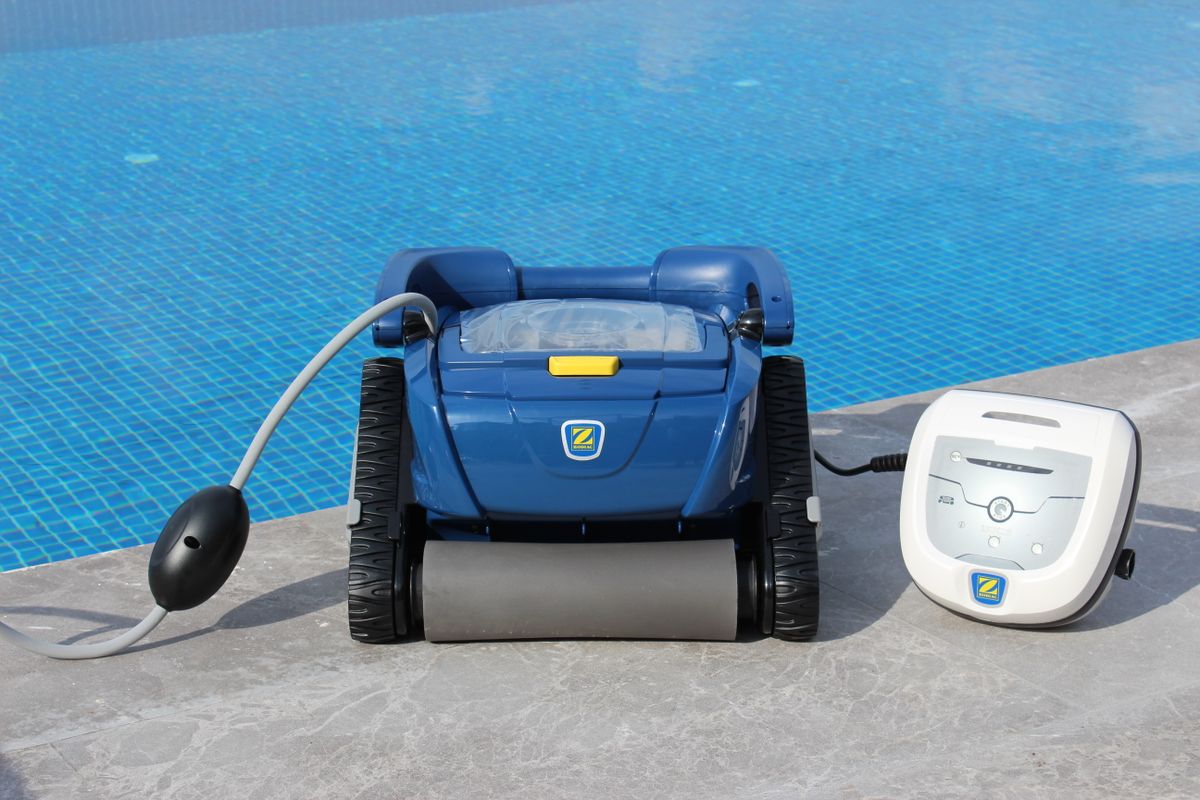
A pool robot cleans the floor and walls on its own, and models with an app can schedule cleaning, choose a mode, and show a map of the area cleaned. The core benefit — a clean pool without manual work — comes even from a robot with no connectivity at all. The app is a nice bonus here, not a reason to pay several hundred extra.
What it does: independent cleaning of the floor, walls, and waterline, filtering debris into its own basket, scheduling and modes via app. Ballpark price: €400–1,600; app-enabled models start at around €600. Who it’s worth it for: any pool from about 15 m³ up — but on a tight budget, choose a good robot without an app and put the money saved toward chemical dosing instead.
Overview: which technology pays off the most?
| Rank | Technology | Ballpark price | Main benefit | Benefit-to-cost ratio |
|---|---|---|---|---|
| 1 | Automatic pH and chlorine dosing | €600–1,800 | Stable water without manual work, less chemical use | Excellent |
| 2 | Variable-speed pump with scheduling | €600–1,400 | Up to 70% savings on filtration electricity (ENERGY STAR) | Excellent |
| 3 | Wi-Fi water monitoring | €200–600 | Overview and early warnings on your phone | Very good |
| 4 | Filtration and lighting automation | €120–1,000 | Comfort, scenes, tariff-based switching | Good (as an add-on) |
| 5 | Robotic cleaner with app | €400–1,600 | Effortless cleaning; app is just a bonus | Good (robot yes, weigh up the app surcharge) |
How much energy does automation really save?
The hardest data exists for pumps. The ENERGY STAR program states that certified variable-speed pumps use up to 70% less energy than single-speed ones; U.S. Department of Energy methodology (2012) and follow-up measurements by the Florida Energy Systems Consortium show that real-world savings, with a sensibly set schedule, typically fall between 50 and 70%. The physics is simple: pump power draw rises with the cube of speed, so slower, longer filtration is always cheaper than short, intense filtration.
For chemicals and heating, comprehensive statistics are lacking, but the savings mechanism is clear: ORP-based dosing prevents chlorine overdosing, temperature monitoring lets you heat only to the temperature you actually use, and scheduling filtration into a cheap tariff window lowers the cost of every kilowatt-hour consumed. The exact amount always depends on pool volume, electricity prices, and existing habits.
What’s more gimmick than benefit?
Not everything “smart” is worth the money. Based on practical experience, we recommend considering whether you actually need:
- Voice control for the pool — turning on the jets via a voice assistant looks impressive, but a button in the app is faster and more reliable.
- Colored light shows with music — a one-off effect for a party, unused in everyday operation.
- Paid “AI water analysis” — if it just repackages data from a pH/ORP sensor into nicer graphs, the sensor with notifications alone does the same job without monthly fees.
- Apps for devices that don’t regulate anything — a smart plug with consumption monitoring tells you the same thing as an expensive “smart” module, if that module can only switch on and off.
What to watch out for before buying?
Compatibility. Manufacturers’ closed ecosystems often don’t talk to each other — one brand’s dosing station may not connect to another brand’s control unit. Before buying, verify that the new device can work with what you already have, or choose open systems that support common smart-home standards.
Cloud dependency. Many apps only work through the manufacturer’s servers: if the server goes down or the manufacturer ends support, you lose remote access — and in the worst case, some functionality too. Prefer devices that can handle basic operation locally (time programs run in the unit, not in the cloud), and calculate subscription costs five years ahead before committing.
Signal in the plant room. A shaft or plant room with concrete walls is a hostile environment for Wi-Fi. Budget for a signal booster if needed, or your “smart” device will be permanently offline.
Service and probes. pH and ORP probes are consumables — they need calibrating and replacing after one to three seasons. Buy brands for which replacement probes and parts are easy to find in the EU.
Winterizing. Sensors and dosing heads usually must not freeze. Check how the device is winterized so the first frost doesn’t ruin an investment worth thousands of euros.
Frequently asked questions (FAQ)
Does a smart pool pay off even for a small above-ground pool?
Partly. For pools up to about 15 m³, a full dosing station usually doesn’t make sense, but Wi-Fi water monitoring for a couple hundred euros and a timer-controlled switching socket for filtration deliver most of the comfort at a fraction of the price. A variable-speed pump only pays off for larger volumes and longer filtration times.
Do I need to rebuild the plant room for automation?
Usually not. Floating sensors just go into the water, a variable-speed pump replaces the existing pump on the same piping, and a dosing station only needs a connection to the filtration circuit and a power socket. A complete control unit with valves is a job for a plumber, but even that usually fits into the existing shaft.
Does automation work with salt water too?
Yes, but choose deliberately: for pools with a salt chlorinator (salt electrolysis), the chlorinator itself regulates disinfection, so you typically only need to add pH control and monitoring. We cover the differences between the two systems in our article on salt water vs. chlorine.
What happens if the internet goes down?
With quality devices, nothing major — time programs, measurement, and dosing all run locally in the control unit, and you just temporarily lose remote access from your phone. That’s exactly why we recommend checking, before buying, which functions a device can handle without the cloud.
How long is the payback period for a variable-speed pump?
With savings of 50–70% on filtration electricity (ENERGY STAR and U.S. DOE figures) and typical outdoor pool operation, payback usually works out to two to three seasons. The longer the filtration times and the more expensive the electricity, the faster the pump pays for itself.
Where to start?
If you’re building your smart pool step by step, follow the order of this ranking: start with automatic chemical dosing, then a variable-speed pump, and only after that monitoring, lighting, and scenes. You’ll find variable-speed pumps, dosing stations, control units, and other equipment in our pool technology category — and we keep adding more guides and comparisons for you in our Guides section.
