
Yes, your dog can swim in the pool — provided you allow it as the owner and are prepared for the consequences. One dog puts roughly the same load on the water as three human swimmers, so expect more frequent filter cleaning and higher chemical consumption. And above all: your dog’s safety always comes first, because not every dog can swim, and none of them can get out of a pool on their own.
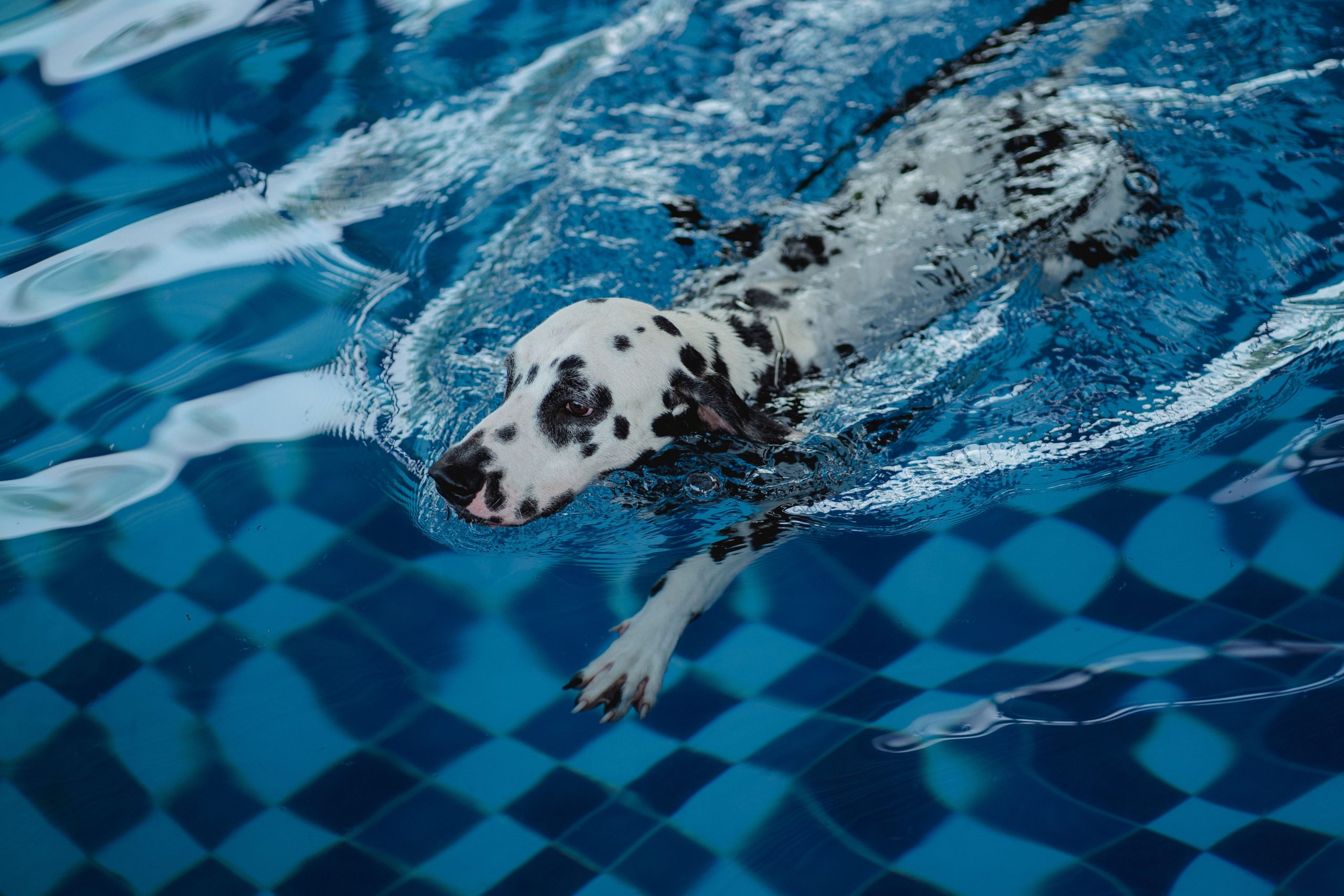
Is a dog allowed in the pool? The decision is yours
No law forbids dogs from swimming in a private pool. It is purely the owner’s decision — and it should be an informed one. A dog brings fur, skin oils, traces of faeces and urine, pollen, soil and everything else it has picked up on its daily walk into the water.
American pool industry sources (such as In The Swim or Swim University) state that one dog places a load on the water roughly equivalent to three human swimmers. It is not an exact science, but the order of magnitude is right: a dog does not shower before swimming, wears no swimsuit, and its coat acts like a sponge for dirt.
If you decide to let your dog into the pool, nothing terrible will happen. You just need to know what it will do to the water, the equipment and the liner — and what you need to do to keep swimming safe for the dog and for your chemical budget.
What does a dog do to the water and filtration?
The first thing you will see after a canine swim session is hair. It floats on the surface, sticks to the walls and ends up in the skimmer. A short-haired dog sheds less, while a husky in moulting season can fill the skimmer basket in a single afternoon.
Check the skimmer and pump strainer after every dog swim. A clogged basket reduces flow, the pump runs dry and wears out unnecessarily. With a cartridge filter, expect to rinse the cartridge more often; with a sand filter, plan on backwashing sooner — we compared the two systems in our article on sand vs. cartridge filtration. Fine hairs and skin oils clog cartridges faster, which is why sand filtration usually works out better for dog owners, ideally combined with a mesh sock over the skimmer basket.
The second effect is invisible: skin oils, saliva and organic contaminants consume your sanitiser. After a day when the dog has been swimming, free chlorine tends to be noticeably lower — test it and top it up, or shock the pool if needed. Dog hair and dirt also introduce phosphates into the water — nutrients for algae. If your dog swims regularly, it pays to test phosphate levels occasionally and bring them down with a phosphate remover.
The third effect: an oily film on the surface and along the waterline. Skin oils behave much like sunscreen — they settle on the liner at water level. An occasional waterline clean and a dose of flocculant or clarifier will quickly get the water back into shape.
Dog safety: the most important part of this article
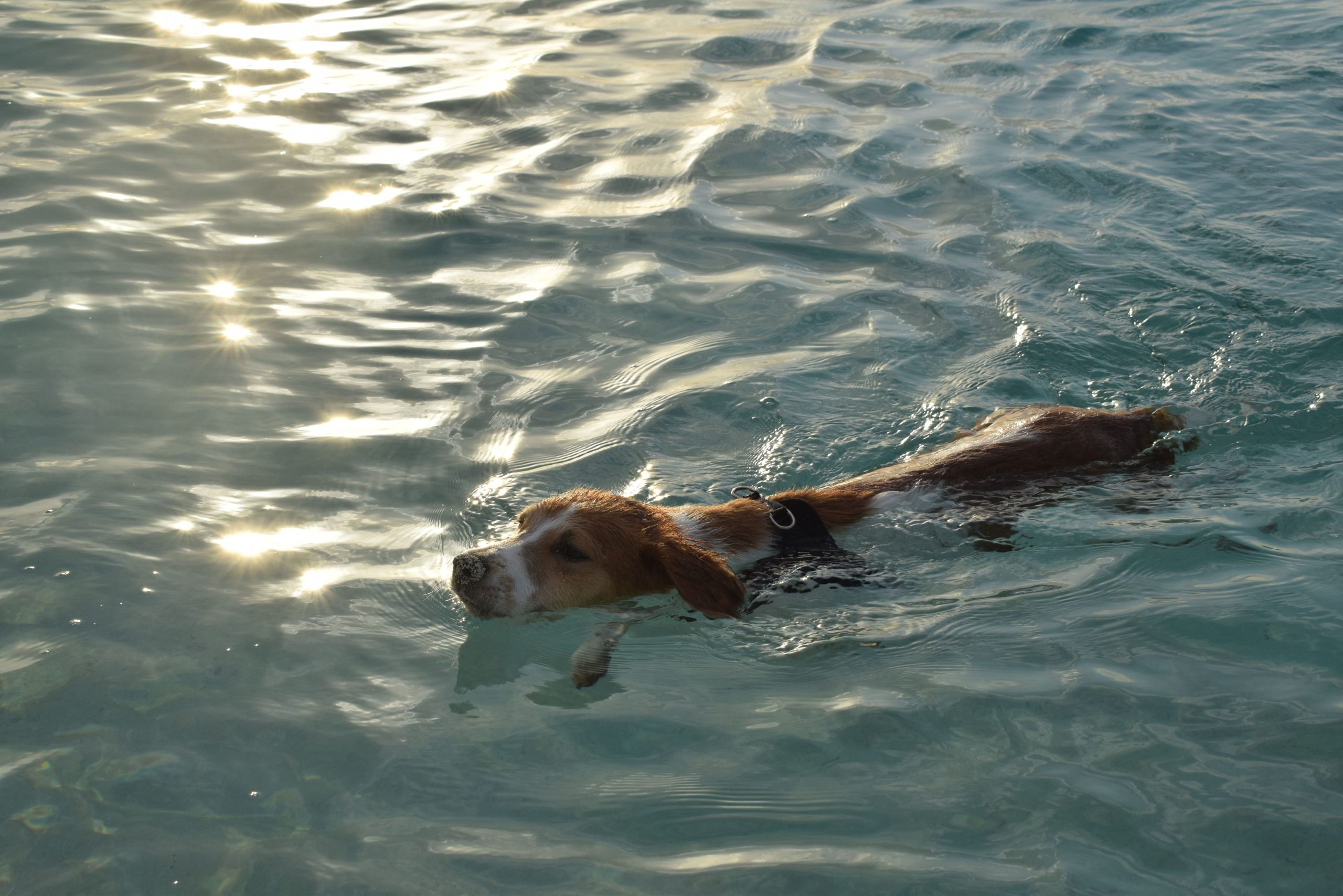
Not every dog can swim. A retriever or a water dog will leap in with enthusiasm and confidence, but a bulldog, pug or dachshund has a body shape that makes swimming difficult — a heavy chest, short legs, a short muzzle. Dogs like these can drown even in a small pool. Never throw a dog into the water “so it learns” — the first experience determines whether it will fear water for the rest of its life.
Teach your dog where the steps are. This is the single most important lesson. Dogs most often drown in pools because they cannot find the exit: they swim along a smooth wall they cannot climb until they are exhausted. Lead your dog to the steps or the shallow end several times, let it climb out and praise it. Repeat until it can find the steps on its own from any part of the pool. Pools with only a ladder are worse — a dog cannot use a ladder, so consider a dedicated dog ramp.
A dog life jacket is not a fashion accessory. For beginners, senior dogs, small breeds and short-muzzled dogs, it is the same insurance policy as armbands for children. Life jackets have a handle on the back that lets you lift the dog out of the water easily.
Never without supervision. The same logic applies as with children — drowning is silent and fast. If your dog does not have a completely reliable way out of the water, never leave it alone near an uncovered pool, even outside swimming time. An enclosure, a cover with sufficient load capacity or a fence around the pool protects a dog just as it protects a child. We covered barriers and supervision rules in detail in our article on child safety around pools and hot tubs — almost all of it applies to dogs too.
Chlorine, dog skin and ears: what to watch after swimming
Normally chlorinated water (0.3–0.6 mg/l free chlorine) will not harm a dog that swims occasionally. A dog’s skin is more sensitive than ours, though, and chlorine dries it out. Rinse your dog with clean water after every swim — a regular garden hose takes a minute and removes chlorine and any chemical residue from the coat that the dog would otherwise lick off.
Dry the ears thoroughly. Breeds with floppy ears (retrievers, cocker spaniels, bassets) are prone to ear canal infections — the warm, moist environment after swimming is ideal for bacteria and yeast. Gently wipe the ears after swimming and let them dry; if the dog keeps shaking its head or the ear smells, see your vet.
Your dog should not drink pool water in large amounts. A few gulps while swimming are fine, but a dog that treats the pool as a giant water bowl risks digestive upset — and worse problems at higher chemical concentrations. Always keep a bowl of fresh water by the pool so the dog has a better alternative. A stricter rule applies right after chemical treatment: after shock chlorination, keep the dog out of the water until the chlorine drops back to normal levels.
Liners and claws: where damage can occur
Dog claws are a real risk for pool liners — not while swimming, but during panicked scrabbling at walls and steps when the dog is looking for a way out. Above-ground pools with thin liners (0.2–0.4 mm) are the riskiest: a dog can puncture one with a single leap over an inflatable ring. With in-ground pools and heavy 1.5 mm liners the risk is much lower, though scratches along the waterline and on the steps cannot be ruled out entirely.
In practice this means: trim your dog’s claws regularly, teach it to climb out via the steps (not to scrabble at the wall), and with a thin-liner above-ground pool it is best not to allow dog swimming at all. We describe the liner types available and how they differ in thickness and durability in our pool liner guide. Concrete and ceramic pools or one-piece polypropylene shells are practically untroubled by dog claws.
A dog in the hot tub? Absolutely not
Here there is no “owner’s decision” to make: a dog never belongs in a hot tub. Ever. Water at 36–38 °C is dangerous for dogs. Unlike humans, dogs do not sweat — they regulate heat almost entirely through panting. In hot water, a dog’s body has no way to cool down, and overheating (hyperthermia) can set in within minutes — even faster in small and short-nosed breeds.
Add to that the more aggressive chemistry in a small volume of water, powerful jets and smooth acrylic walls a dog cannot climb. Keep your hot tub covered with a lockable thermal cover at all times — it protects your dog, your children and your water. If your dog wants some water fun, it belongs in a pool with cool water, or better still in its own dog pool.
Practical rules for dog swimming
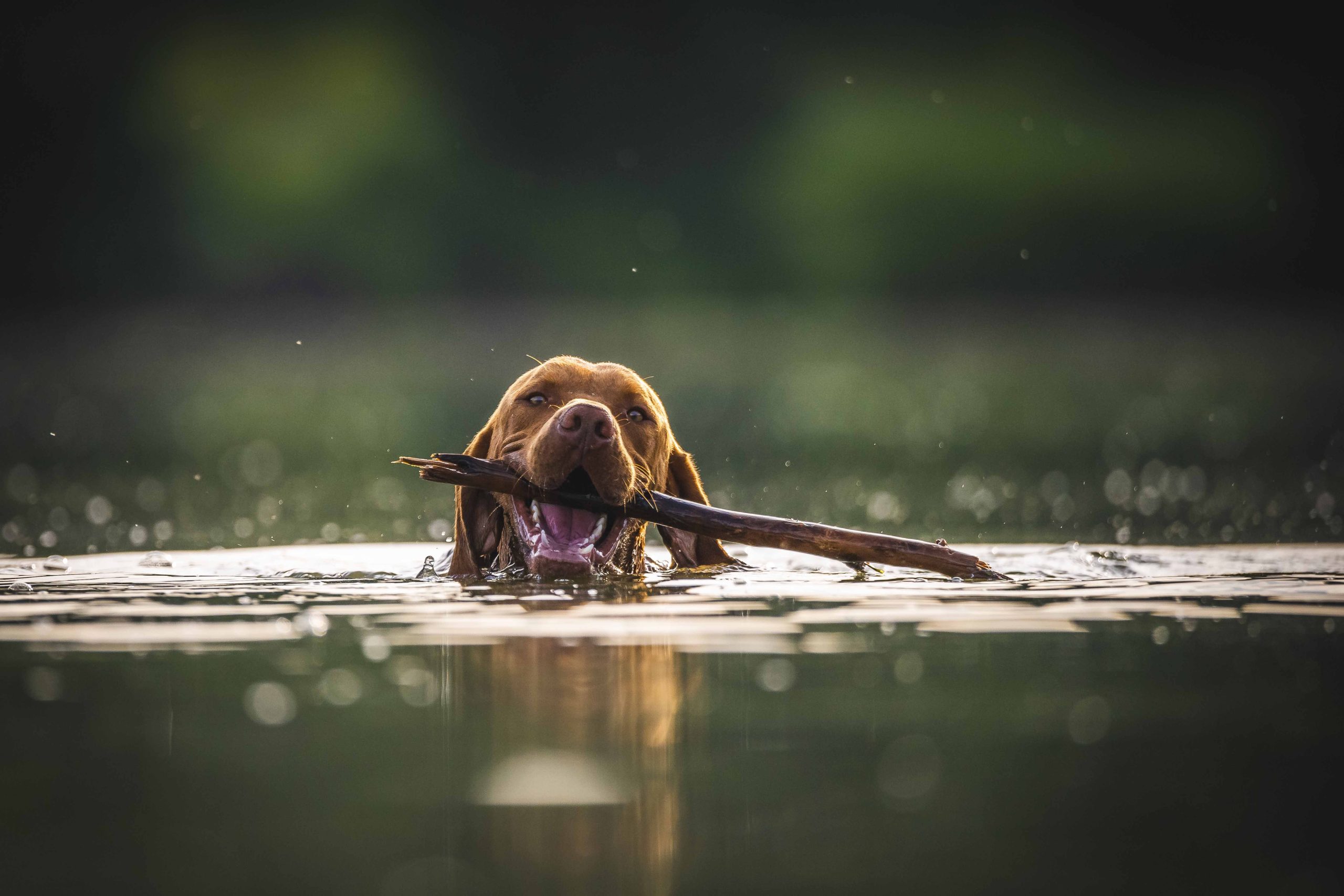
Some good news to finish: most of the impact of dog swimming can be managed with a simple routine. Brush your dog thoroughly before it swims — every hair that ends up in the brush is a hair that does not end up in the skimmer. Do not let a moulting dog into the pool at all; wait until the shedding passes.
Also consider a dedicated dog pool — foldable plastic dog pools with a non-slip bottom cost around €30–100 and are more fun than a deep pool for most dogs. The dog cools off, burns off energy and your filtration stays clean. For water-loving breeds it is the ideal compromise.
The dog-swimmer owner’s checklist:
- Brush the dog before swimming; during moulting season, no pool at all.
- Check claw length — trim sharp claws.
- Teach the dog to find the steps or ramp from anywhere in the pool.
- Put a life jacket on beginners, seniors and small breeds.
- Never leave the dog unsupervised near the water; cover the pool outside swimming time.
- Keep a bowl of fresh drinking water by the pool.
- Rinse the dog with clean water after swimming and dry its ears.
- Clean the skimmer basket and pump strainer.
- Test free chlorine and pH, and top up chlorine as needed.
- After the dog season: backwash the filter, use a flocculant, test phosphates and shock the water.
Dogs in the pool: pros and cons at a glance
| Aspect | Pros | Cons |
|---|---|---|
| Fun and exercise | Excellent joint-friendly exercise, ideal even for senior dogs | Not every dog can swim or enjoys it |
| Water quality | Manageable with regular chemicals and testing | 1 dog ≈ the load of 3 swimmers: higher chlorine use, phosphates, oily film |
| Filtration | Sand filtration plus a skimmer sock can handle the load | Hair clogs the skimmer, cartridges foul faster |
| Pool surface | Concrete, ceramic and rigid shells are risk-free | Risk of claws puncturing the thin liner of above-ground pools |
| Safety | With steps, a life jacket and supervision the risk is low | Without a trained exit from the water, drowning is a real danger |
| Dog health | No problems if rinsed off and ears dried | Dry skin, ear infections, drinking chlorinated water |
| Hot tub | — | Absolute ban: 38 °C overheats a dog; dogs do not sweat |
Frequently asked questions
Is chlorinated water toxic for dogs?
Not at normal concentrations (0.3–0.6 mg/l free chlorine). A few gulps while swimming will not harm a dog, but regularly drinking larger amounts can upset its digestion. Keep your dog out of the water after shock chlorination, and always offer a bowl of fresh water.
How much extra will dog swimming cost me in chemicals?
Assume one dog loads the water roughly like three swimmers. With one or two swims a week, that means slightly more frequent chlorine top-ups and the occasional dose of flocculant — a few euros a week at most. With a large dog swimming daily, sanitiser consumption rises noticeably and it pays to keep an eye on phosphates too.
Can a dog go in an inflatable or above-ground pool?
Better not. The thin liner (0.2–0.4 mm) is the most vulnerable point — dog claws can puncture it while climbing over the wall or scrabbling in panic. If you are planning dog swimming, an in-ground pool with a heavy liner, a rigid shell or concrete is safer — or a separate dog pool.
Why is a hot tub off-limits when a pool is fine?
Because of the temperature. Water at 36–38 °C overheats a dog quickly, since dogs do not sweat and regulate heat only by panting. Add more concentrated chemistry in a small volume of water and smooth walls a dog cannot climb. A hot tub is always dangerous for dogs, without exception.
How do I teach my dog to swim?
Gradually and without pressure: start at the shallow end or on the steps, support the dog under its chest and let it work all four legs. Teach it the way out of the water first; only then extend the swimming. Put a life jacket with a handle on unsure swimmers. Never throw a dog into the water.
In the end, dog swimming is mostly about balance: a few rules for the dog, a little more care for the water. Everything you need — test kits, chlorine, flocculant and phosphate remover — is available in our pool water treatment category. And if you are not sure how to get your water back into shape after the dog season, the other articles in our Guide can help.
