The pressure gauge on your filter is the only window into the inner workings of the entire pool circuit — and yet most owners only glance at it once the water has already turned cloudy. The rule is simple: high pressure means resistance after the pump (most often a dirty filter), low pressure means a problem before the pump (a blocked suction line or air being drawn in). If you note down your “clean” reading after a backwash and give the needle five seconds a day, you will catch most faults before they ever show in the water.
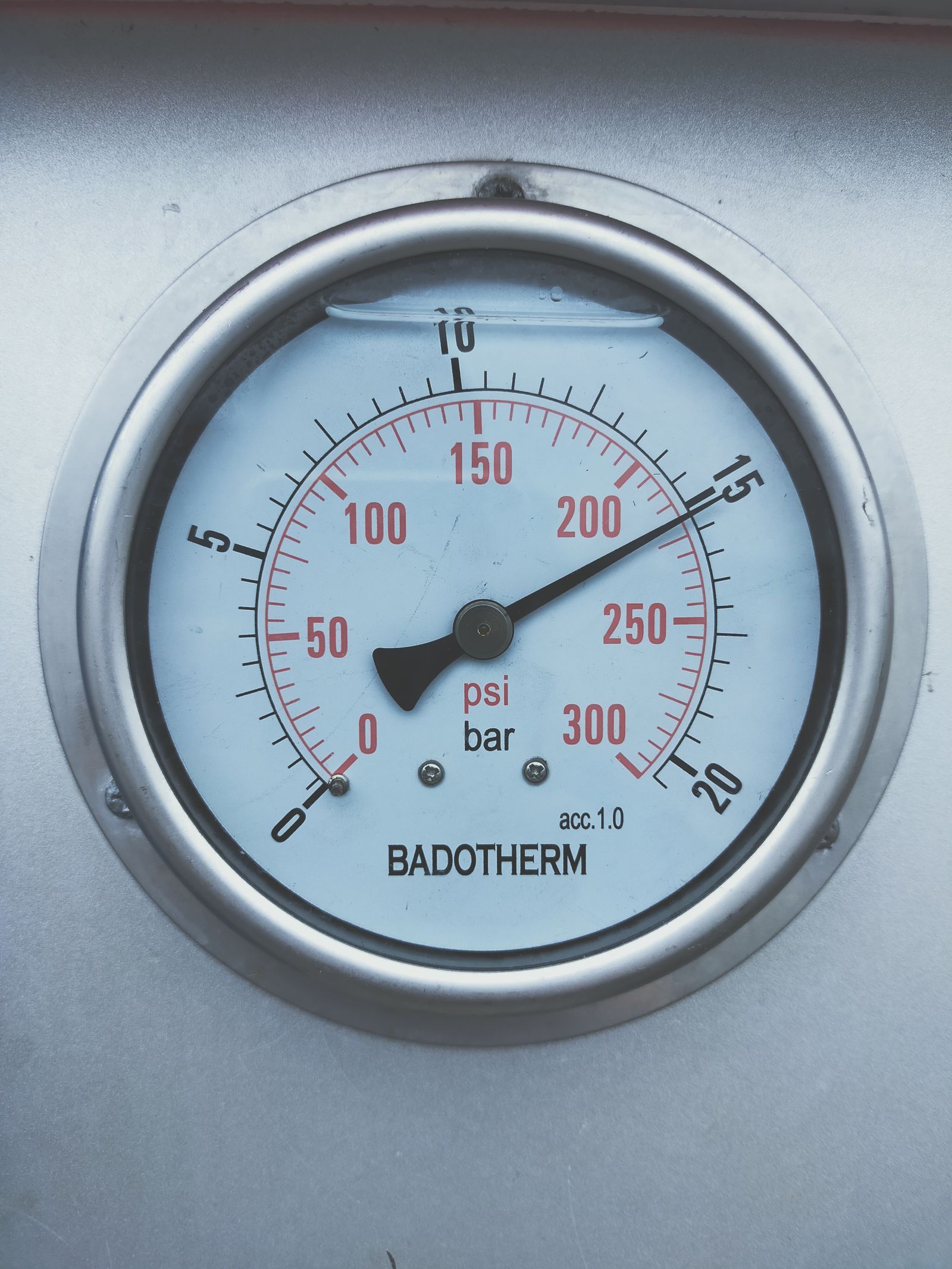
Why is the pressure gauge the most underrated pool diagnostic?
From the owner’s point of view, the pool circuit is a black box: water disappears into the skimmer, flows through the pipework, the pump, the filter, perhaps a heater, and returns through the jets. You cannot see what happens inside — with one exception. The pressure gauge (manometer) on the filter tank measures the water pressure in the system, and its needle responds to every change in resistance in the circuit.
Is the sand clogging up? The needle slowly climbs. Has the pump strainer filled with leaves? The needle drops. Is the system drawing in air somewhere? The needle flutters. One inexpensive instrument costing just a few euros thus stands in for diagnostics you would otherwise pay a service technician for. You only need to speak its language — and that is exactly what we are going to walk through now.
What is the correct operating pressure for a pool filter?
There is no universal “correct” value — and that is the most common misunderstanding. Operating pressure depends on the pump’s output, the diameter and length of the pipework, the height difference, the size of the filter tank, and whether the circuit includes a heater or solar panels. On a typical domestic sand filter, the clean pressure sits roughly between 0.5 and 1 bar, but a perfectly healthy system can also run below 0.4 bar or, conversely, around 1.2 bar.
What matters is therefore not the absolute value but your individual “clean” reading: the pressure the gauge shows immediately after backwashing the filter, with clean water and the pump running. Write this value down — with a marker directly on the tank, in your phone’s notes, anywhere. It is your personal benchmark, against which you will compare every future reading.
- Clean reading = the pressure after a backwash. Write it down and remember it.
- Pressure above the clean reading = something after the pump is creating resistance.
- Pressure below the clean reading = less water is reaching the pump than it should.
What does high pressure mean? Resistance after the pump
The pump pushes water into the filter and on to the pool. Anything in this part of the circuit that creates resistance raises the pressure upstream of the obstruction — exactly where the gauge sits. The most common causes, from most to least frequent:
- A dirty filter. Sand or a cartridge gradually traps debris and resistance grows. On a sand filter, a backwash through the multiport valve helps — you will find the exact procedure in our article on the six-way valve. Remove a cartridge and rinse it with a hose, or replace it.
- A partially closed or shut valve on the return line. Trivial, but it happens — after winterising, servicing, or children playing with the levers. Check every valve between the filter and the jets.
- Scaled-up solar panels or a heater heat exchanger. If the pressure jumped after connecting the solar circuit, look for the problem there — panels foul up with limescale as well as algae.
- Scaled or narrowed pipework. In older pools, limescale and biofilm build up inside the pipes. The pressure then creeps up over months or years, and a backwash brings it down only partially.
Beware of one treacherous detail: an extremely clogged filter can paradoxically “calm” the pressure down — the flow drops so far that the jets barely trickle. Always judge the pressure together with the flow from the jets, never in isolation.
What does low pressure mean? A problem before the pump
When the gauge reads lower than usual, the pump is not getting enough water. The obstruction is on the suction side — between the pool surface and the pump:
- A blocked skimmer or strainer basket. Leaves, insects, hair. The most common and quickest-to-fix cause — tip it out, rinse it, put it back.
- Low water level. If the level drops below the halfway point of the skimmer opening, the pump starts drawing in air. Top up the water.
- Air being drawn in. A leaking strainer lid, dried-out O-rings, loose unions on the suction line. The tell-tale signs: bubbles in the strainer’s sight glass and air blowing out of the jets.
- A blocked suction pipe. Rarer, but possible — a plastic bag or larger object sucked in ahead of the impeller.
If the pump is also humming, losing performance, or not starting at all, work through the detailed guide in our article Pool pump humming or not starting — low pressure and a noisy pump often share the same causes.
When should you backwash the filter based on pressure?
Forget backwashing “every Sunday”. The right moment is set by the pressure gauge: backwash as soon as the pressure climbs 0.2–0.3 bar above your clean reading. That is the usual recommendation for smaller domestic filters; American sources for larger systems quote the equivalent of 8–10 psi, roughly 0.55–0.7 bar above the clean reading. With a small tank and a short circuit, stick to the lower threshold — waiting for +0.7 bar would mean weeks of filtering with miserable flow.
Backwashing more often, “preventively”, makes no sense either: slightly loaded sand actually filters more finely than freshly backwashed sand, and every backwash costs several hundred litres of water. The needle is a more reliable adviser than the calendar. And because a dirty filter reduces flow, it also extends the filtering time you actually need — the connections are explained in our article How long to run your pool filter.
How are pressure and flow related?
Pressure and flow are two sides of the same coin and move in opposite directions. A pump can deliver a certain combination of the two: the more resistance the circuit puts up, the higher the pressure and the less water actually gets through. Picture a garden hose — when you pinch it with your thumb, the pressure behind your thumb rises, but the total amount of water drops.
In practice this means: high pressure = little filtered water. The filter may be running and the electricity meter spinning, but perhaps only half the usual volume passes through the pool. That is why a neglected filter shows up as cloudy water even with unchanged running hours — and why watching the pressure ultimately saves energy too.
Why does the needle flutter or fluctuate?
A healthy system holds the needle steadily on one value. Regular trembling or jumping by tenths of a bar signals air in the system: the pump alternately draws in water and pockets of air, and the pressure pulses. Look for bubbles in the strainer’s sight glass and check the lid seal and the unions on the suction side.
Strong shocks combined with a rattling sound, as if gravel were passing through the pump, point to cavitation — the pump is so starved of water that vapour bubbles form and collapse inside it. Cavitation destroys the impeller and the bearings, so do not put it off: clean the suction line, top up the water, and eliminate any air leaks.
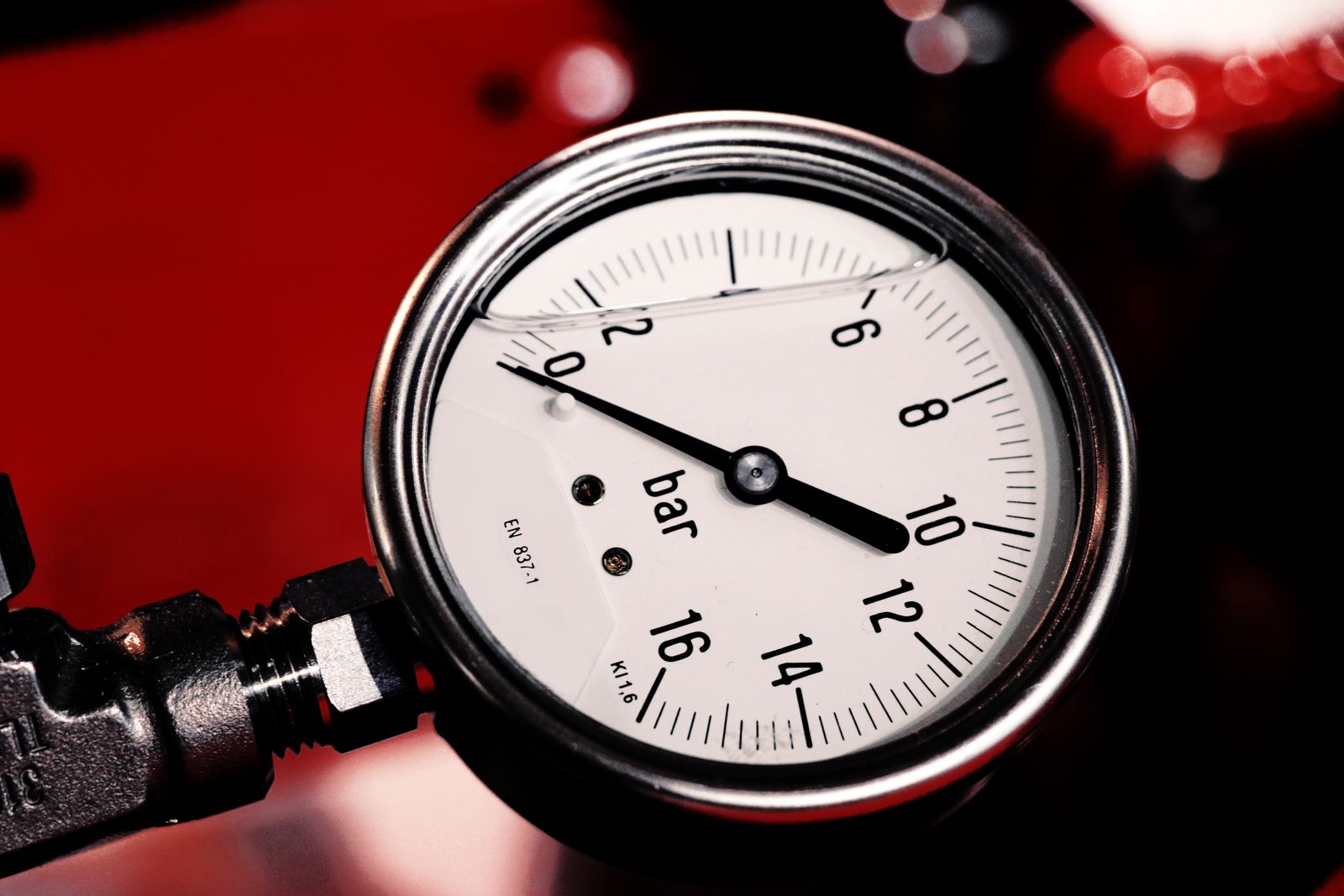
Is your gauge lying to you? When the gauge itself is faulty
Before you start taking the filter apart, make sure the instrument is working at all. Pool pressure gauges are cheap devices operating in chlorinated water and full sun — their lifespan is usually just a few seasons. Typical symptoms of a fault:
- The needle stuck permanently at zero, even though the pump is running and water is flowing from the jets. Most often a jammed mechanism or a blocked inlet channel.
- The needle does not return to zero after the pump stops — the gauge is bent or seized, and all readings are offset.
- A fogged or water-stained glass — water has got inside and the reading is unreliable.
The good news: replacement is a matter of a few euros and two minutes. The gauge usually has a 1/4″ thread — unscrew the old one, fit the new one with PTFE tape, and you are done. Many gauges also have an air relief valve next to them — a small brass screw you use after every backwash to bleed air from the tank until water starts spraying out. Replacement gauges and other small parts can be found in our construction and spare parts category.
Gauge on the valve, or on the tank?
On domestic filters you will encounter two locations. A gauge on the multiport valve is common on smaller sets with a top-mounted valve — it measures the pressure directly in the valve head, i.e. before the water enters the sand. A gauge on the side of the tank is typical of larger filters with a side-mounted valve. For diagnostics the difference is negligible: both positions measure the pressure upstream of the filter bed and respond to clogging in the same way.
Only one thing matters: always record your clean reading from your own specific gauge, in the same valve mode (filter) and with the circuit in the same state. Values from another pool or an internet forum are not transferable.
Diagnostic table: pressure + symptom → cause → solution
| Gauge reading + symptom | Probable cause | Solution |
|---|---|---|
| +0.2–0.3 bar above the clean reading, weaker jets | Dirty sand / cartridge | Backwash, or clean the cartridge |
| Suddenly high pressure, almost nothing from the jets | Closed or partially closed valve on the return line | Check and open the valves after the filter |
| High pressure only with heating/solar switched on | Scaled heat exchanger or solar panels | Clean / descale the heating circuit |
| Pressure creeping up over months, backwash does not help | Calcified sand, scaled pipework | Replace the sand, chemically clean the circuit |
| Low pressure, empty sight glass | Blocked skimmer or strainer, low water level | Clean the baskets, top up the water |
| Low pressure, bubbles in the sight glass | Air being drawn in on the suction side | Tighten the lid, replace the O-rings |
| Needle fluttering, pump rattling | Air in the system, cavitation | Eliminate air leaks, clear the suction line |
| Zero with the pump running, jets fine | Faulty pressure gauge | Replace the gauge (1/4″ thread) |
What to do with the gauge before winter?
The pressure gauge is the filter component most vulnerable to frost: water remains inside it, and when it freezes it bursts the measuring mechanism. Before winterising, unscrew the gauge and store it somewhere dry, or at the very least drain the whole tank thoroughly, valve included. Otherwise a spring surprise in the form of a permanent zero reading is almost guaranteed. The complete procedure, including draining the pipework, is in our guide Pool winterizing step by step.
Frequently asked questions
What pressure is normal for a sand filter?
There is no universal value — typically 0.5–1 bar, but it depends on the pump, the pipework and the tank size. The benchmark is your individual “clean” reading taken after a backwash; deviations from it point to a problem.
When should I backwash the filter?
As soon as the pressure climbs 0.2–0.3 bar above the clean reading (for larger systems, up to 0.55–0.7 bar, i.e. 8–10 psi, is quoted). Backwashing by the calendar is either needlessly frequent or too late — the needle is more accurate.
The gauge reads zero but the filter is running. What now?
If water is flowing normally from the jets, the gauge itself is almost certainly faulty — a stuck needle or a blocked channel. Replacement costs just a few euros: unscrew the old one and fit the new one with PTFE tape on the 1/4″ thread.
Why does the gauge needle flutter?
A trembling needle means air in the system: the pump is drawing air through a leaking strainer lid, an O-ring or a union on the suction side. You can also tell by bubbles in the sight glass. Strong shocks with rattling are cavitation — deal with it immediately, it destroys the pump.
Does high pressure reduce filter performance?
Yes, fundamentally. High pressure means high resistance, and therefore low flow — less water passes through the pool per hour even though the filter runs just as long. The result is cloudy water and needlessly high electricity consumption.
The pressure gauge is the cheapest diagnostician you can get for a pool — you only need to understand it and give it a few seconds a day. If yours has reached the end of its life, or you need O-rings, sight glasses and other small circuit parts, you will find them in our construction and spare parts category; complete pumps and filter units are in our pool technology range.