
A typical garden pool measures six to eight metres — great for cooling off, but too short for swimming. After three strokes you’re at the far wall and turning around. A counter-current unit solves this elegantly: it creates a stream of water you swim against on the spot, turning a short pool into an endless swimming lane. This guide covers the types of counter-current units available, the flow rate you need for serious swim training, and what a retrofit installation involves.

What can a counter-current unit do, and why consider one?
A counter-current unit is essentially a powerful pump that draws water from the pool and returns it through a jet or turbine in the wall. The resulting stream has adjustable intensity — from a gentle flow to a force only a trained swimmer can hold against.
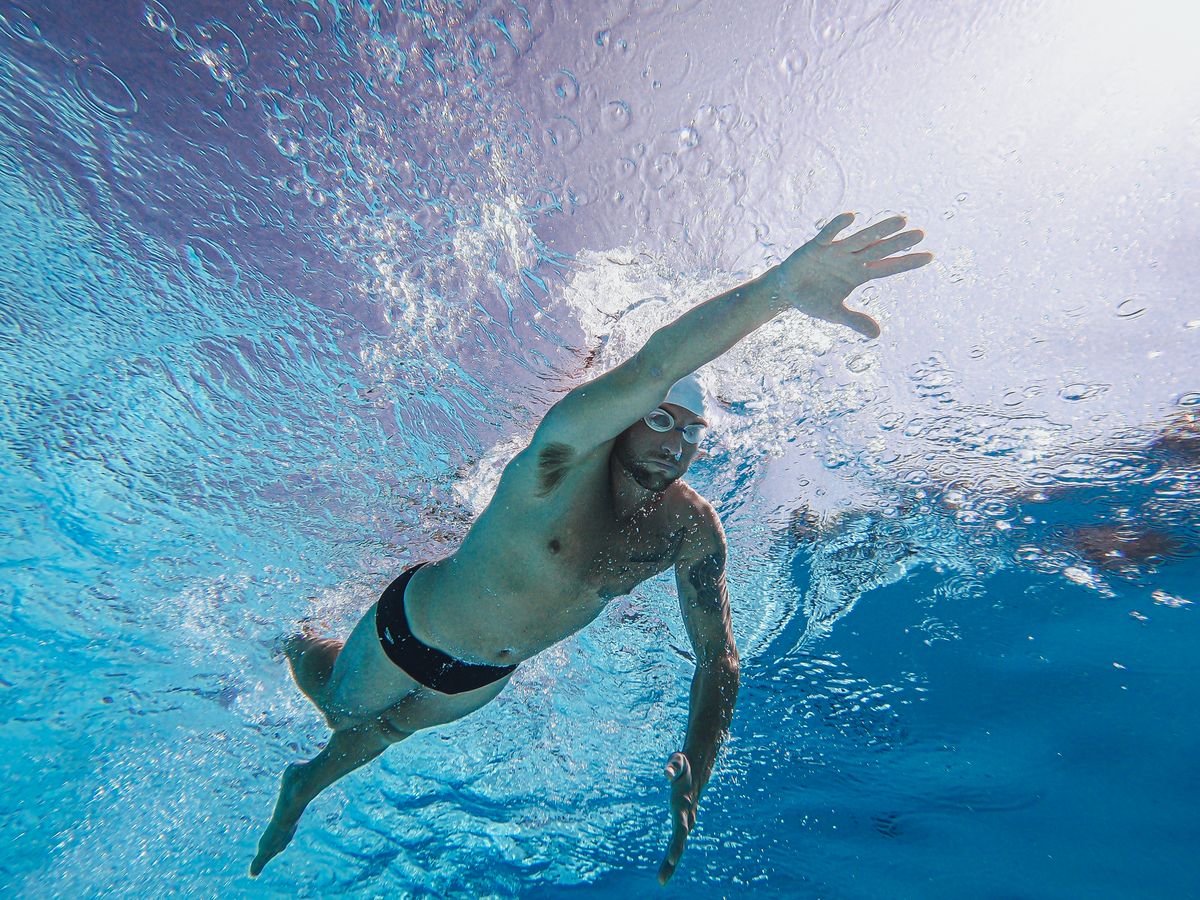
The most common reason to get one is swimming in place. You don’t have to turn around every few strokes; you swim continuously as in a long pool — front crawl, breaststroke, or backstroke. For fitness swimmers, it’s the cheapest way to get a “swimming lane” at home that fits into an ordinary garden.
The second function is water massage. Most counter-current units come with a massage attachment or a hose with a mount: the water stream then works the back, neck, and legs much like the massage jets in a hot tub. And third — kids love counter-current units. The water stream is a safe attraction that keeps them entertained for an entire afternoon; models with air injection produce a bubbly “wild water” effect.
What types of counter-current units are there?
Built-in or clip-on?
In terms of installation, counter-current units fall into two groups. A built-in (integrated) counter-current unit is installed when the pool is built: a counterpart fitting is set into the wall (a special bushing for liner and concrete pools), and the pump is placed in a shaft or plant room next to the pool. The result is clean — all you see in the pool is an elegant faceplate with a jet and a control button.
A clip-on (wall-mounted) counter-current unit is the solution for existing pools. A compact unit with a pump hangs over the edge on the pool wall, with no need to break into or modify the shell. It also works for above-ground and prefabricated pools; the downside is a visible housing in the pool and generally lower output than built-in systems.
Jet system or turbine system?
The second distinction concerns how the unit returns the water. Jet systems push water through one or two nozzles a few centimetres in diameter. The stream is narrow and focused — it widens near the swimmer’s body, but you still have to hold your line, or you’ll “fall out” of the stream. Air is often mixed into the jet, which increases the foaming effect and feels pleasant during a massage.
Turbine systems (e.g., Binder or BADU Jet Turbo Pro) use a large-area turbine instead of a conventional pump-and-nozzle setup. They create a wide, calm stream with no air mixed in that flows around the whole body — the feel is noticeably more natural, closer to swimming in a river. The BADU Jet Turbo Pro is rated at a flow of 150 to 350 m³/h. The price for that comfort: turbine counter-current units start above €4,000, while basic clip-on jet models can be had for under €800.
The key parameter: flow rate in m³/h
The most important figure on a spec sheet is the flow rate — how many cubic metres of water the unit pushes through per hour. It’s the flow rate (together with the shape of the stream) that determines whether you’ll actually be swimming against the current or just enjoying a pleasant soak. Here’s the rough breakdown used by Czech pool-equipment retailers:
- Up to 40 m³/h — water play for kids, massage, and slow recreational swimming. For a trained swimmer, the stream is weak.
- 40–70 m³/h — fitness swimming for most users. This includes, for example, the clip-on BADU Jet Perla with a flow of 40 m³/h or built-in twin-jet models.
- Above 70 m³/h — competitive-level swimming. A typical example is the BADU Jet Super Sport II with two jets and a flow of 75 m³/h (400 V, 3 kW power draw). Turbine systems go even higher.
So if you swim front crawl regularly and want to get out of breath doing it, look for a counter-current unit from roughly 40 m³/h upward — and keep in mind that a competitive swimmer will really appreciate 70+ m³/h. The second key parameter is adjustable intensity: quality counter-current units let you regulate the stream’s force with a throttle valve on the nozzle, and newer models offer stepless speed control via a frequency inverter, so a single unit can serve kids, recreational swimmers, and competitive swimmers alike.
Comparing types of counter-current units
| Parameter | Clip-on jet | Built-in jet | Turbine |
|---|---|---|---|
| Installation | Hung on the wall of an existing pool | During pool construction (counterpart fitting in the wall) | During construction, rarely retrofitted |
| Typical flow rate | approx. 40 m³/h | 40–75 m³/h | 150–350 m³/h |
| Stream character | Narrow, with air | Narrow to medium, 1–2 jets | Wide, calm, no air |
| Suitable for | Recreation, massage, kids | Fitness to competitive swimming | Competitive training, swimming comfort |
| Approximate price | up to €800 | from €1,200 | above €4,000 |
| Appearance in pool | Visible unit | Only faceplate with jets | Only grille/faceplate in the wall |
What does a retrofit installation involve?
The good news: a counter-current unit can be added even to a pool that’s been sitting in the garden for years. The clip-on unit hangs on the pool wall and is secured — over the edge for liner and laminate pools, or anchored into the coping for concrete pools. The mechanical installation itself takes about an hour.
The more demanding part is the electrical work. Powerful counter-current units with a draw of around 2.2–3 kW require a three-phase 400 V connection protected by a residual-current device; weaker single-phase 230 V models exist, but in terms of output they belong more to the recreational category. The supply to the pool must be run by a licensed electrician — this is electrical equipment right next to water, and strict standards apply to the zones around a pool.
Electricity also brings up controls. You must never switch a counter-current unit with an ordinary switch near water, so two safe principles are used instead. Pneumatic control: a button on the unit’s faceplate compresses air in a tube, which trips a membrane switch in the distribution board — there’s no electrical contact anywhere near the water. A piezo button works on a negligible safe voltage and responds to a mere touch; it has no moving parts, so it doesn’t wear out a membrane, and it tends to be standard on pricier models. Comfort-oriented systems also offer remote control or a smartphone app.

Where should the jet go, and how big a pool makes sense?
The jet should point down the pool’s free length and sit roughly 25–30 cm below the surface — that way the stream hits the swimmer’s torso, not the face. On built-in systems, the counterpart fitting is placed on the shorter wall of a rectangular pool; leave at least 4–5 metres of clear water in front of the jet so the stream has room to develop and you don’t kick the opposite wall while swimming.
The smallest reasonably usable pool size for swimming against a counter-current is roughly 4 × 2 metres at a depth of 1.2 metres. In a smaller basin, a powerful stream bounces off the walls and the water churns unpleasantly — for swim training in a tight space, a swim spa, whose tub is shaped specifically around the stream, is a better fit. In round above-ground pools a counter-current unit works too, but more in recreational mode, as a massage.
Counter-current unit, or a swim spa outright?
If you’re still deciding what to get for the garden, a comparison with a swim spa is worth considering — a compact tub with a built-in counter-current unit, heating, and massage seats. A swim spa costs more upfront but runs year-round and doesn’t require building a pool; a counter-current unit, by contrast, is an ideal upgrade for a pool you already have. You’ll find a detailed comparison of both routes in our article on swim spa vs. pool, and we cover training options in the piece on swim spa as a home gym.
Simplified rule of thumb: if you have a working pool and want to swim, buy a counter-current unit. If you don’t have a pool and want to swim even in January, plan for a swim spa instead.
Maintenance: what does a counter-current unit need?
A counter-current unit is a mechanically simple device and needs little upkeep. The basics: check the intake grilles — the suction must not get clogged with leaves or hair, or the pump will run dry and the seal will suffer. For clip-on units, remove the unit at the end of the season, rinse it with clean water, and store it dry; built-in systems should be drained before winter just like the filtration, so frost doesn’t crack the piping.
Once a season, check the pneumatic control tubing for leaks and make sure screw connections are tight. The pump’s mechanical seal is a normal wear part — if water drips from under the pump, replace it before moisture damages the bearings. Water quality, on the other hand, benefits from a counter-current unit: the vigorous flow mixes the chemistry and breaks up dead zones where algae would otherwise take hold.
Frequently asked questions
What flow rate do I need for competitive swimming?
As a rough guide, from 40 m³/h upward for fitness swimming; competitive swimmers should look at models above 70 m³/h (e.g., twin-jet systems with a 3 kW power draw) or a turbine unit with a wide stream. Units under 40 m³/h are aimed more at recreation, massage, and kids.
Can a counter-current unit be fitted into an existing pool?
Yes. Clip-on units hang on the wall of a finished pool with no work on the shell — a technician can install one in about an hour. Do plan, though, for bringing electricity to the pool (400 V for powerful models), which must be done by a qualified electrician.
What’s the difference between a jet and a turbine counter-current unit?
A jet unit pushes water through a narrow, focused stream, often with air mixed in — it’s cheaper, but the stream feels “harder” and you have to hold your line. A turbine unit produces a wide, calm stream with no bubbles that feels like swimming in a river; it typically costs more than €4,000, though.
How much electricity does a counter-current unit use?
Typical models draw roughly 2.2–3 kW. For an hour of swimming a day, that’s about 2–3 kWh, or roughly €0.6–1 a day depending on electricity prices. Unlike filtration, a counter-current unit only runs while you’re actually swimming.
Does a counter-current unit also work as a massage?
Yes, most manufacturers supply a massage attachment or hose. By adjusting the intensity and adding air, you get a stream suited to working the back and legs — it won’t fully replace a hot tub, but it’s welcome after a workout.
A counter-current unit is one of those investments that genuinely changes how you use a pool — a place to cool off becomes a training ground. You’ll find counter-current units, pumps, and other pool equipment in our pool technology category, and more buying guides in our Guide.
