
The colour of your water is the fastest diagnostic tool you have — before you even reach for a test kit, it tells you which direction to look in. Green means either algae or copper, brown is most often iron from a well or tannin from fallen leaves, milky points to calcium or an overloaded filter, and a rainbow film on the surface comes from oils in cosmetics. This article sorts you by appearance and sends you to the right guide. One rule applies to every case: never shock blind until you know what is causing the colour.
Quick diagnostic table: from appearance to cause
Treat the table as a signpost. The “first step” column is always a safe action that will not make things worse, even if you have guessed wrong.
| Appearance of the water | Most likely cause | First step | Detailed guide |
|---|---|---|---|
| Green, cloudy, slippery walls | Algae | Measure free chlorine and pH, run the filter non-stop | Green pool water |
| Green but clear (you can see the bottom) | Oxidised copper in the water | Do not shock, measure pH and copper | see the Clear blue-green water section below |
| Brown to rusty, turned brown after chlorination | Iron (well water, pipework) | Stop further dosing, use a flocculant | Well water in your pool |
| Tea-brown but crystal clear | Tannin from leaves and pine needles | Net out the organic matter, clean the skimmer | Leaves, pollen and insects in the pool |
| Purple to blackish-brown after rain | Manganese from well water | Test for manganese, filter with a flocculant | Well water in your pool |
| Milky white, dull and lifeless | Calcium precipitated at high pH | Measure pH, alkalinity and hardness | Water hardness and scale buildup |
| Greyish and cloudy, colour still blue | Microparticles, overloaded filter or too short a run time | Check the pressure gauge and the filtration hours | Pool filter pressure |
| Cloudy water in a hot tub | Biofilm, organic overload, clogged filter | Remove and rinse the cartridge | Cloudy hot tub water |
| Blue-green, crystal clear, metallic tone | Copper from the heat exchanger or an algaecide | Raise pH to 7.2–7.4, add no more algaecide | see the Clear blue-green water section below |
| Black or dark grey patches on the walls | Black algae, mould in the joints | Brush mechanically first, chemicals only after that | Pool algae: types and prevention |
| Yellow to mustard deposits in shaded areas | Mustard algae | Brush the shaded walls, raise the chlorine level | Pool algae: types and prevention |
| Purple stains on the liner or around the jets | Copper cyanurate (copper + high CYA) | Measure the cyanuric acid level | Chlorine stabiliser and CYA |
| Oily rainbow film on the surface | Oils, sun creams, cosmetics | Wipe the surface, replace the filter media | Foam and smell in a hot tub |
Green water: how to tell algae from copper
Green has two completely different causes, and each is treated the opposite way. You can tell them apart within a minute without dosing anything at all.
Algae always make the water cloudy. The bottom of the deep end is either invisible or lost in a milky green haze, the walls feel slippery to the touch and the colour deepens noticeably within a day or two. Free chlorine is usually below 0.3 mg/l and drops back to zero quickly after a dose, because the biomass consumes it.
Copper, by contrast, leaves the water crystal clear. You can see the joints on the bottom, they just have a greenish cast, as if the pool were lit with a green light. The colour appears abruptly — typically within a few hours of shocking, after a sharp drop in pH or after a dose of copper-based algaecide. The walls are not slippery and the chlorine holds.
A practical test: fill a white bucket with the water and leave it to stand for an hour. Algal water stays green throughout the volume and starts to settle, whereas copper-laden water looks almost clear in a small volume, because the tint only becomes visible through metres of depth. If it is algae, the full procedure is in the article Green pool water, and prevention and the different species are covered in Pool algae. We will not repeat any of it here.
Brown to rusty water: iron, manganese or leaves
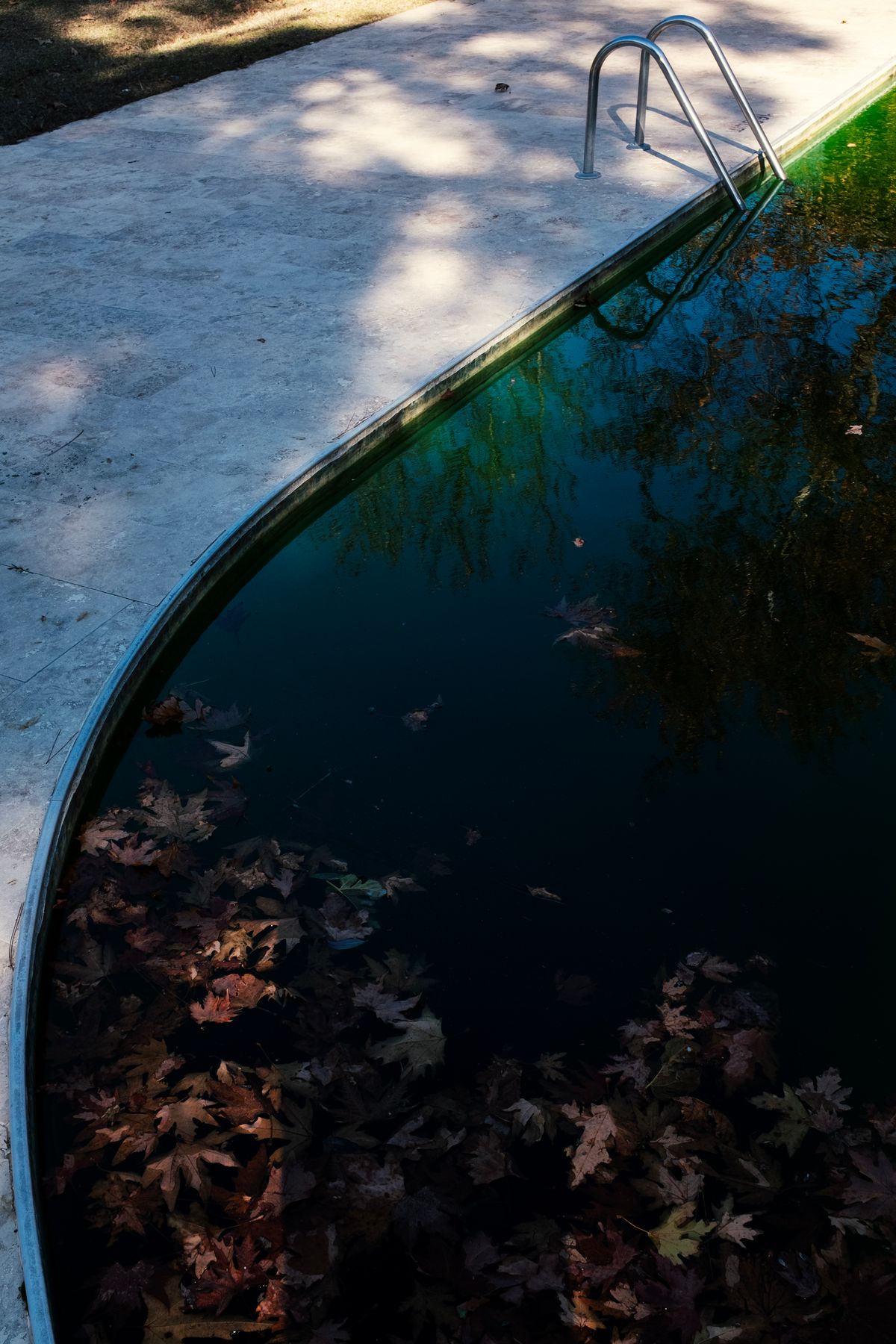
Brown water has two main branches, and one simple question separates them: was the water clear until you added chlorine?
Iron from a well is dissolved in the water and invisible — the pool looks clear once filled. The moment you add chlorine or another oxidising agent, the iron oxidises into an insoluble hydroxide and the pool turns brown within tens of minutes. The rusty shade lingers along the walls and in the corners, where circulation is weakest. The solution belongs to the filling stage, not to disinfection — in detail in the article Well water in your pool.
Manganese behaves in exactly the same way, only the resulting colour is darker: purplish-brown to black, forming a fine deposit on the bottom that can be wiped away. In wells it often occurs alongside iron, and like iron it should be dealt with before the pool is filled.
Tannin from leaves, pine needles and oak bark tints the water the shade of weak tea but leaves it crystal clear — you can see the bottom sharply, just in a brown tone. Chlorine gradually breaks tannin down, but as long as the organic matter is lying on the bottom, the colour keeps coming back. So net it out and vacuum it up first, and only then reach for chemicals. Preventing seasonal debris is covered in Leaves, pollen and insects in the pool.
Milky white and cloudy water
Cloudiness is an optical effect: the water contains particles smaller than the filter can catch, and they scatter the light. The colour stays white or grey-blue, not green.
Precipitated calcium is the most common cause in hard water. When pH climbs above 7.8, dissolved calcium bicarbonate precipitates as fine carbonate and the water turns white almost overnight. Typical triggers: a dose of sodium hypochlorite, a salt chlorinator without pH correction, or heavy aeration from water features. You will find guidance in the article Water hardness and scale buildup.
An overloaded filter does the same thing with different particles — fine dust, pollen, cream residues. The tell-tale sign is cloudiness that is completely uniform, water that clears a little overnight once the pump is switched off, and turns cloudy again in the morning. Check the pressure gauge: a rise of 0.3–0.5 bar above the clean reading means clogged media. The procedure is in the article Pool filter pressure. The other possibility is simply too short a daily filtration time.
In a hot tub, cloudiness is almost always about organic matter: a small volume, a high temperature and concentrated sweat and cosmetics. The causes and the fixes are covered in Cloudy hot tub water.
Clear blue-green water: copper where it should not be
This shade is treacherous, because it actually looks rather attractive — the water is crystal clear, it just has a rich turquoise to blue-green tone. There are two sources.
The first is a copper or brass heat exchanger in the heating system. When pH drops below 7.0 and the water turns corrosive, copper is released from the exchanger into the pool. Besides the colour, you risk permanent damage to the exchanger, so this is not merely an aesthetic issue — the low pH needs raising as soon as possible, and you need to find out why it fell.
The second is copper-based algaecides, especially when repeatedly overdosed “just to be safe”. The copper in them works, but it accumulates, because it does not disappear from the water on its own — it only leaves through dilution or precipitation.
The usual accompanying symptom is staining: greenish to blue-grey marks on the liner and on light-coloured ceramics, and greenish tips on blond hair. The remedy is adjusting the pH into the 7.2–7.4 range, a metal sequestrant and partial dilution of the water. Shocking makes matters worse — oxidised copper is more strongly coloured than dissolved copper.
Black and grey patches on the walls
Here it is no longer about the colour of the water but about the surface. Black algae take hold in the pores of concrete and in the joints, where they form a hard protective shell — which is why ordinary disinfection does not destroy them, and why there is no point adding more algaecide until you have broken the colonies up mechanically with a brush. In liner pools, a dark coating in the joints is more often mould or settled organic matter. How to tell them apart and what to do is in the article Pool algae: types and prevention.
Yellow and mustard deposits in the shade
The characteristic sign of mustard algae is their position: they settle exclusively on the shaded side of the pool, under the steps, behind the ladder and in the corners, where neither the sun nor the main circulation reaches. They look like fine sand or pollen, and the moment you run your hand over them they lift into a cloud — which is the main difference from real sand and from pollen, which stays on the surface.
Crucially, they survive even at normal free chlorine levels. Without brushing, and without cleaning the vacuum head, the brush and any swimming aids, they are back within a few days. If you can see a yellow coating in sunlit spots too, it is more likely settled pollen — covered in the article on leaves and pollen.
Purple stains: a rare but instructive case
Purple to lavender stains on the liner, around the jets and on the salt cell are the rarest phenomenon in this overview. They form as copper cyanurate — a precipitate of copper and cyanuric acid. The conditions are copper being present (from an algaecide or a heat exchanger) together with a high stabiliser level, typically above 100 mg/l, which the water reaches through long-term use of trichlor tablets without any dilution.
The stains themselves are not dangerous, but they are a reliable message that CYA is outside the sensible range and that chlorine is no longer working the way it should. We go into the connections in the article Chlorine stabiliser and cyanuric acid.
A rainbow film on the surface
The oily rainbow coating that breaks into colours like oil on a puddle has nothing to do with disinfection. It is sun creams, body lotions, conditioners and detergent residues from swimwear. In a pool the film gathers around the skimmer and on the surface in still weather; in a hot tub it is visible far sooner and is often accompanied by foam and a musty smell — covered in detail in Foam and smell in a hot tub.
Quick fix: an absorbent sponge or pad on the surface, a thorough filter clean and a shower before bathing as a permanent habit. Chemicals here treat the symptom, not the cause.
The universal first three steps before you pour anything in
Whatever the colour, these three steps always apply, and in this order.
- Test the water. At minimum free chlorine, pH and alkalinity; hardness too if you suspect calcium, and cyanuric acid if you chlorinate with tablets. Without numbers, any intervention is guesswork. How to measure properly is summed up in How to test pool and hot tub water.
- Check the filtration. The pressure gauge, the condition of the media, the flow from the jets, and how clean the skimmer and pump baskets are. A large share of cloudy water is a purely technical problem that no chemical will solve — see Pool filter pressure and what the gauge tells you.
- Do not shock blind. Shocking is the right move for algae and organic loading, but with iron, manganese and copper it fixes the colour in place and turns dissolved metal into a visible precipitate and stains on the liner. At high pH it will also precipitate calcium and add to the cloudiness.
A fourth, less obvious step is to write down the date and the readings you took. Most recurring problems have a seasonal rhythm — after a storm, after visitors, after topping up with well water — and a written record reveals it faster than any chemical.
When the colour means “do not swim”
Cloudiness and discoloration are not merely an aesthetic problem. If you cannot see the bottom at the deepest point, the pool is not safe — a swimmer below the surface is invisible. Equally, with zero free chlorine and visible biological cloudiness, nobody goes in until the readings are back in line. Colours from metals and tannins do not usually pose a health risk, but they can stain hair and light-coloured swimwear.
Frequently asked questions
The water turned green overnight, but my chlorine level is fine. How is that possible?
Most often it is copper rather than algae — algae would have consumed the chlorine. Check whether you have dosed an algaecide in the past few hours, whether the pH has been falling, and whether your heating has a copper heat exchanger. Measure the pH; a value below 7.0 is a strong clue.
Can I clear the pool with a flocculant when I do not know what is causing the cloudiness?
A flocculant is a reasonably safe choice for microparticles, iron and precipitated calcium — it binds fine particles into larger flocs that the filter catches or that you vacuum to waste. It will not help against tannin or dissolved copper, though, and with cartridge filters it should be used only with great caution, because it clogs the media quickly.
Why does the brown water keep coming back even though I have already cleared it once?
Either you are topping up with the same iron-bearing water, or the source of the colour is still in the pool — a layer of leaves and pine needles in the corners and under the steps. With well water it pays to treat it at the filling stage rather than repeatedly afterwards.
Is milky water in a hot tub dangerous?
In itself it mainly signals that the disinfection is not keeping up with the organic load. It becomes a risk only when the cloudiness is accompanied by zero disinfectant residual and a smell — at that point microorganisms are multiplying and bathing should be postponed until the situation is resolved.
How long does it take for the water to clear after treatment?
For simple cloudiness, 24–48 hours of continuous filtration. With algae, expect several days including brushing and repeated filter washing. If nothing has improved after three days of continuous running, the fault is not in the chemistry but in the equipment — most often inadequate filtration or a blocked line.
Colour as the first signal, not the verdict
Discoloured water is not a punishment for neglected care — it is information. Read it correctly and it will save you bags of chemicals that would only shift the problem elsewhere. The cycle is always the same: look, measure, check the equipment, and only then dose.
If your diagnosis leaves you needing test kits, flocculants, pH correction products or metal sequestrants, you will find them in the water treatment category. More guides from this series are waiting in the Advice section.
