
Crystal-clear water can be completely out of balance chemically — while cloudy water can actually be fine. The only way to know for sure is to test it. The good news: you only need to check two or three values, two to three times a week, and pick a method that suits your budget and your habits. In this guide, we compare test strips, drop tests, digital photometers, and smart floating sensors — including prices, accuracy, and the mistakes that reliably throw off your results.
What to Measure and How Often
You don’t need to be a chemist. For everyday pool and hot tub care, keeping an eye on four or five parameters is enough — and each one moves at its own pace. The essentials are pH and disinfectant level (chlorine or bromine), which change fastest since they’re affected by bathers, sunlight, and water temperature.
Total alkalinity (TA) acts as a buffer for pH and changes more slowly, so a weekly check is enough. Water hardness and cyanuric acid (CYA, the chlorine stabilizer used in outdoor pools) shift very gradually — testing monthly is plenty. For hot tubs, with their higher water temperature and smaller volume, we’d lean toward the more frequent end of these intervals.
| Parameter | Target Range | How Often to Test | Note |
|---|---|---|---|
| pH | 7.2–7.6 | 2–3x/week | The most important value — affects both disinfection efficiency and skin comfort |
| Free Chlorine | 0.5–1.0 mg/l (pool), 1–3 mg/l (hot tub) | 2–3x/week | For bromine, aim for 2–4 mg/l |
| Total Alkalinity (TA) | 80–120 mg/l | 1x/week | Low TA = pH “bounces around,” high TA = pH is hard to adjust |
| Water Hardness (CH) | 150–250 mg/l (hot tub), 200–400 mg/l (pool) | 1x/month | Hard water causes scale buildup, soft water damages surfaces |
| Cyanuric Acid (CYA) | 30–50 mg/l (outdoor pools only) | 1x/month | Above 100 mg/l chlorine stops working effectively — partial water dilution is needed |
On top of that, test after heavy bather loads, after a storm, after topping up with fresh water, and before any chemical adjustment. Anyone who doses chemicals “by eye” without testing ends up dealing with cloudy water, foam and smells — and, on balance, uses more chemicals than someone who tests regularly.
Test Strips: Fast, Cheap, but Only a Rough Estimate
Test strips are the easiest entry point into water care. You dip a paper strip with reagent pads into the water for 1–2 seconds, pull it out, wait 15–30 seconds, and compare the pad colors to the chart on the container. The whole test takes about thirty seconds, and a single strip costs roughly €0.10–0.25 (a pack of 50 typically runs €6–12).
The trade-off for speed is accuracy. Reading the colors is subjective — it depends on lighting and how well you can distinguish shades. Strips will reliably tell you whether a value is “roughly fine,” “low,” or “high,” but you won’t get a precise number out of them. For a routine twice-weekly check, though, that’s enough for most owners.
Their key weakness: strips age. The reagents on the pads degrade with moisture and heat, and expired or poorly stored strips give nonsensical readings — typically a falsely low chlorine result. Always close the container right away, store it somewhere dry at room temperature (not in the pool’s equipment shed), and toss out strips past their expiry date without hesitation. Use up an opened pack within the season.
Drop and Tablet Testers: The Sweet Spot with the DPD Method
Drop testers (and their tablet-based counterpart) are a step up in accuracy. You fill a measuring vial with a water sample up to the marked line, add the prescribed number of reagent drops or a tablet, mix, and compare the color of the solution to the chart on the case. You’re comparing the color of an entire column of liquid rather than a tiny pad, which makes the reading noticeably more reliable than with strips.
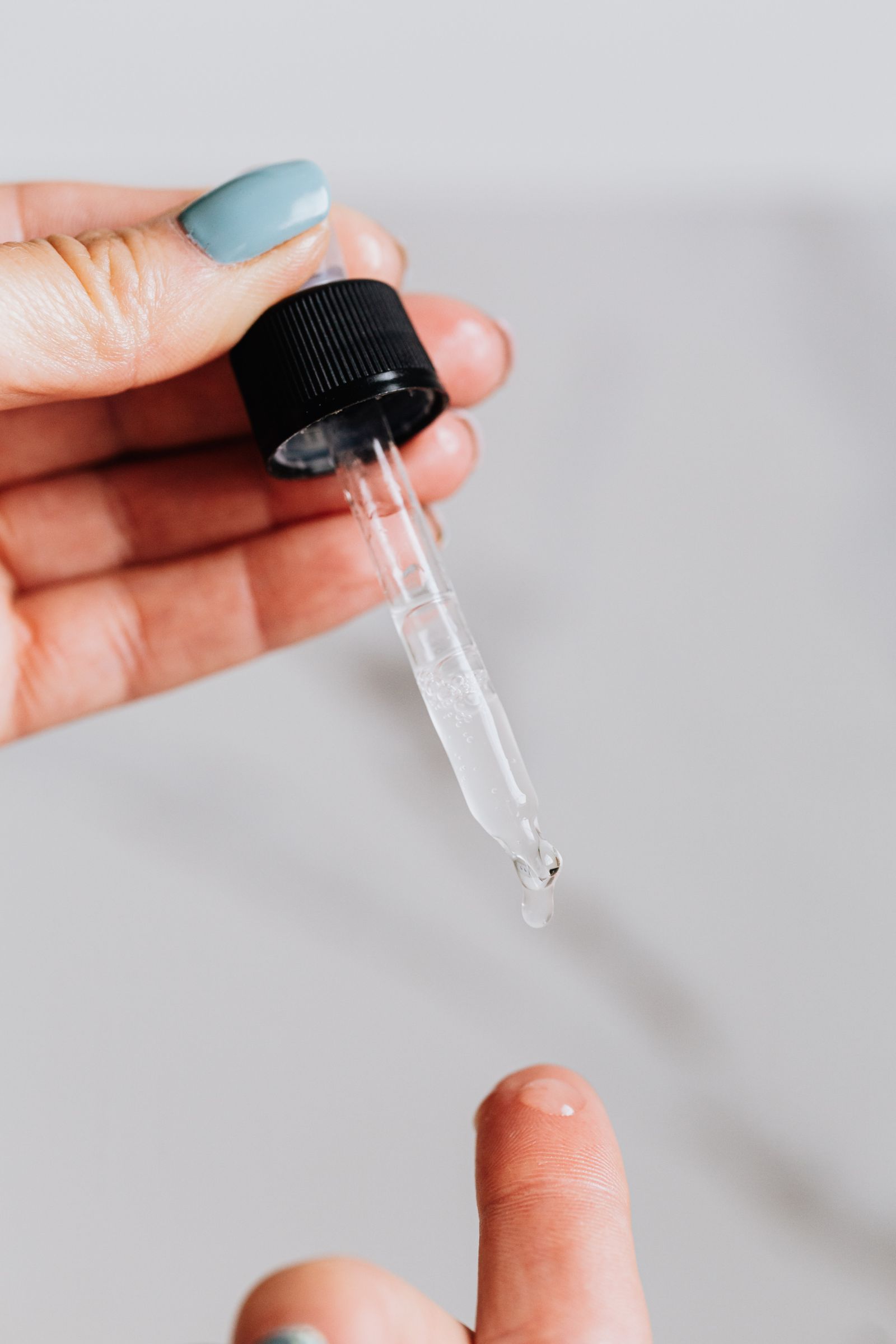
Chlorine is measured using the so-called DPD method: DPD No. 1 reagent turns the sample pink in proportion to the free chlorine concentration. If you also want to know total chlorine (and, by subtraction, combined chlorine — the kind that irritates eyes and smells) you add DPD No. 3. For pH, the reagent is phenol red. The procedure is always the same: rinse the vial with the water being tested, fill it exactly to the mark, add the reagent, and read the color within a minute against a white background.
A basic pH/chlorine drop test kit costs around €8–20, and replacement reagents are just a few euros. The same freshness rule applies here too: replace liquid reagents every season; tablets last longer, but keep them away from moisture.
Photometers and Digital Testers: Accuracy Without Guessing Colors
A photometer does the same thing as a drop test, except you don’t read the color yourself — the device measures it for you. You place a sample with a reagent tablet in the cuvette, the photometer shines light through the solution, and the display shows a precise number: pH 7.43, say, or free chlorine at 0.8 mg/l. No more guesswork, no more squinting on a dim terrace, no more arguing over whether it’s “more pink or more purple.”
Pocket photometers for home use start at around €60–120, while multi-parameter devices measuring 5–10 values cost €160–400. On top of that, factor in the ongoing cost of reagent tablets. Electronic pH meters with a probe are a category of their own — they give instant, reagent-free readings, but the electrode needs regular calibration with buffer solutions and must be kept moist, or it will read inaccurately.
A photometer makes sense if you run a hot tub with a finicky water balance, keep running into recurring problems, or simply want hard numbers you can rely on. For larger pools and more demanding users, it offers the best balance of accuracy and price.
Smart Floating Sensors: Testing That Runs Itself
The most convenient route is a smart water quality monitor — a floating sensor, or one installed inline in the plumbing, that continuously measures temperature, pH, redox potential (ORP, an indirect indicator of disinfection effectiveness), and sometimes conductivity. The data goes over Wi-Fi or Bluetooth to an app that alerts you the moment something drifts out of range and suggests a dosage right away.
Prices range from about €160 to €600 depending on features, and with some brands you’ll also need an app subscription. One important caveat: even a smart sensor doesn’t measure everything — you won’t get CYA, hardness, or alkalinity from it, and the probes need occasional calibration. The ideal combination is a sensor for daily pH and disinfectant monitoring, plus a drop test or photometer for a weekly check on the other values. We’ve covered how monitoring fits into broader pool automation in our article on smart pool automation.
Comparing the Methods: Which One to Choose?
| Method | Purchase Price | Accuracy | Effort | Best For |
|---|---|---|---|---|
| Test strips | €6–12 / 50 pcs | Rough estimate | Minimal, 30 seconds | Routine checks, beginners, kids at the cabin |
| Drop/tablet test (DPD) | €8–20 + reagents | Good | Low, 2–3 minutes | Most pool and hot tub owners |
| Photometer | €60–400 | Very high (numeric result) | Medium, requires tablets | Demanding users, troubleshooting, large pools |
| Smart floating sensor | €160–600 | High for pH/ORP, doesn’t measure everything | Minimal after setup, occasional calibration | Convenience, remote monitoring, smart-home setups |
Practical advice: start with a drop test as your baseline and keep strips on hand for quick spot checks. Add a photometer or sensor once you know that more frequent, more precise data will actually make a difference for you.
How to Take a Water Sample Correctly
Even the most expensive photometer will give you a bad reading from a bad sample. The water’s surface is chemically skewed — sunlight breaks down chlorine there, and sunscreen and debris float on top. So three simple rules apply:
- Elbow depth. Submerge your hand holding the container upside down to a depth of about 30–40 cm (elbow-deep), turn it over there, and fill it with water. You’ll get a sample from the “body” of the water, not the surface.
- Away from jets and the skimmer. Water fresh from filtration and dosing flows out of the return jet, while the dirtiest water collects at the skimmer. Take your sample from the middle of the pool or hot tub, ideally with the filtration running so the water is well mixed.
- Test in the morning or evening. During the day, sunlight burns off chlorine quickly and algae photosynthesis shifts the pH. Morning readings, taken before anyone swims, give the most stable picture.
Test the sample right away — water in the container warms up and off-gasses within a few minutes, which shifts the readings.
The Most Common Testing Mistakes
- Expired or poorly stored reagents. The most common source of nonsensical results. Replace strips and liquid reagents every season, store them somewhere cool and dry, and close the container immediately after use.
- Touching the reagent pads with your fingers. Sweat and oil from your skin can ruin a strip before it even touches the water. Hold the strip by its clean end, and tap it out of the container rather than pulling it out with your fingers.
- Testing right after dosing chemicals. After adding chlorine, pH minus, or pH plus, wait at least 2–4 hours (up to 24 hours after shock chlorination) with the filtration running. Testing sooner only shows a local concentration, not the true overall state.
- Reading at the wrong time. Reagent colors are only accurate at a specific moment — a strip read after two minutes instead of thirty seconds will “over-develop” and show inflated values.
- Not rinsing the vial. Reagent residue from the previous test will skew the next one. Always rinse the vial with the water you’re testing, not tap water.
- Ignoring high CYA. If a strip keeps showing zero chlorine despite regular dosing, test the stabilizer level — above 100 mg/l CYA, chlorine becomes “locked up,” and only a partial water change will fix it.
What to Do With Your Results
Testing only pays off if it’s followed by the right correction — and there’s a proper order to it. Adjust alkalinity first, since it holds pH in place. Only then fine-tune pH to 7.2–7.6; if pH is off, disinfection won’t work properly no matter how much of it is in the water. Adjust chlorine or bromine last. Between each step, let the water circulate with the filter running for a few hours and re-test.
You’ll find the complete dosing process, including specific products and amounts, in our guide to hot tub chemistry step by step — the correction order applies the same way to pools. And if your water won’t hold its values even after proper treatment, it may be time to change it; we cover exactly when in our article on how often to change hot tub water.
Frequently Asked Questions
Are test strips enough for a hot tub?
For a quick daily check, yes, but we recommend a more accurate drop test or photometer at least once a week. A hot tub has a small volume and high water temperature, so values shift much faster than in a pool — and a strip’s half-point pH error already means a real difference in disinfection effectiveness.
How long do test strips and reagents last?
An unopened pack of strips is typically good for 2 years from manufacture; use up an opened pack within a single season. Replace liquid DPD reagents every year; reagent tablets last 2–3 years if kept dry. Take the expiry date on the packaging seriously — expired reagents don’t give you “roughly right” readings, they give you wrong ones.
Why does my strip show zero chlorine even though I dose regularly?
There are three usual causes: expired strips (a false zero), a CYA stabilizer level so high it’s blocking the chlorine, or genuinely high chlorine demand from early-stage algae or organic contamination. Verify the reading with another method, check the CYA level, and shock-chlorinate if needed.
Do I need to calibrate a smart sensor?
Yes. pH and ORP probes drift over time, so manufacturers typically specify calibration with buffer solutions every 6–12 months and probe replacement after 2–3 years. An uncalibrated sensor is just an expensive floating toy — check its readings against a drop test from time to time.
What time of day is best for testing?
In the morning before anyone swims, or in the evening after sunset. The water is well mixed, sunlight hasn’t burned off the chlorine yet, and results stay comparable from day to day. More important than the exact hour, though, is consistency — always test at the same time.
In Short: Test Regularly, Correct Thoughtfully
Whether you choose strips for a few cents or a smart sensor with an app, what really matters is consistency and fresh reagents. Two minutes of testing, twice a week, will save you hours of fixing ruined water and money wasted on unnecessary chemicals. You’ll find testers, reagents, photometers, and complete water treatment products in our water treatment category — and we keep adding practical guides to our Advice section.

1 comment