
Do not run pool water straight onto your flower beds with a hose. If it still holds free chlorine and the pH sits away from neutral, it harms plants and soil life alike — but leave it a few days with no dosing and no cover, confirm with a tester that chlorine is practically at zero, fine-tune the pH and dilute it, and the waste turns into ordinary watering for the lawn. Salt water from a chlorinator should never go on the garden at all. And wherever you send the water, send it slowly: draining fast is one of the few things that can damage a pool structurally.
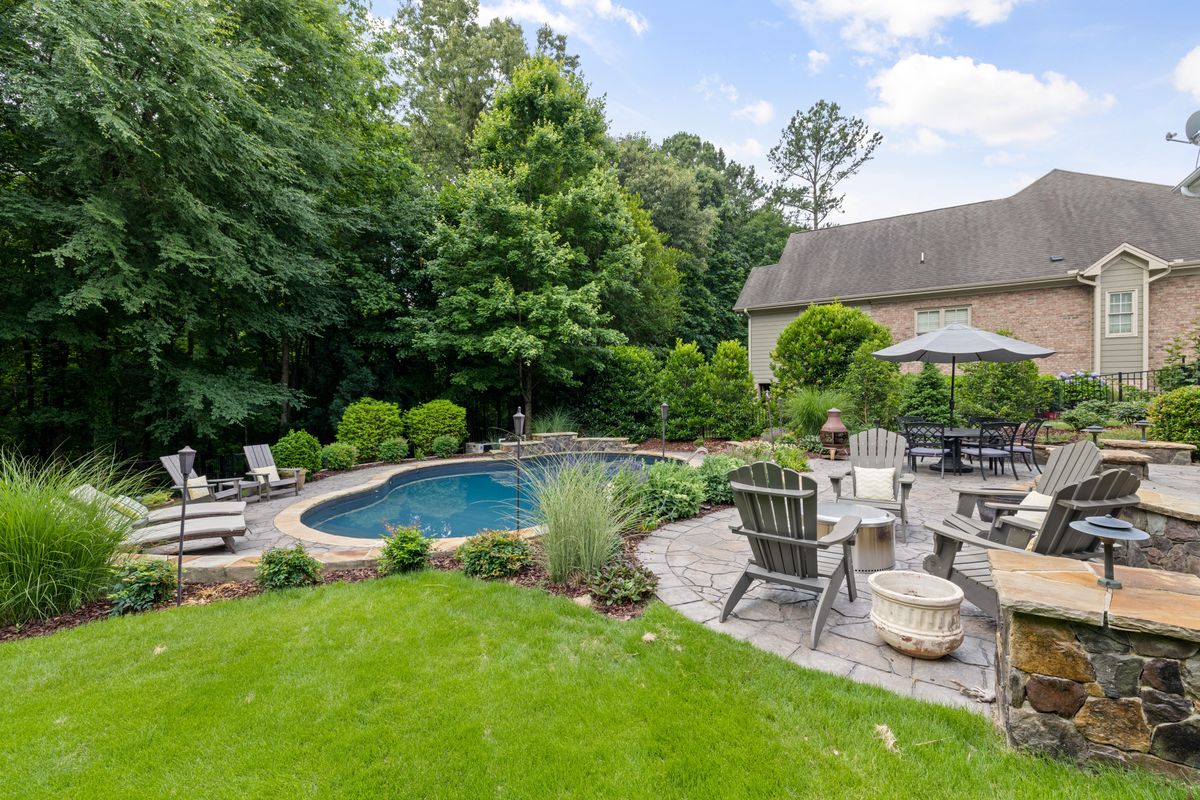
Why pool water should not go straight onto the garden
From a plant’s point of view, pool water is a different thing from hose water. Three factors make the difference: disinfectant, pH and salts.
Free chlorine is an oxidising agent. At the concentration you hold for hygiene (typically 0.3–0.6 mg/l) it kills micro-organisms — and it acts exactly the same way on soil life, meaning the bacteria and fungi that break down organic matter and make nutrients available to roots. A single dose will not destroy healthy soil, but repeatedly watering the same spot with chlorinated water makes no sense. On sensitive foliage, chlorine also shows up as scorched leaf edges.
A pH away from neutral tends to be a bigger problem than chlorine. You run a pool in the 7.0–7.4 range, which is still acceptable, but water right after an acid correction or a shock treatment can be markedly more acidic or more alkaline for a while. Water below pH 6.5 or above 8 needs fine-tuning first, not a flower bed.
Salts and stabiliser. End-of-season water has everything you put in it over the year dissolved in it: chlorine stabiliser, flocculants, algaecides, pH correction products. None of it evaporates — on the contrary, the concentration rises as water evaporates and you top up. Why the stabiliser level in particular is the main reason to change the water is covered in our article on cyanuric acid.
Salt water is worse for soil than chlorinated water
This is the single most important distinction in the whole article. A pool with a salt chlorinator typically contains 3–5 g of salt per litre, that is 3,000–5,000 mg/l of sodium chloride. That is an order of magnitude more than with conventional chlorination and — unlike chlorine — salt does not break down in any way. It does not dissipate, does not decompose in the sun, does not disappear if you wait. It stays in the water, and once you pour that water on your land, it stays in the soil.
Sodium in soil degrades its structure — the soil compacts and drains poorly — and at the same time physically makes it harder for the plant to take up water. Paradoxically, it shows up as drought even while you are watering. Conifers, rhododendrons, azaleas and most vegetables are the most sensitive.
The practical conclusion: do not pour salt pool water onto the garden. Not diluted, and not “just this year”. Deal with it by discharging into the sewer after agreeing it with the network operator, or by very gradual, dispersed release away from planted areas — and even then only after checking what applies in your municipality.
How to prepare the water for garden use
Chlorinated water is fairly easy to make suitable for watering, because free chlorine is unstable. It breaks down under UV radiation and gasses off from the surface. The process has four steps.
1. Stop dosing and uncover the surface. Switch off the automatic doser, take the tablets out of the floater and out of the skimmer, and remove the cover and the enclosure. With no top-up and with access to sunlight, free chlorine falls quickly — in ordinary outdoor water with no stabiliser, within roughly two to four days; with stabiliser it takes longer, easily a week or more (cyanuric acid protects chlorine from UV breakdown for exactly that reason).
2. Confirm with a tester that free chlorine is at zero. Do not judge it by smell or by counting days. Measure it — with a photometer or at least a drop test, because strips are inaccurate at low values. The target is free chlorine of practically 0 mg/l, not “almost nothing”. How the individual measuring methods work and where people go wrong is covered in our article on how to test water properly.
3. Adjust the pH towards neutral. The ideal for watering is roughly 6.5–7.5. If the water is more acidic, let it stand longer — as carbon dioxide gasses off, the pH drifts upwards on its own. If it is above 8, fine-tune it with a small dose of pH minus, then wait again and re-measure before use.
4. Dilute it and spread it over time. Even prepared water should not go on the same spot over and over — rotate the areas, mix it with rainwater, and do not water in full sun. A 200 m² lawn takes 3–4 m³ in one proper watering, which matches a partial water change in the pool nicely.
What pool water suits and what it does not
The line between “yes” and “no” is drawn not only by how tough the plant is, but also by whether the water reaches edible parts or a closed ecosystem.
- Lawn — yes. The safest recipient. Large area, plenty of dilution, a plant that recovers fast. Once the chlorine is gone, without reservation.
- Ornamental trees and shrubs — yes, with judgement. Mature deciduous trees handle it well. With conifers, rhododendrons and azaleas be more careful — they are sensitive to salt and to pH shifts alike.
- Vegetables and herbs — carefully. Water at the roots, not on the leaves, and not in the period just before harvest. For lettuce, spinach and other leafy crops that go from the plot straight to the plate, go back to rainwater instead.
- Compost — rather not. Compost lives and dies by microbial activity, which is precisely what chlorine suppresses. Water it only with water in which you have demonstrably ruled chlorine out.
- Fish pond — never. Not diluted, not “a little”. Fish and invertebrates react to free chlorine at concentrations entirely harmless to people, and a rapid change in pH and temperature kills them even without chlorine. The same goes for a natural pool — it has its own biological balance and pool water will throw it off.
Where to send the water when it is not suitable for watering
Watering uses up only part of the volume. The rest has to go somewhere, and here you need to be precise, because the rules differ by municipality, by type of sewer and by water utility.
The foul sewer is the most common solution for a full water change. Pool water can usually be discharged into it, but with conditions: gradually (a treatment plant cannot cope with hundreds of cubic metres arriving at once) and without an extreme pH or a fresh shock treatment. For larger volumes, ask the network operator directly. Also bear in mind that the discharged volume may show up in your wastewater charges.
The storm sewer, by contrast, tends to be intended for rainwater only, and pool water often cannot be discharged into it, because it flows straight into a watercourse. In a combined sewer, where everything runs together, the foul-sewer rules apply. You cannot tell from the manhole cover in the street — check it.
A soakaway on your own land is the gentlest option environmentally, provided the water meets what we described for watering: no chlorine, neutral pH, not over-salted. It must not, however, run off onto your neighbour’s property, and there is no point releasing it in one spot — waterlogged ground around the pool is a problem we will come back to.
A watercourse — never. A stream, a river, a pond or a drainage ditch is no place for pool water. Chlorine is toxic to aquatic organisms at tenths of a milligram per litre, and an inflow at a different temperature and pH does harm in its own right. This is the one rule in the article with no exception.
Overview: where the water can go and on what conditions
| Where | Condition | What to watch out for |
|---|---|---|
| Lawn | Free chlorine 0 mg/l, pH 6.5–7.5, pool without a salt chlorinator | Do not water the same spot repeatedly; not in full sun |
| Ornamental trees and shrubs | The same, plus dilution | Conifers, rhododendrons and azaleas tolerate it worst |
| Vegetables | Only demonstrably dechlorinated water, at the roots | Not on the leaves, not shortly before harvest |
| Soakaway on your land | Dechlorinated water, a sufficiently large area | Must not run off to the neighbour; watch for waterlogging around the pool |
| Foul sewer | Gradual discharge, normal pH, agreement with the operator for larger volumes | Rules differ by municipality; may show up in wastewater charges |
| Storm sewer | As a rule no — it often flows into a watercourse | Always check with the network operator which type of sewer you have |
| Water from a salt chlorinator | Never on the garden or into a soakaway | Salt does not break down with time or sunlight |
| Pond, stream, river | Never, without exception | Toxic to fish and invertebrates at tenths of a mg/l |
Drain slowly — otherwise you are risking the pool
Draining fast and completely can damage a pool irreversibly. The water pushes outwards and holds the shape of the structure against the pressure of the surrounding soil and groundwater. Take it away all at once and the pressures reverse.
With fibreglass and plastic pools the whole shell can float up or deform if the groundwater table is high — a sunken shell behaves like a boat. With liner pools, an empty liner shrinks and hardens in the sun; once refilled, it may not settle back and the corners end up strained and creased. In concrete tanks, uplift can lift the floor.
Practical rules:
- Never drain a pool completely after prolonged rain or in spring when the groundwater table is high. The ideal time is late summer, after a dry spell.
- Drain slowly and take the water well away from the pool — otherwise you raise the uplift yourself by waterlogging the surroundings.
- If the pool has a venting or drainage element at the floor, follow the manufacturer’s instructions. The absence of such an element is a reason not to drain the pool completely.
- Wherever it is at all possible, leave some water in the pool. Most problems are solved by winterizing with a lowered water level, not with an empty shell.
How much water actually gets drained in a year
With a well-run pool, less than you would expect. Most owners do not change the whole volume every year — they do a rolling partial change that the running of the pool forces on them anyway: filter backwashes, sludge removal, vacuuming. That dilutes the water and keeps stabiliser and salt levels within acceptable limits.
A full change comes into play when the water will not hold disinfectant, is too hard, or has a high stabiliser level. We worked out the annual balance including evaporation and top-ups in our article on pool water consumption. What to refill the pool with and how is picked up in our overview of filling options — including the question of a wastewater rebate.
Hot tub water: small volume, high concentration
A hot tub has a small volume (typically 1,000–1,800 litres), but the load per litre is many times higher than in a pool — high temperature, a lot of people, cosmetics and sun creams. The water is therefore changed more often, as we describe in our article on how often to change hot tub water.
In practice that means: never drain freshly treated water; once you switch the disinfection off, leave the cover open and wait. If you run your hot tub on bromine, give it more time — bromine breaks down more slowly than chlorine. Water from a hot tub with a salt system should not go on the garden at all.
Backwash water from a sand filter
The backwash is the biggest regular water draw of the season: one backwash uses roughly 200–600 litres depending on filter size, and on an ordinary pool it happens once every one to three weeks. Over a season that easily adds up to 2–4 m³.
It carries everything the filter has captured — dirt, algae, precipitate from flocculation. It is not suitable for watering even if the chlorine is at zero; it belongs in the sewer or in a soakaway well away from the pool. It is also a place where you can save: backwash according to the pressure on the gauge, not the calendar, and do not let the backwash run longer than necessary — usually it is enough to wait until the water in the sight glass runs clear. How to handle the valve properly is covered in our article on the multiport valve of a sand filter.
The legal side: general principles, not a universal manual
There is no single universal rule — the conditions differ by municipality, by type of sewer and by the sewer code of your water utility, and the rules differ from country to country and from operator to operator, so check with your municipality or water utility. In general:
- Discharging into surface waters (a stream, a river, a pond) counts as handling water resources, and you should not attempt it without a permit.
- Discharging into a sewer is governed by the sewer code of the particular operator, which sets out what may enter the network and in what quality.
- A soakaway on your own land tends to be the least problematic, but the water must not affect neighbouring properties.
- For larger volumes it always pays to call the network operator in advance. One phone call is cheaper than arguing about it afterwards.
Frequently asked questions
How long does it take for chlorine to disappear from pool water?
With no dosing, an uncovered surface and sunshine, usually two to four days. If the water has a high chlorine stabiliser content, it can take a week or more, because the stabiliser protects chlorine from UV breakdown. Do not rely on an estimate — measure free chlorine with a tester and only start watering once it reads practically zero.
Can I use pool water to water vegetables?
Yes, but carefully, and only once the chlorine has demonstrably gone. Water at the roots, not on the leaves, and skip the period just before harvest. For leafy vegetables that go from the garden straight to the plate, stick to rainwater or tap water instead.
What do I do with salt pool water if it must not go on the garden?
Deal with it by discharging into the sewer after agreeing it with the network operator. Salt does not break down in any way — waiting, sunlight and filtration change nothing about it. Diluting it in the garden does not solve the problem, it just spreads it over a larger area of soil.
Do I have to drain the pool completely for winter?
In most cases no — and it is often the worse option. Standard winterizing assumes a lowered water level, not an empty shell; the water holds the structure against the pressure of soil and groundwater. Drain it completely only when the manufacturer expressly allows it, and never when the groundwater table is high.
Can I drain pool water into a garden pond if there are no fish in it?
Do not do it even then. A pond has its own biological balance — invertebrates, zooplankton, plants and bacteria on the filter — and an inflow of pool water will throw it off even without chlorine, purely through the change in pH, hardness and temperature. On top of that, you risk pushing the pond water out into the surroundings and, via the overflow, into a watercourse.
Summary
Pool water is not waste, but it is not ordinary irrigation water either. One question decides it: what is left in it. Chlorine goes away on its own within a few days once you stop dosing and uncover the surface — and then it becomes usable water for the lawn and for woody plants. Salt never goes away, so water from a salt chlorinator belongs in the sewer, not on the garden. Drain slowly, away from the pool, and for larger volumes it is better to ask the network operator once.
Most problems, though, can be prevented before any draining happens at all: well-maintained water is changed less often and less of it ends up as waste. If you are working out what to disinfect the water with, how to correct the pH or how to get the stabiliser under control, you will find the products and testers you need in the water treatment category. More practical guides can be found in our Guide.
