
A skimmer pool keeps the water level roughly 10–15 cm below the coping and draws water in through one or two openings in the wall. An overflow pool keeps the water level flush with the edge, with water continuously spilling into a channel that runs around the entire perimeter. The overflow look is far more luxurious and keeps the surface noticeably cleaner, but it typically costs 15–30% more and needs a balancing tank plus extra space in the plant room. For most family gardens, a skimmer is therefore the natural first choice, while overflow pools are the domain of statement homes and wellness projects.
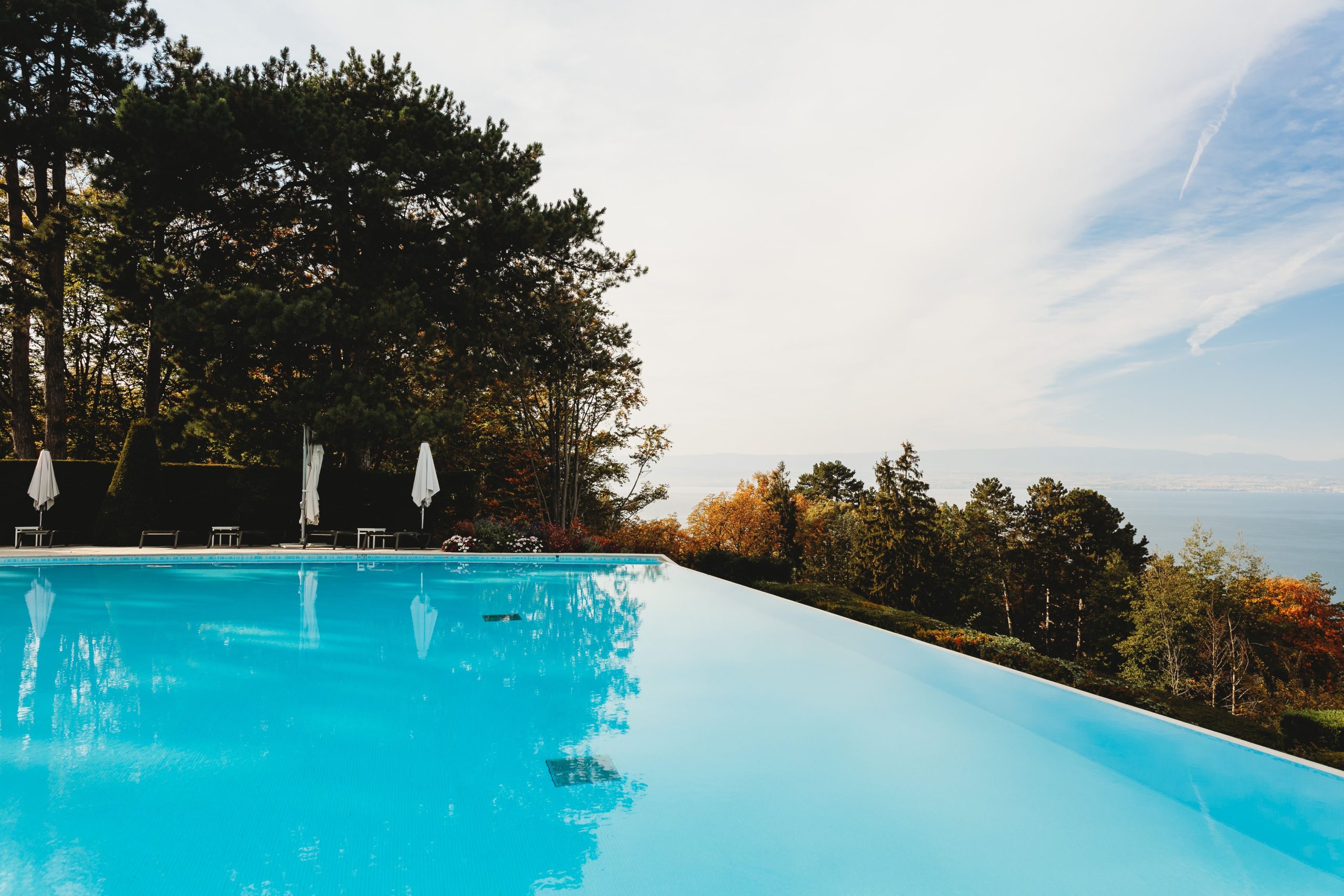
How does a skimmer pool work?
A skimmer is a square opening built into the pool wall just below the coping. The water level sits roughly 10–15 cm below the edge, so it crosses the skimmer opening at about its midpoint. The pump draws water in through this opening, and a floating flap (the weir) skims off a thin layer of surface water along with any debris floating on top.
The water first passes through a coarse basket in the skimmer, then through filtration and, where fitted, heating and disinfection, before returning through jets in the walls. The whole circuit is simple: pool, skimmer, pump, filter, jets. Smaller pools manage with a single skimmer, while larger ones typically need roughly one skimmer per 25 m² of surface area.
Simplicity is this system’s biggest strength. Fewer structural elements mean a lower price, a smaller plant room, fewer places where leaks can occur, and easy winterizing. The downside is that suction happens at only one or two points, so debris at the far end of the pool has to be pushed toward the skimmer by circulation or wind first.
How does an overflow pool work?
An overflow pool works the opposite way. The water level sits flush with the edge, and water constantly spills over the rim into an overflow channel running along one, two, or all four sides of the pool. The channel is usually covered with a walkable grate — polypropylene, stainless steel, or stone.
From the channel, water flows by gravity through pipework into a balancing tank — a separate reservoir that absorbs changes in volume. When three people get into the pool, the displaced water overflows into the channel and the tank takes it in; when they get out, the pump tops the pool back up from the tank. The equipment therefore draws water from the tank rather than the pool itself, and the treated water usually returns through jets in the floor.
The tank’s size is calculated from the surface area and the expected number of bathers — for family pools it’s typically a 2–5 m³ tank, and considerably more for public pools. The tank needs its own space in the plant room, along with level sensors and automatic top-up.
Why does an overflow pool keep the surface cleaner?
The vast majority of debris — pollen, dust, leaves, insects, skin oils, and sunscreen — floats on the surface before it eventually soaks through and sinks. A skimmer collects this layer from a single point, so some of it lingers on the surface longer, sticks to the walls at the waterline, or sinks before it’s removed.
With an overflow system, the surface film drains away continuously along the entire edge. The result is a cleaner surface with no oily ring at the waterline, and better circulation throughout the water column — return jets in the floor push water upward while the surface flows off into the channel. This gives more even distribution of both temperature and disinfectant. It’s exactly why public pool standards in the Czech Republic and across the EU generally require an overflow system for new public facilities.
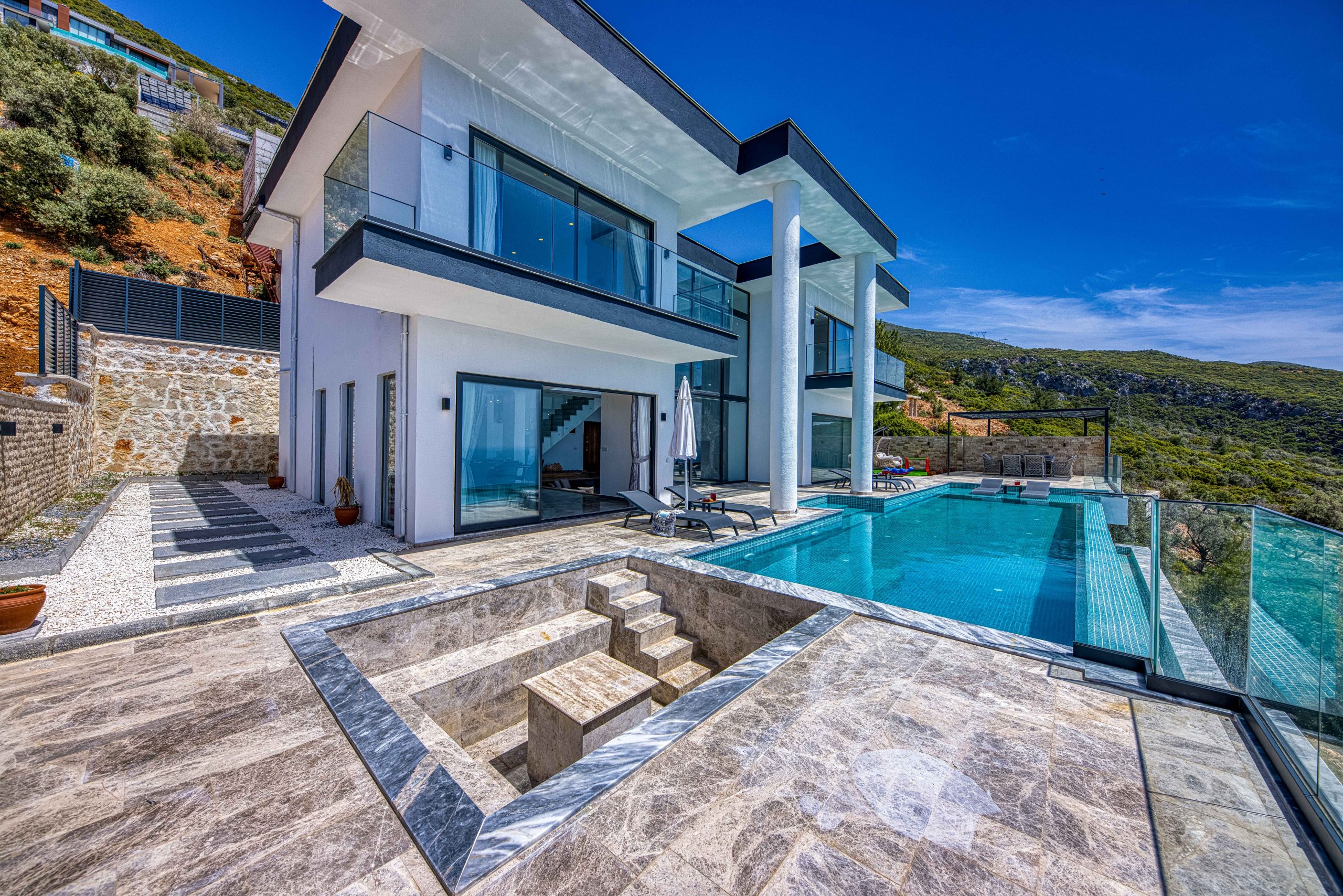
Comparison: skimmer vs. overflow pool
| Criterion | Skimmer pool | Overflow pool |
|---|---|---|
| Water level | About 10–15 cm below the edge | Flush with the edge — a “mirror” surface with no visible rim |
| Purchase price | Lower — the standard choice for family pools | Usually 15–30% higher; for a family-sized pool the extra cost is often around €12,000–24,000 for the channel, grates, and balancing tank |
| Aesthetics | Practical look, with a visible strip of wall above the waterline | An architectural effect where the water surface blends seamlessly with the terrace |
| Removing debris from the surface | Point suction via 1–2 skimmers, dependent on circulation | Continuous along the entire edge — the fastest possible surface cleaning |
| Equipment and space | Simple circuit, small plant room | Plus a balancing tank (typically 2–5 m³), level sensors, automatic top-up, and a larger plant room |
| Water and chemical consumption | Lower — smaller total volume, minimal extra evaporation | Higher — the tank adds volume, plus greater evaporation and splash losses over the edge; chemicals are dosed for a larger total volume |
| Maintenance | Emptying the skimmer basket, routine care | Plus regular cleaning of the channel and grates, and checking the tank and sensors |
| Winterizing | Simple — lower the water level below the skimmer | More demanding — the channel, pipework, and tank all need frost protection |
The price difference doesn’t come from the pool shell itself but from construction details: the overflow edge has to be cast in concrete and sloped with millimeter precision, the channel and grate run around the entire perimeter, and the balancing tank is effectively a second, smaller tank with its own hydraulics. We’ve broken down the full construction budget, including equipment, in our article How Much Does a Pool Cost — the Complete Budget.
Infinity edge: overflow as a luxury effect
A special case of the overflow principle is the so-called infinity edge (the “infinity pool” or “vanishing edge”). Here, the water doesn’t flow into a covered channel at deck level but falls freely over a lowered edge on one side of the pool into a catch basin below. Seen from inside the pool, the water surface appears to blend visually with the horizon — the sea, a valley, or a panoramic landscape.
An infinity edge makes sense on a sloping plot with a view worth building the effect for. Technically, it’s the most demanding variant: falling water means higher evaporation and splash losses, the catch basin has to handle the entire overflow volume, and the pump for the overflow wall is typically sized for a higher flow rate. Expect both running costs and construction precision requirements to be the highest of any pool type here.

Is there a compromise between a skimmer and an overflow system?
Yes, and it’s become increasingly popular in recent years. The so-called hidden or slot overflow replaces the wide grate with a narrow gap along the edge — the water disappears into an unobtrusive slot, so the terrace appears to run visually right up to the waterline. You keep the mirror effect and lose the visible grate, but a balancing tank is still required just as with a classic overflow system, so the price stays close to a full overflow build.
A second option is to run the overflow on just one or two sides of the pool: the edge facing the house or the view overflows, while the remaining sides use a conventional wall above the waterline. You save on part of the channel and grating while keeping the main architectural effect. On skimmer pools, meanwhile, a much higher water level using special high-level skimmers — which draw water from just a few centimeters below the coping — can noticeably improve the look.
Who is a skimmer pool for, and who is an overflow pool for?
A family pool in the garden
If you’re building a pool mainly for the kids to swim in and for summer relaxation, a skimmer is the sensible choice. The money you save can be put to better use on an enclosure, a heat pump, or better filtration — things that extend the season and cut running costs. Maintenance is simpler, and you can winterize it yourself in an afternoon.
A statement home or wellness project
For a home where the pool is part of the architecture — aligned with the living room, next to a wellness zone with a sauna, or built indoors — overflow is in a different league. A mirror-flat surface with no visible rim is an effect a skimmer simply can’t match. In indoor pools, overflow also has a practical benefit: perfectly skimming off the surface film reduces evaporation and buildup at the waterline. The same logic applies to hotel and public facilities, where overflow is the standard.
What’s hard to change once construction is finished?
Choosing a system is a decision for the pool’s entire lifetime. The overflow channel, the sloped coping, the floor jets, and the balancing tank are all cast into the structure — converting a skimmer pool to an overflow pool essentially means a new build: demolishing the coping, new pipework, a new tank, and new hydraulics. Going the other way makes just as little sense; it would only devalue your investment.
What you can change later, on the other hand, includes the equipment in the plant room (pump, filter, water treatment), lighting, the swim jet, and the heating method. The skimmer itself is a replaceable part — the opening, the flap, and the basket can all be swapped out after years of use, just like the grates on an overflow channel. You’ll find replacement skimmers, jets, channel grates, and other structural parts in our pool building components category.
That’s why you should settle the skimmer-vs-overflow question right at the start of the project, alongside size, depth, and where the equipment will go. It also ties into the groundwater level on your plot — the tank is the deepest point of the build — and the structural load-bearing of the terrace around the channel.
Frequently asked questions
How much more expensive is an overflow pool than a skimmer pool?
Builders both in the Czech Republic and abroad typically quote a surcharge of around 15–30% of the total build cost. For a standard family-sized pool, that works out to roughly €12,000–24,000 extra for the overflow edge, channel and grates, balancing tank, and expanded equipment. The exact amount depends on the length of the overflow edge and the grate material.
Is an overflow pool more hygienic?
It demonstrably cleans the surface more effectively — the surface film carrying pollen, oils, and insects drains away continuously along the entire edge, whereas a skimmer collects it from a single point. That’s why public pool standards generally require overflow systems. For a private pool, however, good filtration and properly managed water chemistry will keep the water perfectly safe even with a skimmer.
Does an overflow pool use more water and chemicals?
Yes, slightly. The balancing tank’s volume adds to the pool’s total volume, and water spilling over the edge increases both evaporation and minor splash losses. Disinfectant and pH correction are dosed for the total volume, so chemical consumption is proportionally higher. Automatic dosing and covering the pool when it’s not in use will narrow the difference.
Can an overflow system be added to an existing skimmer pool?
Practically speaking, no. It would require a new coping with a channel, floor return jets, a balancing tank, and completely new hydraulics — in scope, it amounts to a new build. Decide on your system definitively at the design stage.
What is an infinity pool, and how does it differ from a standard overflow pool?
An infinity pool is a variant of the overflow principle where water visibly cascades over a lowered edge into a catch basin below, so the surface appears to blend with the horizon. A standard overflow pool has its channel hidden under a grate at deck level. The infinity edge is the most demanding option both to build and to run, and it makes the most sense on sloping plots with a view.
Whether you choose a practical skimmer or a statement overflow system, the foundation is a quality shell and well-thought-out equipment. You’ll find our full range of skimmer and overflow pool shells, from laminate to ceramic, in the pools category — and our pool construction budget guide will help you plan the costs.
