
The best hot tub isn’t the one with the most jets or the flashiest LED lighting. It’s the one with quality insulation, a reliable control unit, and service that actually reaches you five years down the line. This guide shows you what to ask the dealer, how to prepare your garden or patio, and which mistakes to avoid — before you sign an order for €6,000 to €16,000.
What mistakes do most buyers make?
Sellers of premium overseas brands like Jacuzzi and Hot Spring agree on one thing in their buying guides: customers compare what’s visible and ignore what actually determines lifespan and running costs. The three most common mistakes look like this.
Choosing by jet count and LED lights
The number of jets is the easiest figure to market — and one of the least meaningful. Eighty small jets fed by a weak pump will give a worse massage than thirty well-placed jets with sufficient flow. What matters is the ratio of pump power to jet count, how the jets are positioned relative to muscle groups, and whether they’re adjustable — not the bare number in the catalogue.
Lighting, waterfalls and speakers are much the same story. They’re pleasant, but none of these features heat the water more cheaply or extend the tub’s lifespan. If there’s budget left over for them, fine — they just shouldn’t be the deciding factor.
Paper capacity vs. real seating capacity
A “6-person hot tub” often means comfortable seating for four adults in practice. Manufacturers count every seat, including narrow perches, and the lounger typically eats into the space of two further seats. So ask about real capacity: how many adults can sit at once without their knees touching, and whether taller family members will actually lie in the lounger or float out of it.
Underestimating the base and power supply
A filled 5–6 person hot tub weighs 2 to 2.5 tonnes with people in it. That’s more than a lawn or loosely laid paving can bear — and it’s something a structural engineer must confirm for any patio or balcony. The second underrated issue is electricity: larger models need a dedicated 400 V supply with its own circuit breaker, which must be installed by a licensed electrician. Sort out both before you order, not on delivery day.
What should you ask the dealer before signing?
A good dealer will answer the following questions without dodging. If they avoid answering, that’s an answer in itself.
What insulation and construction does it have?
Insulation determines running costs more than anything else. Ask whether the hot tub has full foam insulation, or perimeter/thermal-lock insulation on the shell and base. Full foam insulates excellently and dampens noise, but complicates any future pipework repairs; perimeter insulation makes servicing easier and reuses waste heat from the pumps. Both approaches are legitimate — a thin layer of sprayed foam on the shell alone, without an insulated base, is not. Don’t forget the thermal cover: it should be at least 10 cm thick and seal around its full perimeter.
Who makes the control unit?
The heart of a hot tub is its control unit (spa pack). Established manufacturers such as America’s Balboa or Canada’s Gecko mean you’ll still be able to find replacement electronics, heating elements and control panels in ten years’ time, and that any competent service technician can work on them. With unbranded electronics from catalogue-only production, you risk a minor fault ending in the replacement of the entire system. For a look at how this kind of diagnostics works in practice, see our Balboa error code overview.
What are the pumps like, and what’s the shell made of?
Ask about the brand and power of the pumps (massage vs. circulation) and whether there’s a dedicated, energy-efficient circulation pump for filtration — standard on quality hot tubs. For the shell, check the material: sanitary acrylic from manufacturers like Lucite or Aristech, reinforced with fibreglass laminate, keeps its colour and shine for decades. Cheap thin-walled plastics and foils age considerably faster.
How do service and spare parts work?
Ask specifically who handles warranty and post-warranty service in your region, how long the technician’s response time is, and whether common parts — jets, filters, heaters, pumps — are in stock. A hot tub is a piece of technology with a 10–20 year lifespan; without available parts it becomes a very expensive rain tank. For a general sense of what’s typically available for your brand, you can also browse our range of spare parts.
Dimensions and placement: patio or garden?
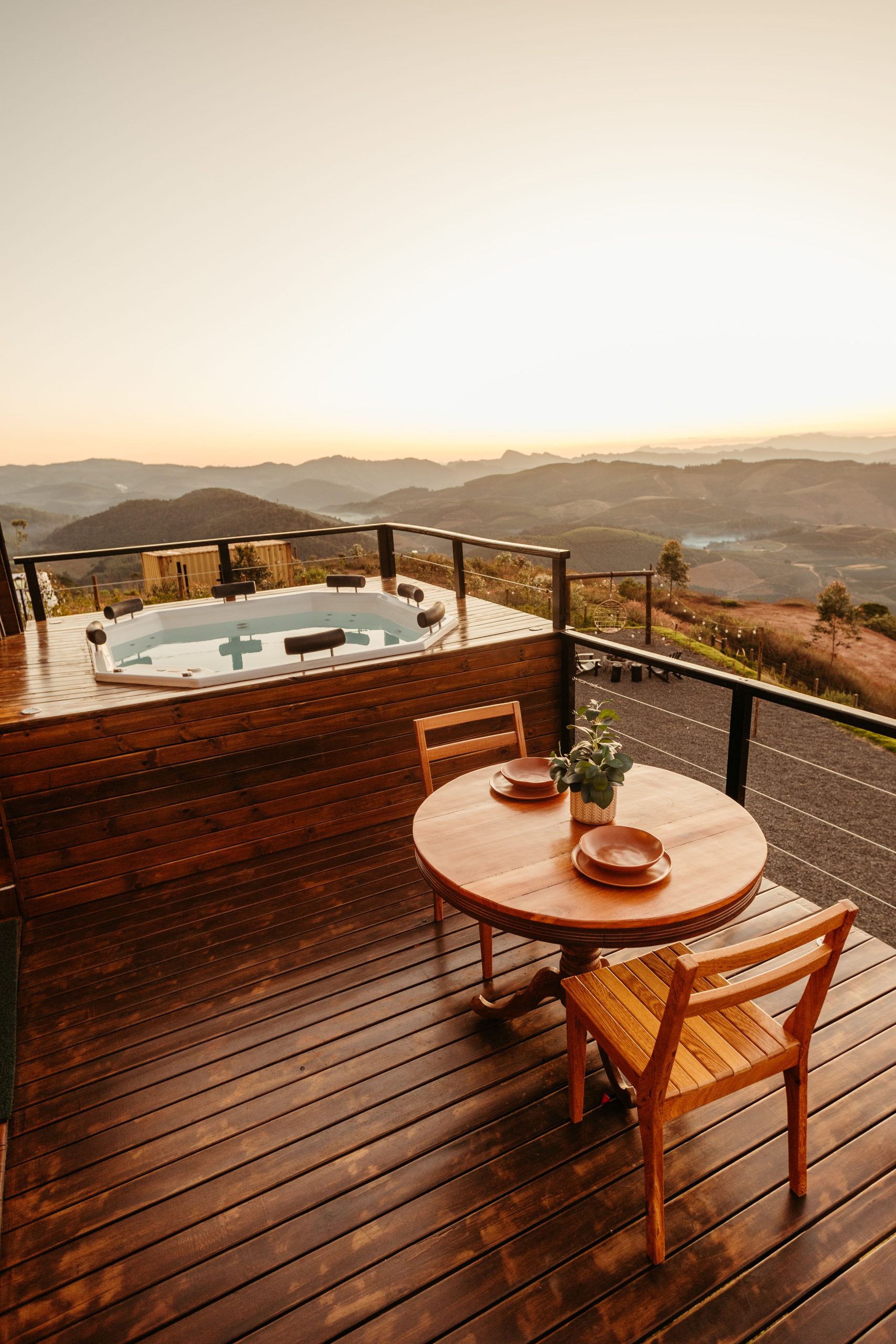
A standard 5–6 person hot tub measures roughly 200 × 200 cm at a height of 90 cm; smaller 2–3 person models start at around 180 × 160 cm. Add at least 60–70 cm of clearance to the footprint, at minimum on the side with the service panel, plus room for the open thermal cover.
The base must be flat, firm and load-bearing — ideally a reinforced concrete slab 10–15 cm thick, or a certified base plate on a compacted gravel bed. Plan for a load of around 400–500 kg/m². For a patio or roof, always have the load-bearing capacity confirmed by a structural engineer; a builder’s verbal assurance isn’t enough.
A question often overlooked: can it even get there? A hot tub is moved lying on its edge, so you need a passage roughly as wide as the tub’s height plus a margin — typically around 100–110 cm. Measure gates, the gaps between buildings, and the height of any underpasses. If there’s no way through, a crane is an option, but renting one typically costs €200–€600 depending on reach.
What do you need to sort out for electricity?
Smaller plug-and-play models are happy with a 230 V socket on its own protected circuit — but bear in mind that a 2 kW heater warms the water slowly and often cuts out when the massage jets are running. Full-featured hot tubs need a fixed 400 V supply, usually with a 16–25 A breaker, capable of running a 3 kW heater and several pumps at once.
In both cases, a residual current device (RCD) with a 30 mA trip current is mandatory — this is the device that protects you from electric shock in water. The supply must be installed by a licensed electrician and the installation documented with an inspection report; your insurer will ask for this too if anything is ever at issue. Run the cable in conduit, and have its cross-section calculated based on the length of the run — at 25 metres, 5×4 mm² or more is typically needed.
How much does it cost to run a hot tub?
In brief: for a well-insulated hot tub used year-round, budget on the order of 200–450 kWh a month depending on climate, water temperature and how often it’s used, plus a further €10–30 a month for chemicals and filters. A poorly insulated tub can use twice as much — which is why the investment in insulation pays for itself every month it’s in use. We cover a detailed, line-by-line budget in a separate article, How Much Does It Cost to Run a Hot Tub.
What to look at vs. what’s just marketing
| What to actually look at | What’s mostly marketing |
|---|---|
| Type and extent of insulation (full foam / insulated shell and base) | “Energy-saving eco mode” with no real consumption figures |
| Control unit from Balboa or Gecko, and parts availability | Proprietary “smart” electronics with no service track record |
| Pump power and count relative to jet count | Absolute jet count (“120 jets!”) |
| Sanitary acrylic reinforced with fibreglass laminate, stainless steel or aluminium frame | Coloured LED lighting, waterfalls and fountains |
| Real seating capacity and depth for your height | Paper capacity figures in the catalogue |
| Thermal cover 10+ cm thick with a sealing collar | Bluetooth speakers included in the price |
| Service network, technician response time, warranty length and terms | “Extended warranty” on the shell only, not the technology |
Why do a wet test?
A wet test — trying the hot tub filled and in swimwear — is a standard service among premium dealers and the best insurance against an expensive mistake. On dry land you can’t tell whether the seats suit your body, whether the water lifts you out of the lounger, or whether the massage is strong enough — or too aggressive. Try every seat, switch through the pump modes, and listen for noise. An hour in the water tells you more than an hour in the catalogue.

Quick checklist before you order
- I know the insulation type and the thermal cover’s thickness.
- The control unit is Balboa, Gecko, or another brand with available parts.
- I’ve verified the real seating capacity myself (ideally with a wet test).
- I have a load-bearing, level base ready — with a structural engineer’s confirmation for a patio.
- I’ve measured the moving route, including gates and passageways.
- An electrician has confirmed the supply (230/400 V), a 30 mA RCD, and will issue an inspection report.
- I know who will provide service and how quickly, and I’ve calculated the running costs.
Frequently asked questions
Which hot tub is best for a garden?
For year-round outdoor use, choose a hot tub with full insulation, a thermal cover of at least 10 cm, and a 3 kW heater on a 400 V supply. Inflatable and plug-and-play models are usable seasonally in a garden, but in winter their running costs become disproportionately high and the shell suffers from frost.
How much does a quality hot tub cost in 2026?
Solid 4–6 person hot tubs with branded technology start at around €6,000, while premium models with better insulation and features run between €10,000 and €16,000. Cheaper offers usually cut corners on exactly what determines cost and lifespan: insulation, pumps and electronics.
Do I need planning permission for a hot tub?
In the Czech Republic, a free-standing, portable hot tub is generally treated as a product, not a building, so you typically don’t need planning permission. But if you’re installing a sunken hot tub, an enclosure, or a new paved surface, we recommend checking with your local building authority first.
Can a standard household electrical installation handle a hot tub?
Small 230 V models, yes, provided they have their own protected circuit with a 30 mA RCD. Full-featured hot tubs need a new fixed 400 V supply sized according to the length of the cable run. In both cases, have the installation done by a licensed electrician and request an inspection report.
How long does a quality hot tub last?
For a branded hot tub with an acrylic shell and Balboa or Gecko technology, expect a lifespan of 10–20 years. Consumable parts are replaced along the way — filters, the thermal cover after 5–7 years, possibly a pump — which is why the availability of spare parts is one of the main selection criteria.
Choosing a hot tub is a decision for ten years or more — and with the right questions, it’s a decision you make once, correctly. Browse our range of hot tubs at poolspashop.eu, and if you’d like to brush up on the basics first, you’ll find more guides in our guides.
