
There is no “best” pool construction — there is the construction that best suits your plot, your budget and your idea of shape. Polypropylene wins on the price/lifespan ratio and on speed, fibreglass on its smooth surface and simple delivery, concrete on freedom of shape and the value it adds to a property, a steel wall on purchase price. And then there is the fact sellers are reluctant to mention: the quality of workmanship decides a pool’s lifespan more than the choice of material. This article compares four constructions by the criteria that only show up ten years later.
If you are still weighing the more basic question — whether to dig at all — start with the article Above-ground vs. in-ground pool. What follows assumes the in-ground build has already been decided and deals with what to build it from.
The big comparison of four constructions
The table sums up the four most common ways an in-ground pool is built. Prices are an indicative range for 2026 for a pool of roughly 6 × 3 m including basic equipment and construction work — a real quotation will differ depending on site access, ground conditions and the level of finishing around the pool. We cover budgeting in detail in the article How much a pool costs.
| Criterion | Polypropylene (welded) | Fibreglass / composite (one-piece) | Concrete (liner or tiling) | Steel wall + liner |
|---|---|---|---|---|
| Indicative price 2026 | approx. €10,000–20,000 | approx. €12,000–24,000 | from approx. €19,000 (liner), from approx. €28,000 (ceramic tiling) | approx. €5,000–12,000 |
| Lifespan of the structure | 20 years and more for PP-C sheets when correctly installed | 20–30 years, gelcoat due for refurbishment after 15–20 years | decades, the surface layer is renewed | shell 25–30 years, liner usually up to 15 years |
| Freedom of shape | high — welded to measure | low — catalogue shell shapes only | unlimited | very low — rectangle, oval, circle |
| Speed of build | days to 2–3 weeks | fastest — the shell is set in place within a single day | 6–10 weeks because of curing breaks | days, but with a concrete base and supporting walls |
| Repairability | excellent — a weld is repaired with an extruder | medium — laminating and gelcoat, needs a specialist | good with a liner (replacement), demanding with tiling | liner replaceable, corrosion of the shell unrepairable |
| Base and backfill concreting | level concrete slab + concreting around the walls (typically dry concrete of approx. 250 mm with gradual filling) | compacted bedding or slab + backfill/concreting as specified by the manufacturer | self-supporting structure, structural design part of the project | slab + retaining walls, cannot be sunk without support |
| Behaviour with groundwater | drainage and a sump are essential, an empty pool risks uplift | the most sensitive — the shell can be pushed up and deformed | the most resistant, can be designed for uplift and as a watertight concrete tank | risky — both the backfill and the shell cope poorly with outside pressure |
| Insulating properties | plastic insulates better than concrete on its own, XPS is easy to add | the fibreglass sandwich insulates decently, insulation is often included | concrete conducts heat — external insulation is essential, not optional | the thin steel shell provides practically no insulation |
The figures for thicknesses and lifespans are based on the technical data sheets of Czech suppliers of pool materials (PP-C sheets are commonly supplied in thicknesses of 5, 6 and 8 mm) and on the parameters of steel-wall pools, where manufacturers state a galvanised shell 0.6 mm thick. The price ranges are a cross-section of quotations from Czech installation companies for 2026 and should be taken as guidance, not as a quotation.
Welded polypropylene pool
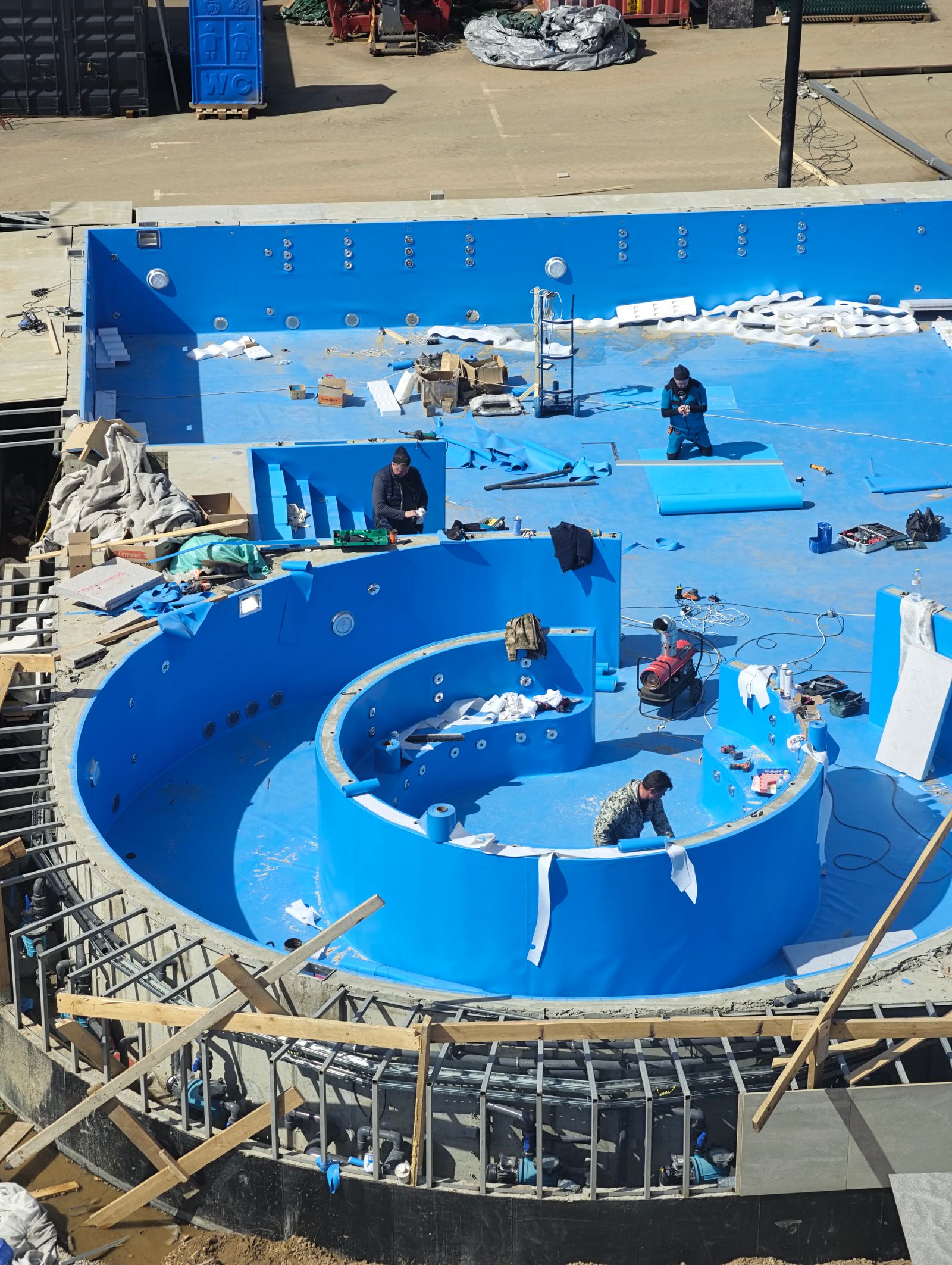
The most widespread choice in Czech gardens, and for a practical reason: it combines a sensible price with a long lifespan and above-average repairability. The shell is welded from sheets of polypropylene copolymer (PP-C) — either at the factory or directly on site.
What is genuinely good about it
- Made-to-measure dimensions with no surcharge for being non-standard. If you have a narrow garden and need 7 × 2.8 m, that is exactly what you get. The shell is welded, not cast in a mould.
- Repairability. A damaged weld or a cut wall is welded with a hand-held extruder. The repair is a matter of hours and does not require draining the whole pool dry for weeks.
- Chemical resistance. PP-C copes well with chlorine, salt water and frost. The material is coloured throughout — a scratch does not reveal a different colour underneath.
- Thermal behaviour. Plastic conducts heat less readily than concrete, which is an advantage here. Adding XPS boards during the backfill concreting is simple and cheap.
Where the weaknesses are
- Thermal expansion. Polypropylene moves more than concrete. A quality structure allows for this with stiffeners and correct backfill concreting; a cheap build “ripples” in a hot summer.
- Dependence on the backfill concreting. The shell is not self-supporting. A poorly executed backfill — uneven, too quick, without filling the pool at the same time — is the most common cause of deformation.
- The surface is not as smooth as gelcoat. The welds are visible. Aesthetics are a matter of taste, but the difference compared with fibreglass is noticeable.
- Sheet quality varies. UV stabilisation, thickness and the origin of the material are items where you can “save” in a way you only discover after eight years.
Who it suits: most families who want a made-to-measure in-ground pool with a long lifespan and do not want to pay for an individually designed concrete build.
Fibreglass (composite) one-piece shell
A ready-made fibreglass shell with a gelcoat surface layer that arrives on a trailer and is craned into the prepared excavation. Logistically the most elegant solution — in terms of freedom of choice, the most restrictive.
What is genuinely good about it
- Speed. The shell is set in place within a single day. From excavation to filled water it is usually a matter of one to two weeks, depending on the surrounding work.
- A smooth surface with no joints. Gelcoat is pleasant to the touch, algae attach to it less readily and it is easier to clean. An ideal environment for a robotic cleaner.
- A predictable result. The shell is made in a hall under controlled conditions, not on a muddy building site. That is a real quality advantage.
- Decent insulation. The sandwich construction of fibreglass holds heat better than bare concrete.
Where the weaknesses are
- The catalogue decides for you. You get the shape the manufacturer has in a mould. If 4.2 m of width fits your garden and the nearest model is 3.8 or 4.5 m, the compromise is yours to make.
- Site access. The shell has to get through. A narrow street, low cables, mature trees or the neighbour’s fence can stop the whole project before it starts.
- Osmosis. In cheaply made shells, moisture penetrates the laminate and creates blisters that crack over time. Quality manufacturers counter this by curing the shell in an oven and with a better layer structure — this is a question worth asking directly.
- Gelcoat ages. After roughly 15–20 years the surface layer is renewed. It is not the end of the pool, but it is a cost item to plan for.
- Repair is a craft. You cannot laminate and re-spray gelcoat under water. Any intervention means draining, drying and a specialist.
Who it suits: someone who wants a pool quickly, has good site access and is happy with one of the catalogue shapes.
Concrete pool with a liner or tiling
The classic that has never aged — and the most expensive route. A reinforced concrete shell is a self-supporting structure; the inner surface is formed either by a welded liner (typically 1.5 mm) or by ceramic or glass tiling on a waterproofing membrane coating.
What is genuinely good about it
- No limits on shape or depth. An overflow edge, sunken steps across the full width, an irregular footprint, extra depth for a diving block — all of it is a matter of design, not of a catalogue.
- Structural resilience. The only construction that can be designed directly for groundwater pressure and for sloping terrain without compromise.
- Longevity of the shell. A concrete shell outlives several generations of inner surfaces. Refurbishment then means a new surface, not a new build — that is the subject of the article Renovating an old pool.
- Perceived value. To a property buyer, a tiled concrete pool is an unmistakable signal of quality.
Where the weaknesses are
- Price and time. The build typically takes 6–10 weeks because of the curing breaks concrete requires. The budget starts where the other constructions end.
- Concrete on its own is not watertight. Watertightness is provided by the liner or by the coating with tiling. Without quality waterproofing, a concrete shell is just an expensive planter.
- Thermal bridges. Concrete conducts heat. Without external insulation, heating becomes expensive — and this is the step most often “cut” during construction.
- Grout joints with tiling. Ceramic looks great, but the grout is where dirt collects and where the first problems appear after some years.
- Dependence on the building contractor. The result stands or falls with whoever does the reinforcement, the concreting and the waterproofing. The highest risk of all four options.
Who it suits: individual architecture, overflow pools, demanding ground conditions and anyone building for decades. If you choose a liner surface, we cover the choice of material in the article How to choose a pool liner.
Steel-wall pool
The cheapest route to an in-ground pool: a galvanised steel shell (around 0.6 mm thick in standard models) into which a PVC liner is fitted. Sinking it into the ground requires a concrete slab and retaining walls — the shell itself will not carry the pressure of the soil.
What is genuinely good about it
- Entry price. The difference compared with the other constructions is an order of magnitude, not a percentage.
- Quick assembly of the shell itself. The wall alone goes up in a day. The rest of the work is in the construction part.
- Replaceable liner. When it reaches the end of its life after some years, replacement is a routine service job.
- A good first pool. It lets you try out running and maintaining a pool without a major investment.
Where the weaknesses are
- Corrosion. Galvanised steel in the ground is a race against time. Once the shell is compromised from the outside there is no repairing it — and you will not notice until it starts to bow.
- Zero insulation. Thin sheet metal does not hold heat. Without XPS and a solar cover, heating costs show up in the very first season.
- Limited shapes and depths. Rectangle, oval, circle — and usually a depth of up to 1.5 m.
- Sensitivity to groundwater. An empty pool in wet ground is at its most vulnerable with precisely this construction.
Who it suits: a limited budget, holiday properties and situations where the pool is meant to last ten to fifteen years, not fifty. The same logic governs the choice described in the article How to choose an above-ground pool.
What matters more than the type of construction
If there were statistics on complaints by cause, material would end up behind these items:
- Ground conditions and preparation of the foundation base. Uncompacted bedding, an uneven slab or missing drainage will kill even the best shell. The geology of the plot and the groundwater level belong in the decision-making earlier than the colour of the liner.
- Backfill concreting and the filling procedure. With both plastic and fibreglass shells the rule is to backfill gradually and in parallel with filling, so that the pressures balance out. A rushed procedure is the most common source of deformation.
- Sizing the equipment. Undersized filtration means cloudy water regardless of what the shell is made of. We cover recommended circulation times in the article How long to run the pool filter, and you will find the equipment itself in the pool technology category.
- The overflow or skimmer solution. It affects comfort and price more than the choice of material — the comparison is in the article Skimmer vs. overflow pool.
- Who builds it. References, the warranty and whether the company will still exist in ten years are parameters just as hard as sheet thickness. We cover the difference between a turnkey supply and DIY in the article Turnkey pool vs. DIY.
The lifetime view: what a pool costs over 20 years
The purchase price is only the first instalment. A realistic comparison of the constructions looks different once renewal costs are added:
- Steel wall: the lowest entry, but over a twenty-year horizon count on replacing the liner and on the real possibility that the pool will finish before the house does.
- Polypropylene: ongoing costs close to zero, repairs cheap and quick. The best price/lifespan ratio for an ordinary garden.
- Fibreglass: low maintenance, but a one-off item for gelcoat refurbishment after 15–20 years.
- Concrete with a liner: liner replacement roughly every 12–20 years depending on quality and use; the shell stays. Lining work in this region runs to the order of tens of euros per m² including labour, and the price rises with the complexity of the shape.
- Concrete with tiling: the highest entry, but the longest interval with no intervention — provided the waterproofing was done properly.
The practical conclusion: the difference in purchase price is partly erased over twenty years. A cheap construction badly executed works out more expensive than a pricier construction done properly. You will find the full calculation including running costs in the article How much a pool costs — the budget.
Frequently asked questions
Which type of pool is best where the groundwater level is high?
A concrete structure designed by a structural engineer for uplift. With plastic and fibreglass shells you need functional drainage with a sump and a pump, and above all the rule that the pool is never drained completely and never left empty over the winter. Without a geological assessment of the plot any recommendation is just a guess — have a borehole done before you sign a contract.
Is polypropylene or fibreglass more durable?
The quoted lifespans overlap — with PP-C sheets the usual figure is 20 years and more, with quality fibreglass shells 20–30 years. What decides is the quality of the specific product and of the installation, not the type of material. Polypropylene has the advantage of easier repair, fibreglass a smoother surface.
Can a steel-wall pool really be sunk into the ground?
Yes, but only with a concrete slab and retaining walls that take the pressure of the soil. A shell that is simply backfilled will sooner or later bow inwards. The cost of the construction work then erases much of the price advantage this option is sold on.
How much does backfill concreting of a polypropylene pool cost?
It is part of the price of the construction work, not a separate catalogue item. Count on a concrete slab and concreting around the walls to a thickness of roughly 250 mm, carried out gradually and in parallel with filling. With turnkey supplies this work is usually included — with a DIY build it is the biggest hidden cost and at the same time the biggest risk.
Can I change the pool surface later?
With concrete, yes — both the liner and the tiling can be renewed or swapped. With plastic and fibreglass shells the surface is changed only exceptionally, but even here a new liner can be fitted as part of a refurbishment, provided the structure is sound.
How to decide
Try it the other way round from how it is usually done. First write down what is non-negotiable for you — the exact dimensions, an overflow edge, site access, the budget ceiling, groundwater. Only then look at which constructions meet those conditions. As a rule one or two are left and the decision shrinks to choosing a supplier, which is the more important part anyway.
And whatever you choose, count on the shell being only half the project. The other half is the equipment that turns it into a pool you can swim in all season. You will find specific pool models and their accessories in the pools category, and further texts on planning and maintenance in the Guide section.
