
You can buy and set up a swim spa within days; a classic in-ground pool is a construction project lasting weeks to months. A pool wins on space and summer comfort for the whole family, while a swim spa wins on year-round use, an endless swimming lane and far lower land requirements. There’s no universal winner — only the right choice for your garden, budget and way of using it. That’s exactly what this comparison breaks down in detail.
What exactly is a swim spa, and how does it differ from a hot tub and a pool?
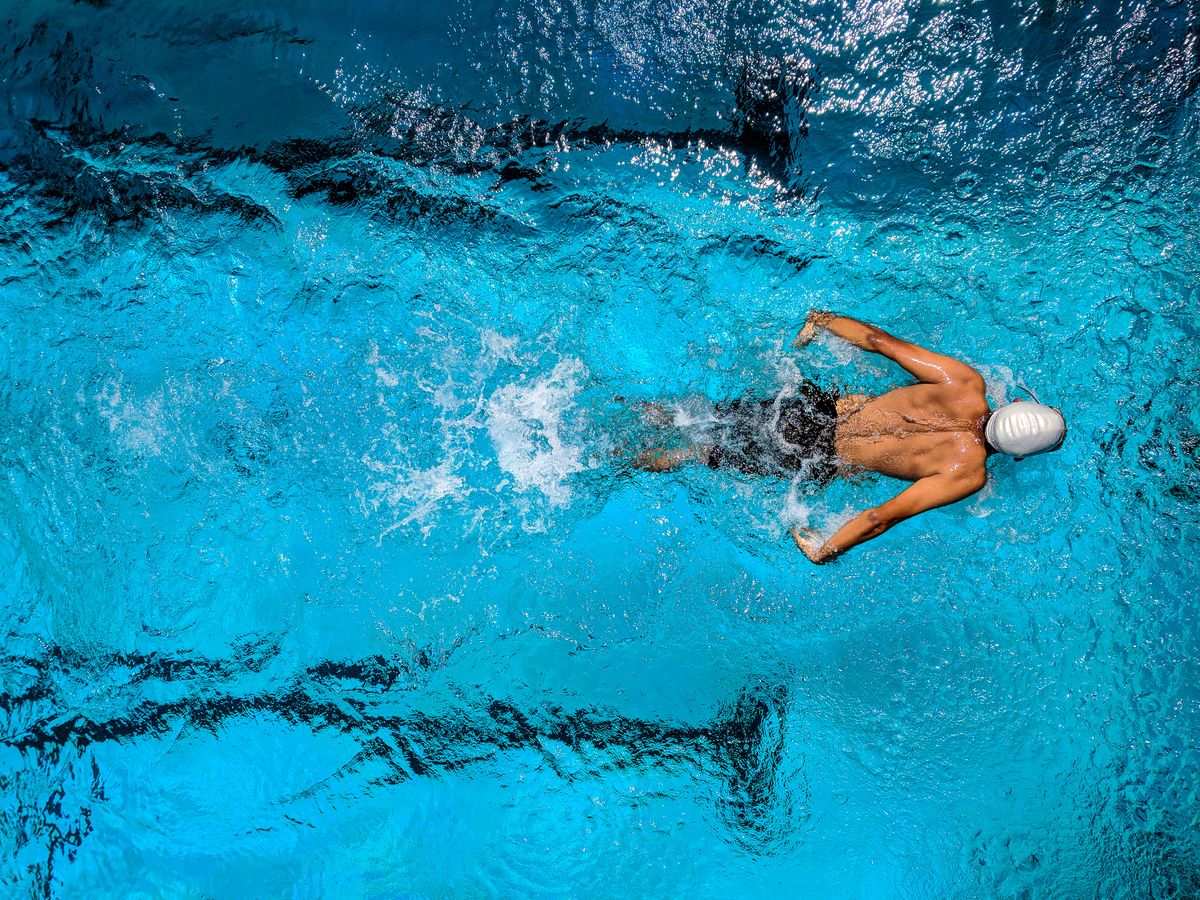
A swim spa is a hybrid between a pool and a hot tub: a compact tank, typically 4 to 6 metres long, with a powerful counter-current that you swim against on the spot — similar to running on a treadmill. You don’t need turns or a twenty-metre lane; you set the current to match your fitness level and swim without interruption for as long as you like.
Most models also combine a swimming zone with a hot-tub section: you train at one end, while the other has anatomically shaped seats with massage jets. Two-zone models even maintain a different temperature in each section — around 28°C for swimming, and up to 36°C for relaxing. Thanks to full-surface insulation and a thermal cover, a swim spa is built to run 365 days a year, even when it’s freezing outside.
Swim spa vs. pool: the big comparison table
The table below summarises the main differences. Prices are indicative for Central Europe; American manufacturer Jacuzzi, in its comparison “Pool vs Swim Spa” (2025), states that a swim spa costs roughly 35% less to buy than an in-ground pool of comparable quality.
| Criterion | Swim spa | In-ground pool |
|---|---|---|
| Purchase price | Roughly €16,000–36,000, including all equipment | Roughly €24,000–60,000 or more, depending on the specification |
| Installation | 1–3 days onto a prepared hardstanding, usually without a building permit | Weeks to months: excavation, concrete, equipment; often requires notification or a building permit |
| Space requirements | Approx. 10–15 m², including the surrounding service area | Typically 40 m² or more, including safety zones and the technical pit |
| Year-round use | Yes, as standard — insulation and the thermal cover are designed for winter operation | Typically 4–6 months; winterising, or costly enclosure and heating |
| Heating costs | Low, thanks to the small volume (6–10 m³) and insulation; according to Jacuzzi, $1–3 a day | High for a heated pool (40–70 m³); several times more outside the season |
| Maintenance and chemistry | Small water volume, short filtration cycles, 30–50% less chemistry (Jacuzzi, 2025) | Larger volume, longer filtration cycles, regular vacuuming and wall cleaning |
| Property value | Usually not reflected in the appraised value, but you can take it with you when you move | A quality pool can increase a home’s value; a neglected one can even have a negative effect |
How much does a swim spa really cost, and how much does a pool?
When it comes to purchase price, people often compare incomparable things. A swim spa’s price is nearly all-inclusive: in one unit you get the tank, insulation, filtration, heating, counter-current, massage system and thermal cover. You only need to add the hardstanding (a concrete slab), a crane for placement and an electrical connection.
For an in-ground pool, the catalogue price of the shell is just the beginning. The real budget includes excavation work, concreting, a technical pit, filtration, piping, paving around the pool — and almost always an enclosure or a roller cover, without which a Central European season is very short. Canadian manufacturer Hydropool states 2025 prices for swim spas in the range of roughly $20,000–40,000, while an in-ground pool including construction comes to $30,000–70,000, and with above-standard equipment, well over $100,000.
It’s only fair to add: if price is your only criterion, a simple above-ground pool costs a fraction of a swim spa’s price. It makes sense to compare a swim spa with an in-ground pool of a comparable category, not with a round above-ground pool costing a couple of thousand euros.
Installation: days, or an entire building season?
A swim spa arrives as a finished product. You need a level hardstanding with sufficient load-bearing capacity, crane access and a suitable electrical connection — and you can often be swimming that very same weekend. Jacuzzi states a typical installation time of 1–3 days; in most cases you won’t need a building permit, but always check the specific conditions with your local building authority.
An in-ground pool is a construction project: design documentation, notification or a permit, excavation, concreting, utilities, landscaping. Even when everything goes smoothly, expect weeks; if complications arise, expect an entire building season. On the other hand, the result is a permanent feature of the garden designed exactly to fit your plot.
Running and maintenance: where the swim spa clearly wins
The biggest everyday difference isn’t in the purchase, but in the running. A swim spa heats 6–10 m³ of water in an insulated tank under a thermal cover; a pool heats 40–70 m³ in a concrete shell that loses heat into the ground and, through its surface, into the air. That’s why a swim spa can be kept at 30°C or more all year round at costs that would be unthinkable for an outdoor pool outside the summer season.
It’s similar with chemistry and time. A smaller water volume means lower consumption of products and a faster response to any adjustment; according to the Jacuzzi comparison (2025), a swim spa uses 30–50% less chemistry than a pool. The principles of water care are the same for both, though — pH, disinfection, filtration — and you’ll find everything you need in the pool chemistry category.
| Running cost item (approximate) | Swim spa | In-ground pool |
|---|---|---|
| Water volume | 6–10 m³ | 40–70 m³ |
| Heating — Jacuzzi 2025 figures | $1–3 a day, year-round | heated pool over $10 a day, hundreds of dollars a month outside the season |
| Annual maintenance — Hydropool 2025 figures | $300–800 | $1,200–2,500 |
| Season of use | 12 months | 4–6 months without an enclosure and heating |
Who is a swim spa the right choice for?
A swim spa makes the most sense in three situations:
- A small plot. On an area of around 10 m², where an in-ground pool would never fit, you get full-fledged swimming and massage. A swim spa can be placed on a terrace, next to the house, or even inside a wellness room.
- Year-round swimming. If you want to swim in January just as in July, a swim spa is practically the only economically sensible outdoor option. Winter swimming in steam rising off the water is also an experience in its own right.
- Rehabilitation and fitness. The adjustable counter-current works like a swimming trainer: you swim continuously “against the water” with no turns, at a precisely dosed load. Warm water and the massage zone help with muscle and joint recovery — which is why physiotherapy practices and athletes alike use swim spas.
When should you choose a classic pool instead?
A pool remains the king of the summer garden, and there are situations a swim spa can’t replace it in:
- Families with children. Children need room to play, jump around and romp with friends. A swim spa’s counter-current lane doesn’t offer that — a pool with a shallow end and wide steps does.
- Summer relaxation and fun. Afternoons by the water with friends, sun loungers, ball games — that’s the pool’s domain. A swim spa comfortably fits around 4–6 people.
- A larger construction budget and a showcase garden. An architecturally designed pool is a dominant feature of the property that, according to Jacuzzi, can increase a property’s value by 5–8% in attractive locations. A swim spa is a product; a pool is an investment in the property.
Honestly: what are the downsides of a swim spa?
To keep the comparison fair, let’s admit the swim spa’s weaknesses too. The first is the swimming lane: it physically measures 4–6 metres, so don’t expect classic swimming with turns, diving in, or underwater swimming. The counter-current simulates continuous swimming very well, but swimmers used to a competition lane need a short adjustment period — and on the cheapest models with tube jets, the current tends to be narrow and “patchy”. Always test the quality of the counter-current before you buy.
The second weakness is price compared with simple pools: a swim spa is more expensive than any above-ground pool, and its cost is budget-wise close to a smaller in-ground pool. You’re paying for technology, insulation and year-round operation — if you’re only planning to swim on summer weekends, that’s an unnecessarily large investment. And third: a swim spa usually isn’t reflected in a property’s appraised value, even though, unlike a pool, you can take it with you when you move.
Combining both: luxury that makes sense
On larger plots, a combination is increasingly common: a classic pool for the summer season, family and guests, and a swim spa alongside it for year-round training and evening relaxation in 36°C water. In winter the pool sleeps and the swim spa runs at full capacity; in summer the roles reverse and the swim spa serves as a hot tub. Those working through their budget in stages often start with a swim spa — using it immediately, year-round — and add the pool in a later phase of the garden project.
Frequently Asked Questions (FAQ)
How much does a swim spa cost?
As a rough guide, expect €16,000–36,000 depending on length, equipment and the quality of the counter-current, plus the cost of the concrete slab, crane and electrical connection. Premium two-zone models with a separate hot-tub section can exceed €40,000.
Do I need a building permit for a swim spa?
In most cases, no — a swim spa is a product placed on a prepared surface, not a building. However, if you want to sink it into the ground or build a terrace or shelter around it, check the conditions with your local building authority in advance.
Can a swim spa really be used in winter?
Yes, it’s built for it: full-surface insulation, an insulated thermal cover and continuous heating keep the water at the set temperature even in freezing conditions. Year-round operation is precisely the main argument for a swim spa as a “year-round pool” — unlike an outdoor pool, which is winterised for the cold season.
Is swimming against the current comparable to swimming in a pool?
For fitness training, yes — a quality wide-flow system creates an even current in which you swim continuously without turns, and you can set the load precisely. However, you won’t train competitive turn technique or diving in a swim spa; for that you need a full-length lane.
What’s cheaper to run — a swim spa or a pool?
A swim spa run year-round is, thanks to its small water volume and insulation, significantly cheaper than a pool heated all year; Hydropool (2025) states annual maintenance of $300–800 versus $1,200–2,500 for a pool. However, an unheated pool used only in summer can work out cheaper than a swim spa running for 12 months.
Whether you lean toward compact year-round swimming or a generous summer water feature, well-chosen technology decides how much you’ll enjoy the water for the next twenty years. Browse our range in the hot tubs and swim spas and pools categories — and you’ll find more practical guides in our Advice section.
