
Underwater LED lighting is one of the least expensive upgrades that fundamentally changes how you perceive and use your pool or hot tub. For an investment starting at roughly €60, you extend your swimming day well into the evening, improve safety and turn your garden into a place where you actually want to sit after dark. The key is choosing the right type of light for your pool — and leaving the electrical work to a professional, because water and electricity demand low-voltage 12 V and an IP68 rating with no compromises.
Why is pool lighting worth it?
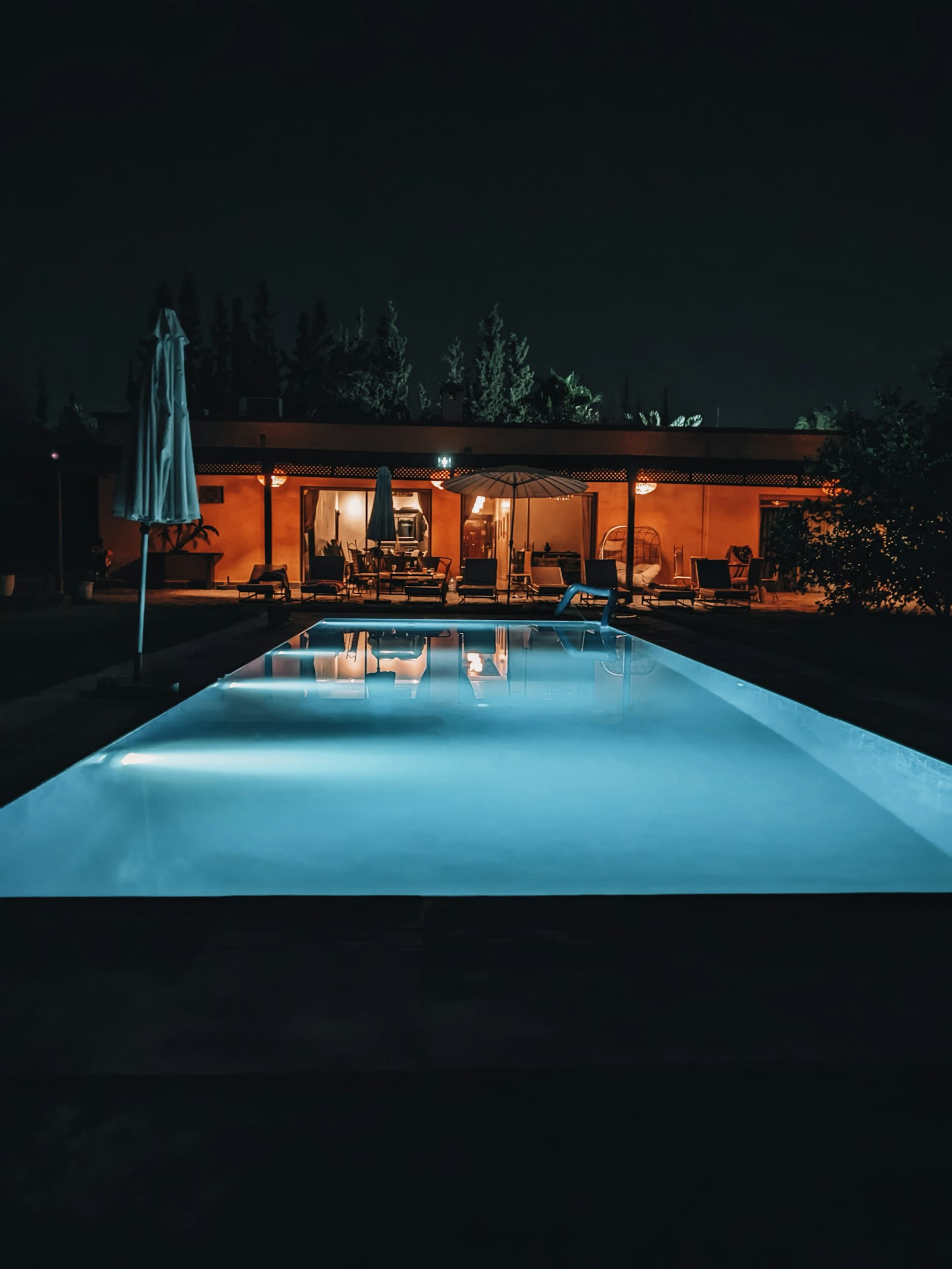
The first reason is purely practical: in summer, the calmest time for a swim is the evening — yet nobody feels like getting into an unlit pool after dark. Underwater lights extend your pool’s usable hours by two to four hours a day, and those evening swims tend to be the ones the family reminisces about all winter.
The second reason is safety. Illuminated water means you can see the bottom, the steps and who is in the water at any moment. For families with children this makes a real difference: a dark surface hides both swimmers and obstacles, a lit one does not. Lighting is no substitute for adult supervision, but it helps it considerably.
And the third reason is atmosphere. A pool with turquoise-lit water becomes the centrepiece of the garden after dark even when nobody is swimming. Architects treat underwater light as a design element — the water works like a giant lamp with soft, diffused light.
What types of underwater lights are there?
The market divides along one main criterion: whether you install the light during pool construction or retrofit it into a finished pool. Both routes lead to LED today — they differ only in the mounting method.
Recessed LED lights in the pool wall
The classic solution for masonry, concrete and fibreglass pools: a mounting niche is set into the wall during construction, and the light fitting slots into it. The cable runs through a conduit above the water line to the transformer. The advantages are a clean look — the light sits flush with the wall — and easy replacement: the fitting can be lifted above the surface on its cable reserve without draining the water.
Plan on one light of 20–35 W for roughly every 20–25 m² of water surface. For an 8 × 4 m pool that typically means two lights on the longer wall, aimed away from the house so they don’t dazzle the terrace.
Flat LED lights for liner pools — retrofit installation
You have a finished liner pool and don’t want to break into the wall? Flat LED lights, just 2–4 cm thick, are mounted through the wall with a double-sided seal, or surface-mounted on the wall with concealed cable routing. A pool company can handle the installation in a few hours; lowering the water level is usually enough — no need to drain the pool.
The light output of today’s flat LEDs is comparable to recessed models, so this is a fully fledged solution, not a compromise. This category is exactly what’s driving the boom in retrofitting lights to older pools.
Hanging and magnetic lights for above-ground pools
For above-ground and frame pools, the simplest route is a light hung over the rim of the wall, or a pair of magnets that “clamp” the wall between them — one magnet holds the light underwater, the other sits outside. No drilling, no structural modification, often battery-powered or rechargeable via USB.
The light output is lower than with recessed lights, but it’s sufficient for pools up to 4–5 m in diameter. Just watch the quality: choose lights rated IP68, not cheap “party” accessories rated IPX7, which won’t survive prolonged submersion.
Replacing a PAR56 bulb with LED
Older pools often have large round light fittings with a 300 W PAR56 halogen bulb. The good news: an LED PAR56 bulb has the same base and dimensions, so the swap takes minutes — lift the fitting above the surface, replace the bulb and you have modern RGB lighting drawing 20–35 W in the original housing.
Before replacing, check the transformer voltage (LED PAR56 bulbs are made for 12 V AC) and the condition of the fitting’s seal. If the seal is hardening or cracking, replace it along with the bulb.
Overview of light types and indicative prices
| Light type | Which pool it suits | Installation | Indicative price per unit |
|---|---|---|---|
| Recessed LED in a niche | Masonry, concrete, fibreglass — during construction | Niche set into the wall, cable in a conduit | €160–480 |
| Flat LED for liner pools | Liner pool — retrofit | Through-wall fitting, no draining | €100–320 |
| Hanging/magnetic light | Above-ground and frame pools | Tool-free, hung or held by magnets | €32–100 |
| LED PAR56 bulb | Older pools with a halogen fitting | Bulb swap in the original housing | €60–160 |
| 12 V safety transformer | All wired variants | In the equipment pit or plant room | €32–120 |
On top of the lights themselves, budget for cabling, conduits and the electrician’s labour — for a retrofit of two lights typically €120–320 depending on cable-run lengths.
White, blue or RGB? How to choose the light colour
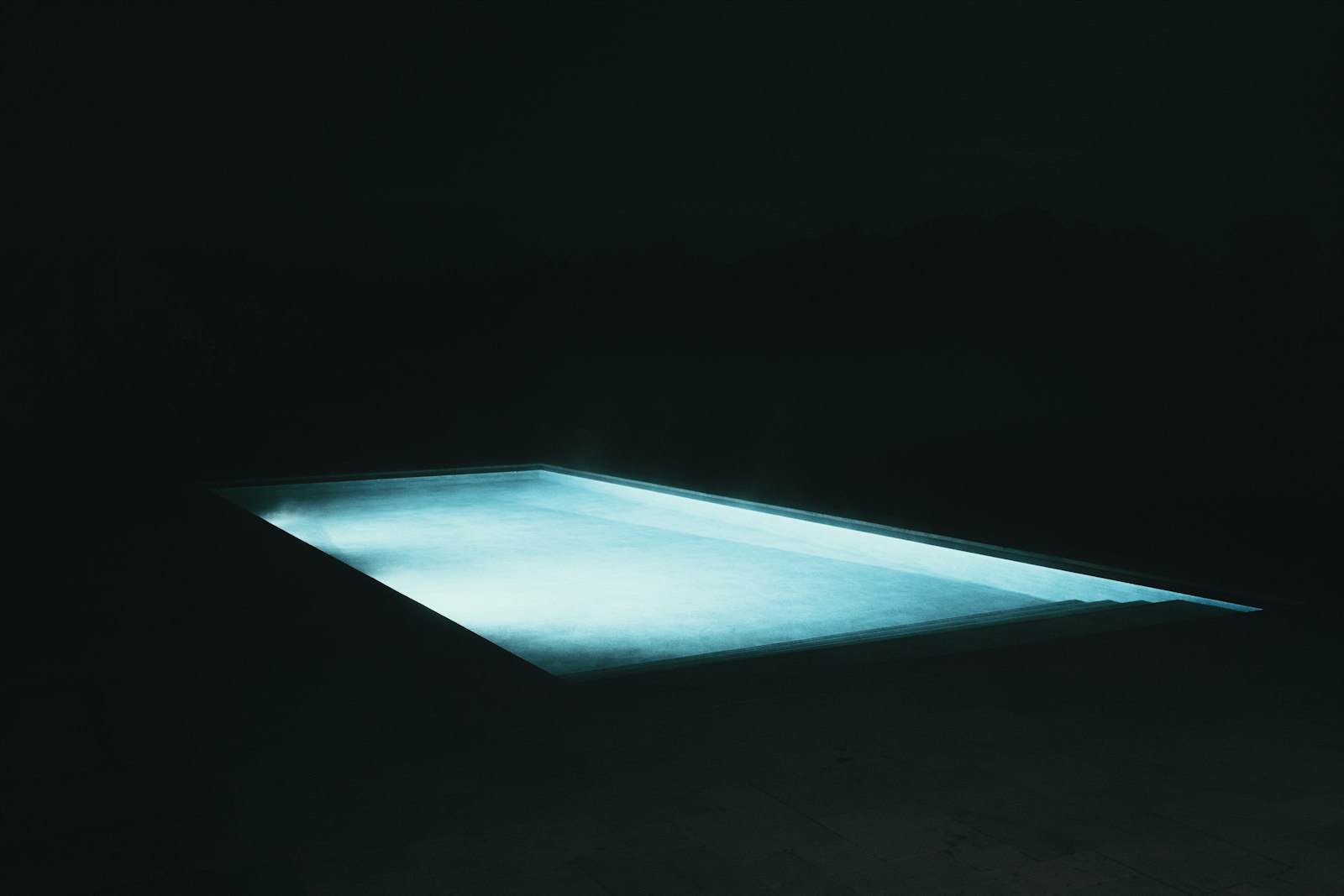
Single-colour lights are cheaper and ideal for many pools: cool white (around 6,000 K) gives the water a crystal-clear, “hotel” look, while warm white (2,700–3,000 K) feels cosier and pairs better with a wooden deck. Blue accentuates the turquoise of the water, but beware — in water with a green tint it will highlight the problem rather than hide it.
RGB (or RGBW, with an added white diode) can produce any colour as well as preset scenes: slow colour fades, a fixed colour for an occasion, a dimmed mode for dinner. In practice most owners settle on two or three favourite scenes — but the ability to match the pool to your garden lighting or “switch to party mode” is exactly the effect people buy RGB for.
If you have several lights, buy them from a single manufacturer and control them together. Two RGB lights each running its own sequence look like a malfunction, not a scene.
How to control the lights: from a wall switch to a smart home
The baseline is a simple switch by the transformer — it works reliably, but with RGB lights the colours are often cycled by short off-and-on pulses, which isn’t the most convenient. The next step up is a remote control with a receiver between the transformer and the light: you change colours, brightness and scenes from your lounger.
The highest comfort comes from app control via a Wi‑Fi module or pool automation: switch the lights on from your commute home, set a schedule (for example, on at sunset, off at 11 p.m.) and synchronise scenes with your garden or terrace lighting. If you’re considering combining filtration, heating and chemical dosing into a single system, read our guide to smart pools and automation.
Safety first: rules for electricity near water
This is the most important part of the article. Underwater lighting belongs to the zone with the strictest electrical safety requirements, and several non-negotiable rules apply:
- Low voltage, 12 V AC. Only safe extra-low voltage from a dedicated safety transformer may enter the water. Never connect an underwater light directly to 230 V — not even “just to test it”.
- Transformer out of reach of water. The transformer belongs in the equipment pit or plant room, always above any possible flood level and at the prescribed distance from the pool edge.
- IP68 rating. Both the light and the connectors must be certified for permanent submersion. IPX7 (“withstands temporary immersion”) is not enough for a pool.
- Installation by a qualified electrician. Wiring, residual-current protection and the bonding of metal parts around the pool are jobs for a licensed electrician — it’s not just about standards, but also about keeping your home insurance valid.
- Regular inspection. Have the pool’s electrical installation inspected at the recommended intervals; the inspection report also comes in handy in the event of an insurance claim.
The good news to close this chapter: precisely thanks to the 12 V and IP68 system, correctly installed pool lighting is one of the safest electrical applications in the home. Risk only arises from DIY shortcuts.
Lighting the surroundings: making the garden match the pool
A brightly lit pool in the middle of a dark garden feels like a glowing monitor in a dark room — striking, but harsh. So add a layer of soft light around it: low garden LED bollards along the path to the pool, solar lamps in the flower beds and LED strips (outdoor-rated, at least IP65) hidden under the deck edge or beneath the steps.
The rule is: less, and lower. Light should guide your steps and accentuate materials, not shine into your eyes. The colour temperature of the surrounding lighting should match the pool — a warm white terrace pairs best with warm white in the water too. How to fit a pool, a terrace and lighting onto a small plot is covered in our article on a pool in a small garden.
LED in the hot tub: backlighting and chromotherapy
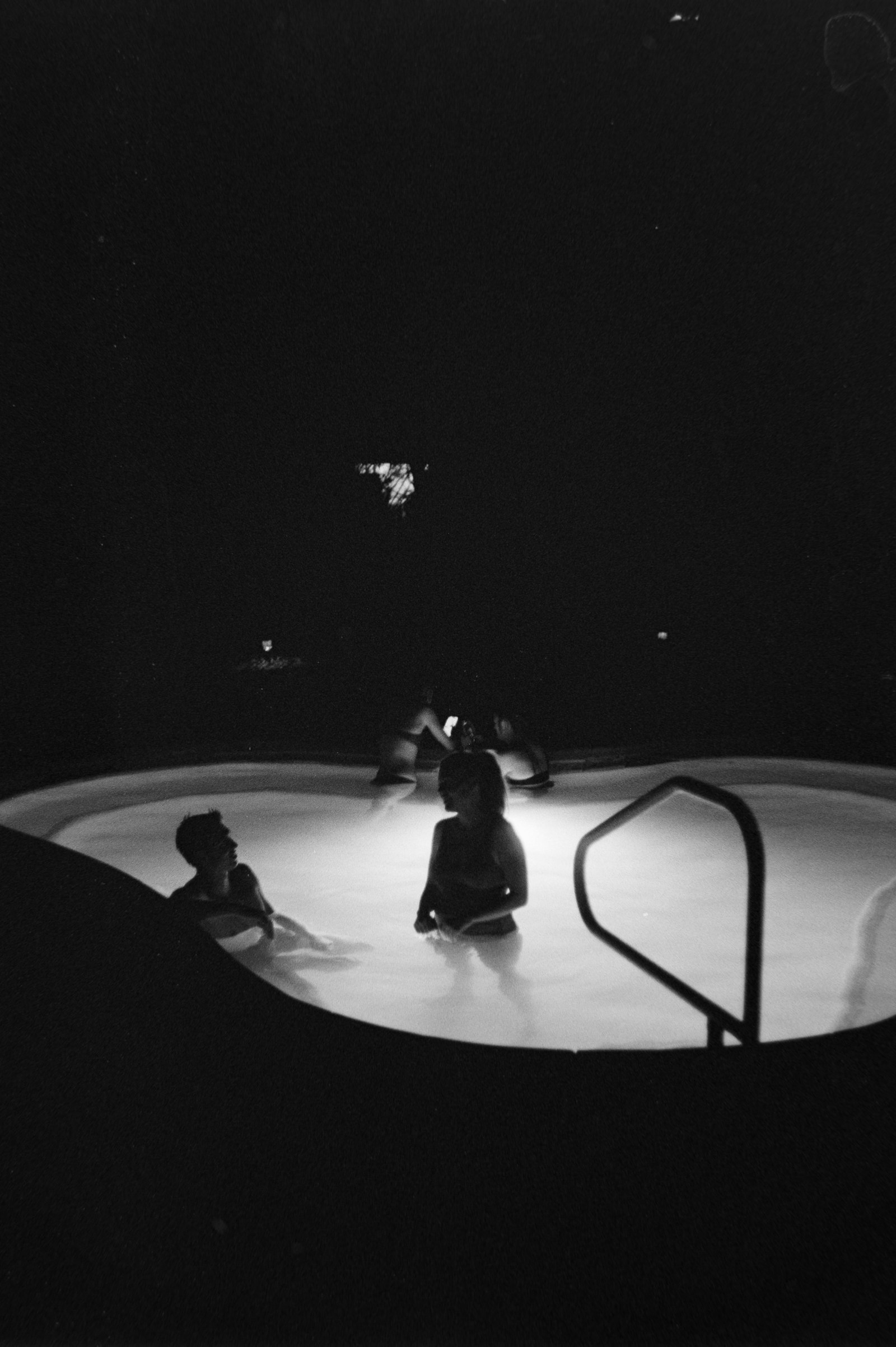
Hot tubs usually come with LED lighting from the factory — from a single central light to dozens of points along the water line, in the headrests, jets and waterfalls. Everything runs on safe extra-low voltage and is controlled from the hot tub’s panel or an app.
Chromotherapy is an interesting feature: the targeted use of colours to set a mood. Blue and green are associated with winding down before sleep, warm tones with relaxation, bolder colours with stimulation. It’s not a medical treatment, but as part of an evening ritual it works beautifully — especially combined with fragrances, which we cover in our article on aromatherapy for hot tubs.
If the backlighting in an older hot tub is failing, LED modules and fibre-optic runs are commonly available spare parts — replacement is done through the service panel, not by draining the shell.
How much power does LED lighting use? Comparison with halogen
Here LED wins hands down. A PAR56 halogen bulb draws 300 W; its LED replacement with comparable light output draws 20–35 W. At 3 hours of lighting a day over a whole season (say 150 evenings), the halogen consumes roughly 135 kWh, the LED just 9–16 kWh. At a price of around €0.28/kWh, that’s a difference of approximately €34 per season on a single light.
On top of that, LEDs last tens of thousands of operating hours compared with hundreds for halogen, so you can forget about regularly buying bulbs and handling the light fitting. Swapping halogen for LED therefore typically pays for itself within two or three seasons.
Conclusion: a small investment with a big effect
Alongside heating, lighting is the most rewarding pool upgrade: it extends the day, improves safety and turns the garden into an evening living room. There’s a route to it for every pool — from a magnetic light for a few dozen euros to a recessed RGB system controlled by an app. The one thing never to skimp on is electrical safety: 12 V, IP68 and installation by an electrician. You’ll find lights, transformers and other pool equipment in our pool technology category — and more guides in our Advice Centre.
Frequently asked questions
Can lights be added to a finished pool without draining it?
Yes. For liner pools, flat LED lights are mounted through the wall with the water level lowered; for above-ground pools, hanging or magnetic lights require no structural modification at all. Fully draining the pool is almost never necessary.
How many lights does a pool need?
As a rule of thumb, one 20–35 W light per 20–25 m² of water surface. A 6 × 3 m pool is served by one quality light, an 8 × 4 m pool by two. Place the lights on the wall facing away from the house so they don’t dazzle the terrace.
Can I wire up an underwater light myself?
Replacing a PAR56 bulb or hanging a battery-powered light, yes. But all wiring of cables, the transformer and the protective devices belongs in the hands of a licensed electrician — this is a zone with the strictest safety requirements, and your home insurance depends on it.
Do LED lights work in winter under a covered pool?
Technically they can — IP68 lights will survive winter in the water. In a winterised pool with a lowered water level, however, the light must remain permanently submerged, or you should lift it above the surface on its cable reserve. Running it under a solid cover serves no practical purpose.
Is RGB worth it, or is white enough?
If you mainly want to see into the water and extend your swimming time, quality white is enough. RGB is worth it for anyone who treats the pool as part of the garden’s evening scenery and wants to match colours with the surrounding lighting — the price difference is usually 20–40% of the light’s cost.
