
No filtration or water chemistry, however good, removes debris from the pool floor — for sand, leaves and settled biofilm you need a vacuum. The basic rule of thumb is simple: a small above-ground pool is well served by a manual vacuum costing a modest sum, while an in-ground pool from roughly 6 metres in length justifies an electric robotic pool cleaner that handles the floor, walls and waterline entirely on its own. In this guide we’ll go through all four types, their real-world 2026 prices, and what to watch out for so the robot you choose can actually handle your pool.
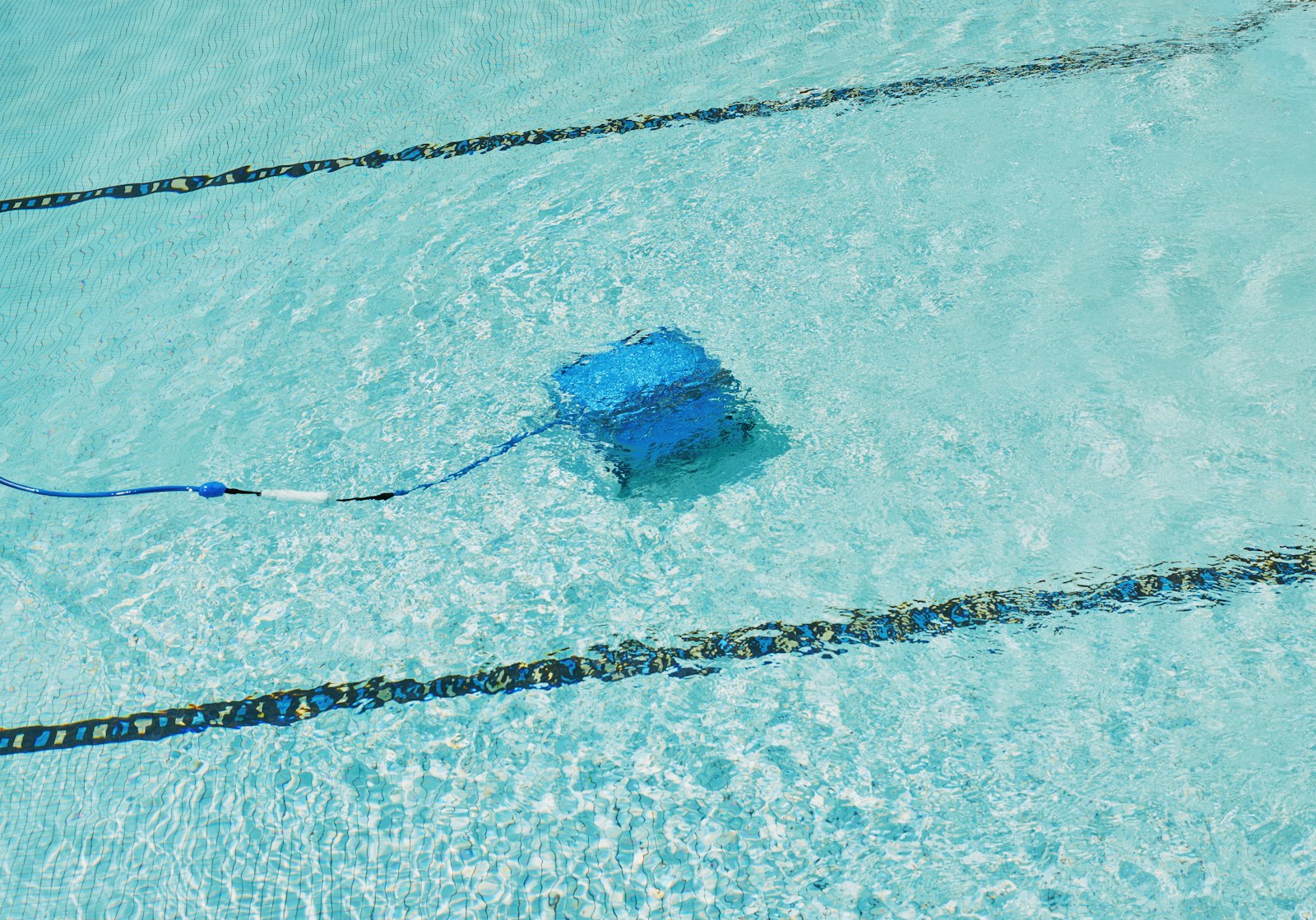
What types of pool vacuums are there?
Four established categories exist on the market, differing in drive principle, degree of automation and price. Before comparing specific models, work out which category you actually need — the gap between a manual vacuum and a premium robot is an order of magnitude, not just in price.
| Type | How it works | Approx. price 2026 | Best for |
|---|---|---|---|
| Manual pole vacuum | A brush head on a telescopic pole; suction comes from the pool’s own filtration via the skimmer, or from a built-in battery-powered motor | €16–120 | Above-ground and small pools up to approx. 20 m³, hot tubs, steps and corners |
| Semi-automatic (hydraulic) | Connects to the skimmer via a hose and moves at random, driven by pulses of suction from the filtration | €80–320 | Medium-sized pools with a sufficiently powerful pump, flat floor |
| Corded electric robot | Its own motor and filter, powered via a cable from a 12/24 V transformer, independent of the filtration system | €400–1,400 | In-ground pools up to approx. 12 m in length, floor + walls + waterline |
| Cordless battery robot | Its own motor, filter and battery, no cable, returns to the pool edge once discharged | €320–1,600 | Pools with no nearby power outlet, irregular shapes, up to approx. 12 × 6 m |
These prices reflect the Czech and European market in the 2026 season. The cheapest battery robots under €400 usually handle only the floor; models that also clean the walls and waterline start at around €600, and the premium class with smart navigation ranges between €1,000 and €1,600.
How does a manual vacuum work, and when is it enough?
A manual vacuum is a brush head on a telescopic pole. Either it’s connected to the skimmer via a hose and your pool’s filtration draws in the debris, or it has its own battery-powered motor and a collection bag — in which case it needs neither a hose nor a running pump.
For an above-ground pool up to 4.5 metres in diameter, a hot tub, or a children’s paddling pool, this is a fully adequate solution. Vacuuming the floor takes 10–20 minutes, and you have full control the whole time — you can reach into corners and up to the steps that a round robot can’t get to. A manual vacuum is also useful even if you own a robot: for localised debris after a storm, it’s quicker than running a full cleaning cycle.
Semi-automatic vacuums: cheap automation with a catch
A hydraulic (semi-automatic) vacuum connects to the skimmer via a hose and moves across the floor on its own, driven by the suction of your filtration system. No electronics, no battery, minimal breakdowns. You can get one from €80.
The catch is that the vacuum puts extra load on your filtration: coarse debris ends up in the pump’s pre-filter, and the sand filter clogs faster. You need a pump with sufficient output (usually at least 6 m³/h), otherwise the vacuum barely crawls along. Movement is purely random, so on a large floor it can miss some spots, and it won’t clean the walls at all. For a mid-sized pool of a simple shape with good filtration, though, it’s a reasonable compromise.
Electric robot: corded or battery-powered?
An electric robot is a standalone machine with its own motor, pump and filter — it collects debris in its own cartridge, so it doesn’t put any load on your filtration at all. That’s precisely its biggest advantage over a hydraulic vacuum.
Corded robots are powered by safe low voltage from a transformer next to the pool. You don’t need to worry about battery life, and output stays stable for the whole cycle, which typically takes 2–3 hours for the floor plus walls. The downside is the cable: it needs to be 2–3 metres longer than the distance from the outlet to the furthest point of the pool, and on cheaper models without a swivel joint it tends to tangle.
Battery robots have improved significantly over the last few seasons and in 2026 make up most of the new products on the market. There’s no cable or transformer — you simply place the robot in the water. Mid-range models run for 90–120 minutes per charge, premium ones up to 150 minutes — enough for a pool up to roughly 12 × 6 metres. Expect charging to take around 3–4 hours, and keep in mind that the battery is a wear part with a lifespan of a few hundred cycles.
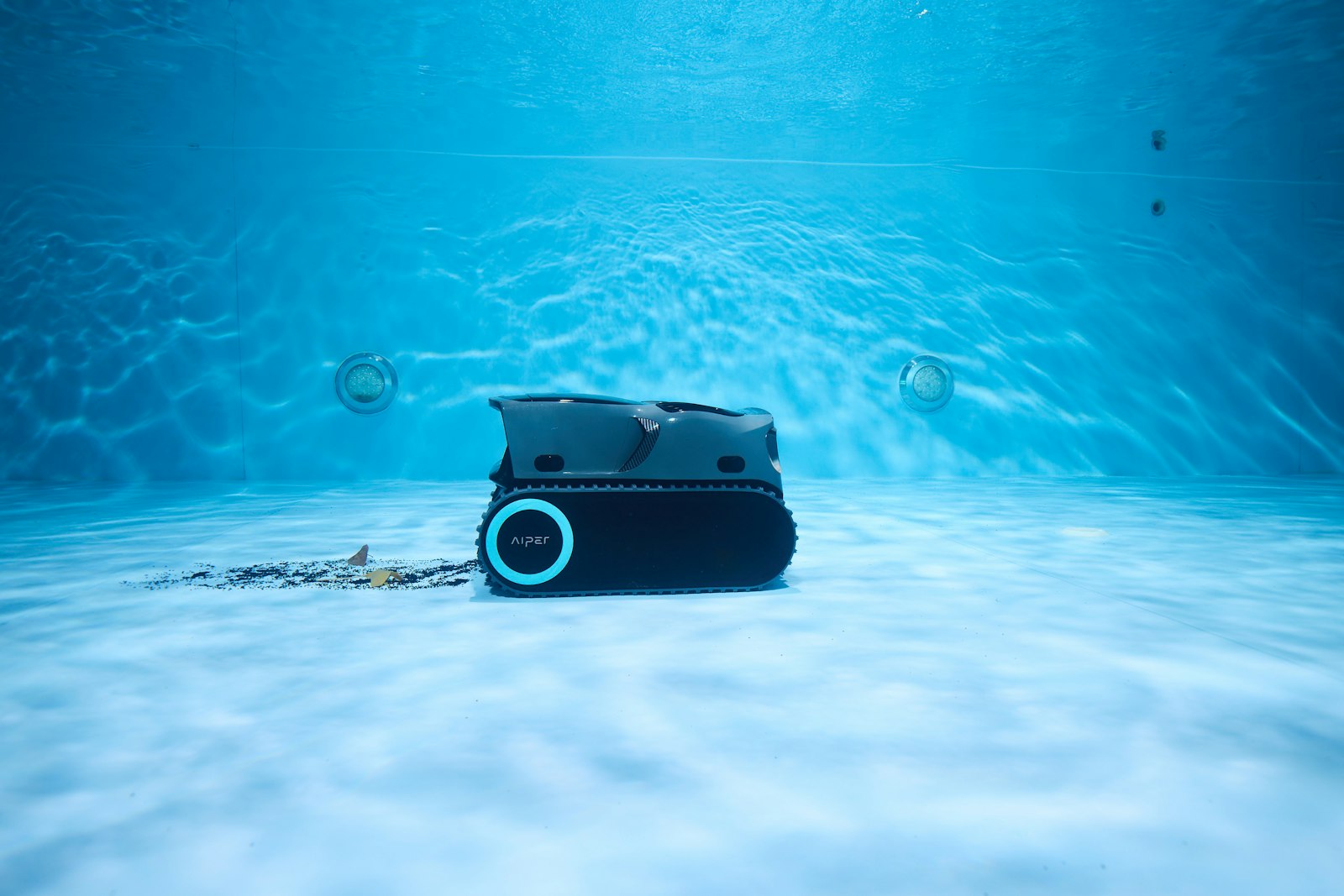
What should you look for when choosing a robot?
Does it clean only the floor, or the walls and waterline too?
Basic robots up to around €480 travel only along the floor. If you have an in-ground liner pool or a skimmer pool where an oily film settles on the walls and waterline, choose a model with a floor + walls + waterline mode. Cleaning the waterline is precisely the discipline that separates mid-range from higher-end models — the robot has to maintain suction even while it’s partly above the waterline.
Filter fineness
Standard filter cartridges catch particles from about 180 microns upward — leaves, insects, coarse sand. For pollen, fine dust and cloudy water you need an ultra-fine filter around 60 microns (even finer with some brands). The ideal robot comes with both filter sets: a coarse one for spring start-up and a fine one for everyday use. The size of the filter cartridge determines how often you’ll need to empty it.
Cable length, or battery life
For a corded robot, the rule is: cable length ≥ distance from the outlet to the furthest corner of the pool + 2 metres of margin. Cables of 12–18 metres are commonly sold. For a battery robot, work out the surface area: for an 8 × 4 metre pool you need a real-world runtime of at least 90 minutes in floor + walls mode, and for a 10–12 metre pool, 120–150 minutes.
Navigation vs. random movement
Cheap robots move at random and rely on statistically covering the whole floor within two hours — this works for a regular rectangle, but complex-shaped pools end up with missed spots. Robots with gyroscopic or ultrasonic navigation map the pool and travel systematic paths: they clean faster, use less energy and don’t miss areas. For pools over 8 metres or of an irregular shape, paying extra for navigation is definitely worth it.
App control and smart features
Controlling the robot from your phone isn’t a necessity, but it’s handy: you can schedule cleaning cycles for specific days of the week, choose a mode (floor only, waterline only, intensive), and on some models even manually steer the robot to a specific spot. With battery robots, you’ll appreciate the return-to-edge function after the cycle finishes — you can then pull the robot out with a hook instead of fishing for it in the middle of the floor.
How to size a robot to your pool’s size and shape?
Manufacturers state the maximum pool length a robot is designed for — treat it as a hard ceiling, not a recommendation. A robot rated on paper for “up to 10 metres” will be working right at the edge of its runtime and coverage in a 10-metre pool.
- Above-ground pool up to 4.5 m: a manual or small battery vacuum — a robot is an unnecessary luxury.
- In-ground pool, 6–8 m: a basic to mid-range robot — for a simple rectangle, random movement is enough.
- Pool 8–12 m or an unusual shape: a robot with navigation and wall cleaning — for a battery version, 120 minutes of runtime or more.
- Steps, ledges, islands: keep in mind that no robot will clean these spots perfectly — a manual vacuum as a supplement always comes in handy.
The floor material matters too: gentle foam or combined brushes are suited to liner and laminate, while rougher concrete and mosaic surfaces call for active PVC brushes with higher pressure.
How to care for a robot so it lasts?
A pool robot is an appliance that works in chemically treated water — a lifespan of 5–8 years is realistic, but only with regular care that takes a few minutes after each cycle.
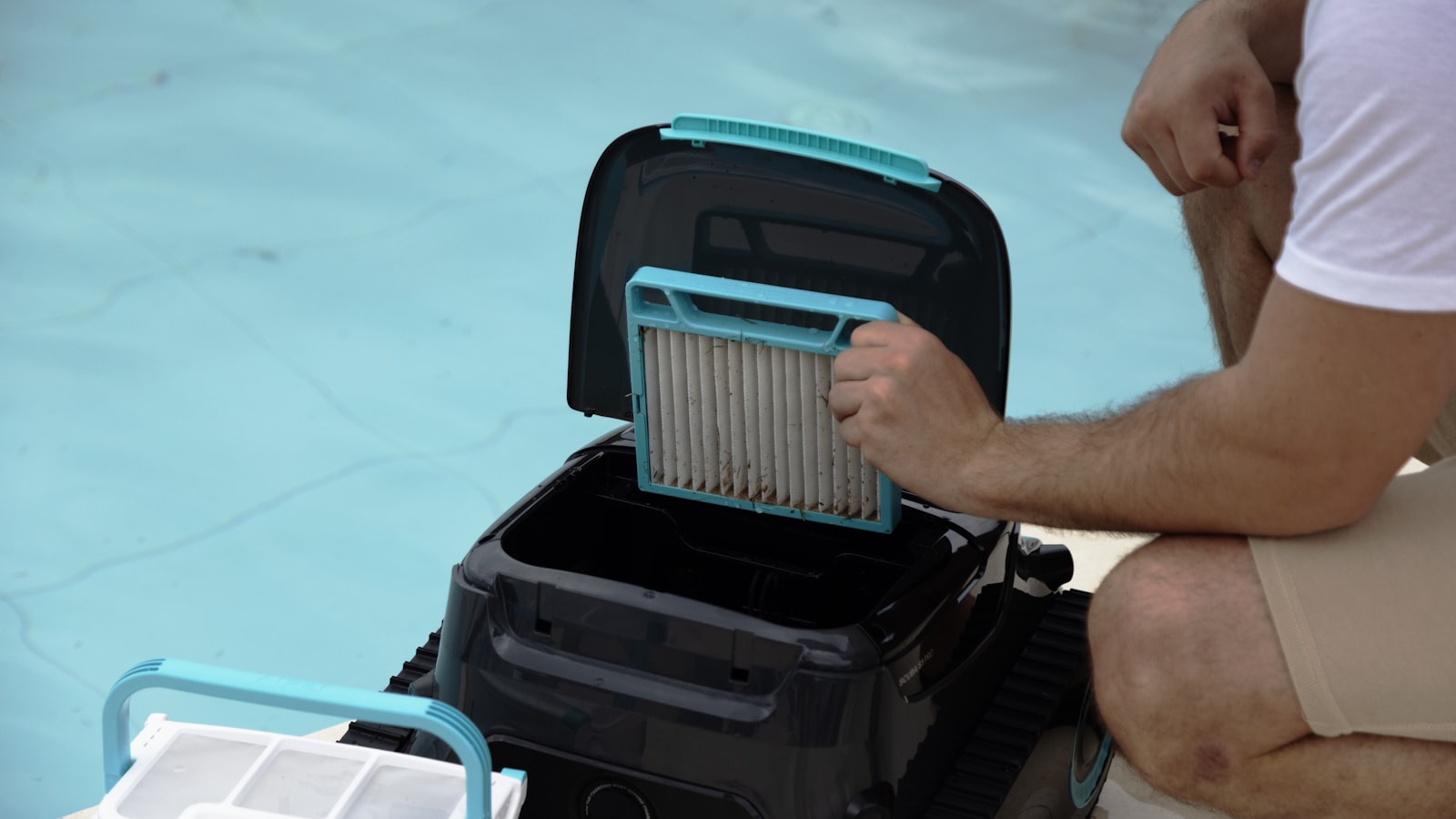
- Clean the filter after every use. Tap out the cartridge and rinse it with a stream of water from a hose. A clogged filter reduces suction power and overloads the motor — it’s the most common cause of a “lazy” robot.
- Rinse the robot with clean water after taking it out. Chlorine and salt residue speeds up the aging of plastics and seals — doubly so with salt water.
- Don’t store it in the water or in the sun. The robot belongs out of the pool, in the shade — ideally on a caddy, which higher-end models usually include. Leaving it in the water permanently ruins the seals, and UV radiation damages the cable and the plastics.
- Winterize a battery robot charged to 50–70% and store it at room temperature over winter; a fully discharged lithium battery often can’t be revived after winter.
- Check the brushes and tracks — they’re wear parts, and replacing them is cheap and simple.
Common mistakes: what a robot can’t do
The most costly mistake is thinking a robot replaces filtration or water chemistry. It doesn’t. A robot removes settled debris; circulation, disinfection and balancing the water still have to be handled by filtration running 8–12 hours a day and correctly dosed chemistry. If the water goes bad, the robot won’t save it — we describe what to do when a pool turns green in our article on green pool water.
Other common mistakes: running the robot immediately after shock chlorination (a high chlorine concentration damages plastics and seals — wait until it drops below 3 mg/l), vacuuming coarse leaves without skimming them out with a net first (this clogs the filter within minutes), leaving the robot in the pool while people are swimming, and, with corded models, running the cable taut over a sharp coping edge. And finally — a robot isn’t a submarine for murky ponds: if you can’t see the bottom, flocculate and correct the chemistry first, then vacuum.
FAQ: the most common questions about pool vacuums
Is a robot worth it for an above-ground pool too?
For pools up to 4.5 metres in diameter, usually not — a manual or small battery vacuum for €40–120 will clean the floor in a quarter of an hour. For larger above-ground pools (from around 5.5 metres), a basic floor robot for up to €480 already makes sense; just check that it’s rated for pools with an above-ground structure and a soft liner.
How long does it take for a robot to clean a pool?
A robot can handle just the floor of a medium-sized pool in 1–1.5 hours; a full floor + walls + waterline cycle takes 2–3 hours. Robots with navigation are roughly a third faster than models with random movement, because they don’t cover the same spot twice.
Can a robot stay in the pool permanently?
It shouldn’t. Permanent immersion in chlorinated water shortens the lifespan of the seals, plastics and motor, and manufacturers generally exclude it from the warranty. Take the robot out after each cycle, rinse it, clean the filter and store it in the shade. It only belongs in the water for the duration of cleaning.
Does a pool robot work in salt water too?
Most current robots do, but check the datasheet — salt is more aggressive toward seals and metal parts. After every cycle in salt water, rinse the robot thoroughly with fresh water, otherwise its lifespan will shorten noticeably.
What to do if the robot moves but isn’t picking up debris?
Nine times out of ten, the cause is a clogged filter or worn brushes. Clean the cartridge, check whether a twig has got stuck in the suction opening, and inspect the impeller blades. Swapping the coarse filter for a fine one also helps — dust and pollen simply pass straight through a coarse cartridge.
In conclusion: a clean pool without the effort
A well-chosen vacuum turns an hour-long weekly chore into a few minutes of upkeep. Leave the manual vacuum for finishing off details, pick the hydraulic type as a budget-friendly compromise, and choose a robot wherever you want the pool to take care of itself. You’ll find manual vacuums, robots, nets and brushes in the pool maintenance category; pumps and filtration, without which not even the best robot can do without, are in the pool technology section. We keep publishing more guides and how-tos in our Advice section.
