
An outdoor shower beside the pool is not a spa-style ornament, it is the cheapest filter you can own. Sunscreen, sweat, deodorant and cosmetic residues washed off in the shower never reach the water, so there is nothing for the chlorine to bind to and nothing to form cloudiness and foam. The investment starts at around a hundred euros and shows up both in your chemical consumption and in how long the water stays crystal clear.
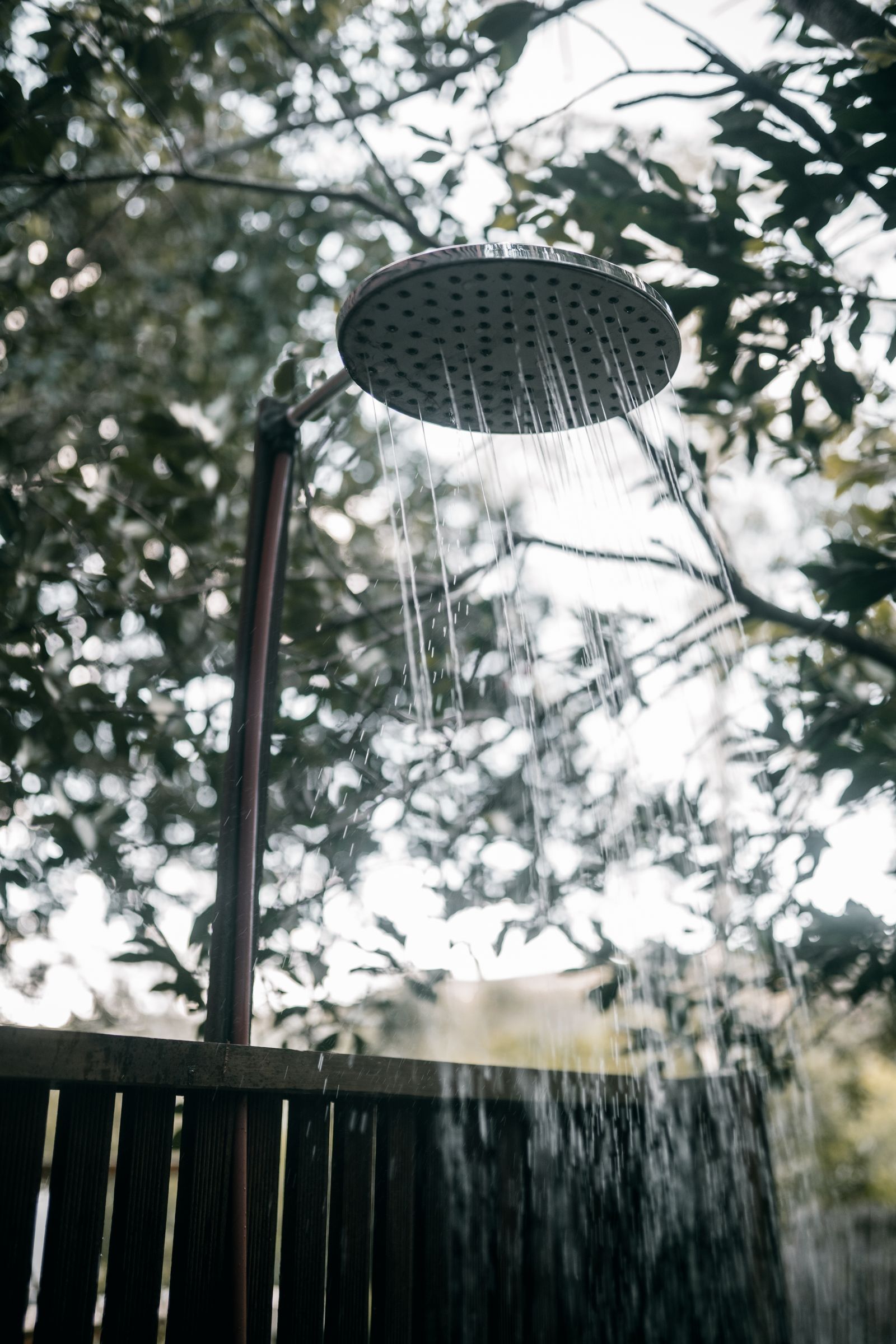
Why a shower before swimming saves chemicals and money
Organic contamination does not enter a pool from the air, it comes mainly from people. Every bather brings along a combination of sweat, skin oils, shower gel residues, deodorant, hair products and, above all in summer, sunscreen. These substances dissolve or emulsify in the water and become an immediate burden on the disinfection.
Chlorine makes no distinction between a bacterium and a lotion — it reacts with anything organic. Part of the dose you paid for on hygiene grounds is therefore burned up breaking down cosmetics. You know the result: chlorine “disappears” faster than it should, you have to dose more, and the water still turns dull.
Sunscreens are the toughest opponent here. They are designed to stay put in water, they contain oils and UV filters, and in the water they form a fine emulsion that scatters light — exactly what you perceive as cloudiness. At the same time they settle on the surface as a greasy film and on the walls at the waterline as a sticky band that then has to be scrubbed off by hand.
In hot tubs the effect is even more pronounced, because the “people per litre of water” ratio is incomparable. While four people in a pool are diluted into 40,000 litres, in a hot tub those same four people share 1,200 litres. That is why cosmetics there so reliably lead to foam and odour — the article on foam and smell in a hot tub covers this in more detail.
Money plays a bigger role in this than it seems. Less organic load means lower consumption of chlorine products, less flocculant, less shocking and a longer service life for your filter media. With your own shower you are therefore not paying for comfort, you are taking work away from the chemicals — the same logic as in our overview of tips on how to save on pool chemicals.
Compulsory in public pools, a good habit at home
At lidos and water parks, showering before entering the pool is laid down in the operating rules and staff enforce it — otherwise the water in a facility with dozens of visitors a day could not be kept within limits by any reasonable means. At home nobody checks the same obligation, but the physics and chemistry of water work in exactly the same way.
Compared with a public pool, a domestic one has one advantage and one drawback. The advantage is an order of magnitude fewer bathers. The drawback is technology that is an order of magnitude weaker: an ordinary garden filtration system has nowhere near a fraction of the capacity of a professional treatment plant. All the more reason not to let dirt in.
What types of outdoor shower are available
The choice depends mainly on whether you want the shower only for the season or intend to use it outside summer too — and how far the pool is from the house.
| Type of shower | Water source and heating | Indicative price | Suitable for |
|---|---|---|---|
| Solar shower with a 20–35 l tank | Garden hose, water heated by the sun inside the column | €80–320 | The simplest solution, purely seasonal use |
| Shower on a cold water supply | Fixed cold water supply, no heating | €160–600 | A quick rinse on a hot day, constant pressure |
| Shower with hot water from the house | Hot and cold water supply with a mixer tap | €480–1,600 | Year-round comfort, hot tub, sauna |
| Shower enclosure with a screen | Depends on the chosen supply, plus the construction work | €1,000–3,200 | Privacy, washing with soap, guests |
Solar shower with a tank
The most widespread option beside garden pools. A column with a capacity of roughly 20–35 litres is filled from a garden hose and the sun heats the water inside it. Installation is an afternoon’s work, and the shower can be dismantled and stored away for the winter. The drawbacks are the limited supply of warm water and the dependence on the weather.
Shower connected to a cold water supply
A fixed cold water supply means an unlimited supply and stable pressure. For a summer rinse after sunscreen, cold water is perfectly sufficient — on a hot day it is even more pleasant. The pipework, however, has to be laid below the frost line or have reliable draining for the winter.
Shower with hot water from the house
The most comfortable option: a classic shower mixer with both hot and cold water. It makes sense anywhere the outdoor water feature is used outside summer as well — beside a hot tub, a hot shower after climbing out of the water on a freezing evening becomes the difference between “once a month” and “three times a week”. The article on a hot tub in winter goes into detail on year-round operation.
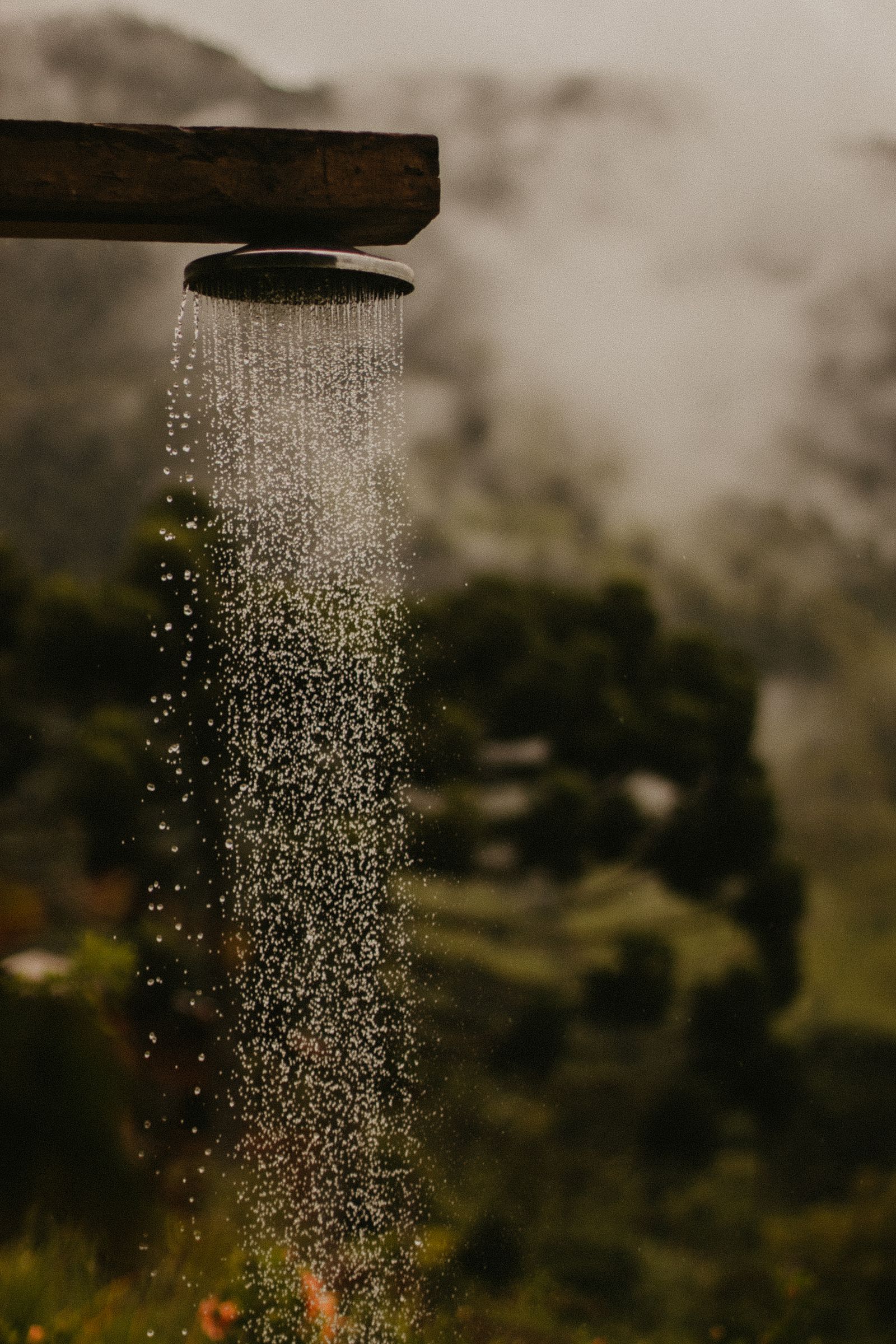
Shower enclosure with a screen
As soon as you want to use soap, change clothes outdoors or let guests shower, you need a screen. This is handled with a wooden grille, composite slats or a masonry wall adjoining the terrace. Take care: wherever soapy water falls, it has to be drained into the sewer, not merely soaked away.
Installation: what must not be underestimated
A shower looks like a trifle, but it brings together three things at once — water on the inlet, water on the outlet, and a surface people walk on with wet feet.
Water supply and draining for the winter
The most common mistake is running the pipe shallowly below the surface with no way of draining it. In autumn the water inside freezes, splits the pipe or the body of the tap, and the fault only shows up in spring when you fill up. The supply line should therefore always include a stopcock inside the building and a drain cock at the lowest point of the branch. Before the first frost the water is drained off and the tap is left open.
Drainage
A clean rinse without soap can usually be led into a soakaway or a gravel bed at domestic showers, if local conditions and regulations allow it. Soapy water belongs in the sewer. The essential rule: shower water must never run back into the pool — otherwise you have just sent the dirt you have washed off straight back to where you wanted to keep it out of. The area around the shower has to fall away from the pool.
Non-slip surface and anchoring
A shower means a permanently wet spot. Without a non-slip treatment it is the most dangerous square metre in the whole garden, especially for children. The answer is paving with an appropriate slip-resistance rating, a wooden or composite grille, or a rubber surface. The cheapest time to deal with the surface is while the paved area around the pool is being built, not afterwards — the logic of what follows what is the same as when planning the pool surround.
The column itself is anchored into a concrete slab or into paving on a solid base, never into a lawn or a slab laid in sand. A solar shower with a full tank weighs over 30 kilograms and tips over remarkably easily when a child hangs off the head.
Solar showers in practice: what to watch out for
A solar column works simply — the water stands in a black body and the sun heats it. On a sunny summer day the contents are lukewarm within about two hours and by the afternoon can reach temperatures well above body temperature. The material of the column is not a thermostat, though; no safety device limits the temperature.
Hence the most important operating habit: run the first few litres from a sun-baked shower off to one side and test them by hand before you send a child under it. Water that has stood all day in a black pipe on the south side can be unpleasantly hot.
Better-quality columns have a mixing lever, so the hot water is blended with cold from the supply. If your shower does not have one, the fix is simple — you let the hot layer run off and top it up with cold from the hose. After each use it is a good idea to leave the tank full so that it is ready for the next day.

Maintenance: three things a year
Spring flush
After the winter, let the shower run to waste for several minutes before you use it for the first time. Biofilm builds up over the winter in the standing water in the hose or column, and the first water through tends to be cloudy. At the same time, check that the joints are tight and that the drain cock works.
Winterising
Drain, drain, drain. The column of a solar shower is emptied completely, the hose is disconnected and the tap is left in the open position. Removable showers are best stored somewhere dry. Winterising the shower belongs to the same round of jobs as winterising the pool step by step, so it can be managed in a single afternoon.
Limescale in the shower head
A shower head is a classic place for calcium to build up — after a while the nozzles spray sideways or do not spray at all. The remedy is to unscrew the head and soak it in a descaling solution or in vinegar. In hard water areas this has to be repeated more often; the article on water hardness and limescale explains the connections.
Where to put the shower
The ideal position meets three conditions at once. First, it is on the route between the house (or the changing room) and the pool entry, so that it can be used in passing — a shower you have to make a detour for does not get used. Second, it is far enough from the pool edge that shower water does not run into the basin and splashes do not land on the surface.
Third, it addresses privacy. Being overlooked by neighbours or from the street decides whether the shower will be used in swimwear without embarrassment. It helps to face away from the fence, or to use a green wall, a slatted screen, or a position tucked behind the plant room.
One practical detail to finish: the spot deserves a towel hook and a bench, or at least a shelf. Without them people walk past the shower because they have nowhere to put their towel.
What it all costs
A ready-made solar shower costs €80–320 and the owner installs it themselves. A fixed cold water supply below the frost line, including the trench, adds roughly €200–800 depending on the distance from the house and the type of ground. A hot water supply, mixer tap and a paved area with a shower enclosure already run to several thousand euros and belong in the construction budget, not in the accessories shopping list.
The payback is hard to calculate precisely, but the order of magnitude is clear: the reduced consumption of chlorine products, flocculant and algaecide at an ordinary family pool amounts to tens up to low hundreds of euros per season. A solar shower therefore pays for itself within one to three seasons — and that is without counting the time saved cleaning the greasy band at the waterline.
Frequently asked questions
Is a rinse without soap enough?
Yes, for normal use it is. The aim is not a hygienic bath but the mechanical removal of sweat and, above all, sunscreen. Thirty seconds under running water removes a substantial part of what would otherwise end up in the pool. Soap, by contrast, creates an additional load — if you do use it, rinse yourself off thoroughly.
How long after applying sunscreen can you go into the water?
Manufacturers usually recommend letting the cream dry for 15–20 minutes so that it bonds to the skin. Dried cream is then released into the water more slowly than freshly applied cream. The ideal combination is to apply it in advance, wait, and shower before entering.
Does a shower have to have hot water?
No. For a summer pool, cold water is fully functional and far cheaper to install. Hot water pays off where there is a hot tub, a sauna or a cold plunge tub in year-round use.
Can a shower be connected directly to pool water?
No. Pool water contains disinfectant at a concentration intended for bathing, not for showering your head and face, and above all it would return contaminated via the shower. A shower always belongs on the drinking water supply or on a hose-fed tank.
What about a shower when the pool is a long way from the house?
In that situation a solar shower filled from a garden hose is the most sensible choice. It does away with both the trench and winter pipe protection, and the column can be dismantled in autumn. A later upgrade to a fixed supply can always be done when the ground is being dug up for other equipment anyway.
An outdoor shower is one of the few pool investments that simultaneously raises comfort, improves water quality and cuts running costs. If you are choosing a specific model — from simple solar columns to showers with a mixer tap — you will find them in our pool equipment category, and more practical guides to water care are waiting in the Guide section.
