
The output of a sauna heater is derived from the volume of the cabin, not from its floor area. The established rule of thumb is roughly 1 kW per 1 m³ of volume in a well-insulated cabin with timber lining — and to that volume you add an allowance for every square metre of uninsulated surface, typically glass, stone or concrete. It is precisely this forgotten allowance that is the most common reason a sauna “never really gets hot”.
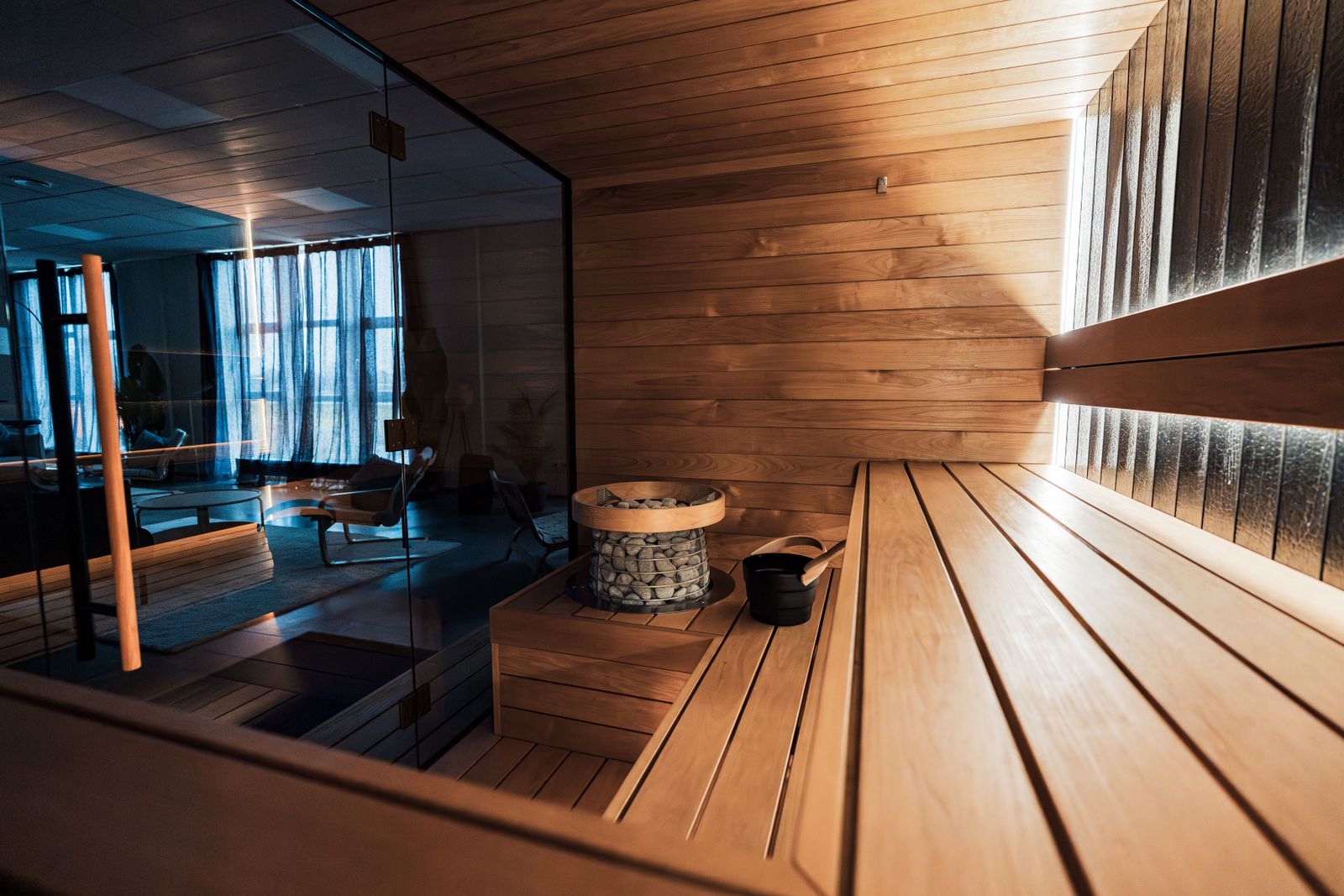
The basic rule: 1 kW per 1 m³ of cabin volume
You work out the volume as length × width × height of the cabin in metres. A cabin measuring 2.0 × 1.9 × 2.1 m has a volume of roughly 8 m³, which under the basic rule corresponds to a heater of around 8 kW. This rule is a guideline, not a standard — practically every manufacturer of Finnish sauna heaters uses it as a starting point, and in catalogues you will find it translated into “recommended cabin volume from–to” tables.
What matters is what the rule applies to: a closed, well-insulated cabin with timber lining and a vapour barrier, in other words a classic Finnish sauna running at around 80–90 °C. What is being heated is the air and the mass of the timber — and the larger the volume, the more energy is needed to reach operating temperature within a sensible time, typically 30–45 minutes.
Cabin height is often underestimated. Adding 20 cm of height to a 2 × 2 m sauna means 0.8 m³ of extra volume, which is almost a whole kilowatt. That is why the standard height of a sauna cabin stays around 2.0–2.1 m; a higher ceiling mainly enlarges the space above head height, where the hottest air collects and nobody makes use of it.
What increases the volume: uninsulated surfaces
Glass, stone, concrete or masonry have fundamentally worse thermal properties than an insulated timber wall. Heat escapes through them faster and is at the same time stored in them — so the heater is not only warming the air, but also this mass and the losses through it. That is why the calculation does not add kilowatts directly, but a notional extra volume, which is then converted using the same rule of 1 kW per 1 m³.
Glass in the door and glazed walls
Fully glazed doors are the standard today and in themselves already mean an allowance. A common sauna door of 0.7 × 1.9 m has an area of 1.33 m². For every square metre of glass you normally add 1.2 m³ to the volume, so roughly 1.6 m³ extra — which in a small two-person sauna is an increase of more than 40 %.
In cabins with a glazed front wall or a panoramic window facing the garden this runs to several square metres, and the allowance can easily reach half of the original volume. A glazed sauna will therefore never get by with a heater sized only for the dimensions of the cabin.
Stone, concrete and masonry
An uninsulated masonry, concrete or stone wall has an even greater thermal capacity than glass. For these surfaces an allowance of 1.2 to 1.5 m³ per 1 m² is commonly used, and similarly for solid log walls without insulation. You will find the specific coefficient in the manual for the particular heater and it takes precedence over the general rule — each manufacturer sets it themselves.
A typical case from practice: a sauna built into a cellar or bathroom where one or two walls were left as the original masonry and simply clad with boards, without insulation and without a vapour barrier. The cabin looks like timber but behaves like masonry — and a heater chosen by the dimensions will be permanently inadequate.
How the allowance is calculated
The procedure is always the same and can be done on paper in five minutes:
- Work out the basic cabin volume: length × width × height (in metres).
- Measure the area of all uninsulated surfaces — door glass, windows, masonry or concrete walls (in m²).
- Multiply every square metre by the coefficient for the type of material (usually 1.2 for glass, 1.2–1.5 for masonry and stone).
- Add the basic volume and all the allowances together — the result is the calculated volume.
- Convert the calculated volume in m³ into kilowatts at a ratio of 1 : 1 and round up to the nearest larger standard heater size.
Worked examples for three typical cabins
The table below shows how the same rule behaves across three common sizes. The usual output range of electric sauna heaters for domestic use looks roughly like this: 3.5 — 4.5 — 6 — 8 — 9 — 10.5 kW, and then 12, 15 and 18 kW for larger cabins.
| Cabin | Dimensions and volume | Uninsulated surfaces | Allowance | Calculated volume | Recommended heater |
|---|---|---|---|---|---|
| Two-person | 1.4 × 1.4 × 2.05 m ≈ 4.0 m³ | glass door 1.33 m² | +1.6 m³ | ≈ 5.6 m³ | 6 kW |
| Family (4 people) | 2.0 × 1.9 × 2.1 m ≈ 8.0 m³ | glass door 1.33 m² + small window 0.36 m² | +2.0 m³ | ≈ 10.0 m³ | 10.5 kW (9 kW only as a minimum) |
| Larger, with a glazed wall | 2.2 × 2.2 × 2.1 m ≈ 10.2 m³ | glazed front wall incl. door 4.2 m² | +5.0 m³ | ≈ 15.2 m³ | 15 kW |
Note the third row: the cabin has a volume of 10 m³, but it needs a heater half as powerful again. Anyone sizing it “by the metres” ends up with a 10.5 kW heater and then wonders why the sauna takes an hour and a half to warm up.
What happens when the heater is undersized
An undersized heater will not destroy the sauna, but it will spoil the experience permanently. It shows up in three ways:
- Long heat-up times. Instead of 30–45 minutes it takes an hour or more. With a sauna you want to use spontaneously after work, that means you will stop using it.
- The target temperature is never reached. The cabin stalls at 65–70 °C and goes no higher, because the losses match the output. After you pour water on the stones the temperature drops and takes a long time to come back.
- Permanent full-power operation. The heater never switches off on the thermostat and runs at 100 % for the whole sauna session. The heating elements and the contactor therefore work without a break, which does nothing for their service life.
The paradox is that an undersized heater does not save electricity. Kilowatt-hours are counted from the energy drawn, not from the installed output — and when the heater runs twice as long at full power, consumption is the same or higher, because longer operation means a longer period of heat losses.
And what if the heater is oversized
The opposite extreme is often underrated. A heavily oversized heater in a small cabin:
- Heats unevenly. The thermostat cuts out quickly and in short cycles, the temperature in the cabin fluctuates and the difference between the benches becomes more noticeable.
- Dries out and “burns” the air. The radiant heat from a glowing element is unpleasantly harsh in a small cabin, the air feels scorched and the session is less enjoyable than in a sauna with a correctly sized heater.
- Requires a heavier supply. Higher output means thicker cable, a larger circuit breaker and sometimes an increase in the main breaker as well — a permanent charge for headroom you will never use.
Sensible headroom is roughly one step up the output range from the calculated value, not two or three. If the calculation comes out exactly on the boundary between two sizes, choose the higher one — especially for outdoor cabins and saunas used all year round.
Electrical connection: when a three-phase supply becomes necessary
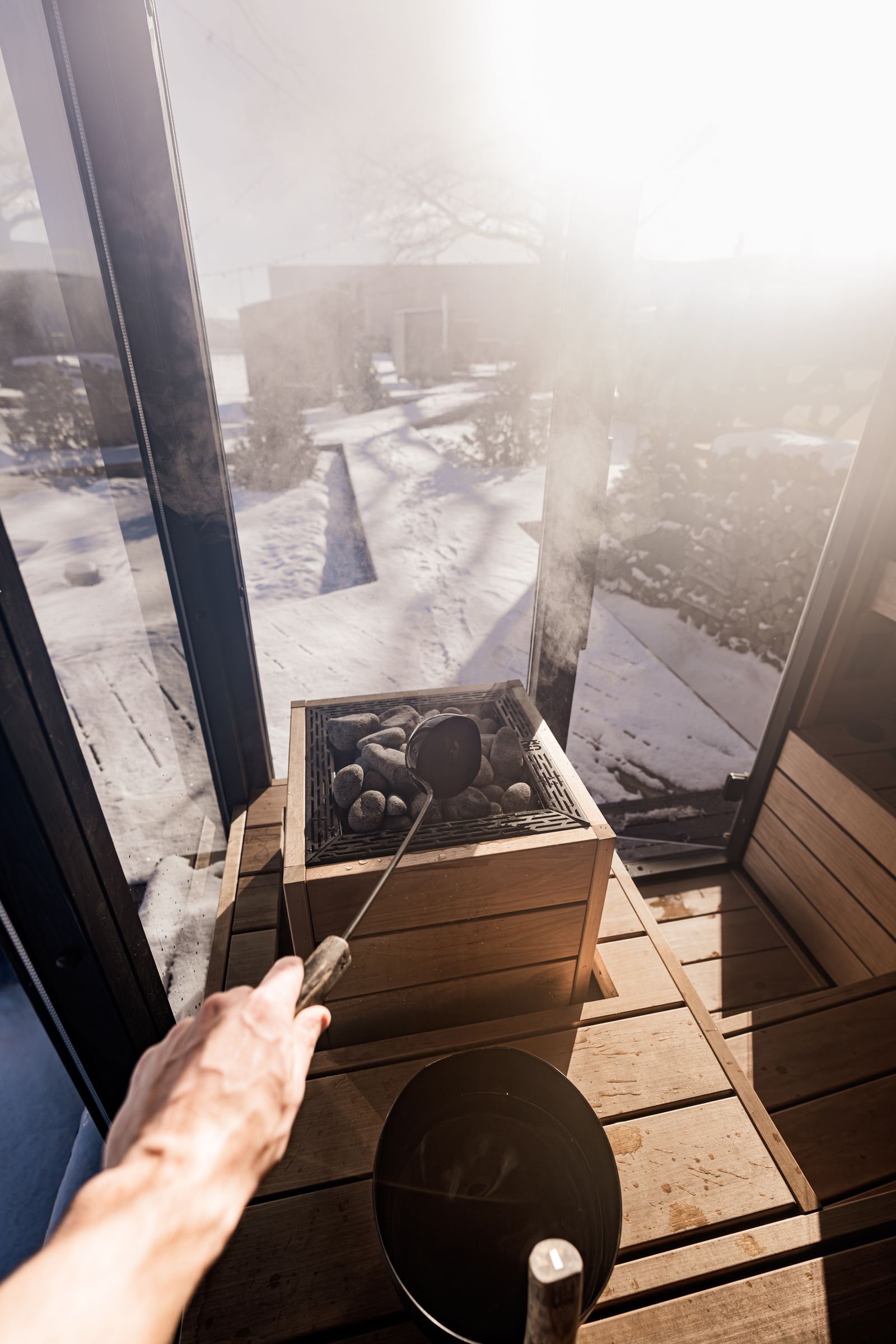
Demands on the supply grow with output. As a guide, heaters of roughly up to 3–3.5 kW can be run on a single-phase 230 V supply, whereas from 4.5 kW upwards they are practically always connected three-phase at 400 V. Most domestic saunas therefore need a three-phase supply.
A rough guide to the currents: a 6 kW heater draws approximately 8.7 A per phase, a 9 kW one about 13 A, a 10.5 kW one about 15 A and a 15 kW one around 22 A. These correspond to circuit breakers of the order of 3×10 A, 3×16 A, 3×20 A and 3×25 A. Treat these figures purely as an indication of the order of magnitude. The actual conductor cross-section, the type and rating of the breaker and the residual current device are specified by an electrician according to the length of the run, the way the cable is installed and the headroom on the main breaker.
A sauna heater belongs on a dedicated protected circuit with its own supply from the consumer unit, not on a socket circuit. Sauna rooms are also subject to special requirements for electrical installations in high-temperature areas, so both installation and inspection are a job for a professional — a do-it-yourself connection is both a safety and an insurance problem. Similar logic applies to other wellness appliances; we covered how this works for hot tubs in the article on hot tub electrical requirements.
Wood-fired heaters: output is stated differently
With wood-burning heaters, kilowatts work differently. Manufacturers state a recommended cabin volume in m³ (a from–to range) and a rated heat output, which however depends on the quality and moisture content of the wood, on the chimney draught and on how you stoke it. The rule of 1 kW per 1 m³ does not work here as a precise tool — go by the volume range from the technical data sheet and pick a cabin nearer the middle of the range than at its upper limit.
The fundamental difference lies in the building work. Wood-burning heaters need a chimney of adequate diameter and draught, safe clearances from combustible structures, a non-combustible hearth plate and an inspection report from a chimney sweep; regular sweeping and inspection of the flue are mandatory. A comparison of the two principles, including running requirements, is in the article on electric versus wood-burning sauna heaters.
How output affects consumption
Higher output does not in itself mean a higher bill. What counts is the energy per sauna session: the heater warms up at full output and then merely cycles to maintain the temperature, so the average draw is far lower than the rated output. A correctly sized heater reaches temperature quickly and then heats intermittently — an undersized one runs flat out all the time.
The actual figures, that is how many kWh a single sauna session uses and what that does to the monthly bill, are covered separately in the article on sauna electricity consumption and running costs. Alongside output, the quality of the cabin insulation and how often you use it have a decisive influence.
What to ask the retailer
Before you confirm the order you should know the answers to these questions:
- What cabin volume range is the heater certified for (from–to m³) and where in that range does my calculated volume fall?
- What allowance coefficient for glass and masonry does the manufacturer of this particular heater recommend?
- What voltage, number of phases and recommended protection does the manual require?
- How many kilograms of stones does the heater take, and is the corresponding quantity included in the delivery? The amount of stone affects both thermal inertia and the quality of the steam.
- Is the control unit included, or bought separately? Does it handle delayed start and a weekly programme?
- What are the minimum safety clearances between the heater and the benches and walls, and will they fit into my floor plan?
Three mistakes that keep coming back
Counting floor area instead of volume. “My sauna is four square metres, so four kilowatts.” But a 2 × 2 m sauna with a height of 2.1 m has a volume of 8.4 m³, which is twice that. Always multiply three numbers together.
Forgetting the glass. Practically every cabin has a glass door today, and in a small sauna it means tens of per cent of extra volume. With a glazed wall it is even more pronounced.
Buying by price instead of by calculation. The difference in purchase price between a 9 kW and a 10.5 kW heater is on the order of a hundred euros or so. The difference between a sauna that is ready in 40 minutes and one that never gets past 70 °C is fundamental — and the only remedy is replacing the heater, which means the whole investment again plus the labour.
Frequently asked questions
Does the 1 kW per 1 m³ rule apply to an infrared cabin too?
No. An infrared cabin does not heat the air but radiates directly onto the body, so it is sized by the number and type of emitters, not by cabin volume. The power input of these cabins is typically 1.5–2.5 kW and a normal socket is usually enough. We go into the details in the article on an infrared sauna for a flat.
Can I buy a heater with headroom and simply not run it at full power?
The controller regulates temperature, not output — the heater heats at full power until the thermostat cuts out. A modest margin (one step up the output range) is sensible; substantial oversizing leads to uneven heat, harsh radiant heat and an unnecessarily heavy supply.
How does an outdoor sauna affect the calculation?
If the cabin is well insulated, the same procedure applies. In winter, however, heat losses account for a larger share in an outdoor installation, so it is worth choosing the higher of the two outputs under consideration. What is critical is the thickness of the insulation and the vapour barrier, not the location itself.
Does the quantity of stones affect the output required?
Not the output required, but the behaviour of the sauna, yes. More stone means a longer heat-up, but a more stable temperature and better steam when water is poured on. Always fill the heater with the recommended quantity from the manual — a half-empty basket shortens the life of the heating elements.
What if I am not sure about the insulation of an existing cabin?
Feel the walls after a session: if some surfaces are noticeably cooler than the surrounding timber, heat is escaping there and it belongs in the calculation as uninsulated surface. In older built-in saunas without a vapour barrier it is safer to count an allowance even for walls that look like timber.
In conclusion
Calculating the output is not difficult, it just must not stop at the dimensions of the cabin. Volume × 1 kW, plus an allowance for every square metre of glass and masonry, rounded up to the nearest standard size — and then have the result checked against the technical data sheet of the particular heater. If you are still at the planning stage, first go through the guide to choosing a home sauna, because the type and location of the cabin determine the whole of the rest of the calculation.
Sauna heaters, cabins and other home wellness equipment can be found in the wellness category. Further articles on saunas, hot tubs and looking after them appear regularly in the Guide.
