
Algae in a pool are not one problem but three different ones — and each behaves differently. Green algae float freely in the water and respond to chlorine quickly, mustard algae cling to shaded areas on the walls and survive ordinary disinfection, and black algae take root in the pores of concrete and in grout joints, where nothing but mechanical brushing will remove them. An algaecide, meanwhile, is not a disinfectant: it slows growth, but it does not kill bacteria and it does not address the cause. Prevention rests on stable free chlorine, circulation and a brush — chemistry is only an add-on.
This article is about recognising the types of algae and about prevention. If you are dealing with an acute situation right now and the water has already turned green, start with our guide to green pool water — the shock disinfection and clean-up procedure is described there. Come back here once the water is clear, because that is exactly the moment when it is decided whether the problem will return.
Three types of algae you will meet in a home pool
Botanically these are single-celled organisms that produce energy from light. From a pool owner’s point of view, however, it is more practical to divide them by where they live and how you fight them.
Green algae — the most common and the least vicious
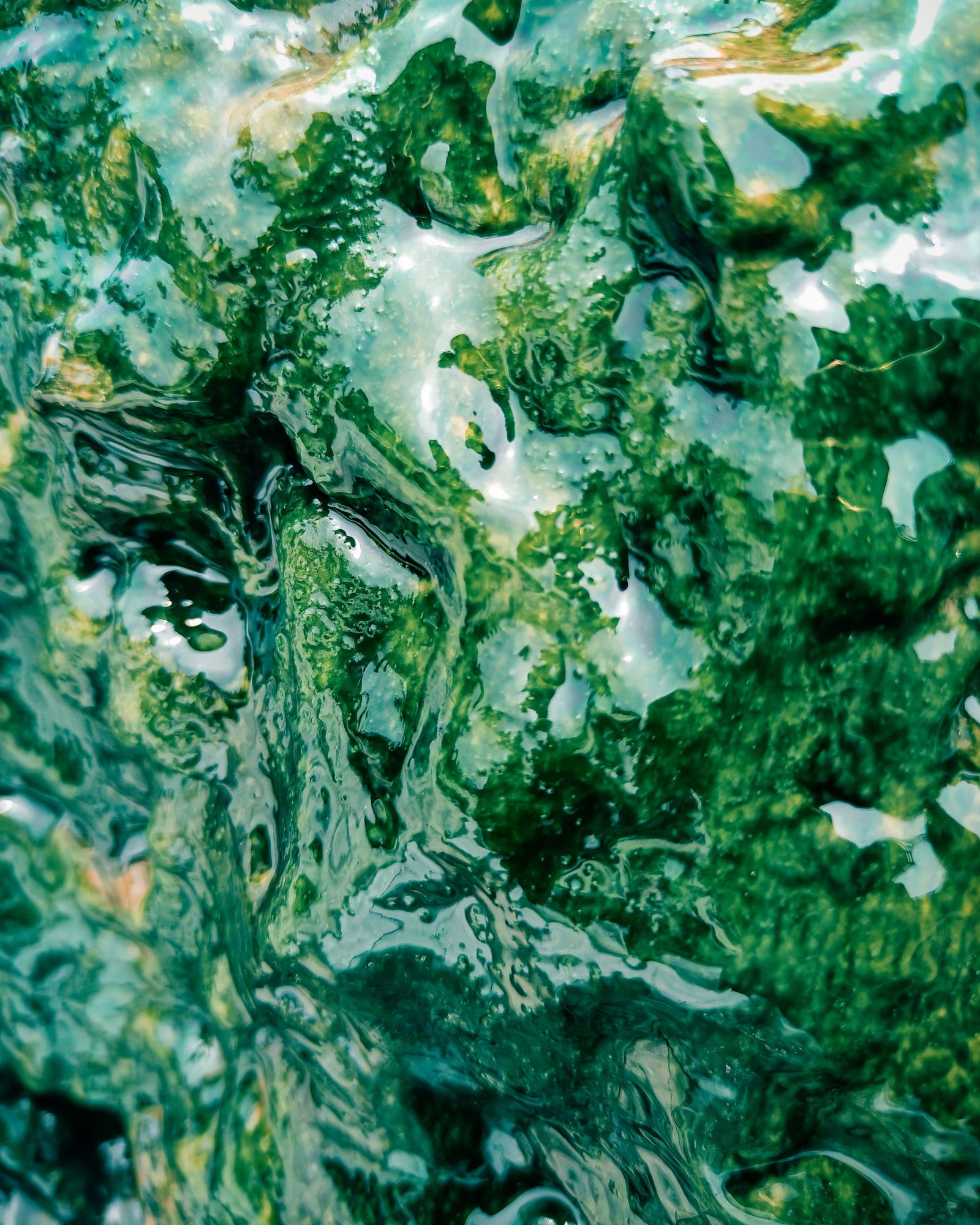
They float freely in the water and cloud it to a greenish tint, later into an opaque emerald soup. The walls tend to feel slippery, but the main mass sits in the water column. They appear fast: two warm days with the filtration switched off and free chlorine dropping below 0.3 mg/l are enough.
The good news is that green algae are sensitive to chlorine. The bad news is that the speed at which they multiply can consume the disinfectant faster than you can top it up — which is why water “turns” over a single weekend.
Mustard (yellow) algae — they settle in the shade
They look like a fine yellow-brown dust or sand on the floor and walls, typically on the north side, behind the steps, in corners and under the coping. The characteristic sign: when you sweep a brush through the deposit, it lifts like a little cloud and within a few hours settles again in exactly the same spot.
Mustard algae are considerably more resistant to chlorine than green ones and are easily confused with ordinary sediment or sand from the filter. You can tell the difference because sand does not come back once vacuumed away. Algae do.
Black algae — the worst, because they take root
They form dark blue-green to black spots a few millimetres across, most often in tile grout, in the pores of concrete, around the inlets and in micro-cracks. Above the colonies sits a protective layer that chlorine practically cannot penetrate, and the organism has “roots” reaching into the material.
That is why simply raising the chlorine does not work on black algae. What is needed is mechanical disruption of the protective layer with a stiff brush (a different one for concrete and for liner — take care not to damage the surface) and then a spot application of the product directly onto the site. Without brushing, the colony regenerates from the same point within a few days.
| Type of algae | Identifying sign | Resistance to chlorine | Procedure |
|---|---|---|---|
| Green | Water clouded green, slippery walls | Low | Shock disinfection, flocculation, 24 h filtration, vacuum to waste |
| Mustard (yellow) | Yellow-brown “dust” in shade, behind steps, in corners; returns after being stirred up | Medium to high | Thorough brushing, higher chlorine dose, cleaning of everything that has been in the water (vacuum, cover, swimwear) |
| Black | Dark spots in joints and pores, rough to the touch, firmly attached | Very high | Stiff brush to break the layer + spot chemistry, repeatedly; check again the following week |
What algae need in order to grow
You will not see algae until all four conditions are met at once. Prevention is therefore a game of removing conditions, not of catching up with chemicals.
- Light. Without photosynthesis they do not multiply. That is why a covered pool practically never gets algae, and why outbreaks form where light falls and the water stands still.
- Warmth. Above roughly 26 °C the rate of multiplication climbs steeply. At 22 °C you have days of margin, at 30 °C hours. A heated pool therefore needs a stricter regime than a cold one — this also relates to the choice of the ideal water temperature.
- Nutrients. Mainly phosphates and nitrates. They are brought in by rain, run-off from a freshly fertilised lawn, leaves, sunscreens, birds and top-up water from a well (see well water in your pool).
- Weak disinfection. It is not just about the chlorine you measure, but about effective chlorine. When water is over-stabilised with cyanuric acid, the test may show 1 mg/l and yet the water barely disinfects at all — the so-called chlorine lock. The article on chlorine stabiliser and cyanuric acid covers this in detail.
The practical consequence: most “inexplicable” repeated blooms are caused by over-stabilised water or a constant supply of phosphates, not by too little algaecide.

Prevention as a system, not as a one-off intervention
Stable free chlorine, not swings
The goal is to hold free chlorine permanently in the 0.5–1.0 mg/l band, not to jump between 0 and 3. Algae need only a short window without disinfection to get going, and after that they consume chlorine faster than you can add it. Regular testing is cheaper than a shock treatment — the how-to is in our article on testing your water, and automation is covered by automatic chlorine dosing.
Keep an eye on pH as well. Above 7.6 the effectiveness of hypochlorite drops significantly, so at pH 8.0 you effectively have half the disinfection even though the test shows the same number.
Brushing the walls once a week
The most underrated step in the whole of prevention. A brush mechanically strips the biofilm away before it has time to become a colony. Focus on the places the vacuum and the flow of water cannot reach:
- steps and their undersides — the most common starting point for mustard algae,
- corners and the wall-to-floor transition,
- the shaded side of the pool (in our climate typically the north side),
- around the inlets, skimmer, ladder and light,
- tile joints and any micro-cracks.
Ten minutes a week is enough. A robotic cleaner makes the job easier, but it usually cannot handle vertical walls and the undersides of steps perfectly — we discuss the options in our article on how to choose a pool vacuum.
Adequate filtration and circulation with no dead zones
The water must pass through the filter at least once a day, in practice rather twice. You will find the specific calculation of run time based on volume and pump output in our article on how long to run your pool filter.
Where the water flows matters just as much. Angle the inlets so that they create a circular movement and reach the corners and the surface too. A dead zone behind the steps or in a narrow corner is the place where algae settle first — and even a double dose of chemicals will not help, because it simply does not get there. A clogged filter also passes less water than you think; check the pressure on the gauge.
Phosphate remover — when it makes sense
A phosphate remover based on lanthanum or aluminium salts precipitates phosphates into an insoluble form that the filter captures. It is not a universal product for every pool, but it has a clear indication.
It makes sense when algae keep returning even with correctly managed disinfection, when the pool stands under trees or beside a regularly fertilised lawn, or when you top up with well water. Before buying, measure phosphates with a test — values above roughly 0.2 mg/l are worth addressing, below 0.1 mg/l the application is pointless. Expect temporary cloudiness after dosing and count on backwashing the filter the following day.
Covering the pool and what to do after rain
A cover or an enclosure takes light away from algae and at the same time keeps out leaves and pollen. A thunderstorm is the riskiest moment of the season: it dilutes the disinfectant, knocks pH down and brings in nutrients and organic matter. Exactly what to do before and after a storm is summarised in the article on rain, storms and pool chemistry. The basic rule: after heavy rain, measure and top up chlorine the same day, not at the weekend.
Algaecides: how to use them properly
An algaecide is a preventive product. It works best in a small regular dose in clean water, where it hinders new cells from taking hold. Using it as a “fire extinguisher” on green soup means a high dose, a poor result and often foam or discoloration on top of it — in that situation you need shock disinfection and a flocculant, not an algaecide.
The second essential point: an algaecide does not replace disinfection. It does not kill bacteria or viruses, it creates no residual hygienic protection and it does not show up in a test as free chlorine. A pool with algaecide alone is a pool without hygiene.
| Type of algaecide | How it works | Watch out for | Suitable use |
|---|---|---|---|
| Quaternary ammonium compounds (QAC) | Disrupt the cell wall of the algae | Foams heavily, especially with counter-current units and water features; lower effectiveness against mustard algae | Cheap routine prevention in calm pools |
| Polymeric (polyquat) | The polymer coats the cell and prevents it from dividing | Higher price, slightly increases flocculant consumption | Foam-free prevention — suitable where there is a water feature or an overflow pool |
| Copper-based | Copper ions act as a biocide, effective even against resistant species | Risk of greenish discoloration of the water, staining of the liner and bleaching of blonde hair; unsuitable for soft water with low pH | Targeted use against mustard and black algae, spot treatment |
With copper-based products, “less is more” applies twice over. Exceeding the dose only shows up after several days and the discoloration is difficult to remove. Always dose with the filtration running and into water with adjusted pH.
And what about algae in a hot tub?
Algae are rare in a hot tub — at 36–38 °C the environment does not suit them and the surface is usually covered by a thermal cover, so light is missing too. When a greenish or brown film appears in a hot tub, it is almost always biofilm in the pipework or cloudiness from organic matter, not algae.
The approach is therefore different: it is not solved with an algaecide but by cleaning the circuit and restoring disinfection. You will find the how-to in our articles on cloudy hot tub water and hot tub hygiene and legionella. The exception is a hot tub run in summer at a lower temperature (around 28 °C) with the cover off — there algae are possible and the same rules apply as for a pool.
Quick diagnosis: what you see and what to do about it
| What you observe | Probable cause | First step |
|---|---|---|
| The water clouded green over the weekend | Green algae after a chlorine or filtration failure | Shock disinfection following our guide to green pool water, then find the cause of the failure |
| Water clear, but the walls are slippery | Biofilm starting to form | Brush the whole pool, raise chlorine to the top of the band for 2 days |
| Yellow powder behind the steps, returns after being stirred up | Mustard algae | Brush + higher chlorine dose, disinfect the vacuum, cover and swimwear as well |
| Dark spots in the joints that cannot be wiped off | Black algae | Stiff brush to break the layer, spot chemistry, check in a week and repeat |
| Chlorine disappears within a few hours | High consumption by organic matter or a hidden algae colony | Check shaded spots and joints, verify cyanuric acid |
| The test shows chlorine, but the water “does not work” | Over-stabilisation (chlorine lock) or pH above 7.6 | Measure cyanuric acid and pH, partially replace the water if necessary |
Frequently asked questions
Do I have to use algaecide if my chlorine is set up well?
No, you do not. With stable free chlorine, working filtration and regular brushing, most pools get through a whole season without algaecide. A preventive dose pays off mainly in pools in full sun, in warm water, or where the owner goes away for longer periods.
Why do algae come back even though I cleaned the pool?
Most often because a source remained — a colony in a joint, under the steps, on the vacuum or in a cover you did not disinfect. The second reason is permanently insufficient disinfection, typically because of high cyanuric acid. The third is a constant supply of phosphates from the surroundings.
Can I tell mustard algae from filter sand?
Yes, by their behaviour. Sand disappears for good once vacuumed, algae reappear in the same spot within 24 hours. Another helpful test is a drop of concentrated hypochlorite straight onto the deposit — algae fade, sand does not.
Do salt water or a UV lamp help against algae?
Salt water produces the same chlorine as classic chemistry, so in itself it offers no better protection against algae — the difference is described in our article on salt water vs. chlorinated water. UV and ozone destroy micro-organisms only at the moment they flow through the chamber and create no residual protection in the water, see UV lamp and ozone. Both are a supplement, not a replacement for chlorine.
How long does it take to get rid of black algae?
Count on several weeks and repeated intervention. One brushing and one dose of chemicals will weaken the colony but will not destroy the root part inside the pore of the material. If the outbreak returns even after a third attempt, the problem usually lies in a damaged surface that retains porosity — then only a repair or a new liner will help.
Summary
Algae are neither chance nor bad luck, but the result of a specific combination of light, warmth, nutrients and weak disinfection. Remove one of the conditions and the problem disappears; add algaecide to a pool with poorly managed chlorine and you merely postpone the inevitable. The cheapest prevention is a brush, regular testing and a long enough filtration cycle — chemistry complements this trio, it does not replace it.
You will find testers, disinfectants, phosphate removers and algaecides for all three types of algae in our water treatment category. More practical guides to pool and hot tub care are published regularly in our Advice centre.
