
You usually cannot identify a hot tub from the brand on the front panel — that tells you who sold it, not who made the components inside. What matters are the labels on the control pack, the pump and the heater under the service panel, plus a handful of precise measurements. This guide walks you through where to look, what to measure once the label has gone, and exactly what to send your supplier so they can advise you first time.

Why hot tubs are so confusing in this respect
Hot tubs are sold across Europe under dozens of trade names, but the components for them come from only a handful of large manufacturers. Control packs, pumps, heaters, jets, filters and topside panels are therefore often identical or very closely related across apparently unrelated brands.
Rebadging adds to this. One and the same Asian-built model is sold in different countries under a different name, with a different cabinet colour and a different type designation — the internals stay identical. So the brand on the tub tells you almost nothing about the parts, while the text moulded into the pump body tells you almost everything.
A third complication: online shops introduce their own catalogue numbers. The same filter then turns up under three different codes at three retailers, and under a fourth code at the maker of the filter cartridges. So always search primarily by the component manufacturer’s original designation and by dimensions, not by a code from a web shop.
The good news is that this shared component base works in your favour. Once you know which control pack is inside and what flanges the pump has, you can source a part even for a hot tub whose brand ceased to exist ten years ago.
Where to look for identification: six places, in the order to work through them
Before you take anything apart, disconnect the hot tub from the electricity supply — switch off the breaker and the RCD in the consumer unit and check that the panel has gone dark. Around water and 230/400 V you do not rely on “I’m only lifting a panel off”.
- The rating plate on the cabinet by the electrical supply. It is usually on the lower part of the shell near the point where the cable enters, or directly on the service door. Here you will find the model name, serial number, year of manufacture, voltage, fusing and total power input. Photograph the whole thing, including the small print — the serial number often carries a production batch code from which the supplier can tell the generation of the equipment.
- The label on the control pack. Once the service panel is off, this is usually a plastic box into which most of the cabling runs. On the lid or the side you will find the system type designation and the software configuration number. It is precisely this number that determines which topside panel and which heater assembly are compatible.
- The label on the pump. Stuck or moulded onto the motor: power, voltage, frequency, speed, number of speeds and type designation. On hot tubs with several pumps, photograph each label separately and note which one drives the jets and which the filtration.
- The print inside the filter. Pull out the filter cartridge and look at the plastic end cap — the cartridge type designation is usually moulded there, sometimes with the area in m² or ft². If the print is worn, shining a torch across it at a sharp angle helps.
- Documentation and invoice. The manual, warranty card, handover record, an email from the dealer. Even an ancient invoice contains the exact commercial model name that appears nowhere on the tub. Search your email inbox for the dealer’s name too.
- The label on the heater. The stainless steel tube between the pump and the water manifold. On the body or on the plastic end fitting you will usually find the power in watts, the voltage and the tube diameter. Without this information there is no point ordering a heater element.
Photograph everything in situ, sharply and close up, and ideally from a distance as well so it is clear where the part sits in the system. A photo of the label is far more valuable to the supplier than a hand-written transcription, because transcriptions often confuse a zero with the letter O or skip the suffix after the hyphen.
When the label is missing: what to measure and photograph
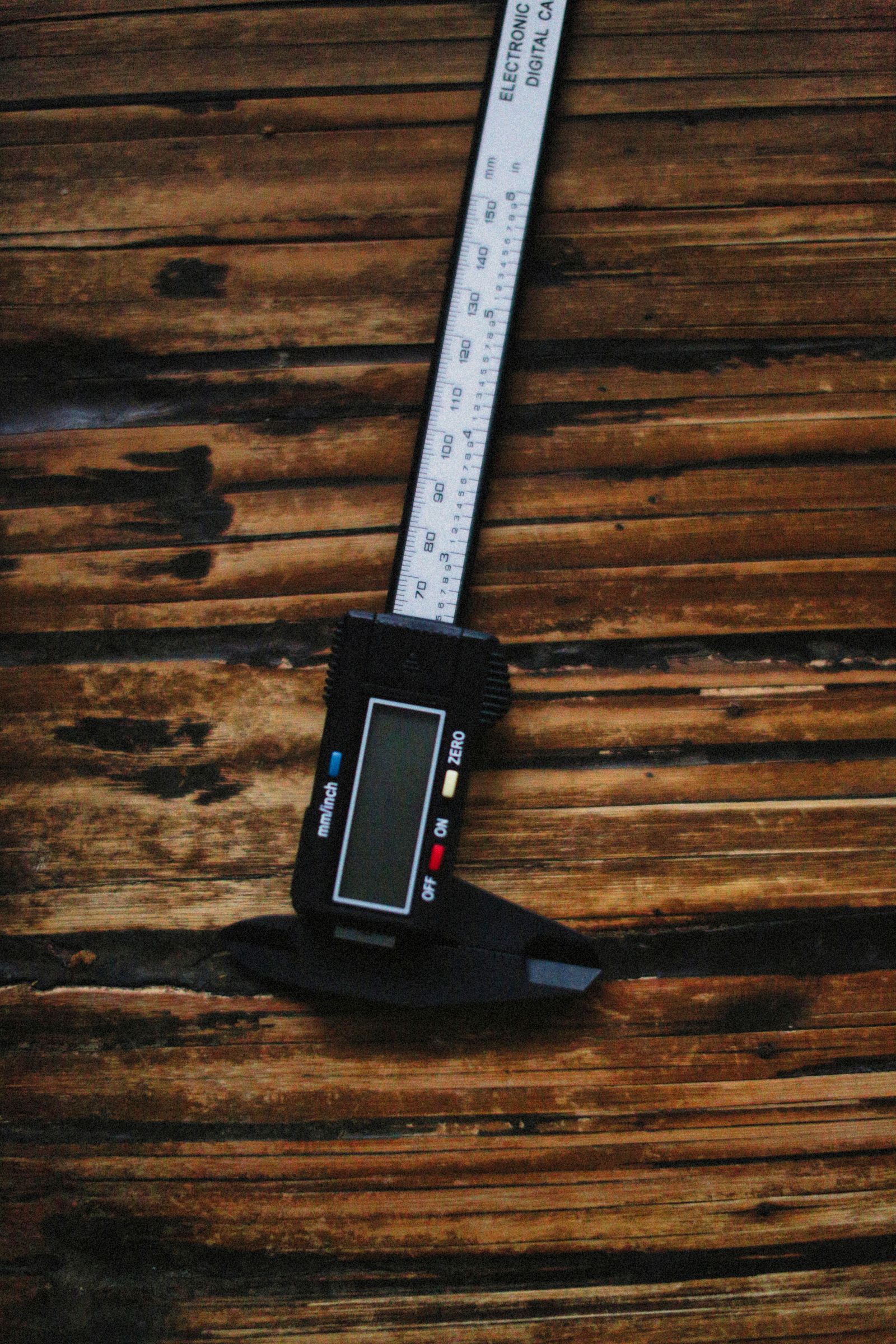
A worn, fallen-off or water-corroded label is not the end. Most parts are defined by a few dimensions and precise measurement replaces the label. Measure with a caliper, not a tape measure — with diameters, millimetres decide the outcome. Always take the photo of the part with a rule or scale in the frame.
Filter cartridge
You need the outside diameter, the overall length and the type of both end caps. There are usually three end cap types: an SAE internal thread (the cartridge screws in), a plain base with a hole (it slides over a pipe) and a solid base with a handle. Measure the inside diameter of the hole as well — it varies between otherwise identical cartridges. The practical side of replacement and cleaning is covered in the article hot tub filter cleaning.
Pump
Note down the power, voltage, number of speeds (single or dual speed), the diameter and type of the flanges on both suction and discharge, and how they are oriented relative to one another. Photograph the orientation from the front and from the side — two otherwise identical pumps can differ in whether the discharge points upwards, sideways or backwards. Add the overall length of the assembly too, because there is usually little space in the cabinet.
Jet
What matters is the outside diameter of the collar in the acrylic and the fixing type — bayonet, thread, or a snap-in internal insert. Photograph the jet removed from the body as well as the empty body in the acrylic. If the issue is weak performance rather than mechanical damage, start with the diagnosis in the article weak hot tub jets.
Heater element
Record the overall length of the tube, the power in watts, the voltage, the diameter and the connection type including the thread. Photograph how the sensors are mounted as well — without the correct position of the pocket for the temperature sensor you will not be able to fit the part in place.
Pump seal
The key dimension is the diameter of the shaft the seal sits on, plus the outside diameter of the seat and the material of the rings. The replacement procedure is described in the article hot tub pump seal replacement.
| Part | What to measure and record | What it is most often confused with |
|---|---|---|
| Filter cartridge | Outside diameter, length, end cap type, inside diameter of the hole | A cartridge 2–3 cm shorter, or with a thread instead of a plain base |
| Pump | Power, voltage, number of speeds, flange diameter and orientation, length | Different discharge orientation; dual speed mistaken for single speed |
| Jet | Collar outside diameter, fixing type, insert depth | The internal insert confused with the complete jet body |
| Heater element | Length, power, voltage, diameter and connection thread | Different power for the same length; different sensor pocket position |
| Pump seal | Shaft diameter, seat outside diameter, material | An imperial size rounded to millimetres |
| Topside panel | Control pack type, number of buttons, cut-out shape, cable length | A visually identical panel with a different communication protocol |
Component brands you will come across in Europe
The following names do not appear on the hot tub shell, but on the parts inside. Treat them as a pointer to compatibility, not as a recommendation of a particular manufacturer.
- Balboa — a widespread American system of control packs and topside panels. The particular combination of panel and pack is governed by the system designation, not by the hot tub brand. An overview of the messages can be found in the article on Balboa error codes.
- Gecko — a Canadian maker of control electronics and panels, common on mid-range and higher-end hot tubs.
- LX / WTC — pumps and heater assemblies very widespread on hot tubs imported from Asia; the type designation is usually moulded directly into the motor body.
- Waterway — jets, suction assemblies and manifold parts; one of the most common jet fixing standards.
- Darlly, Pleatco — manufacturers of filter cartridges who produce replacements for other makers’ originals; their catalogues work as conversion tables between dimensions and types.
Once you find any of these designations on a part, the search becomes far simpler: you stop looking for “a part for a brand X hot tub” and start looking for a specific component by its own type number.
Original or compatible part?
For mechanical parts a compatible replacement is usually a sensible choice. Filter cartridges, seals, gaskets, unions and jet internal inserts are defined by dimensions and material — if the dimensions match and the material suits operation in warm chlorinated water, the replacement works just as well as the original and tends to be cheaper and more readily available.
With electronics be more careful. Control packs, topside panels and heater assemblies communicate with each other, and visual similarity does not guarantee compatibility — a panel with the same number of buttons may have a different protocol or a different software configuration number. Here it pays either to go original, or to choose a replacement expressly approved for the specific pack type.
Watch the warranty too. On a hot tub still under warranty, unqualified work or an unapproved part can limit your claim — before you reach for the cheaper option, check the terms with your supplier. The general rules are summarised in the article warranty claims for pools and hot tubs. Work on the fixed part of the electrical installation is, moreover, exclusively for a suitably qualified person.
What to send your supplier so they can advise you first time
Most pointless rounds of questions arise because the first message contains only “I need a filter for my hot tub”. Send all of this straight away:
- Photos of every label you found — cabinet, control pack, pump, heater.
- Photos of the part itself with a rule in the frame, from two sides.
- The measured dimensions in millimetres, following the table above.
- A description of the fault — what is happening, since when, what the panel reports, what you have already tried.
- Model and year if you know them, plus the name of the original dealer.
- A photo of the whole hot tub from the outside and one shot into the open cabinet — the layout of the equipment reveals both the generation and the manufacturer.
It also pays to say whether you need a functionally equivalent part or exactly the same one. On older hot tubs the original part often no longer exists and the answer is a newer version plus an adaptor — the supplier will ask about this anyway.
Common ordering mistakes
A filter two centimetres too short. The diameter matches, the end caps match, but the shorter cartridge does not seat in the housing and some of the water bypasses the filtration. Length is just as important a dimension as diameter.
A pump with different flange orientation. The right unit in terms of power and dimensions, except the discharge points elsewhere and the hose in the cabinet will not reach. Always photograph how the existing pump is rotated.
A different voltage or a different number of speeds. A single speed pump in place of a dual speed one robs the hot tub of its quiet filtration mode and increases consumption; a different voltage is simply unusable.
A visually identical topside panel. The same cut-out shape and the same buttons do not mean compatibility with your control pack. What decides is the pack type and the software configuration.
Ordering by a code from someone else’s web shop. Internal catalogue numbers do not match between retailers. Stick to the component manufacturer’s designation and to dimensions.
Frequently asked questions
The hot tub has no label at all and the brand no longer exists. Is it worth sourcing parts?
Yes. The vast majority of parts are standardised across brands, so what decides is the component type designation and the dimensions, not whether the original company still exists. Problems only arise with specific plastic parts of the shell and with proprietary electronics, where the only solution is sometimes to move to a different, available system.
How do I tell whether I have a single speed or a dual speed pump?
From the label, which usually shows two speed values or two power ratings, and from the number of conductors in the supply to the motor. An indirect clue is the hot tub’s behaviour: if the filtration cycle runs noticeably more quietly than the massage, it is almost certainly a dual speed pump.
Can I measure the part myself, or should I call a service engineer?
Measuring the filter and the jet and reading off the labels is within anyone’s reach once the power is disconnected. As soon as the water circuit has to be opened, the heater moved or the electrical installation touched, the work belongs to a service engineer.
Is it worth buying a spare part in advance?
For consumables, yes — a spare filter cartridge and a set of gaskets will save you days of downtime. For electronics and pumps it makes no sense: they store badly, they are expensive and you do not know which part will fail first.
What if the supplier does not have the part?
Ask about a functional equivalent. If you know the component type and the dimensions, there is often a newer range from the same manufacturer that will fit in place with a simple adaptor or a change to the wiring.
The basics are always the same: label, dimension, photo. With these three things you can track down practically anything for a hot tub, even when the brand on the shell has long since meant nothing. Once you know which component is inside, the equipment and structural components and spare parts categories will make it easier to navigate the range of pumps, filtration and heating — and you will find more practical guides in our Guide.
