
A summer storm can wreck, in two hours, the water you spent a whole month carefully balancing. Rain dilutes the sanitizer, drags down the pH and washes nutrients into the pool that algae positively feast on — which is why water so often “flips” green after a big storm. The good news: if you work through the rescue plan below within 24 hours — drain, skim, test, rebalance, shock and filter — your pool will recover from the downpour with no lasting damage.
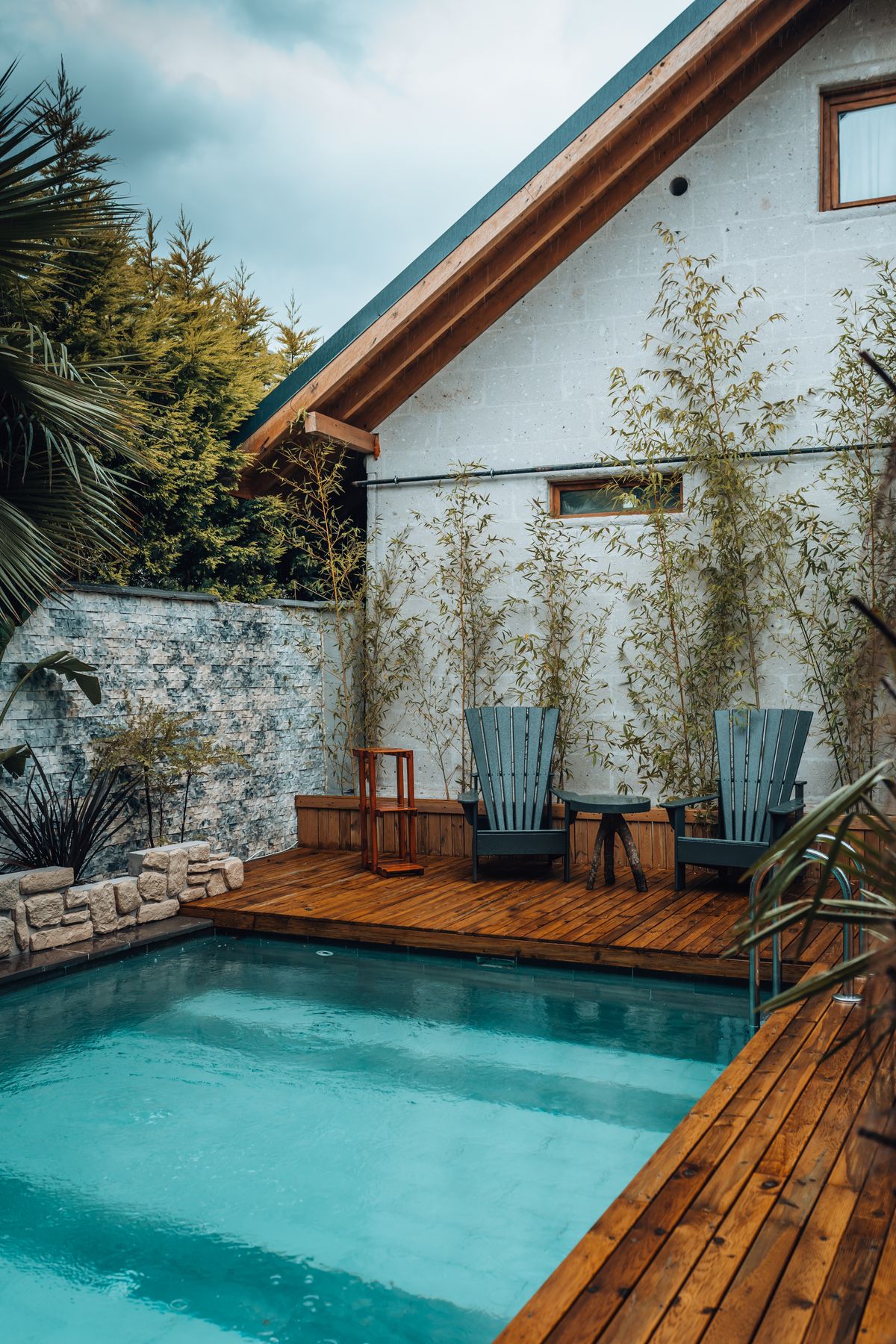
What exactly does rain bring into the pool?
Rainwater looks clean, but for pool chemistry it is a fourfold hit. The first is dilution: a 50 mm downpour on an 8 × 4 m pool means roughly 1,600 litres of new water with no chlorine, no stabilizer and no calcium. In a 40 m³ pool that alone dilutes every reading by a few percent — and on top of it comes the water running off the surrounding surfaces.
The second hit is acidity. Ordinary rain has a pH of around 5.0–5.6 (it is saturated with atmospheric CO₂), so after heavy rainfall both the pool’s pH and its total alkalinity typically drop. Low alkalinity then makes the pH “bounce around” and harder to stabilize.
The third hit is washed-in debris: soil, fertilizer residues and organic matter run into the water from the lawn, flower beds, paving and roofs — in other words phosphates and nitrogen, the main nutrients for algae. And the fourth hit falls straight from the sky: storm wind and rain wash pollen and dust out of the air, which end up as a fine film on the surface and an extra load on your filtration.
- Dilution: free chlorine, cyanuric acid (CYA) and water hardness all drop.
- Acidic rain: pH and total alkalinity fall.
- Runoff from the surroundings: soil, fertilizers, phosphates — food for algae.
- Airborne fallout: pollen, dust and fine organic matter on the surface.
Water hardness deserves a mention too. Rainwater is practically distilled — it contains no calcium or magnesium at all. A single downpour only nudges it slightly, but a rainy summer with repeated draining and refilling can gradually push hardness below 150 mg/l, at which point soft water starts attacking grout, stainless steel and heat exchangers. In salt-water pools, dilution also lowers the salinity — if your salt chlorinator reports low salt after heavy rain, that is the very same mechanism.
Why does the water “flip” green within 48 hours of a storm?
It is a textbook combination of three factors. The sanitizer, diluted and thrown off by acidic rain, stops keeping up; washed-in phosphates feed the algae; and the summer warmth after a storm (water at 26–30 °C) speeds the whole process up. Under favourable conditions algae multiply exponentially — which is why the water can be crystal clear on Friday and green by Sunday.
If it has already happened and the water is green, follow the detailed guide in our article on green pool water. The rescue plan below exists precisely so it never gets that far.
The after-storm rescue plan, step by step
Do not wait to “see how it turns out”. The sooner you start, the cheaper and shorter the rescue will be — ideally as soon as the rain stops.
- Drain off the excess water. The water level should sit roughly halfway to two-thirds up the skimmer. An overfilled pool is poor at collecting surface debris. Drain through the filtration system on the waste setting, so some of the debris on the floor leaves with it.
- Scoop out the coarse debris. Net out leaves, twigs and insects before they sink to the bottom and start to decompose — decomposing organic matter consumes chlorine.
- Check and clean the skimmer and the pump’s strainer basket. After a storm the baskets tend to fill up within hours. A clogged basket means weak flow and weak filtration at exactly the moment you need it most.
- Test everything, not just chlorine and pH. After heavy rain, measure free chlorine, pH, total alkalinity, CYA and ideally hardness too — dilution shows up in every reading. We explain how in our guide on how to test pool and hot tub water.
- Fix alkalinity first, then pH. Target alkalinity is 80–120 mg/l, pH 7.0–7.4. Alkalinity is the “buffer” — while it is low, the pH will not hold and the sanitizer will not work at full strength.
- Shock the pool. The usual dose is roughly 10 g of fast-dissolving chlorine per 1 m³ of water (follow the label of your specific product). The shock wipes out microorganisms and algae spores before they get a chance to multiply. Apply it in the evening so the sun does not break the chlorine down.
- Run the filtration non-stop for 24 hours. After the shock, leave the filtration running for a full day straight so all the water passes through the filter several times.
- If the water is cloudy, add flocculant. Fine cloudiness from soil and pollen is often too fine for sand — flocculant binds the particles into larger flocs the filter can catch, or you can vacuum them off the floor.
A quick note on the filter itself: after muddy rain, keep an eye on the sand filter’s pressure gauge — if the pressure rises 0.2–0.3 bar above its normal value, it is time to backwash. With a cartridge filter, rinse the cartridge even twice a day until the water clears; a clogged cartridge chokes the flow much faster than sand does.
When is a small correction enough?
Not every rain is a disaster. A short shower dropping a few millimetres, especially on a pool tucked under an enclosure or a cover, barely moves the readings — a routine test the next day and perhaps a small pH correction is all it takes. A cover is by far the cheapest insurance: it stops direct rain, pollen fallout and most runoff. You will find a comparison of the options in our article on pool enclosure vs. solar cover.
A rough rule of thumb: up to 10 mm of rain on a covered pool, just a check; 10–30 mm on an open pool, test and correct; over 30 mm or visible runoff from the surroundings — the full rescue plan including a shock.
Storms and safety: lightning means get out of the water immediately
Before you touch the chemistry, one absolute rule applies: no swimming during a thunderstorm. Water conducts electricity and a swimmer is the highest point on the surface — out of the pool and the hot tub at the first thunder, and back in no sooner than 30 minutes after the last rumble.
The second risk is wind. Before the storm arrives, secure the solar cover (lock the reel, anchor the cover), close and latch the enclosure segments, and put away garden furniture, parasols and toys — a flying sun lounger can punch through the polycarbonate of an enclosure and damage a pool liner.

Hail: what to check on the enclosure and cover
Quality multiwall polycarbonate usually withstands hail up to 2 cm; larger stones can punch through solid polycarbonate or older, brittle panels. After a hailstorm, go over the enclosure systematically: cracks and star-shaped fractures in the panels, loose trims and seals, dented aluminium profiles and the operation of the rollers. On a solar cover, check for burst bubbles — a damaged cover holds heat poorly and breaks down faster into small fragments you then end up fishing out of the water. If you are considering a sturdier structure, our guide on how to choose a pool enclosure will help.
Pool overflowed or the equipment pit flooded? Circuit breaker first
An overflowing pool itself is more of a cosmetic problem — the water runs off into the lawn and you restore the level by draining. Far more serious is a flooded equipment pit. Neither the pump, the control panel nor the lighting transformer is built to run underwater.
The procedure: switch off the circuit breaker for the pool circuit immediately (never reach into a flooded pit that is live), pump the water out with a submersible pump, let the equipment dry for at least 24–48 hours and have the insulation checked before restarting — ideally by an electrician or a service technician. A motor that has been underwater may hum and fail to start when switched on; the typical causes and fixes are covered in our article on a pool pump that hums but won’t start. For the future, pit drainage, raising the wiring off the floor and a 30 mA RCD all help.
Overview: symptom after rain and the matching response
| Symptom after rain | Likely cause | Response |
|---|---|---|
| Water level above the skimmer | Torrential rainfall | Drain to operating level (½–⅔ of the skimmer) |
| Leaves and insects in the water | Wind and runoff | Net them out, clean the skimmer and strainer baskets |
| pH below 7.0, low alkalinity | Acidic rain, dilution | Raise alkalinity to 80–120 mg/l, then fine-tune pH to 7.0–7.4 |
| Free chlorine below 0.3 mg/l | Dilution + organic load | Shock treatment (approx. 10 g/m³), filter for 24 h |
| Milky cloudiness | Soil, pollen, fine particles | Flocculant, filtration, vacuum the sediment off the floor |
| Greenish tinge within 48 h | Algae: nutrients + weak sanitizer + warmth | Shock, algaecide, continuous filtration — see the green water article |
| Pump hums, won’t start | Flooded pit, damp electrics | Switch off the breaker, dry out, have it checked by a technician |
| Cracks in the enclosure | Hail, wind-blown objects | Replace the panels, check trims and seals |
Frequently asked questions
Do I have to shock after every rain?
No. A shock is warranted after torrential rain (roughly over 30 mm), after visible runoff from the surroundings into the pool, or when a test shows free chlorine below 0.3 mg/l. After an ordinary shower, testing the water and fine-tuning the pH is enough — unnecessary shocking only drives up running costs.
How long after shocking must you stay out of the water?
Until free chlorine drops back into the roughly 0.5–1 mg/l range, which usually takes 12–24 hours depending on the dose, temperature and sunlight. Don’t rely on guesswork — measure it with a tester, not a timer.
Does rain also lower the stabilizer (cyanuric acid)?
Yes, but only through dilution — CYA otherwise practically never leaves the water. A noticeable drop only occurs after draining a larger volume of water and topping up with fresh. After heavy rains that involve draining, re-measure CYA from time to time; below 20 mg/l, chlorine disappears quickly in sunlight.
Does adding chlorine before a storm help as prevention?
Yes, it is the cheapest prevention there is: the day before a forecast downpour, raise free chlorine towards the upper end of the range (around 1 mg/l, or briefly more under heavier load) and cover the pool. Dilution then knocks the readings down into the normal range instead of below it.
Should I replace the water after a storm?
It is almost never necessary. Even heavily contaminated post-storm water can be handled by a combination of shock, flocculant and filtration within 2–4 days. Replacing the water only makes sense in cases of extreme mud contamination from widespread flooding.
Storms are simply part of summer — and with a covered pool, a tester and a small stock of chemicals, a downpour is just a minor episode, not a ruined week. Everything you need for the rescue plan, from pH plus/minus through shock chlorine to flocculants, is in our water treatment category, and you will find more seasonal guides in our Advice centre.
