
The heater element is the most expensive part a hot tub owner replaces routinely — and also the one they are most likely to destroy themselves. The vast majority of burnt-out heaters have one of two causes: a few seconds of dry running, or years of scale building up on the coil. Both can be prevented without tools — and this article shows how, plus how to tell whether cold water really is down to the heater and not something cheaper.

One distinction first. If your hot tub is not heating right now and you are after a “what to check first” procedure, the guide you want is hot tub not heating: step-by-step diagnosis. This article goes one level deeper — it is about the component itself, why it dies and how to extend its life.
How a hot tub actually heats the water
The overwhelming majority of acrylic hot tubs with a control pack (Balboa, Gecko and similar systems) use a flow-through heater. It is a short stainless steel tube fitted directly into the pipework after the filter, with a heating coil running inside it. Water flows past the coil and is heated as it passes — there is no “heating” in the tub shell itself.
The heater never works on its own. The system always gives it three safeguards:
- A flow sensor — a pressure switch or flow switch that allows the heating to come on only when the pump really is moving water. A fault here is typically reported as the code FLO.
- Temperature sensors — usually a pair of sensors in the pipework, one for regulation and one for monitoring (high-limit).
- A thermal cut-out — the last line of defence, which disconnects the heating on overheating. On some systems it resets itself once things cool down, on others it has to be reset manually.
Output. On single-phase models connected to 230 V the heater output typically sits in the range of 2 to 3 kW (3 kW is the most commonly quoted figure); with a three-phase connection you can also come across 4 kW and more. The exact figure from your hot tub’s spec sheet always takes precedence — how to read one is covered in how to read a hot tub spec sheet. The number is not academic: it directly determines how quickly the tub heats up and how much you pay for heating, which we work through in hot tub running costs.
Why heater elements burn out
1. Dry running — the most common cause
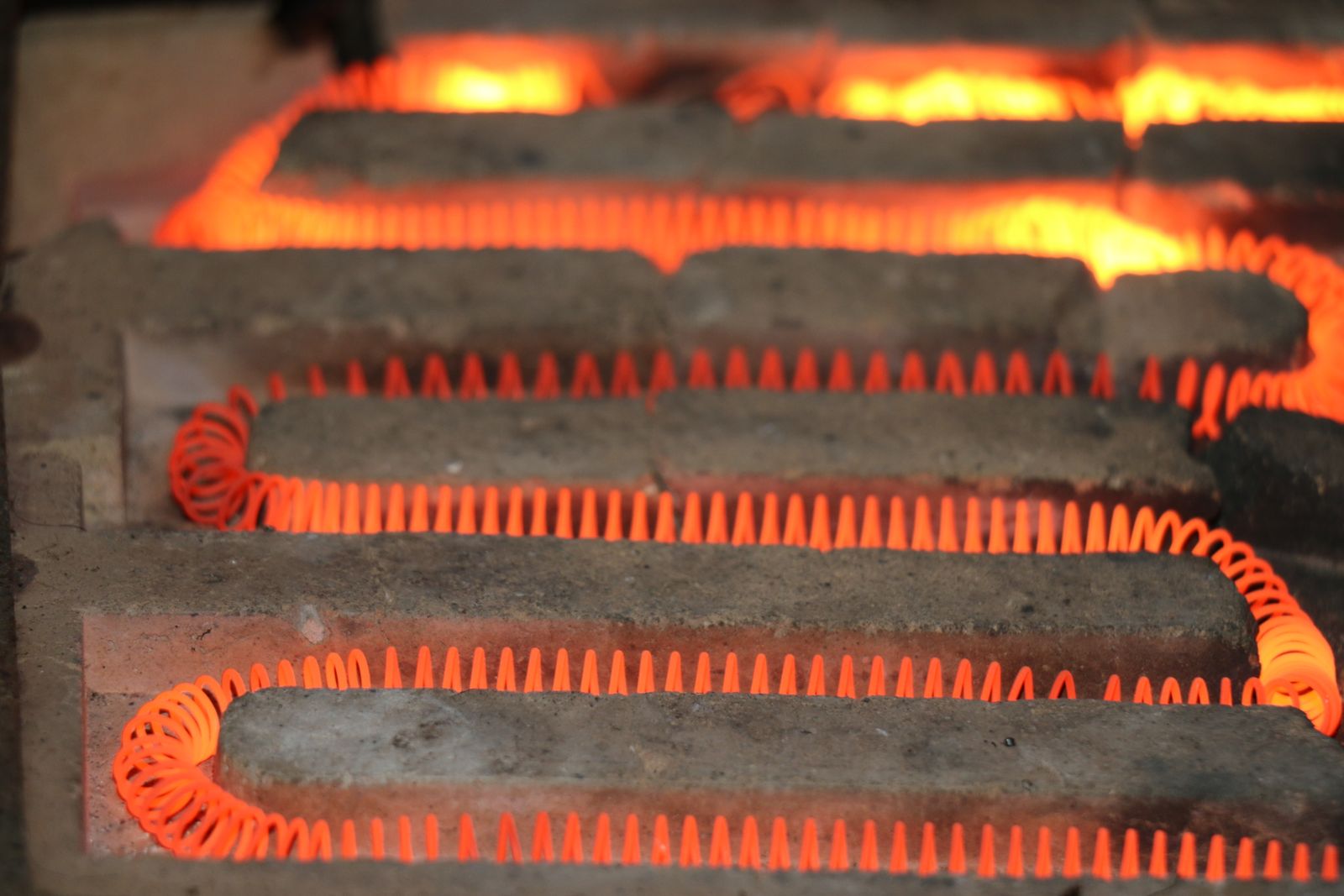
The coil inside the tube is cooled by the water flowing past it. Without water it reaches, within a few tens of seconds, a temperature that neither the stainless steel nor the insulation can survive — and that is that. There are two classic scenarios: a water level that is too low (the skimmer starts drawing in air) and an air lock in the pipework after draining and refilling the tub.
It is the second case that kills the most elements. After a water change the system is full of air, the pump becomes air-locked, flow is zero or intermittent — and if the control pack switches the heating on before the circuit has been bled, the element is finished. That is why you always purge the air after every fill and only then switch the heating on.
2. Scale on the coil
Limescale precipitates out of the water most readily where it is hottest — which is to say precisely on the surface of the heating coil. The resulting layer acts as thermal insulation: heat is transferred into the water less effectively, the coil overheats locally and its service life is shortened. Consumption rises at the same time, because heating takes longer.
The risk grows with water hardness and high pH — the harder and the more alkaline the water, the faster scale is deposited. We cover this in detail in water hardness and scale build-up.
3. Aggressive chemistry and low pH
The opposite extreme does no less harm. Persistently low pH turns the water into a corrosive environment that attacks even stainless steel — pitting forms on the element and, in worse cases, a breach. The typical scenario: the owner “knocks the pH down” with one large dose of product, the concentrated solution passes through the heater and damages it locally. Chemicals belong in flowing water, dosed in stages, as described in our guide to hot tub chemistry step by step.
4. High chlorine, bromine and salt water
A high concentration of sanitiser — especially immediately after shocking — is likewise a strain on stainless steel. This is particularly sensitive with bromine and with salt water: if the hot tub does not have a heater intended for salt operation (usually made of a higher-grade stainless steel or with a titanium element), the element’s life in a salted environment is shortened considerably. We look at the connections in bromine in a hot tub and salt water vs chlorine.
5. Electrolytic corrosion from poor bonding
A less well-known but very real killer. If the hot tub’s metal parts are not properly bonded and earthed, stray currents can pass through the water and the stainless element behaves like a sacrificial anode — corroding from the inside even though the chemistry is fine. The giveaway tends to be rust spots or a brownish film in the tub. The subject is covered in bonding and earthing for pools and hot tubs.
How a burnt-out element shows itself
- The water heats up markedly more slowly than before (typically just a few tenths of a degree per hour instead of around 1.5 °C) — or not at all.
- The display shows an error code relating to heating or overheating.
- The RCD trips the moment the heating comes on: a breached element is leaking current into the water. This is a safety condition, not a quirk — leave the hot tub switched off and call an electrician. The background is described in hot tub electrical requirements.
- Rust spots or brown cloudiness in the water after the heating comes on.
- Temperature swings — the hot tub heats for a while, then shuts down, and starts again once it has cooled (a tired element behaves this way, but so does a clogged filter).
Is the heater really to blame? A diagnostic table
A burnt-out element is only one of five common causes of cold water — and far from the most frequent. Before you order a part costing hundreds, work through the cheaper candidates.
| Symptom | Most likely cause | What to check first |
|---|---|---|
| Heats slowly, the pump is noisier, weak flow from the jets | Clogged filter / low flow | Remove and rinse the filter, check the level and that the gate valves are open |
| A flow error code (FLO / FL1) right after starting | Flow switch or air in the circuit | Bleed the air, check the pump and the switch — not the element |
| The display reports a nonsensical temperature, sensors disagree | Faulty temperature sensor | Compare the display reading with a thermometer in the tub |
| Heats only at certain times, otherwise not at all | An economy / sleep mode or filtration timer is set | Check the heating mode in the control pack menu |
| The heating never comes on, pump and sensors are fine | Faulty relay in the control pack | Measurement at the pack’s output — a job for a service engineer |
| The RCD trips every time the heating comes on | Breached heater element | Have the insulation resistance measured — do not use the hot tub until then |
| Heats slowly even with a clean filter and correct level, the water is hard | Scaled-up coil or a tired element | Check the history of hardness and pH, consider descaling |
The two cheapest steps — cleaning the filter and topping up the water level — resolve a surprisingly large share of “my hot tub isn’t heating” cases. Always do them before you reach for the phone.
Replacement: what it involves and what it costs
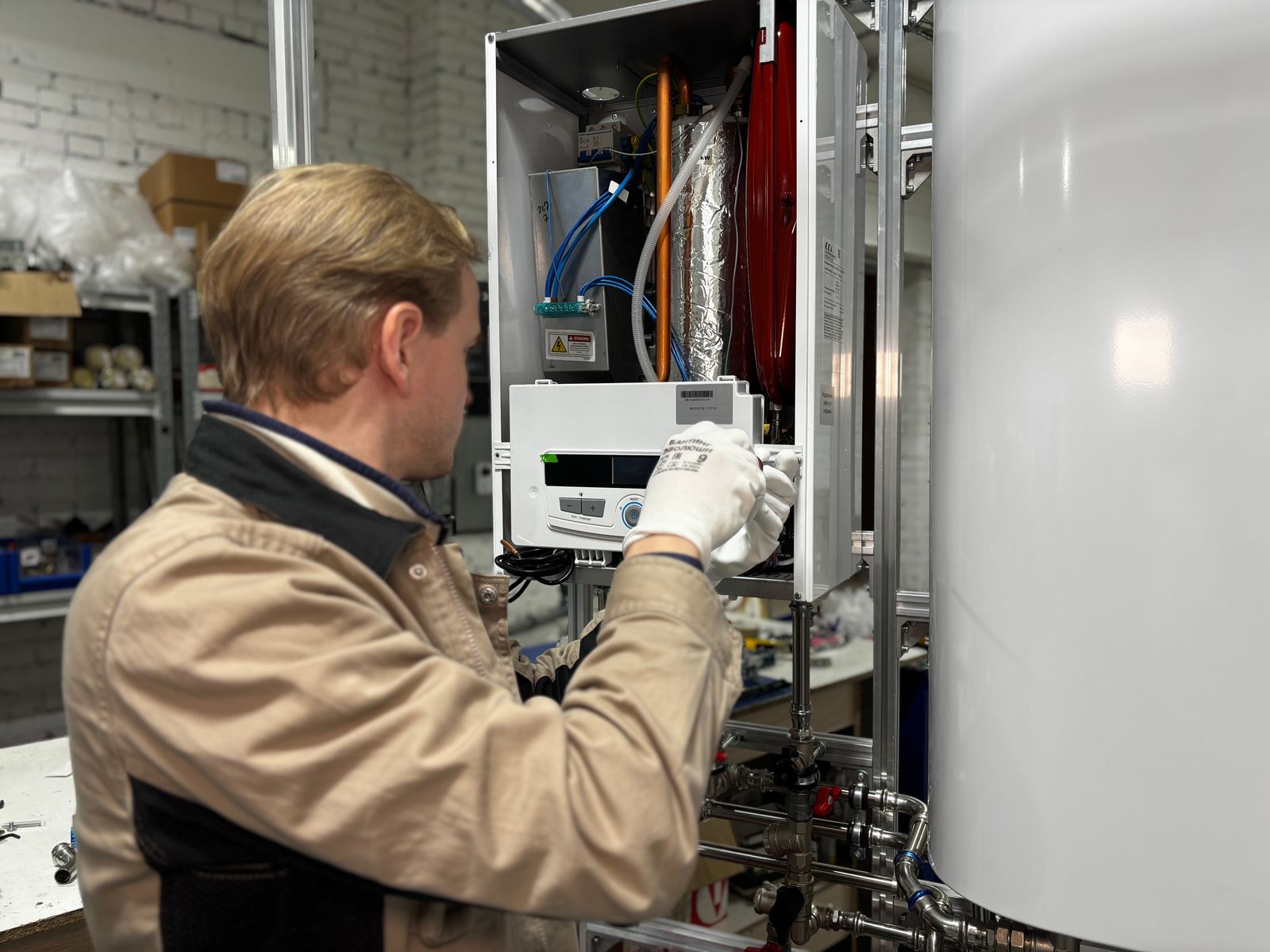
Physically it is straightforward work: drain the water (or at least the circuit), loosen the union nuts at both ends of the heater tube, disconnect the conductors and the earth bonding lead, remove the element, fit new seals, tighten, refill, bleed the air and only then switch the power on.
Safety warning. The electrical side — disconnecting and connecting conductors, checking the protective bonding, measuring insulation resistance — is strictly for someone with the appropriate electrical qualification. A hot tub is a device combining water and 230/400 V; mistakes here are not forgiven. What you can safely do yourself is the draining, gaining access and preparation, not the wiring.
Indicative prices (depending on type and output; this is a range for orientation, not a binding price list):
| Item | Indicative price |
|---|---|
| The heater element itself (stainless steel, 2–3 kW) | €80–240 |
| Complete heater assembly with sensors | €160–480 |
| Set of seals and union nuts | €8–32 |
| Service labour (call-out + replacement) | €60–160 |
Compatibility: four dimensions that have to match
Heater elements are not universal. Before ordering you need to know:
- Tube length — measured between the seating faces; 15″ (about 38 cm) turns up most often, but variants exist.
- Output and voltage — a 2 kW element in place of a 3 kW one means slower heating; a higher output than the breaker allows is, conversely, dangerous.
- Connection and thread — the tube diameter and the type of union nut differ between manufacturers.
- Flange type and terminal positions — the position of the terminals and of any sensor ports has to match your control pack, otherwise the assembly will not fit into the space beneath the tub.
The safest approach is to photograph the label on the old element and on the control pack and compare the data with the hot tub’s spec sheet. When replacing a part is still worth it and when it is time for a new tub is covered in hot tub lifespan and servicing.
Prevention that actually works
- Watch the water level. The water must be above the skimmer. After every drain and refill, bleed the system first and only then switch the heating on — this single rule saves more elements than anything else.
- Keep pH and alkalinity in check. The target is a pH of roughly 7.2–7.6 and stable alkalinity; neither aggressively acidic nor alkaline water does the element any good. The procedure is in hot tub chemistry step by step.
- Deal with water hardness. With hard water use a scale inhibitor and consider descaling the circuit at every water change — see water hardness and scale build-up.
- Clean filter, clean flow. A clogged filter = lower flow = an overheating coil. The rhythm of rinsing is described in hot tub filter cleaning.
- Do not shock while the heating is running. Dose a shock treatment into flowing water with the heating off and let it dilute before you start the heating again.
- Never put concentrated chemicals straight into the skimmer — that sends the concentrate to the heater by the shortest possible route.
Heating, insulation and consumption are more closely linked than you would expect
The heater element is not a source of “extra” heat — it merely makes up what the hot tub loses. The better insulated the shell and the tighter the cover, the fewer hours the element works each year. That means lower consumption and at the same time a longer life for the component.
The biggest heat loss goes through the water surface, so a good, unsaturated thermal cover is one of the few investments that pays back twice over. How much heating really costs and how the figures shift with the season is examined in hot tub running costs.
Frequently asked questions
How long does a hot tub heater element last?
With sensible chemistry, softer water and a clean filter it commonly lasts many years and tends to be a part the owner replaces once in the lifetime of the tub. In hard water, with unstable pH or after a single episode of dry running, it can be finished within a few months. Its life is therefore decided by how it is operated, not by its age.
Can a scaled-up element be saved by descaling?
If the layer of scale is thin and the coil is not yet damaged, descaling the circuit with a product intended for the purpose will help and heating will speed up. But once an element has burnt out or been breached, no chemical will bring it back — the only solution is replacement.
Can I tell a burnt-out element by the fact that it trips the RCD?
It is one of the strong signals: a breached element leaks current and the RCD correctly trips. Certainty, though, comes only from measuring the insulation resistance. An RCD can also be tripped by a faulty pump, the lighting or moisture in a terminal box, so do not buy a new part without measurement. Do not use the hot tub until it has been checked.
Can I fit a higher-output element so the hot tub heats faster?
Not without an electrician’s assessment. The heater output has to match the breaker, the supply cable cross-section and the capabilities of the control pack — a higher output on an unchanged installation means overloading and risk. In practice, faster heating is obtained more cheaply through better insulation and a better cover than through a more powerful element.
Is salt water really worse for the heater element?
It depends on the material. Hot tubs designed for salt operation have a heater made of a more resistant material and have no problem. But if you add a salt system afterwards to a tub that was not designed for one, you increase the risk of corrosion to the element and to other metal parts — always check first that the manufacturer permits it.
In conclusion
The heater element is a part that does not fail of its own accord. What kills it is air in the pipework, calcium on the coil and chemistry out of range — and all three are entirely within the owner’s control. A few minutes after filling and regular water testing will add years to the heater’s life.
When the time comes for a spare part or for upgrading your heating, you will find flow-through heaters, sensors, pumps and heat pumps in the category pool and hot tub technology. More practical maintenance guides can be found in the Guide.
