
A thermal cover is the cheapest and at the same time most effective “heater” your hot tub has: most heat is lost not through the walls, but through evaporation from the water surface. A quality cover with an EPS core can reduce this loss so dramatically that it makes a difference of tens of euros on your monthly bill. In this guide you will learn how a thermal cover is constructed, how to choose foam thickness and density, how to tell that your old cover is past its prime, and how to care for a new one so it lasts the usual 5–7 years.
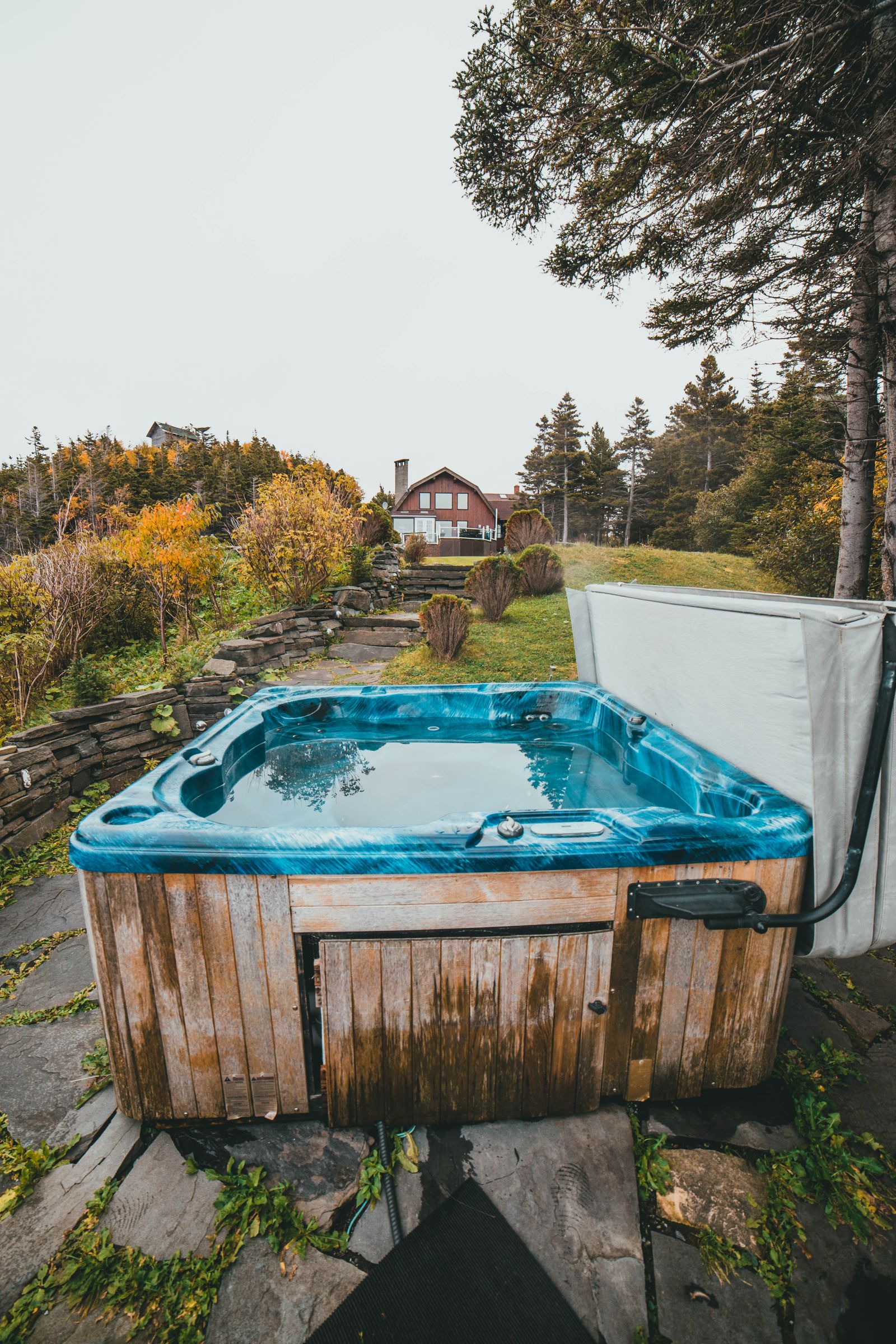
Why does the cover decide your running costs?
Hot tub water is kept at 36–38 °C practically around the clock. Physics is unforgiving: heat escapes where the insulation is weakest, and that is always the water surface. Evaporating water carries away an enormous amount of energy — every litre of evaporated water means roughly 0.63 kWh of heat that the heating element has to put back in.
The walls of an acrylic hot tub are usually filled with polyurethane foam or reflective insulation, but the water surface has no insulation of its own. Without a cover, water evaporates from it day and night, so the heater runs almost constantly. With a quality thermal cover, evaporation stops and an insulating layer of air forms above the surface as well. In real-world operation the difference is typically 30–50% of energy consumption — you will find specific figures and model calculations in our article How much does it cost to run a hot tub.
In practical terms, an old waterlogged cover or one with a cracked core can cost you more money over a single winter than a brand-new cover would. That is why this unassuming component deserves the same attention as your filtration or water chemistry.
How is a thermal cover constructed?
At first glance, a thermal cover is just a “vinyl cushion”. Inside, however, it hides several layers, each with its own role — and it is precisely their quality that separates a cheap cover from a premium one.
EPS core: thickness and taper
The foundation is a pair of wedge-shaped panels made of expanded polystyrene (EPS). The wedge shape is described by two numbers: 10/8 cm, for example, means the panel is 10 cm thick at the centre of the cover (along the central fold) and 8 cm at the edge. The taper ensures that rainwater and melting snow run off the cover instead of pooling on it.
Common thicknesses are 10/8 cm for milder conditions and seasonal use, and 12/10 cm for year-round operation in our climate. A thicker core means better insulation and a higher load capacity for snow; the price difference is typically just a few per cent of the total investment, but you will feel the difference in savings every winter month.
Foam density
Alongside thickness, what matters is the density of the EPS, stated in pounds per cubic foot (lb) or in kg/m³. The standard is 1.0 lb (approx. 16 kg/m³); premium covers use 1.5 to 2.0 lb (24–32 kg/m³). Denser foam insulates better, absorbs less water and carries a heavier snow load without sagging. For year-round outdoor operation, density is at least as important as thickness.
Vapour barrier
Each EPS panel should be heat-sealed in polyethylene film — the vapour barrier. It prevents moisture from the steam above the water surface from penetrating the foam. Failure of the vapour barrier (tears, delaminated seams) is the most common reason a cover “gets heavy”: the foam soaks up water and stops insulating. On quality covers the film is thicker and double-welded.
Vinyl jacket
The outer shell is made of marine vinyl — a material resistant to UV radiation and mould, the same type used for boat upholstery. A quality jacket weighs over 600 g/m² and features reinforced seams, a stiffener along the central fold (usually an aluminium or steel profile that protects the cover when folding), ventilation gussets on the sides and a skirt around the perimeter that conceals the gap between the cover and the shell.
How do you know the cover is past its prime?
A thermal cover is a consumable part, and it announces the end of its life quite clearly. The three most reliable signals are:
- The cover has become heavy. A new cover can easily be lifted by one person. If it suddenly takes two of you, the foam has absorbed water — and a waterlogged cover loses its insulating ability. Water conducts heat many times better than dry polystyrene, so a heavy cover is mostly heating the air outside.
- The cover is sagging. A depression in the middle means a broken or collapsed core. Water and snow collect in the hollow, accelerating the degradation further, and steam escapes between the panels.
- Mould and odour. Dark stains on the underside, a musty smell when you open the cover, or a crumbling bottom film all signal that the inside of the cover is permanently damp. Mould also gets into the water and increases sanitiser consumption.
A practical test: lift the cover by one corner. If it feels heavy and you can hear water sloshing inside the panel as you tilt it, the verdict is in. Drying out waterlogged EPS unfortunately does not work — the foam structure is already compromised and the cover is due for replacement.

How long does a thermal cover last?
As a rule of thumb, expect 5–7 years. Actual lifespan depends on three things: the quality of the vapour barrier, UV exposure and care. A cover on a hot tub under a pergola or roofed terrace lasts longer than one exposed to full sun all day; regularly treated vinyl resists cracking for longer. Conversely, aggressive chemistry (permanently high chlorine right under the cover) accelerates degradation of the bottom film — so after a shock treatment, leave the cover open for an hour.
The economics are simple: if a six-year-old cover has visibly become heavy, the increased energy consumption usually “pays for” a new cover within one to two heating seasons.
How to care for a thermal cover so it lasts as long as possible?
Maintenance takes a few minutes a month and noticeably extends the cover’s life:
- Cleaning: once a month, rinse the vinyl with water and wash it with a mild soap solution. Do not use abrasive cleaners or solvents — they attack the plasticisers in the vinyl.
- Vinyl treatment: two to four times a year, apply a vinyl protectant with a UV filter (not silicone-based car polish). The vinyl stays supple and does not crack.
- Underside: when changing the water, wipe the bottom film with a sanitiser solution to keep mould at bay.
- Do not put heavy objects on the cover — no planters, tools or seated persons. Point loads break the EPS core, which then never holds its shape again. For the same reason, keep sweeping off heavy wet snow throughout the winter.
- Handling: do not drag the cover along the ground by its skirt and do not lay it on a rough surface — damage to the bottom film opens a path for moisture into the core.
Is a cover lifter worth it?
A cover lifter is a simple lever mechanism that folds the cover and stows it behind the hot tub. The reason we recommend one almost without exception is simple: most covers are destroyed not by the weather, but by handling. A cover weighing 15–25 kg that gets hauled over the edge of the shell or laid on paving twice a day takes hits exactly where it is most vulnerable.
The basic types:
- Pivot lifter — the most common; the cover folds and tilts back behind the rear wall. It needs 30–45 cm of clearance behind the hot tub.
- Hydraulic lifter — with gas struts that take most of the weight; one person, or even a supervised child, can manage it. Suitable for heavier 12/10 cm covers.
- Side-shelf system — the cover slides onto a shelf beside the hot tub; the solution for installations under a low pergola where the cover cannot stand upright.
- Frameless sliding systems — for built-in and sunken hot tubs where nothing can be anchored to the shell.
A lifter makes sense whenever you use the hot tub frequently, when one person operates it, and with sunken installations practically always — there, the cover has nowhere to “lean”. Before buying, measure the free space behind and above the hot tub.
Safety: the cover as a lock over the water
The thermal cover plays one more role that is often forgotten when the focus is on savings: it is the first barrier between a child and 38 °C water. Quality covers comply with the ASTM F1346 standard and have lockable clips around the perimeter — straps with key-operated buckles that anchor into the shell or cabinet.
Lock all the clips, not just the two front ones: a cover locked only at the front can be lifted from the back. The clips also hold the cover down in a gale. If you have small children at home, treat a locked cover as a matter of course, on a par with a stair railing — we cover the topic in depth in our article Child safety around pools and hot tubs.
Which cover to choose: thickness and density by usage
The choice comes down to how and when you use your hot tub. For year-round operation in a Central European climate — especially if you keep the hot tub running through freezing weather, as we describe in our article Hot tub in winter — the investment in a thicker, denser core pays back fastest.
| Usage | Recommended thickness (centre/edge) | Foam density | Note |
|---|---|---|---|
| Seasonal (spring–autumn), sheltered spot | 10/8 cm | 1.0 lb (16 kg/m³) | The basic choice; store the cover somewhere dry over winter |
| Year-round, milder locations | 10/8 to 12/10 cm | 1.5 lb (24 kg/m³) | A good price-to-savings ratio for most households |
| Year-round, mountain regions and snow | 12/10 cm | 1.5–2.0 lb (24–32 kg/m³) | Higher snow load capacity, reinforced central stiffener |
| Rentals and intensive use | 12/10 cm | 2.0 lb (32 kg/m³) | Withstands frequent handling; lockable clips a must |
In every case, insist on a double-welded vapour barrier and UV-stabilised marine vinyl. For year-round operation, a heat-reflective floating blanket on the water surface (a so-called thermo blanket) under the cover is also worthwhile — it acts as a second insulating layer and protects the underside of the cover from chemicals.
How to measure correctly for a made-to-measure cover?
Thermal covers are made to measure for a specific shell, and incorrect measurement is the most common cause of complaints. Proceed as follows:
- Measure the shell, not the old cover — the old cover may be deformed. Measure the outer dimensions of the acrylic (width × length) at the widest points.
- Determine the corner radius: place a carpenter’s square into the corner and measure at what distance from the imaginary right-angled corner the shell starts to curve. Common radii are 10–30 cm.
- Fold direction: the central fold should run parallel to the longer side on the side where you will open the cover, or according to the position of the lifter.
- Skirt and clips: measure the height from the top edge of the acrylic to the anchoring point of the clips; the standard skirt length is 5–10 cm.
- Add tolerance: manufacturers usually allow an overhang of 1–2 cm on each side so the cover overlaps the edge and no draught gets underneath.
For common models from branded hot tub makers, it is enough to tell the supplier the manufacturer and model — they usually have the dimensions in their database. For atypical and older shells, have the dimensions confirmed with a sketch.
Frequently asked questions about thermal covers
How much energy does a quality thermal cover really save?
On a hot tub run year-round, the difference between a new 12/10 cm cover and an old waterlogged one is typically 30–50% of the heating consumption. In the winter months this amounts to tens of euros per month; a new cover therefore usually pays for itself within one to two heating seasons.
Can a waterlogged cover be dried out and saved?
Practically no. Once water penetrates a torn vapour barrier into the EPS core, it compromises the foam structure and the cover never regains its insulating ability. Drying it in the sun removes only part of the water and the problem returns within a few weeks. A waterlogged cover is due for replacement.
What is the difference between a thermal cover and a floating thermo blanket?
A thermal cover is a rigid insulating cover with an EPS core that bears snow, locks shut and provides the main insulation. A thermo blanket is a lightweight reflective sheet floating directly on the water surface under the cover. It does not replace the cover, it complements it — reducing condensation on the underside of the cover and adding a second insulating layer.
Does the cover need lockable clips if we have no children?
We recommend them in every case. Besides protecting children and pets, the clips hold the cover down in strong wind — a cover torn off by a gale is one of the most common types of hot tub damage. A locked cover also deters uninvited visitors, which you will appreciate at holiday properties.
How should we store the cover if we drain the hot tub for winter?
Clean the cover, let it dry completely, treat the vinyl and store it flat in a dry place — ideally in a garage, supported across its entire surface. Do not store it upright leaning against a wall (the core warps) and do not place any objects on top of it.
The thermal cover is unassuming, yet it has more influence on your hot tub’s comfort and running costs than any other accessory. If you are currently choosing a new hot tub, pay attention to the specifications of the supplied cover on each model — in our range of hot tubs you will find models with quality thermal covers for year-round operation, as well as advice on choosing a made-to-measure cover. And you will find more practical guides in our Advice Centre.
