
The sauna is interesting for athletes mainly for one reason: repeated heat stress triggers the same adaptations as training in the heat. The best-documented effect is heat acclimation — an increase in plasma volume, an earlier onset of sweating and a lower heart rate at the same workload. Claims about “fat burning” or “detoxification”, on the other hand, have no physiological basis and you will not find them in this article.
This text sums up what actually happens in the body during a sauna session, which protocols are used in the studies, how to fit the sauna around training and — just as importantly — when to skip it.
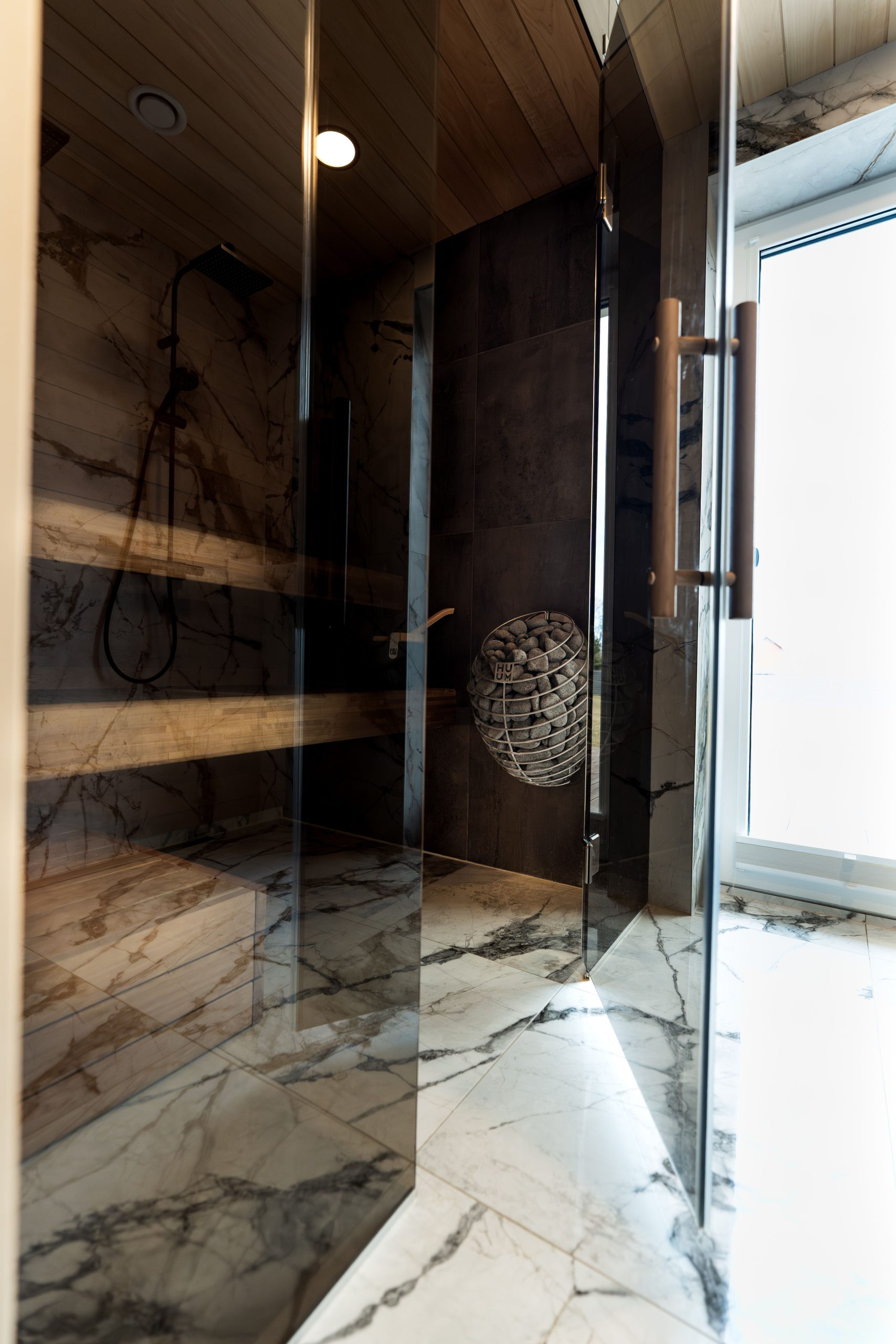
What happens in the body during a sauna session
In a Finnish sauna (typically 80–90 °C) the body is solving a single problem: getting heat out. The response is predictable and measurable.
- Higher heart rate. From a resting 60–80 beats it commonly rises to 120–150 beats per minute. A review in Mayo Clinic Proceedings (Laukkanen et al., 2018) describes the cardiovascular response to sauna bathing as similar to moderate-intensity physical activity.
- Blood shifts to the skin. A substantial part of cardiac output is redirected into the skin circulation so that heat can be carried to the surface. That is why blood pressure falls after a longer session and standing up quickly can leave you dizzy.
- Sweating and fluid loss. A typical loss rate is roughly 0.6–1.0 kg per hour; a single ordinary sauna visit therefore costs you on the order of 0.5 kg. That is a loss of water and salts, not fat — the weight comes back as soon as you drink.
- Heat stress. The rise in core and skin temperature is itself the stimulus for adaptation. The sauna is therefore a load, not a rest, and the body “charges” you for it much as it does for light training.
We covered the basics of technique (length of the phases, number of rounds, cooling down) in the article on how to sauna properly; here we focus on the sporting context.
Heat acclimation: what it is and why it is used before races in the heat
Heat acclimation is controlled, repeated exposure to heat after which the body copes with work in the heat under less physiological strain. The review by Périard et al. (Scandinavian Journal of Medicine & Science in Sports, 2015) describes adaptations that appear as early as the first week of regular exposure:
- Increased plasma volume — more fluid in circulation, a more stable stroke volume.
- Lower heart rate at the same output.
- Earlier onset of sweating and a higher sweat rate — the body starts cooling before the core has a chance to overheat.
- Lower core and skin temperature at a given workload.
- A lower sodium concentration in sweat is also described (more economical handling of salt).
Athletes use this mainly before races in the heat — a marathon in summer, a triathlon in southern Europe, a tournament in the tropics. That is where the benefit is clearest. Whether acclimation also improves performance in cool conditions is far less certain.
What the sauna studies specifically show
The most cited work is that of Scoon and Hopkins (Journal of Science and Medicine in Sport, 2007): six trained runners completed three weeks of sauna bathing immediately after training (approximately 30 minutes at ~90 °C, on average just under 13 sessions). Plasma volume rose by roughly 7 %, time to exhaustion increased, and the authors estimated an improvement equivalent to roughly 2 % of 5 km time.
How to read that: six athletes is a very small sample, the main outcome was a run to exhaustion (not a race), and the result so far lacks strong replication. A more recent study using intermittent sauna exposure in middle-distance runners reported improvements in performance markers both in the heat and in temperate conditions, but here too the samples are small. A reasonable conclusion: plasma expansion is reliably documented, the transfer to performance in cool conditions is promising but not proven.
A review of passive heating (Frontiers in Physiology, 2018) sums up the practical side: the sauna and hot baths are an acceptable alternative to training in a climate chamber, provided they are long enough, frequent enough and start soon after exercise.
A typical protocol — and what comes from research and what from practice
From research: sauna bathing immediately after training, approximately 20–30 minutes in total, a temperature around 85–90 °C, 3–4 times a week for 2–3 weeks. Most cardiovascular changes including the increase in plasma volume set in during the first week; a fuller adaptation is described after 10–14 days of regular exposure.
From practice (this is not a protocol from a study): start with shorter sessions and build up, split the time into two or three rounds, reduce the frequency in the last week before a race and skip the sauna the day before the start. These are operational recommendations, not data.
What the studies do not say: that acclimation replaces training volume, that “the hotter the better”, or that the protocol would be safe for everyone regardless of their state of health.
Where to place the sauna in relation to training
After light or moderately demanding aerobic training — this is the situation in which heat exposure makes the most sense. The body is warm, the adaptive signal adds up and you can handle the load.
Not straight after very demanding strength training, if strength and muscle mass are the goal. The argument here is not against heat as such, but against combining it with exhaustion and dehydration; after a hard strength block the body is already loaded enough and further heat stress is more likely to worsen the quality of recovery. Push the sauna back by several hours, or to another day.
Never on race day or immediately before it. Starting with a fluid deficit defeats the purpose of the whole preparation.
Never when dehydrated. If you are coming off a long session in the heat, or have not yet caught up on drinking, the sauna will deepen the problem and increases the risk of collapse.
Replacing fluids and minerals
The simplest check is weighing yourself before and after on an empty stomach, ideally undressed and after towelling off. The difference in kilograms corresponds roughly to litres of fluid lost. For a sauna session 0.5 kg is normal; after a longer combination with training it can easily be 1–1.5 kg.
The same applies to replacement as to exertion in the heat: the work of Shirreffs and Maughan shows that restoring balance requires drinking roughly 1.25–1.5 times the weight lost (that is, 1.25–1.5 l for every kilogram lost), because part of the fluid leaves in the urine.
Why plain water is not enough when losses are larger: sodium leaves with the sweat. If you replace only water, the blood is diluted, the body starts excreting and much of what you drank simply drains away. In studies with drinks of differing sodium content, the resulting hydration was better the more sodium the drink contained (above roughly 40 mmol/l the difference against plain water was clear). In practice: for losses up to half a litre water is enough; for larger losses add a mineral water with a higher sodium content, a sports drink or plain salty food.
Sauna and sleep
Regular sauna bathing subjectively improves sleep quality, and that is one of the most frequently cited reasons why athletes use it. Soberly: the data are mostly questionnaire-based, that is, based on how people feel rather than on measurements of sleep architecture. The mechanism (the fall in core temperature after warming makes falling asleep easier) is plausible, but there are few good-quality studies. We discuss a similar principle and its limits for hot tubs in the article on the hot tub, health, sleep and recovery. A practical rule: take the sauna 1–2 hours before bed rather than immediately before lying down.
Combining with cold water
Alternating heat and cold is pleasant and subjectively refreshing — and for athletes in particular there is one important “but”. According to several studies, cooling immediately after strength training blunts adaptations: Roberts et al. (The Journal of Physiology, 2015) described markedly smaller gains in muscle mass after 12 weeks of training followed by cold water immersion than in the control group. A 2024 meta-analysis (European Journal of Sport Science) confirms the blunting of hypertrophy; for strength the picture is less clear-cut.
In practice that means: an ice bath after strength training yes, when the aim is rapid recovery between matches or tournament rounds; no, when the aim is building strength and mass. After endurance training the situation is less clear-cut and the data more mixed.
If you are new to cold water, have a look at getting started with cold exposure and, if you have your own tub, at cold plunge water care. Alternating heat and cold itself is covered in the article on contrast therapy.
Goal → protocol → what to watch out for
| Goal | Typical protocol | What to watch out for |
|---|---|---|
| Acclimation before a race in the heat | 20–30 min at 85–90 °C straight after training, 3–4 times a week, 2–3 weeks | Plasma expansion is documented; not in the last days before the start, thorough rehydration |
| Relaxation and subjective recovery | 2–3 rounds of 8–12 min, after light training or on a rest day | The effect is mainly subjective; do not use it as a substitute for sleep and food |
| Support for sleep | 1 shorter block 1–2 h before lying down | Evidence predominantly questionnaire-based; immediately before sleep it may instead disturb it |
| Rapid recovery between matches | A short sauna or contrast alternation, adequate rehydration | Cooling must not intrude on a block aimed at strength and mass |
| Building strength and muscle mass | Move both the sauna and the cold water back by hours or to another day | Cold water immersion straight after strength training blunts hypertrophy |
When to skip the sauna
This is the part there is no point in going around. The sauna is a load on the circulatory system, and in the following situations you do not belong in it:
- Illness and fever. The body is already dealing with heat; further load will not help it.
- Acute injury and swelling. Warming in the first days after a strain, sprain or contusion makes the swelling worse.
- Dehydration. After a long session in the heat, during diarrhoea or after drinking too little, the risk of collapse is substantially higher.
- Alcohol — a fundamental warning. The combination of alcohol and the sauna is the most dangerous thing on this whole list. In a Finnish analysis of sauna deaths (Kenttämies et al., Journal of Forensic Sciences, 2008) half of those who died were under the influence of alcohol. Alcohol blunts the perception of overheating, impairs blood pressure regulation and increases the risk of rhythm disturbances. Never use the sauna after drinking alcohol.
- Cardiovascular disease, unstable blood pressure, arrhythmias, medication (especially for blood pressure, diuretics and psychotropic drugs), pregnancy. None of these means an automatic ban, but it is something you must discuss with your doctor — and decide according to your specific situation, not according to an article.
- Never use the sauna alone if you have any health problems or do not feel well. Most serious sauna incidents happen to someone who is inside unsupervised.
The general safety minimum: at any sign of dizziness, palpitations, nausea or tingling, get out immediately, sit down, cool down gradually and replace fluids.
Infrared cabin, or Finnish sauna?
For heat acclimation what matters is how high the core temperature gets and how long it stays there. A Finnish sauna delivers this stimulus more readily, because it works with a high ambient temperature and the sauna acclimation studies are built on exactly that.
An infrared cabin typically operates at 45–60 °C. The warming is pleasant and more tolerable for a longer stay, but the heat stress is smaller and the data on acclimation in an infrared cabin are considerably weaker. For everyday relaxation and for a flat it is a practical solution — see an infrared sauna for a flat. For targeted preparation for a race in the heat, reach for a Finnish sauna. The differences between cabin types and heating systems are covered in the article on how to choose a home sauna.
Frequently asked questions
How long does it take for heat acclimation to show?
Most cardiovascular changes including the increase in plasma volume set in during the first week of regular exposure; a fuller adaptation is described in reviews after 10–14 days. In the studies, sauna after training was used 3–4 times a week for 2–3 weeks.
How long do the adaptations last if I stop using the sauna?
The adaptations fade over a matter of weeks and plasma volume falls fairly quickly. That is why an acclimation block is planned to finish shortly before a race, not a month in advance.
Will I lose weight by using the sauna?
No. The drop on the scales after a sauna is a loss of water and salts, which come back as soon as you replace fluids. The sauna does not burn fat, nor does it create any “detoxification” mechanism beyond the normal function of the liver and kidneys.
Does the sauna help with muscle soreness after training?
The evidence is weak and mixed. Subjectively many athletes report relief, but there are few good-quality studies that would demonstrate a faster return of performance after warming. Treat it as a pleasant extra, not as a recovery tool with a clear effect.
Can I combine the sauna with a hot tub?
Yes, but the heat load and the fluid loss add up. If a longer stay in a hot tub at 37–38 °C follows the sauna, expect a higher total loss and drink accordingly. The same rules apply as above: not after alcohol, not when dehydrated, not alone if you have health problems.
In conclusion
For athletes the sauna has one clearly documented role — heat acclimation before exertion in the heat, with a measurable increase in plasma volume and a lower heart rate at the same work. Everything else is either weakly supported (sleep, muscle soreness) or marketing (fat burning, detoxification). The key is to place it on the right day, replace fluids and salts thoroughly, and respect the situations in which you do not belong in the sauna.
If you are considering your own sauna, cold plunge or a whole wellness area, have a look at the range in the wellness category — and you will find more texts on similar topics in our Guide.
Disclaimer: this article is informative in nature and does not replace medical advice. People with cardiovascular disease, blood pressure or rhythm disorders, pregnant women and anyone taking medication should discuss sauna bathing with their doctor beforehand.
