
A pool should be an oasis of calm — until the neighbour complains that your pump is droning under their bedroom window. The good news: most pool equipment noise can be eliminated cheaply and quickly, from anti-vibration pads through smart filtration scheduling to a heat pump’s quiet night mode. In this guide we walk through the typical noise sources with approximate decibel levels, how to diagnose the problem by sound, and solutions ranked from the cheapest to full construction work.

Where Does the Noise Come From — and How Loud Is It Really?
Decibels are a logarithmic scale — an increase of 10 dB is perceived by the ear as roughly a doubling in loudness. For reference: 30 dB corresponds to a whisper, 40 dB to a quiet library, 50 dB to a calm office or a modern fridge, 60 dB to normal conversation and 70 dB to a vacuum cleaner. During the day you barely notice your filtration, but at three in the morning, when ambient noise drops below 30 dB, even a “quiet” 50 dB becomes a problem.
Approximate values for individual sources (based on manufacturers’ data sheets, usually measured at a distance of 1 m):
| Noise source | Approximate level (1 m) | Note |
|---|---|---|
| Old single-speed pump | 65–75 dB | Always runs at full power, plus vibrations into the base |
| Inverter (variable-speed) pump at low speed | 40–50 dB | At 30–50% speed it is significantly quieter and filters most of the day |
| Older on/off heat pump | 55–65 dB | Fan + compressor at full power, frequent starts |
| Inverter heat pump in night/quiet mode | 38–48 dB (often below 30 dB at 10 m) | Manufacturers quote a reduction of 3–10 dB versus normal operation |
| Hot tub air blower | 60–70 dB | The loudest element of a hot tub, but only runs during massage |
| Vibrations transmitted into the structure | hard to measure | Low-frequency droning, travels through walls and decking further than through air |
An important detail: check whether the manufacturer quotes sound pressure at a given distance (dB at 1 m, 10 m) or the sound power of the whole unit. The power figure tends to be 8–15 dB higher — two units that look “equally loud” on paper can then differ very noticeably in reality.
Diagnosis: What Does the Sound Tell You?
Before you start spending, listen. The character of the sound usually points straight to the cause.
- Deep humming or whining from the pump — typically worn motor bearings, or possibly cavitation (the pump “chewing” air bubbles due to insufficient water inflow). You will find a detailed procedure in our article pool pump humming or not starting.
- Rattling or clicking — most often debris in the pump’s pre-filter: a pebble, a fragment of plastic or a hard leaf swirling around in the basket. Just switch off, clean the basket and check it is not cracked.
- Buzzing vibrations and droning — a pump bolted rigidly to concrete or wood without a flexible buffer transmits its vibration to the whole structure. The sound then “plays” several metres away; with a hot tub on a deck it can carry right into the living room below.
- Whistling or hissing from the heat pump fan — a damaged blade, ice build-up or an obstruction in the air intake. Check that nothing is hanging around the unit and that the fins are not clogged.
A practical tip: a free sound-meter app on your phone will handle rough measurements. It is not a certified measurement, but you will see the “before and after” difference of every measure immediately — and a number in hand is also useful when talking to your neighbour. Measure in the evening, when ambient noise does not distort the picture, always from the same spot and at the same height.
Solutions from the Cheapest Up: What to Try First?
1. Anti-Vibration Pads (a Few Euros)
Rubber or silent-block pads under the feet of the pump and the heat pump break the transmission of vibrations into the base. With a pump bolted directly to a concrete slab, this is often the difference between “the whole pit is droning” and “I can only hear a faint hum”. An investment of roughly 8–30 €, ten minutes of work.
2. Tightening Connections and Flexible Hose Couplings
A loose union, a slack flange or a pipe resting against the wall of the pit acts as a sounding board. Tighten the connections, cushion the pipework with rubber and, where a rigid pipe connects directly to the pump, consider a short flexible coupling — it absorbs the vibration before it spreads through the whole system.
3. Move Filtration to the Daytime
The cheapest “silencing” of all: a timer. Filtration does not need to run at night — schedule it between 8 a.m. and 8 p.m., when the noise disappears into everyday background sound, and let the equipment sleep at night. How many hours a day you actually need is something you can calculate in our article how long to run your pool filter.
4. The Heat Pump’s Night / Quiet Mode
Most modern inverter heat pumps have a “silent mode” in their controls: it limits the fan speed and compressor output, by 3–10 dB according to manufacturers. Heating takes longer, but overnight it is usually enough just to maintain the temperature. On many models the mode can be scheduled automatically, for example from 9 p.m. to 7 a.m.
5. Upgrading to Inverter Technology
If you are still running a ten-year-old single-speed pump or an on/off heat pump, swapping it for an inverter solves both the noise and the electricity bills in one go — at low speed an inverter pump runs 15–25 dB quieter and consumes a fraction of the energy. How inverter heat pumps work is described in our guide to heat pumps for pools and hot tubs; automatic speed control according to demand is then handled by smart pool automation.
Construction Solutions: Equipment Pit, Wall, Smart Placement
When the cheap steps are not enough — typically on small plots where the equipment sits a few metres from the neighbour’s fence — it is time for construction work.
- An equipment pit or shed. An enclosed, insulated space knocks 10–20 dB off the pump noise. The essential condition: ventilation. The motor needs cooling and moisture must get out, otherwise you shorten the equipment’s lifespan and condensation lingers in the pit. Point the vents away from the neighbours.
- A noise barrier or dense greenery. A solid wall (masonry, gabion, a massive fence) between the source and the neighbour works — but it must be higher than the direct line between source and ear. A hedge tends to scatter noise and soften it psychologically; physically it attenuates only a few dB — the ideal is a combination of both.
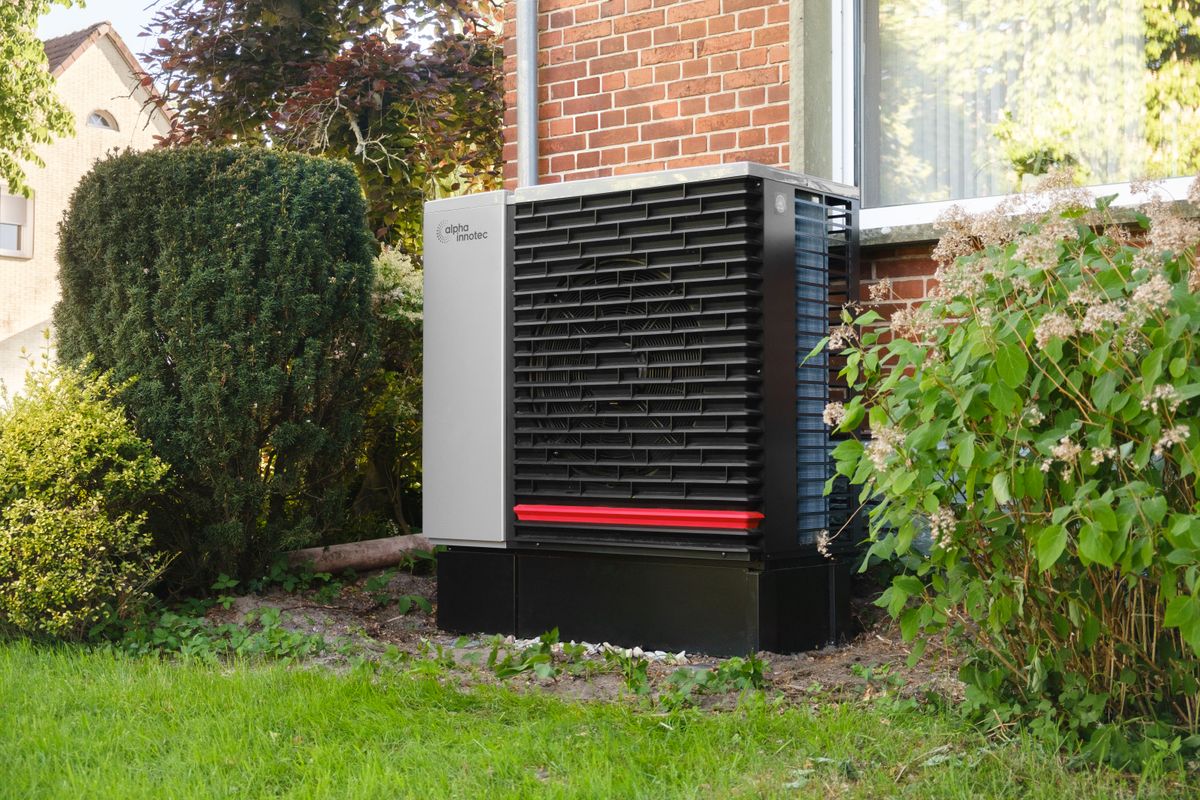
- Heat pump placement. Do not install a heat pump in a corner between two walls — the reflections effectively amplify the noise, and manufacturers quote a penalty of up to +6 dB for such placement. The ideal: open space, air discharge towards the garden, as far as possible from bedrooms — yours and your neighbours’.
- A soft base under the unit. A heat pump on rubber blocks on a concrete pad is quieter than a unit bolted to the house wall, which acts as a soundboard.
Also bear in mind that a heat pump sounds different in summer and in the cold season: at temperatures below 10 °C the unit occasionally defrosts and briefly changes its sound — that is normal operation, not a fault. So when planning the location, also consider where you will be hearing the equipment in spring and autumn, when the heat pump works hardest.

Hot Tub at Night: How Not to Disturb the House or the Neighbours?
The massage pump itself you switch on deliberately — the problem is usually the automatic filtration cycles, which are factory-set to start at, say, 2 a.m. Reschedule them to daytime in the control panel; the circulation pump of a modern hot tub is admittedly quiet (often below 45 dB), but vibrations through the base can wake a light sleeper a floor below.
With a hot tub on a deck or balcony, focus precisely on the transmission of vibrations into the structure: a rubber mat or support pads under the shell will do more than any wall insulation. What a deck under a hot tub has to bear and how to prepare it is covered in our article on a hot tub on a deck and structural load. And use the blower thoughtfully — it is the loudest function of a hot tub, and after 10 p.m. you can do without it.
Neighbours and the Legal Minimum
Most municipalities enforce night-time quiet hours — typically from around 10 p.m. to 6 or 7 a.m. — and noisy equipment during that time is the shortest route to a conflict and to a visit from the authorities. Noise limits for residential outdoor areas are set by local environmental and public health regulations, and their measurement and enforcement is handled by the relevant local authority; a permanently noisy heat pump is therefore not just a matter of courtesy.
In practice, though, the cheapest noise-control measure is communication. Tell your neighbours when the filtration runs, offer to adjust the schedule, and the problem usually disappears before anyone reaches for a measurement report.
Overview: Noise Source → Solution → Effort
| Source / symptom | Solution | Effort and cost |
|---|---|---|
| Pump vibrations into the base | Anti-vibration pads, silent blocks | Low, up to 30 € |
| Rattling pipework and connections | Tightening, rubber pads, flexible coupling | Low, DIY |
| Rattling inside the pump | Cleaning the pre-filter basket | Low, 5 minutes |
| Filtration noisy at night | Timer — daytime operation only | Low, timers from 12 € |
| Heat pump disturbing in the evening | Night/quiet mode, scheduling | Low, panel settings |
| Humming bearings in an old pump | Overhaul, or upgrade to an inverter | Medium, a few hundred € |
| Old on/off heat pump | Upgrade to an inverter heat pump | Higher, a four-figure sum in € |
| Noise carrying to the neighbours | Ventilated pit/shed, solid wall, relocating the heat pump | Higher, construction work |
| Hot tub vibrating into the deck | Rubber mat, daytime filtration cycles | Low to medium |
Frequently Asked Questions
How loud is a pool pump in decibels?
An old single-speed pump produces roughly 65–75 dB at 1 m, a sound comparable to a vacuum cleaner. An inverter pump at low speed runs at around 40–50 dB, which corresponds to a quiet office — over the fence you can practically no longer hear it.
Can a heat pump run at night?
Technically yes, but because of night-time quiet hours it is better to schedule heating for the day and leave only the quiet mode on overnight, which reduces the fan speed by 3–10 dB. Modern inverter heat pumps in night mode often drop below 30 dB at 10 m — close to the level of a whisper.
Why is my pump suddenly humming louder than before?
The most common causes are worn motor bearings, cavitation from air in the suction line, or debris in the pre-filter basket. You can tell them apart by the character of the sound: whining points to bearings, rattling to debris, gurgling surges to cavitation.
Does a hedge help against noise?
Only partially — greenery scatters the noise and visually hides the source, but the physical attenuation amounts to just a few dB. What works reliably is a solid barrier (a wall, a gabion) higher than the direct line between the source and the listener’s ear, ideally complemented by greenery.
Do I have to worry about ventilation in an equipment pit?
Yes, always. An enclosed pit without ventilation overheats the pump motor and traps moisture, which shortens the equipment’s lifespan. Orient the ventilation grilles away from the neighbours — you solve cooling and noise at the same time.
A quiet solution usually does not start with an excavator, but with a rubber pad, a timer and one evening spent in the control panel settings. And if it is time to retire your old noisy equipment, you will find inverter pumps, heat pumps and complete filtration systems in our pool equipment category — your ears and your neighbours will appreciate it from the very first night.
