
The sauna heater is the heart of every sauna — it determines how quickly the cabin heats up, what the climate inside feels like and how much your sauna sessions will cost. The short answer: choose an electric heater where you want convenience, clean operation and precise control (typically a house or flat in town), and a wood-fired heater where a strong electrical supply is missing and where the ritual of fire is part of the experience — typically at a cottage or country retreat. In this article we take both options apart in detail: from sizing the output through sauna stones to safety and the chimney.
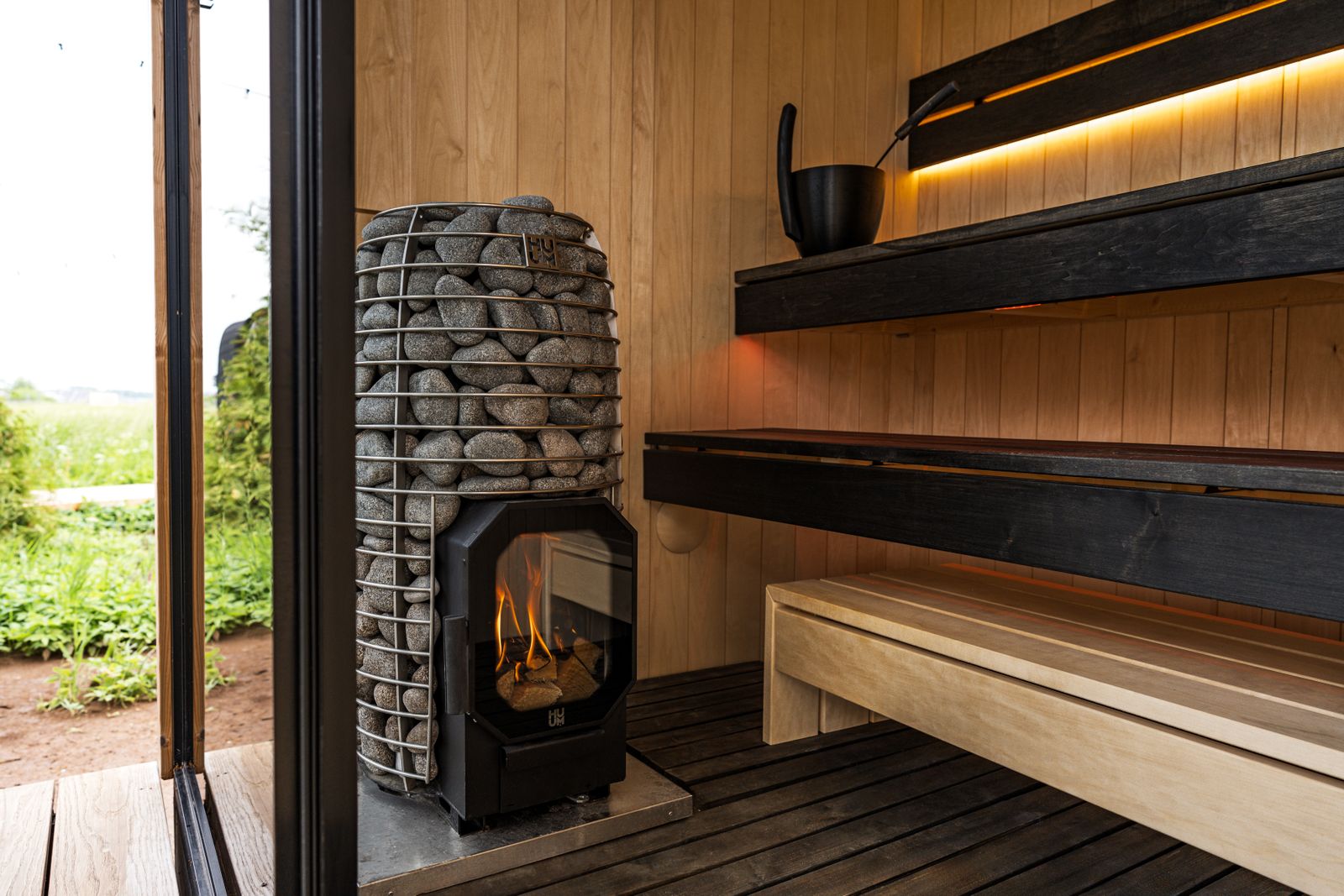
If you are still deciding what kind of sauna to get in the first place — Finnish, infrared, outdoor or indoor — start with our guide How to choose a home sauna. This article goes one step further: it assumes you already have or are planning the cabin, and deals purely with its heating heart.
Electric sauna heaters: cleanliness, simplicity, precision
Electric heaters are by far the most common choice for home saunas today — and for good reason. You switch them on with a button or an app, they need no chimney, produce no ash or smoke and hold the temperature to within a few degrees. For a sauna in a family home, an apartment wellness area or anywhere in town, they are practically the only sensible route.
How many kW do you need? The rule of thumb: 1 kW per 1 m³
The basic rule, quoted by the Finnish manufacturer Harvia among others: allow roughly 1 kW of heater output per 1 m³ of cabin volume. A sauna measuring 2 × 2 × 2.1 m has a volume of about 8.4 m³ — so a heater of around 8–9 kW is the right match.
Watch out for the corrections, though. Uninsulated surfaces increase the required output significantly: according to Harvia, every 1 m² of glass, stone or other uninsulated surface acts as if the cabin volume had grown by a further 1.2 m³. For cabins built from uninsulated solid logs, the entire volume is multiplied by a factor of 1.5. A glazed designer sauna of 8 m³ with four square metres of glass therefore effectively needs a heater sized for about 13 m³ — that is, around 12–13 kW. An undersized heater struggles, takes ages to heat up and never gets the stones properly hot; slight oversizing, on the other hand, does no harm.
Power supply: from 3.6 kW upwards, plan for 400 V
Small heaters up to roughly 3.6 kW can be connected to a standard 230 V supply. The vast majority of home heaters (6, 8, 9 kW), however, require a three-phase 400 V supply with an appropriate circuit breaker — typically 3× 16 A for a 9 kW heater. The connection must be made by an electrician using a fixed cable with an adequate cross-section and temperature rating (silicone cable is used inside the cabin); a makeshift plug-and-socket arrangement has no place in a sauna. The situation is similar to hot tubs — we covered it in detail in our article on hot tub electrical requirements.
Controls: thermostat, timer, Wi-Fi
Basic heaters have a built-in thermostat and a rotary timer. The higher class uses an external control unit with a digital panel outside the cabin and, increasingly often, a Wi-Fi module with a mobile app — so you can preheat the sauna on your way home from work and keep an eye on temperature and consumption in the app. Manufacturers such as Harvia (MyHarvia app) or Estonian HUUM (HUUM app) offer remote control as standard on their flagship models; EU legislation requires safety features for remote start, such as a door-closed sensor on the cabin.
Wood-fired heaters: the ritual of fire and independence from the breaker box
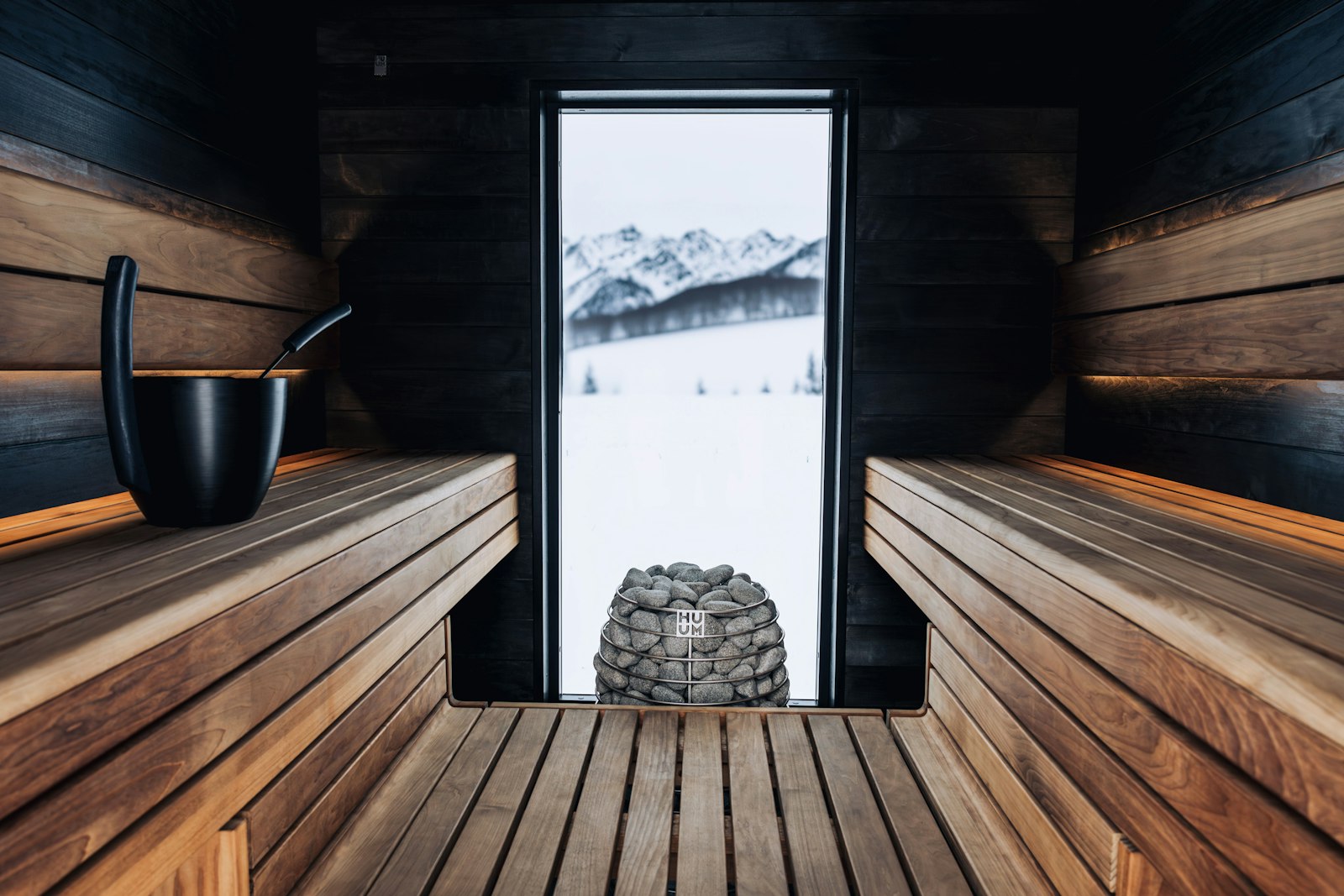
Wood-fired heaters are the original, “real” Finnish way. The crackle of logs, the scent of smoke before you step in and the soft radiant heat create an experience electricity cannot imitate. And there is a practical argument too: at a cottage with a weak breaker or no electricity at all, a wood-fired heater is the only option. A nine-kilowatt electric heater would stand no chance on a typical single-phase 25 A cottage supply.
What a wood-fired heater requires: a chimney and inspections
A wood-fired heater needs a flue and chimney sized for wood burning, terminating above the roof in accordance with the relevant standards. Before it is put into service, the flue system must be checked and approved by a certified chimney inspector, and after that regular inspection and cleaning is required — in most countries at least once a year for solid-fuel appliances. The exact requirements vary from country to country across the EU, but the principle is the same everywhere: do not run the sauna without a valid chimney inspection, not least because of your insurance. For outdoor saunas in built-up areas it also pays to check local rules on wood burning and the siting of the structure in advance.
The longer heat-up is part of the ritual
An electric heater brings a well-insulated sauna to 80 °C in roughly 30–60 minutes. With a wood-fired heater, allow 45–90 minutes — you have to light the fire, keep feeding it and watch the draught. A drawback for some, and for others exactly the reason to want wood: preparing the sauna is a meditation in itself. Consumption is roughly one armful (5–10 kg) of dry hardwood per session; the fuel must be dry, with a moisture content below 20%.
Comparison: electric vs. wood-fired sauna heaters
| Criterion | Electric heater | Wood-fired heater |
|---|---|---|
| Purchase price | from about €330, quality models €600–1,600, designer units with Wi-Fi over €2,000 | from about €500 + chimney and installation, often €1,200–3,200 in total |
| Running costs | 8 kW heater, 1.5 h of operation ≈ 8–10 kWh ≈ €2–3 per session | 5–10 kg of wood ≈ €1–2, almost free with your own firewood; + annual chimney inspection |
| Heat-up to 80 °C | 30–60 minutes, unattended | 45–90 minutes, needs stoking |
| Installation requirements | 400 V supply, electrician; no chimney | chimney, flue inspection; no demands on the breaker |
| Temperature control | precise, thermostat/app | manual, by stoking and draught |
| Maintenance | minimal — checking stones and heating elements | ash after every firing, chimney cleaning, sweep’s inspections |
| Best suited to | town, family home, indoor saunas, frequent sauna use | cottages and cabins, outdoor saunas, lovers of the fire ritual |
Prices are indicative, based on typical European offerings in 2026; the electricity cost is calculated at around €0.25–0.32 per kWh.
Sauna stones: the underrated key to good steam
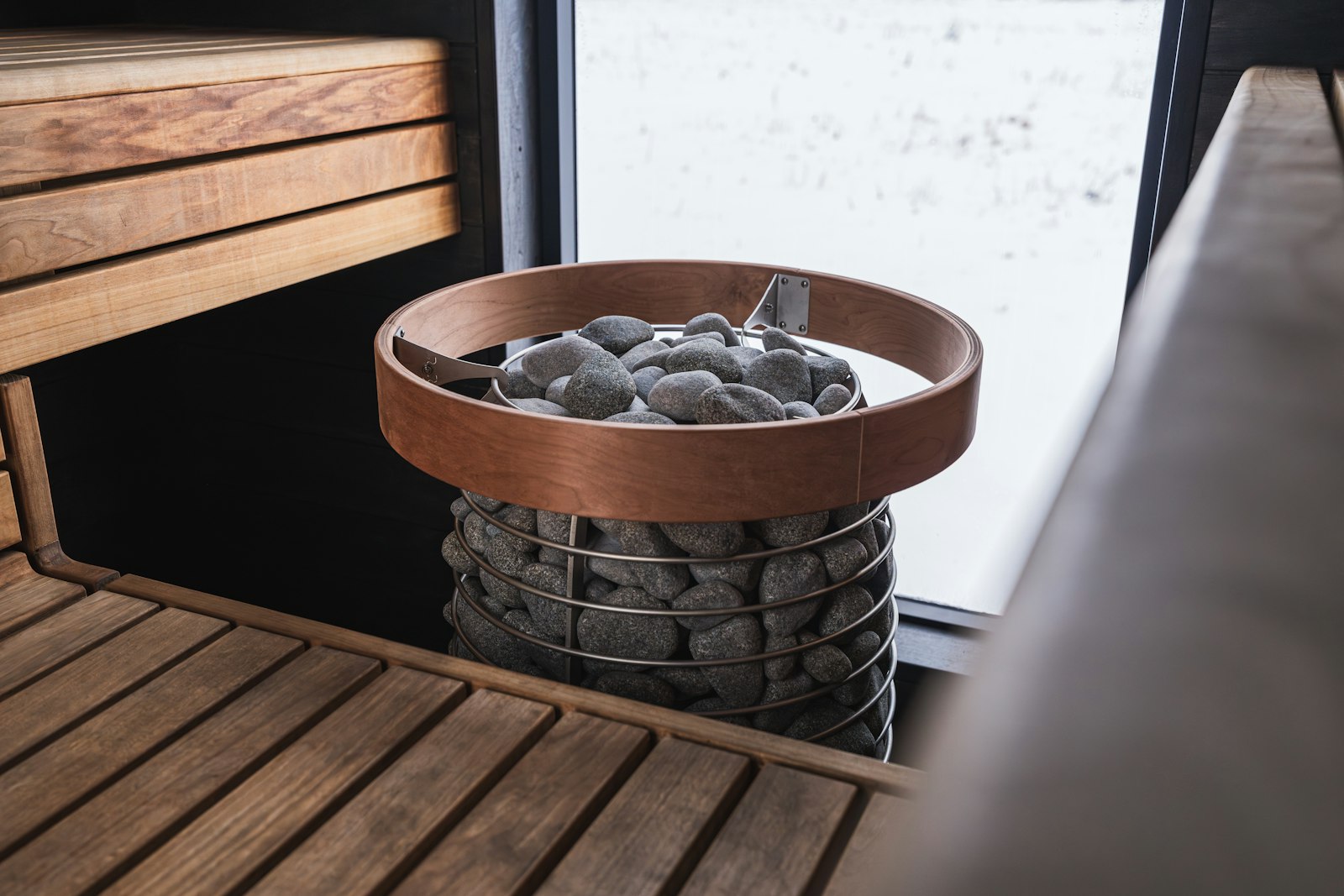
The stones are not decoration — they store heat and, when water is poured over them, create steam (löyly in Finnish). The whole experience stands or falls on the quality and quantity of the stones.
How many stones, and which ones?
The quantity is specified by the manufacturer for each model, and the differences are huge: a typical wall-mounted heater holds 20–40 kg, designer column heaters considerably more — for example the HUUM DROP takes 55 kg, the CLIFF 75 kg and the HIVE Mini as much as 150 kg of stones. The more stones, the softer and longer-lasting the steam. Use only stones intended for saunas — typically olivine diabase or peridotite — in the grade prescribed by the manufacturer (most often 5–10 cm, 3–5 cm for some models). Ordinary stones from the garden can crack under thermal shock, or even shatter and “shoot out”.
How often should the stones be replaced?
HUUM recommends checking the stones once a year or after roughly 300 hours of heating; if you sauna three times a week, that means replacement about once a year, and with occasional use once every two to three years. Over time the stones crumble and break down — the debris then blocks the airflow, the heater overheats and the heating elements fail prematurely. At every check, restack the stones loosely so air can flow between them, discard cracked pieces and top up the missing volume.
Safety: clearances, a guard rail and a CO detector
Sauna heaters work with temperatures of several hundred degrees, which is why a few iron rules apply:
- Safe distances from wood — every manufacturer specifies minimum clearances from walls, benches and the ceiling (typically a few to a few dozen centimetres for electric heaters depending on the model, considerably more for wood-fired heaters, possibly with shielding by a non-combustible board). Never go below the values in the manual.
- A protective guard rail — a wooden rail around the heater protects against accidental contact. Mandatory wherever children use the sauna; a sensible choice everywhere.
- Never dry anything on the heater — a towel on the heater is the most common cause of sauna fires.
- A CO detector for wood-fired heaters — carbon monoxide is invisible and odourless. A CO detector in the sauna anteroom (not in the hot cabin itself, where it would be damaged) costs a couple of dozen euros and can save a life. A smoke alarm in the adjoining rooms goes without saying.
- Air supply — a wood-fired heater consumes oxygen; both the cabin and the firebox must have ventilation provided in line with the design.
Accessories that make a sauna a sauna
A quality heater comes with a few companions without which proper sauna bathing is impossible:
- Bucket and ladle — wooden or combined with a liner, for pouring water over the stones. Always pour small amounts of water, and never onto electrical parts.
- Thermometer and hygrometer — ideally a combined instrument; in a Finnish sauna you aim for 70–100 °C and 10–20% humidity.
- Hourglass — the classic 15-minute timer, because electronics do not belong in 100 °C and session length is worth watching.
- Backrests, seat mats and sauna towels — always put a towel or mat on the bench; it protects the wood from sweat.
How long to stay in the sauna, how many rounds to do and how to cool down properly — we covered all of it in detail in our article How to sauna properly.
Combi and bio heaters: steam on demand
Between the classic Finnish sauna and the steam bath stands the combi heater with an evaporator (often labelled “combi” or bio heater). Alongside the heating elements it has a water tank that produces a constant gentle mist — the cabin can then run as a milder “bio sauna” at around 50–65 °C and 30–65% humidity. Sauna essences can be dosed into the evaporator, so the heater handles aromatherapy and herbal baths too. Combi heaters are a great choice for families where some members do not enjoy the hot Finnish sauna; the price is a higher purchase cost and somewhat more demanding maintenance (descaling the tank).
Conclusion: choose the heater to match the place and the ritual
In the end the decision is simpler than it seems. If you have a 400 V supply available and want to sauna comfortably, often and without worries, choose a quality electric heater correctly sized for the cabin volume — ideally with a reserve for glazing. If you sauna at a cottage where the breaker will not cope, or you simply love fire, invest in a wood-fired heater with a proper chimney and inspection. In both cases, do not skimp on the stones or on safety. You will find sauna heaters, stones and complete home wellness equipment in our wellness category — and more guides to the world of saunas and hot tubs in our advice section.
Frequently asked questions
How powerful a heater do I need for a 2 × 2 m sauna?
A 2 × 2 m cabin with a height of 2.1 m has a volume of about 8.4 m³, which calls for a heater of around 8–9 kW. If you have a glass door or wall, add the equivalent of 1.2 m³ of volume for every m² of glass — so realistically more like 9–10.5 kW.
Can I plug an electric sauna heater into an ordinary socket?
Only the smallest ones up to about 3.6 kW. Typical home heaters of 6–9 kW require a fixed three-phase 400 V supply with its own circuit protection, which may only be connected by an electrician. The cable inside the cabin must be heat-resistant (silicone).
How often are sauna stones replaced?
Check them once a year or after roughly 300 hours of operation. With three sauna sessions a week that works out at replacement about once a year; with occasional use, once every two to three years is enough. Always replace cracked and crumbling stones — they restrict the airflow and destroy the heating elements.
Do I need a chimney inspection for a wood-fired heater?
Yes. Before the heater is put into service, the flue system must be approved by a certified inspector, and regular inspection and cleaning is required afterwards — in most countries at least once a year for solid-fuel appliances. Your insurer will also ask for the inspection certificate in the event of a claim.
What are bio heaters and what is the evaporator for?
Bio (combi) heaters combine classic heating elements with a water evaporator. They allow milder sauna sessions at 50–65 °C with higher humidity and the dosing of aromatic essences. One heater thus covers both a Finnish sauna and a gentle herbal bath.
