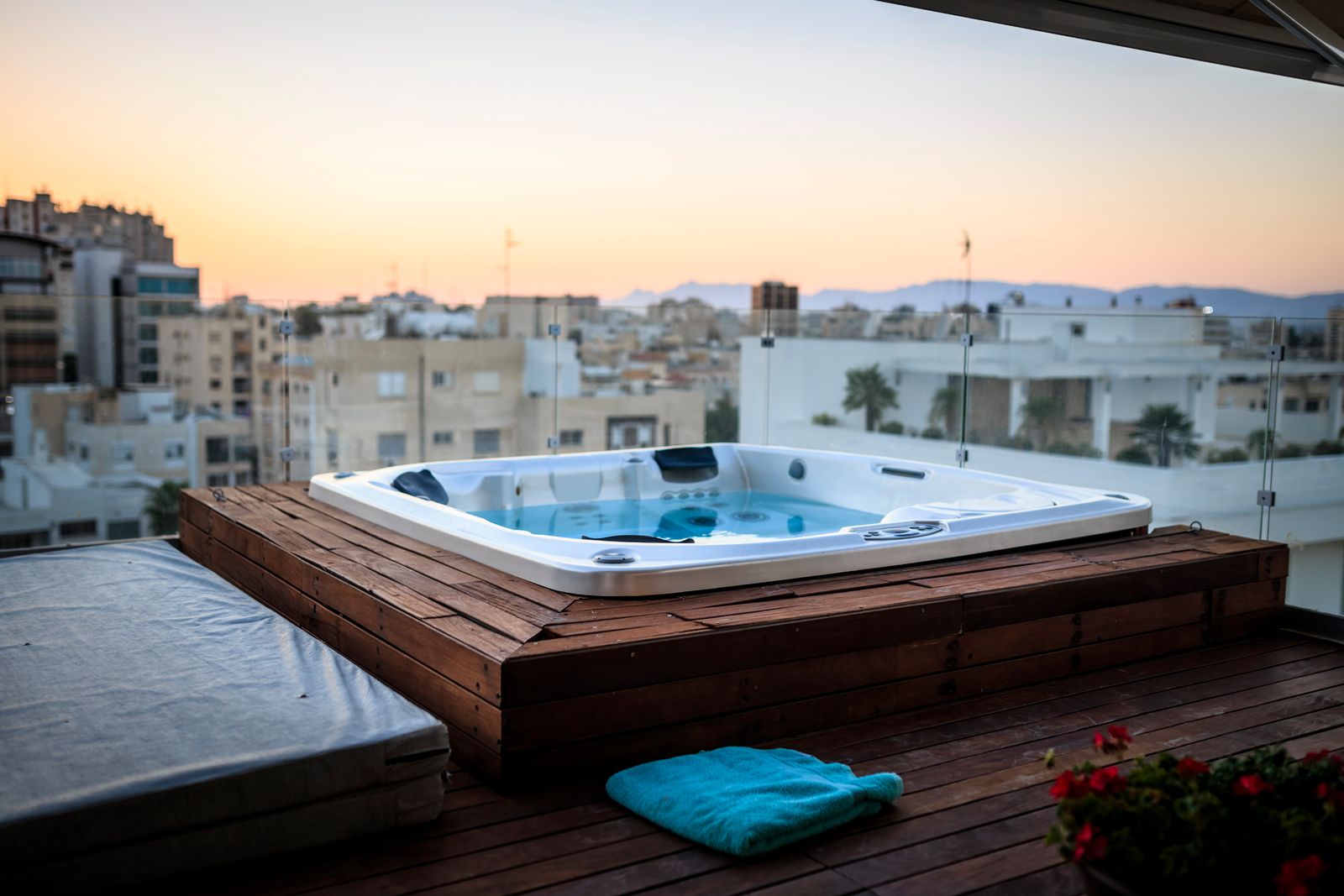
A hot tub and a pool are among the biggest energy consumers in a household — and at the same time among the most flexible. You can shift water heating by hours without any loss of comfort, right into the moments when electricity on the exchange is cheapest. With a spot-price tariff and simple automation, you can save well over a hundred euros a year without giving anything up.
What is a spot tariff and how do hourly prices work?
With a classic fixed tariff, you pay the same for every kilowatt-hour, whether you use it at three in the morning or seven in the evening. With a spot tariff, the price of the energy itself follows the short-term wholesale market, organised across Europe by day-ahead power exchanges such as EPEX Spot. Prices for the following day are published every afternoon — for each hour, or increasingly for each quarter-hour separately.
Your supplier adds their margin and a standing fee to the exchange price; the regulated part (grid charges and levies) stays the same as with a standard tariff. The prerequisite is interval metering — a smart meter that records consumption in time intervals. Grid operators are rolling these out widely, and at connection points with a higher-rated breaker, typical for a hot tub or heat pump, they are often already standard.
The key point is that you know the prices a day ahead. In the evening you check (or your automation checks) which of tomorrow’s hours will be cheap, and schedule the heating precisely into them.
What does a typical day on the spot market look like?
The daily price curve in Central Europe follows a fairly readable rhythm that repeats for most of the year:
- Night (roughly 0:00–5:00): low demand, cheap hours — the traditional “valley”.
- Morning (roughly 6:00–9:00): the first peak — households and businesses start up, prices jump.
- Midday (roughly 10:00–15:00): thanks to massive solar generation, prices fall on sunny days, in spring and summer even towards zero; negative prices, where you effectively get paid to consume, appear on the market more and more often.
- Evening (roughly 17:00–21:00): the most expensive part of the day — the sun sets and demand peaks. The gap between midday and the evening peak is commonly two to five times.
Exact values vary from day to day with the weather, the season and the situation across the European grid. What matters is the pattern: cheap nights, cheap sunny middays, expensive mornings and evenings. And that is exactly the pattern a pool and a hot tub can exploit perfectly.
Why are a hot tub and a pool ideal appliances for spot pricing?
Water is an excellent heat store. A hot tub holding 1,000–1,500 litres under a quality thermal cover loses only around 0.5–1 °C per hour even in freezing weather; well-insulated models considerably less. A pool with tens of cubic metres of water is even more inert — under a cover it typically loses 1–2 °C overnight.
This means the heating does not have to run while you are bathing. You can “charge” the water to the target temperature during cheap hours and let it coast through the expensive peak — or switch the heating off entirely. Comfort stays the same; only the bill changes. The same logic applies to combining with your own generation, which we cover in our article on solar PV for pools and hot tubs — spot pricing is essentially its equivalent for anyone without panels.
How much heating actually consumes is something we calculated in detail in Hot tub running costs — and precisely because it amounts to hundreds to thousands of kilowatt-hours a year, it pays to think about when you draw them, not just how many.
Practical strategies: when to heat, filter and hold temperature
The basic rule: move energy-intensive operations into the night valley and the sunny midday, and let the peaks run on stored heat alone.
| Equipment | What to shift into cheap hours | What to do during the peak | Key condition |
|---|---|---|---|
| Hot tub | Top-up heating to 38 °C at night or over midday; water changes and reheating after refilling strictly in the valley | Heating off or a lowered target temperature; the water holds its heat under the cover | A quality thermal cover — without it, the heat “escapes” during the peak |
| Pool with a heat pump | Heating and the main filtration cycle over midday (cheap power + higher outdoor temperature = higher COP) | Heat pump and filtration both idle; the pool is covered by a solar cover or enclosure | A timer or filtration automation |
| Swim spa | Tempering the larger water mass at night and over midday; use the swim jet any time — it only runs briefly | Maintenance only; the large water volume holds its temperature | An insulating cover across the entire surface |
| Filtration and water treatment | The whole filtration cycle, filter backwashing, UV/ozone operation into the valley | The minimum — only a short run-on if needed | Keep to the required daily filtration time |
With a hot tub, it also pays to know the heating dynamics — we cover how long it takes to raise the temperature by a degree in How to heat a hot tub and pool faster. A typical hot tub with a 3 kW heater raises the temperature by roughly 1.5–2 °C per hour, so a two- to three-hour cheap window is plenty to reheat after a whole day of coasting.
How to control it all: from a timer socket to Home Assistant
A spot tariff only makes sense if you actually manage your consumption. The options range from simple to fully automatic:
- Your supplier’s app and manual planning: most spot-tariff suppliers show tomorrow’s prices in their app. You then manually set the filtration timer or lower the hot tub temperature. It works, but it requires discipline.
- A smart plug or switching relay: for a filtration pump or a heat pump up to 16 A, a smart plug/relay with a scheduler is enough; more advanced models can switch directly according to hourly prices.
- Hot tub WiFi control: modern hot tubs with a WiFi module let you change the target temperature and economy modes from your phone — so you schedule reheating into cheap hours without ever touching the power supply.
- Home Assistant and similar platforms: full automation — the system downloads tomorrow’s prices, picks the cheapest hours and switches heating, filtration and the heat pump on by itself. You set the rules once and never worry again.
A complete overview of smart pool equipment control, including specific scenarios, is in our article Smart pool and automation.

What to watch out for: freeze protection, expensive days and breakers
Never disconnect the freeze protection. Managing a hot tub by price means changing the target temperature or modes — never hard-cutting the power with a smart plug in winter. A hot tub without power in freezing weather is a matter of hours before serious damage to the plumbing and pumps. What safe winter operation looks like is described in Hot tub in winter.
Spot can also be considerably more expensive. On tight days (a freezing, windless inversion, generation outages across Europe), even night-time prices can soar. Anyone who heats “whenever they feel like it” can lose money on spot pricing — the savings stand or fall with discipline, ideally with automation that skips the expensive hours by itself.
Breakers and reserved capacity: if you concentrate hot tub heating, the heat pump, the washing machine and car charging into the same cheap hours, your instantaneous draw rises. Check that your main breaker can handle the overlap, or set up appliance prioritisation.
Off-peak dual tariffs vs. spot: a dual-rate tariff with utility-controlled off-peak hours (ripple control) is the simpler relative of spot pricing — the cheap hours are set by the grid operator, not the exchange. For a passive user, the dual tariff tends to be more convenient; spot offers greater savings potential, but only with active management. The two approaches cannot be freely combined — you have one distribution rate, and only the way the energy itself is purchased changes.
Model calculation: how much can shifting the heating save?
The following calculation is an illustrative model, not any supplier’s offer. Assumptions: a hot tub with an annual heating consumption of 1,500 kWh (see our breakdown of running costs), an average all-in price of €0.24/kWh in peak hours and €0.12/kWh in cheap hours (spot-based energy + regulated charges, which are the same in both cases).
| Scenario | When the heating runs | Price per kWh (model) | Annual heating cost |
|---|---|---|---|
| No management | Any time, often during the peak | Ø €0.20 | €300 |
| Manual planning | Mostly night and midday, occasionally the peak | Ø €0.152 | €228 |
| Full automation | Practically only cheap hours | Ø €0.124 | €186 |
The difference between unmanaged and fully automated operation in this model comes to roughly €115 a year for the hot tub alone. For a pool with a heat pump and a seasonal consumption of 1,000–2,000 kWh for heating and filtration, the savings come out similar; on top of that, running the heat pump at midday improves its COP, so you save twice. Actual amounts depend on how exchange prices develop, your distribution rate and your level of discipline.
Who is a spot tariff right for — and who isn’t it?
Spot pays off if: you have large shiftable appliances (a hot tub, a pool heat pump, a swim spa, a water heater, an electric car), you are willing to set up automation or at least follow the app, and you can handle the swings — in an expensive month you pay more, in a cheap one less.
We would rather advise against spot if: you want absolute bill predictability, you have no intention of managing your consumption, or most of your usage falls into the evening peak anyway and cannot be shifted. In that case a fixed tariff or a dual-rate off-peak tariff is usually the wiser choice — and look for savings in insulation, a thermal cover and more efficient equipment instead.
Frequently asked questions
Do I need a new electricity meter for a spot tariff?
Yes, the prerequisite is interval (smart) metering that records consumption in time intervals. Grid operators are installing them widely and usually free of charge; at connection points with a higher-rated breaker, one is often already fitted. Just ask your grid operator.
Won’t the hot tub cool down if I switch the heating off through the evening peak?
Under a quality thermal cover, a well-insulated hot tub typically drops 1–2 °C over 3–4 peak hours. Reheating in the following cheap window evens it out in an hour or two. Without a proper cover, though, the strategy fails — the heat escapes before you can replace it cheaply.
Can I switch my hot tub with a smart plug in winter?
No. A hard power cut disables the freeze protection and risks frozen plumbing. In winter, always manage consumption only by changing the target temperature or economy modes via the hot tub’s controls, ideally with a WiFi module.
What if exchange prices become extremely high?
You ride out short-term spikes thanks to the heat stored in the water — you simply skip heating for a few hours. Sustained high prices will show up on your bill; some suppliers therefore offer spot with a price cap, or the option to switch back to a fixed product. Check the terms in your contract in advance.
Is spot worth it even without automation?
Partially — simply shifting heating and filtration to night and midday with a timer captures most of the potential. Full automation based on hourly prices, however, also exploits days with an atypical curve and removes the risk of human forgetfulness.
If you are getting your pool or hot tub ready for spot hours, start with the equipment: an efficient heat pump, correctly sized filtration and controllable heating are the foundation on which every kilowatt-hour works in your favour. You will find the equipment in our pool technology category — and more guides in our Advice centre.