
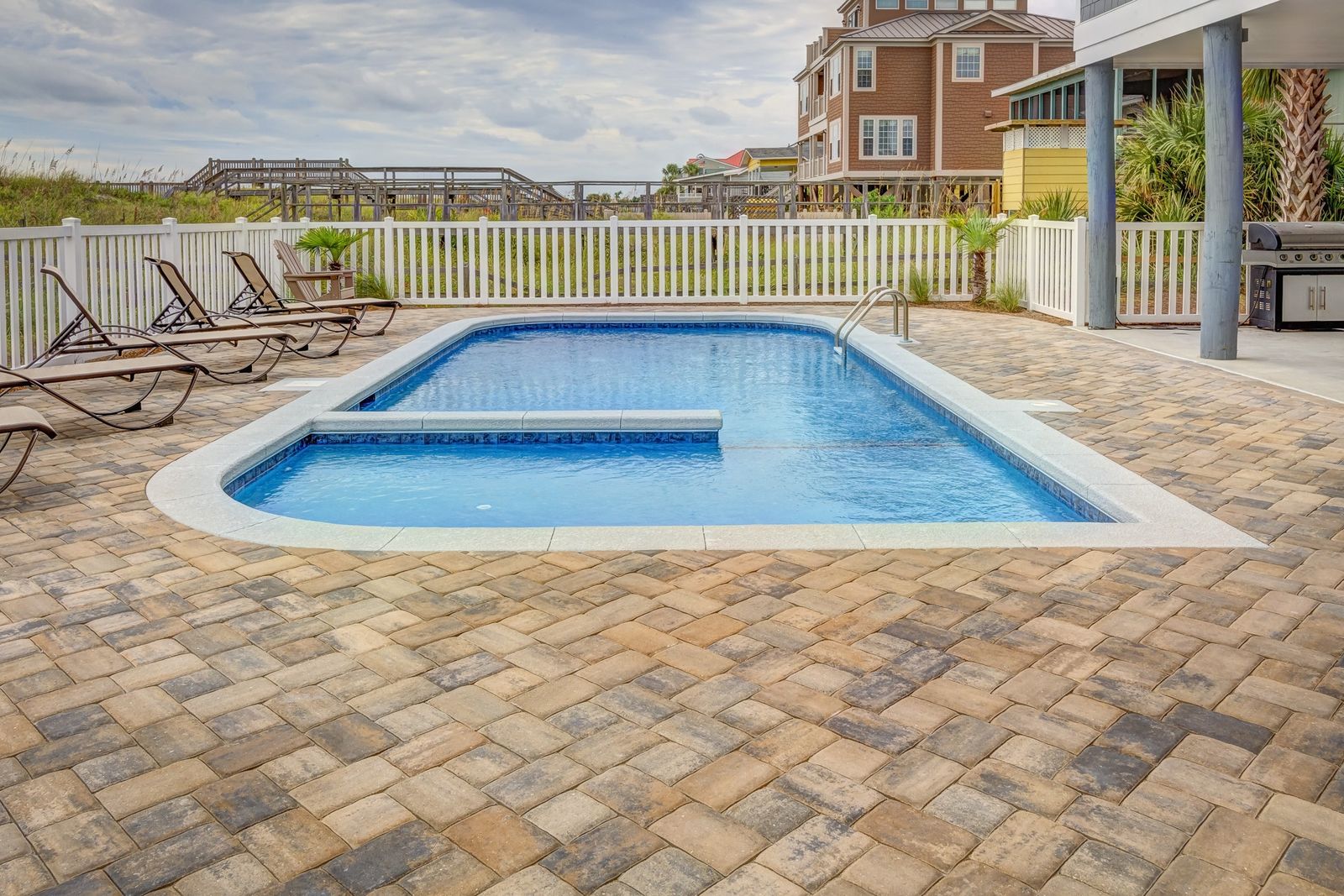
A pool alarm alerts you the moment a child or pet falls into the water, or when someone approaches the pool without your knowledge. You can choose from submersible surface-wave alarms, infrared barriers, gate alarms, child wristbands with an immersion sensor and cameras with AI person detection. One thing, however, holds true without exception: no technology replaces adult supervision — an alarm is a safety net for the moments when everything else fails, not a substitute for attention.
Why bother with a pool alarm at all?
The drowning of a small child is fast and silent — no cries for help, no splashing you would hear from the house. And the critical window is just a few dozen seconds. This is precisely the gap an alarm is meant to fill: it turns a silent event into a loud sound that forces you to react immediately.
An alarm, however, is only the last link in the chain. We have dedicated a separate article to rules, barriers and supervision principles — on child safety around pools and hot tubs — start there. This text focuses purely on the technology: what the individual alarm types can do, where their limits lie and how to combine them into a system that works.
What types of pool alarms are there?
Submersible (wave) surface alarm
The most widespread type. The device floats on the surface or is attached to the pool edge and detects pressure waves beneath the surface. The fall of a body weighing roughly 6–8 kg or more (a small child, a larger dog) creates a characteristic wave and the alarm sounds its siren — usually within a few seconds.
You need to know the limits in advance. Strong wind, torrential rain or falling branches can cause false alarms; better models therefore filter the waves electronically and distinguish a fall from ordinary rippling. Conversely, a very slow, quiet slip into the water may not be detected at all. And beware: the alarm reports that something has already happened — the child is in the water at that moment. That is why it is the last layer of protection, not the first.
Perimeter alarm and infrared barrier
Infrared posts placed around the pool create an invisible “wall”. As soon as someone breaks the beam, the siren sounds — that is, before the child even reaches the water. This is the key advantage over a surface alarm: you gain a head start.
The downsides are the price (you need several posts covering each other), the installation requirements and false alarms triggered by pets or birds. Better systems can ignore objects below a set height.
Door and pool gate alarm
A simple magnetic sensor on the fence gate, patio door or sliding door from the house. As soon as the door opens without a code being entered or an adult-only button being held, the siren sounds. It is cheap, reliable and a clever complement to a physical barrier — a fence without an alarm is only as good as your habit of closing the gate.
Personal wristband for a child
A wristband with an immersion sensor that the child wears on the wrist. As soon as the sensor is submerged in water, the base station in the house triggers the alarm. The advantage: it protects a specific child anywhere — by the pool, a garden pond or a rainwater barrel. The disadvantage: it only works if the child is actually wearing it and no one has taken it off. For visiting children who do not have a wristband, it does not help at all.
Camera with AI person detection
Modern outdoor cameras can tell a person from an animal or a shadow and monitor a defined zone — say, a rectangle around the pool. As soon as a person enters the zone, a notification arrives on your phone, or the camera’s siren sounds. Some systems can even detect people in the water, but reliability varies significantly between manufacturers, and reflections on the surface remain a tough problem for AI.
A brief note on the legal side: a camera may film your own property. If it also captures your neighbour’s garden or a public pavement, you enter the GDPR regime with all its obligations. So set the detection zone to cover only your own pool and its surroundings — it is both good manners and dispute prevention.
Alarm types compared
| Alarm type | When it triggers | Strengths | Limits | Approximate price |
|---|---|---|---|---|
| Submersible / wave (surface) | After a fall into the water | Simple installation, monitors continuously | Reacts only after the fall; false alarms in wind | 100–320 € |
| Perimeter / infrared barrier | On approach to the pool | Warns before the child reaches the water | Higher price, installation, animals | from 320 € |
| Door / gate | When the gate or door opens | Cheap, reliable, complements a fence | Guards only one route to the pool | 20–100 € |
| Child wristband | When the sensor is submerged | Protects a specific child anywhere | Must be on the wrist; does not protect visitors | 60–200 € |
| Camera with AI detection | When a person enters the zone | Notifications with image, recording | Depends on Wi‑Fi and an app; GDPR with neighbours | 80–400 € |
Prices are indicative, based on the typical European market in 2026; professional perimeter systems for large properties can cost several times more.
What does the law say? France yes, most countries no
In France, securing a private in-ground pool has been mandatory by law since 2003. The owner must install at least one of four standardised devices: a barrier (standard NF P90‑306), a safety cover (NF P90‑308), an alarm (NF P90‑307), or a lockable enclosure (NF P90‑309). Non-compliance carries a fine of up to 45,000 €. Among other things, the French alarm standard requires a sufficiently loud siren and resistance to false alarms — which is why the NF P90‑307 certification is worth looking for even when buying elsewhere in Europe; it is a useful quality benchmark.
The Czech Republic has no comparable specific obligation for private pools — securing them is entirely the owner’s responsibility. That does not make it pointless, though. The French model of four equivalent layers is a good guide for thinking about protection even without a legal obligation. And once again: not even a certified alarm replaces adult supervision — something the French authorities themselves explicitly point out.
What to look for when choosing an alarm?
- Siren volume — look for at least 100 dB. The siren must be audible inside the house through closed windows, otherwise the alarm is useless. Ideally, combine a siren at the pool with a receiver in the house.
- Phone notifications — smarter models send a push message even when you are away from home. If you already control your pool through an app, it makes sense to integrate the alarm into the same ecosystem — we describe how in our article on smart pools and automation.
- Battery life and battery monitoring — a quality alarm reports a low battery itself. A dead alarm is worse than none at all, because it gives a false sense of security.
- Swimming mode — a surface alarm must be temporarily deactivatable while you swim, and above all it must re-arm itself as soon as the water calms down. Manual re-arming is a weak point: forget once and the protection is gone.
- Resistance to false alarms — for surface alarms, sensitivity adjustable to the pool size; for cameras, person detection instead of plain motion detection. An alarm that “screams” pointlessly every day will sooner or later get switched off by the family.
- Certification — the aforementioned NF P90‑307 for surface alarms is a good quality filter even outside France.
The Swiss cheese model: layers, not one silver bullet
Safety experts use the Swiss cheese model: every layer of protection has holes, but when you stack up more layers, the holes do not line up and the risk drops dramatically. No single layer — not even the most expensive one — is enough on its own.

| Layer of protection | What it does | Where its holes are |
|---|---|---|
| 1. Adult supervision | Continuous attention, immediate reaction | Phone, doorbell, “just a minute” in the kitchen |
| 2. Barrier (fence, gate) | Physically prevents access to the water | Open gate, climbing over, visitors |
| 3. Lockable enclosure / cover | Closes off the water surface itself | Unlocked during the season, human factor |
| 4. Alarm (gate + surface) | Loudly warns of intrusion or a fall | Dead battery, disarmed mode, false alarms |
| 5. Parental preparedness | First aid and resuscitation skills | Without practice, the skill fades |
In practice this means: a fence with a gate alarm, a lockable enclosure for times when nobody is swimming — we covered the parameters and types in our guide on how to choose a pool enclosure — plus a surface alarm as the final safety net. And above all of that, supervision, because technology can fail, be switched off or have a dead battery. We are deliberately saying it for the third time: an alarm does not replace supervision, it only backs it up.
What about hot tubs?
With a hot tub, the role of an alarm is played by a lockable thermal cover: a quality cover with lockable clips can bear a child’s weight and at the same time prevents access to the hot water. The ASTM F1346 standard, which most reputable cover manufacturers meet, tests exactly this. How to choose a cover with the right load capacity and insulation is described in our article on hot tub thermal covers. A gate alarm on the patio door and a camera with a zone around the hot tub then work just as they do for a pool.
How much does smart safety cost?
A basic setup for a family pool — a gate alarm, a certified surface alarm and an outdoor camera with person detection — comes to roughly 320–720 €. That is a fraction of the price of the pool or its enclosure. A perimeter system pushes the budget above 800 €, but on large properties with several routes to the water it makes sense. And the cheapest layers are free: a closed gate, a locked cover and the eyes of an adult who is watching.
Frequently asked questions
Will a surface alarm also be triggered by a dog or a fallen branch?
A larger dog, yes — which is actually desirable, since a dog can drown too. Quality alarms with electronic wave filtering can distinguish a falling body from wind ripples or small debris; cheap models without filtering will report false alarms more often in windy weather. Set the sensitivity according to your pool size and test it following the manufacturer’s instructions.
Does a surface alarm work under an enclosure or a cover?
Yes, submersible alarms can work under an enclosure; with covers it depends on the type — a solar cover lying on the surface dampens the waves and worsens detection. An enclosure and an alarm are not mutually exclusive, though — quite the opposite: a locked enclosure is a barrier, while the alarm covers the moments when it is open.
Is a pool alarm mandatory?
In most European countries, no — Czech legislation, for instance, imposes no specific obligation to secure a private pool. The exception is France, where since 2003 every in-ground pool must have at least one standardised safety device (a barrier, cover, alarm or enclosure). But the responsibility for safety on your property always rests with you.
Is an AI camera enough instead of a classic alarm?
On its own, no. A camera depends on Wi‑Fi, an app and on you noticing the notification; a surface alarm with a loud siren works independently and will wake you even at night. The ideal is a combination — the camera tells you who and where, the siren makes sure nobody misses it.
Will an alarm replace supervision of children?
No, under no circumstances. Every manufacturer and every standard states it explicitly: an alarm is the last rescue layer for when everything else fails, not a babysitter. Around water with small children, the rule is continuous adult supervision within arm’s reach — you will find everything essential in our article on child safety around pools and hot tubs.
You will find alarms, sirens, cameras and smart sensors in our pool equipment category; control units and technology for connecting them to your pool automation in pool technology. Choose the layers that make sense for your property — and always keep the most important one, attentive supervision, for yourself.
