
There is no lifeguard on duty at a home pool or hot tub. If something happens, the first few minutes rest on whoever is closest — and that is usually a family member with no training. This article is a calm overview of the principles worth knowing in advance: what to do in a drowning, in overheating, after a fall, after contact with chemicals or after an electric shock.
First, one important sentence: this is not a first aid course
Reading a text will not teach you how to resuscitate anyone. The procedures below are summarised in general terms following the established recommendations of the European Resuscitation Council (ERC) and the Red Cross, but you will only gain the actual skill by practising on a manikin under an instructor.
Take a first aid course. Basic courses are run by the Red Cross and a number of other organisations, usually last one day and cost very little. If you own a pool or a hot tub, it is the cheapest item in the whole operation with the highest return.
In an acute situation, always call 112. The emergency medical dispatcher will talk you through the procedure over the phone, including resuscitation. Do not worry that “it may not be that serious” — judging that is exactly what the dispatcher is there for. Call immediately, not after several minutes of trying on your own.
Recommendations are also refined over time. Treat this article as orientation and as a reason to schedule a course, not as a replacement for professional training.
What drowning really looks like
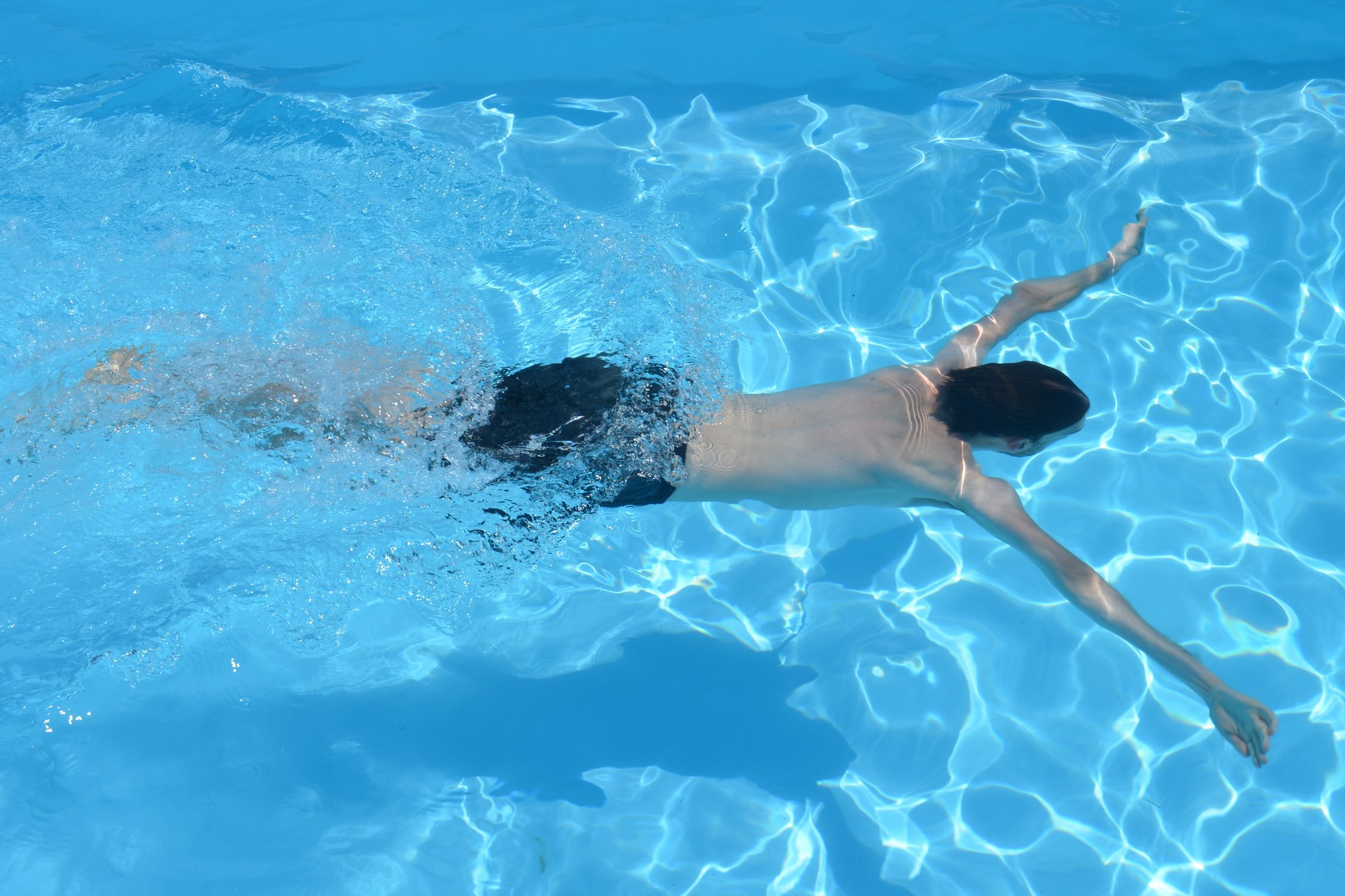
The cinematic image of a drowning person — waving their arms, calling for help, splashing around — is misleading. Real drowning tends to be silent and fast.
Someone who is drowning has no breath left for shouting: the mouth repeatedly sinks below the surface and comes back up, and when it is above the water the body uses it to breathe, not to speak. The arms instinctively press down and out to lift the mouth above the water — which is why the person cannot wave them or grab a rescue aid. The body usually stays vertical, with no kicking of the legs.
Typical signs worth watching for:
- head tilted back, mouth right at the waterline, hair over the face
- glassy eyes, a blank stare or closed eyes
- a vertical position in the water with no leg movement
- “climbing an invisible ladder”
- a child who stops calling out in the water and suddenly goes quiet
With children in particular, silence is more alarming than shouting. Everything unfolds within tens of seconds and often a few metres from adults. Prevention — fencing, covers, supervision, alarms — is therefore always more important than first aid itself; we cover it in detail in our articles on child safety around the pool and hot tub and pool alarms and safety features.
Drowning: the procedure worth knowing by heart
1. Your own safety first. A rescuer drowning is a real risk. If you can reach, hold out a pole, a leaf net, a towel or a flotation aid and pull the person towards the edge. Only enter the water if you are a strong swimmer and have no other option.
2. Call 112 as early as possible. Ideally a second person does this while you help. If you are alone, put the phone on speaker and talk to the dispatcher while you work.
3. Get the casualty out of the water and check response and breathing. Tilt the head back, lift the chin, then for ten seconds look, listen and feel for airflow. Gasping, gurgling or occasional breaths are not normal breathing — in that case you act as you would in cardiac arrest.
4. In drowning, you start with rescue breaths. The cause of the arrest is a lack of oxygen, which is why, according to ERC recommendations and the updated position of the American Heart Association (2024), resuscitation of a drowning casualty begins with five rescue breaths and only then continues in the standard ratio of 30 chest compressions : 2 breaths. That differs from resuscitating an adult in sudden cardiac arrest, where lay rescuers are often advised to do compressions only.
5. Chest compressions. Centre of the chest, roughly 5–6 cm deep in an adult, at a rate of 100–120 compressions per minute. Let the chest recoil fully between compressions. Continue until the emergency services arrive or signs of life appear.
6. Automated external defibrillator (AED). If one is available in your town or on site, send someone else for it — do not interrupt the resuscitation yourself. The device talks you through the whole procedure by voice and decides on its own whether a shock is appropriate. Before attaching the pads, dry the chest and move the casualty out of any puddle of water.
7. If the person is breathing but unresponsive. Place them in the recovery position on their side, cover them and keep checking their breathing until the ambulance arrives.
Trying to “push the water out of the lungs” is pointless and costs time — water in the stomach comes out on its own, and pressing on the abdomen risks inhalation of vomit. And one more thing: even after a seemingly happy ending, a drowning casualty belongs in a doctor’s care. Breathing difficulties can develop hours later.

Overheating in a hot tub or sauna
The second most common incident in home wellness is not dramatic, but it is often underestimated: collapse from overheating. Hot water dilates the blood vessels, blood pressure drops, and standing up quickly brings on dizziness or fainting — and fainting in a hot tub means a face below the surface.
Warning signs: dizziness, palpitations, nausea, weakness, headache, tingling, a sudden feeling of cold or confusion. Anyone who notices them should get out of the water immediately — even if “it will pass in a moment”.
What to do:
- Help the person out of the water, carefully and with support. Never let them climb out alone.
- Move them to a cooler, shaded place and lay them on their back with the legs raised.
- Cool them gradually — a lukewarm towel on the neck, armpits and groin, plus fanning. Not an ice-cold shower.
- If they are fully conscious, offer sips of water. Never give anything to someone who is not fully conscious.
- If the condition does not improve within a few minutes, or if confusion, vomiting, seizures or unconsciousness appear, call 112.
Prevention is simple and boring: a sensible water temperature, short sessions and breaks. The usual recommendation is a maximum of 15–20 minutes at a time at a temperature of up to 38–40 °C, then a break and rehydration. More detail in the article on the ideal water temperature in a pool and hot tub. Alcohol raises the risk considerably — the combination of hot water and alcohol is among the most frequent causes of collapse. Extra caution is needed for older people, people with heart conditions, those on antihypertensive medication and pregnant women; the specifics are summarised in the article on hot tubs and pools for seniors.
Slips, falls and suspected spinal injury
Wet paving, the ladder and the pool steps are the single most common place for an injury — and jumping into shallow water is the most dangerous individual manoeuvre.
The basic rule: if you suspect an injury to the head, neck or spine, do not move the casualty unnecessarily. Suspicion always arises after a jump into the water, a fall from a height, hitting the head on the pool edge, and whenever there is neck pain, tingling or weakness in the limbs.
In the water: keep the body horizontal, support the head and torso with your hands in line with the body’s axis, and keep the face above the surface. Do not pull on the limbs. Only take the person out of the water if they would otherwise drown — and if possible with several people, keeping them in one plane.
On the poolside: let them lie still, cover them, talk to them, watch their breathing. Control bleeding with direct pressure through a clean cloth. If the person is unconscious and not breathing, resuscitation takes priority over everything else.
Prevention here is about surfaces: anti-slip paving, rounded edges, handrails at the steps and a ban on running around the pool. Materials and solutions are covered in the article on pool surrounds, paving and decking.
Contact with pool chemicals
Concentrated water treatment products are corrosives and oxidising agents. Most domestic incidents happen while decanting, mixing, or opening a container in which pressure has built up.
Eyes. Rinse with a stream of lukewarm clean water for at least 15–20 minutes, from the inner corner outwards, holding the eye open. Do not rub. Remove contact lenses if it can be done easily. A follow-up medical examination is always appropriate, even if the symptoms subside.
Skin. Remove contaminated clothing and rinse with plenty of lukewarm water for at least 15 minutes. Do not neutralise anything with the “opposite” chemical — the reaction releases heat and makes the damage worse.
Inhaled fumes. Most often after mixing chlorine-based and acidic products. Get into fresh air immediately, loosen clothing, rest, sit the person up in a half-sitting position. If there is breathlessness, coughing or wheezing, call 112.
Ingestion. Do not induce vomiting. Rinse the mouth, give a small amount of water to drink and call for help.
Always keep the product container to hand. The label carries the exact name, concentration and first aid instructions — which is precisely what the doctor and the dispatcher will ask about. The national poison information centre in your country also operates around the clock and can be called by members of the public as well as by health professionals; look up its number in advance and keep it with your emergency contacts.
The best protection is storage: original containers, chlorine and acids kept separately, a dry, ventilated space out of the reach of children, and gloves and goggles for every handling. The principles of buying and storing are summarised in the article on how to save on pool chemicals; the amount of manual handling is dramatically reduced by automatic chlorine dosing.
Electric shock near water
Water and electrical installations sit side by side at a pool — the pump, the heating, the lighting, extension cables. If you suspect an electric shock, there is one single rule the whole household has to know.
Do not touch the casualty until the power is off. Switch off the main breaker or the residual current device, or pull out the plug. Nobody enters water you suspect of being live — not even a rescuer.
Once the source is disconnected: call 112, check consciousness and breathing, and in the case of cardiac arrest start resuscitation and use an AED if one is available. Cool burned areas with lukewarm water and cover them with sterile dressings. Even an apparently mild shock belongs in a doctor’s care because of the risk of heart rhythm disturbances.
Prevention here is purely technical: an inspected installation, a residual current device, and proper bonding and earthing of all conductive parts — a topic covered in the article on pool bonding and grounding.
What to keep permanently at hand by the pool
The equipment does not have to be expensive; it has to be in one place, and everyone in the house has to know where.
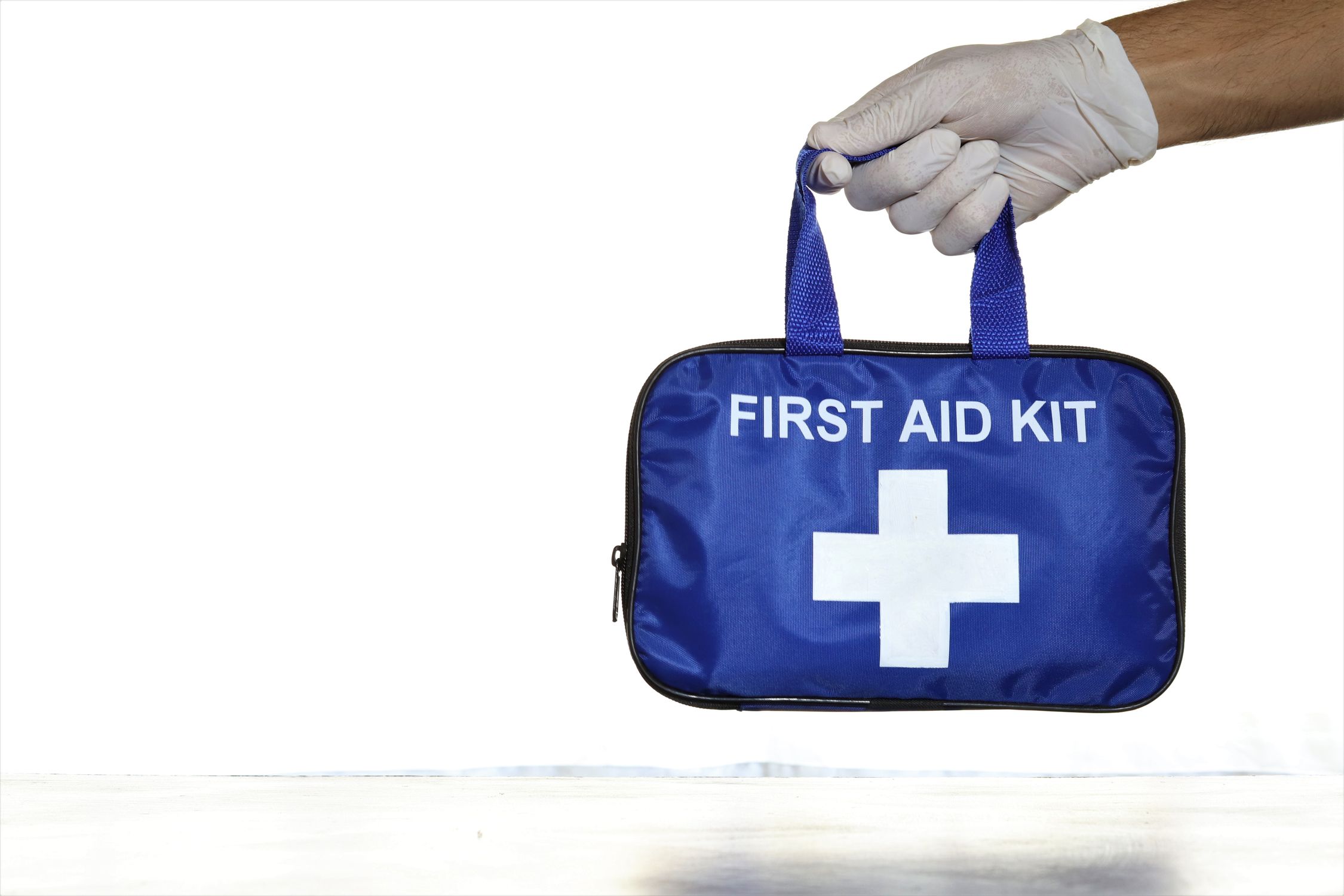
- A first aid kit in a sealable waterproof box — bandages, sterile dressings, plasters, an elastic bandage, scissors, gloves, a CPR face shield, a thermal blanket, eye wash solution.
- A rescue flotation aid on a pole — a telescopic pole with a net will do as well, but a ring buoy with a line is safer.
- A charged phone by the pool — the most common delay is not a lack of knowledge, but running into the house for a phone.
- A sign with the address and GPS coordinates in a visible place, ideally at the garden entrance. In a panic nobody recalls a holiday home’s address precisely, and the ambulance service needs it first.
- Information on the nearest AED — many municipalities have a defibrillator at the town hall or the fire station; find out where it is in advance, not in the middle of a crisis.
- Chemical containers and safety data sheets kept in the store room, not thrown away.
Situations and the first three steps: a quick overview
| Situation | First three steps | What to watch out for |
|---|---|---|
| Drowning | 1) Safe retrieval (pole, aid) 2) Call 112 3) Check breathing, in cardiac arrest 5 rescue breaths and CPR 30:2 | Do not enter the water unnecessarily; do not try to push water out of the lungs; always see a doctor afterwards |
| Overheating in a hot tub or sauna | 1) Out of the water with support 2) Cooler place, lying on the back with legs raised 3) Gradual cooling and sips of water | Give nothing to anyone with impaired consciousness; if the condition does not improve, call 112 |
| Fall, blow to the head | 1) Do not move them, support the head in line with the body 2) Call 112 3) Monitor consciousness and breathing | Always assume a spinal injury after a jump into shallow water |
| Chemicals in the eye or on the skin | 1) Rinse with lukewarm water for 15–20 minutes 2) Remove contaminated clothing 3) Take the container and call a doctor or the poison information centre | Do not neutralise, do not rub, do not induce vomiting |
| Inhaled fumes | 1) Into fresh air 2) Rest, half-sitting position 3) If breathless, call 112 | Do not go back into an enclosed space before it has been ventilated |
| Electric shock | 1) Switch off the breaker or RCD 2) Call 112 3) Check breathing, in cardiac arrest CPR and AED | Do not touch the casualty or the water before the source is disconnected |
Frequently asked questions
How much water is enough for a child to drown?
Very little, and very fast — which is why safety recommendations apply not just to the pool, but also to the hot tub, a rain barrel or an inflatable paddling pool. What matters is uninterrupted supervision by an adult and a physical barrier between the child and the water, as we describe in the article on child safety around the pool and hot tub.
Do I really have to give mouth-to-mouth during resuscitation?
In drowning, yes — the cause of the arrest is a lack of oxygen, so rescue breaths are an essential part of the procedure. If for any reason you cannot give breaths, at least do uninterrupted chest compressions; any resuscitation is always better than none. A CPR face shield in the first aid kit removes most of this obstacle.
Which emergency number should I call?
112 is the single European emergency number, it works across the EU and in most of Europe, it is free, and it works even from a phone with no credit. Some countries also have their own direct number for the ambulance service; if you know it and the situation is purely medical, it may connect you a little faster. What matters is calling immediately, not working out which number is “more correct” — 112 will always get you help.
How often should a first aid course be repeated?
Practical skills fade quickly without repetition. The usual recommendation is to repeat the training roughly once every two years, and for a household with a pool ideally before the season starts. Courses for the public are run by the Red Cross and other organisations more or less everywhere.
Do I need a defibrillator at home?
For an ordinary household it is not standard equipment, and it is certainly no substitute for knowing how to resuscitate. It makes more sense to find out where the nearest publicly accessible AED is and keep that information by the phone — but for guesthouses, holiday rentals and wellness facilities with higher footfall, buying one is worth considering.
Preparedness is part of the equipment
First aid at the pool rests on three things: prevention that stops the situation from arising, equipment you have at hand, and a practised skill. You can sort out the first two this weekend; you will gain the third on a one-day course. The rest of the safety and maintenance equipment — from rescue aids through barriers to covers — can be found in the pool equipment category. More texts on running your pool safely are waiting in the Guide.
