
The surface around your pool is the one part of the garden you walk on barefoot, soaking wet and often with two children in tow. It has to stay slip-resistant when wet, it must not burn the soles of your feet, it has to cope with chlorine and frost, and it has to carry water away from the pool, not into it. The good news: each of the five common materials will meet those conditions — just at a different price and with a different amount of upkeep.
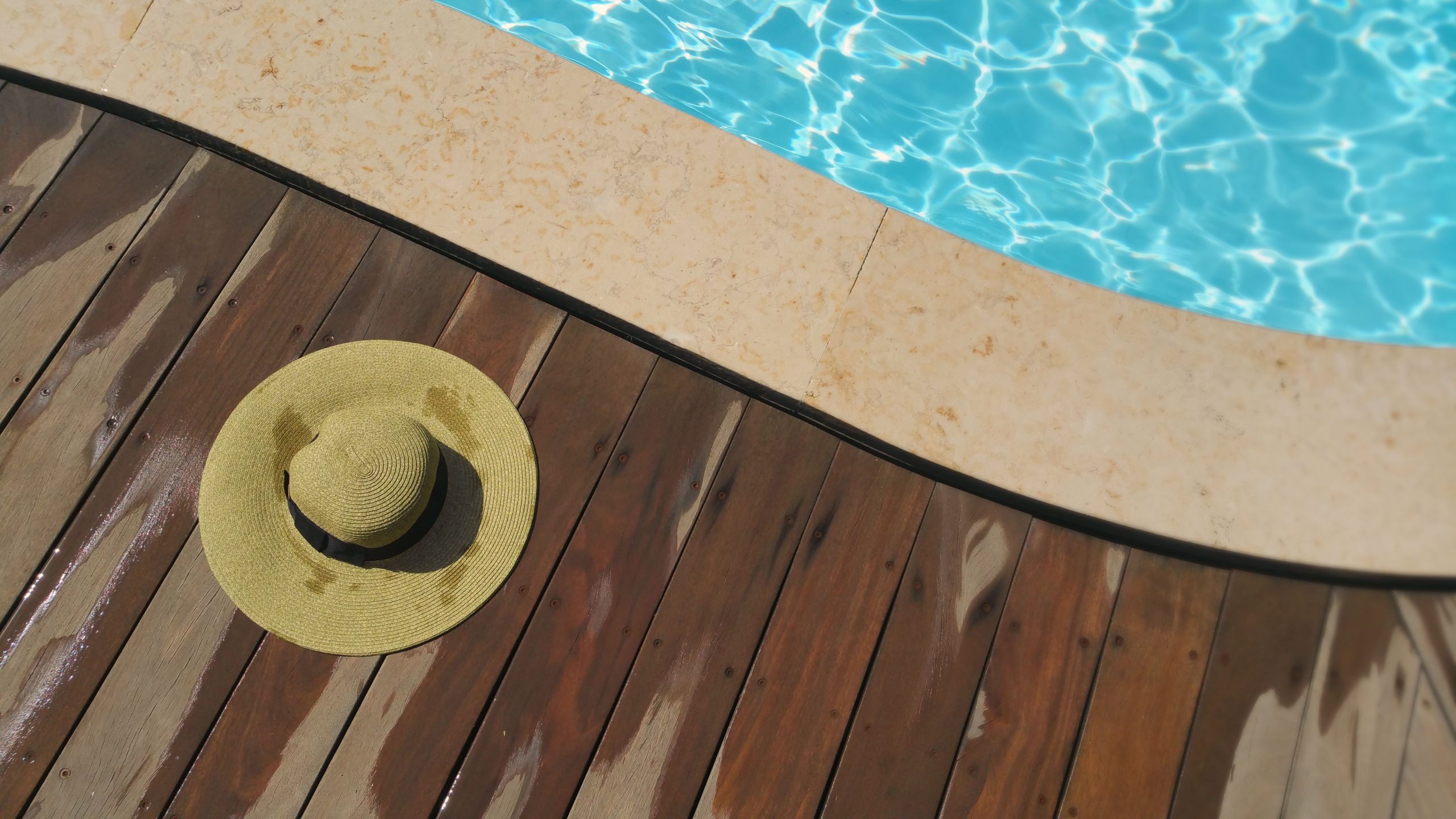
What a surface by the water has to deliver
Before you start choosing between wood and travertine, go through four technical requirements. A material that fails even one of them will annoy you every single season.
Slip resistance when wet — and barefoot
Two different scales tend to get mixed up here. Values from R9 to R13 come from a ramp test carried out in footwear (today EN 16165, formerly DIN 51130) and are relevant for the plant room, technical areas or a driveway. For an area walked on barefoot with wet feet, a different test applies (formerly DIN 51097), with groups A, B and C.
A rule of thumb for a garden pool:
- Group B — the minimum for the horizontal area around the pool and for the coping.
- Group C — for sloping surfaces, steps, foot baths and entry ramps, in other words places where water runs off and the foot presses down at an angle.
- With paving, ask for both figures. A serious manufacturer states something like “R11 / B” or “R11 / C” directly in the technical data sheet.
Watch out for one trap: high slip resistance means a coarser surface, and that is harder to clean and unpleasant on the knees. The ideal is medium coarseness with a pronounced texture, not sandpaper.
Temperature in the sun — the most underrated parameter
A scorching surface can ruin an entire afternoon. What decides it is the combination of colour and material:
- Colour is a stronger factor than the material itself. Dark anthracite paving heats up tens of degrees more in direct summer sun than a light beige slab from the very same production range.
- Thermal conductivity determines how quickly the heat transfers into the sole of your foot. Wood and WPC conduct heat less readily than stone, so even at the same surface temperature they feel more bearable.
- Porosity and evaporation: travertine and similar limestones stay cooler because they hold moisture, which then evaporates.
A practical rule: if you are planning a south-facing area with no shade, go for light shades. Anthracite looks superb in the visualisation, but in August nobody will cross it without flip-flops.
Resistance to chemicals and frost
The area around the pool is hit by chlorinated water, brine and residues of pH-adjusting products. Limestones and some sandstones react to acidic products by going dull, and even polished granite can lose its shine. Ceramics and porcelain paving are practically indifferent to chemicals.
Frost resistance is not a marketing adjective but a measurable property — with ceramics it comes down mainly to water absorption. Porcelain paving with absorption of up to 0.5 % will not let water into its structure, so frost has nothing to tear apart. Ordinary “bathroom” tiles with absorption above 3 %, on the other hand, will flake off outdoors after a few winters.
Easy cleaning
Sunscreen, pollen, leaves and — in shaded spots — algae all settle around a pool. Look for a surface that can take a pressure washer and does not have deep open porosity. With jointed paving, a quality grout is worth the money — the joints are always the weakest link.
Materials compared: what you get for the money
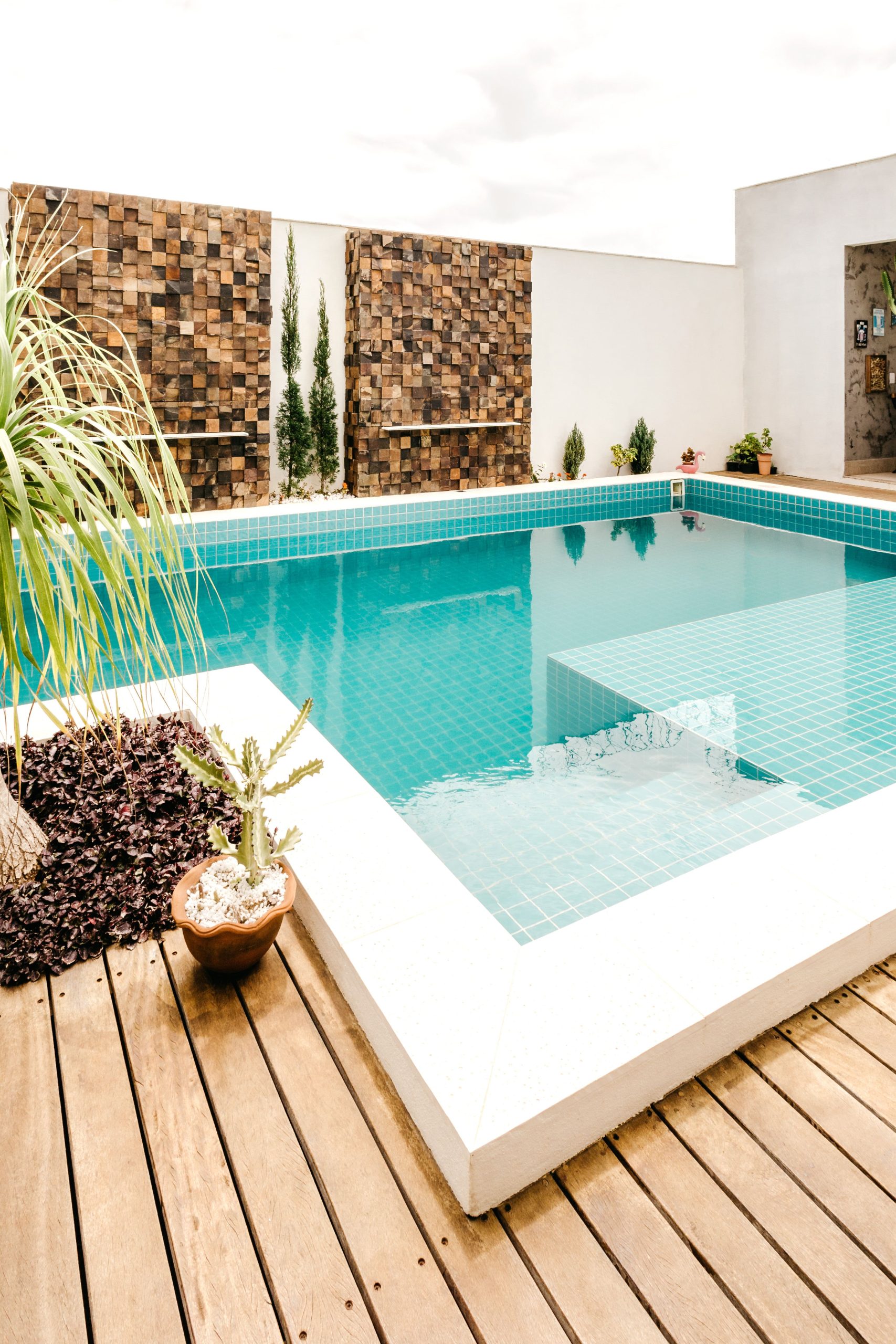
Prices are indicative for 2026 and include the usual installation and substructure, but not the base layers or drainage.
| Material | Price incl. installation | Temperature in the sun | Slip resistance | Maintenance | Service life |
|---|---|---|---|---|---|
| Concrete paving (frost-resistant) | €48–80/m² | Medium to high, depends on the shade | Good, excellent with exposed-aggregate surfaces | Low, an occasional pressure wash | 25–40 years |
| Porcelain paving (20 mm) | €80–140/m² | Medium, low in light shades | Very good if you choose class B/C | The lowest of all | 40+ years |
| Travertine | €100–180/m² | Low — stays pleasant even at midday | Excellent (natural texture) | Medium, sealing recommended | 40+ years |
| Granite | €120–220/m² | High with dark varieties | Good with a flamed or blasted finish, poor when polished | Low | 50+ years |
| Wooden deck (larch, thermowood) | €100–180/m² | Low — the most pleasant to the touch | Good, but algae are a risk in the shade | High: oiling every 1–2 years | 15–25 years |
| WPC / composite | €100–180/m² | Medium to high with dark profiles | Good with grooved profiles | Low, washing is enough | 15–25 years |
| Gravel (washed pebbles) | €10–20/m² | Low | Not something you walk on barefoot | Low, top up occasionally | Practically unlimited |
| Lawn | €3–8/m² | The lowest | Slippery when wet | High: mowing, watering | Depends on care |
When to choose which
- Ceramics are the best choice if you want a surface that looks the same in ten years as it did on day one. Maintenance-free, chemically inert, and available in wood-effect finishes too.
- Travertine wins on comfort: light, cool, never scorching. You pay for that in the price and in the need for sealing.
- Wood is the nicest underfoot and handles differences in level best, because it sits on a joist frame. Count on regular oiling, otherwise it turns grey and starts to splinter.
- WPC is the compromise: the look of wood, the upkeep of paving. Keep an eye on the shade — dark profiles get hot.
- Gravel and lawn are cheap supplementary areas — ideal behind the pool or between the deck and the fence, not as the main walking zone. Pebbles stuck to the soles of feet end up in the skimmer.
Pool coping: the detail that makes the whole impression
The coping (overflow or skimmer type) is a band of paving right on the edge of the pool and does three jobs at once: it protects the structure and the liner from damage, it forms a safe edge for climbing out of the water, and it carries splashed water away.
- Edge shape. A rounded profile (radius) is far gentler on bare feet — and on a child climbing out on their tummy — than a sharp edge. Pools with a cover also use a straight profile with a chamfered edge.
- Overhang above the water line. The coping is usually laid with a slight overhang past the pool wall so that water drips back into the pool rather than underneath the paving.
- Overflow edge. In overflow pools the water spills along the whole length into a channel and from there into a balance tank. Aesthetically it is unbeatable, but it calls for more equipment — we cover the differences in detail in our article on skimmer vs. overflow pools.
- The coping material does not have to match the deck. Combining a stone coping with a wooden deck is one of the best-looking solutions there is — and at the same time it gives you a slip-resistant edge exactly where it is needed most.
Fall and drainage: the water has to run away from the pool
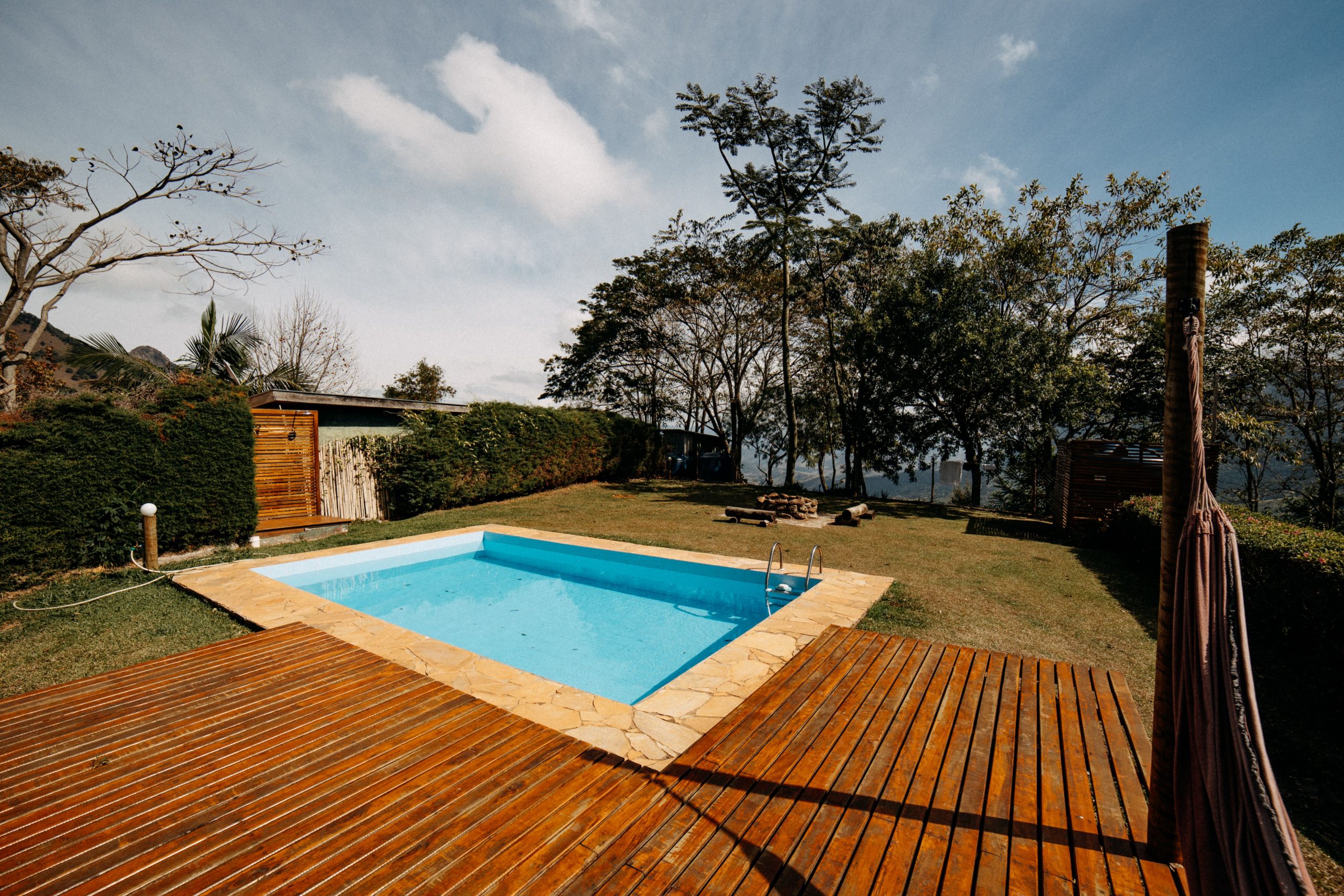
This is the most common mistake we see in DIY builds. The area around the pool is graded towards the pool, because “it looks better that way”. The result is that every shower of rain washes dust, sand, pollen and product residues off the terrace and into the water.
The correct solution:
- A fall of 1–2 % away from the pool. On a 3 m wide terrace that means 3–6 cm of height difference — invisible to the naked eye, but not to water.
- A drainage channel along the outer edge of the terrace, or at least on the side where the area meets a slope or the house. It carries water to a soakaway or into the storm drain.
- A drainage layer beneath the paving. Water that gets through the joints has to have somewhere to go. Without drainage it builds up in the base and lifts the slabs in winter.
- With a wooden deck, leave a 4–6 mm gap between the boards and free space under the joists for air to circulate. A deck laid tight onto concrete will rot from below.
Surroundings and debris: where the trees stand, the filter gets cleaned
A mature birch or lime tree above the pool means emptying the skimmer basket every week — and in September every day. Leaves in the water also release organic matter that eats up your disinfectant.
If you do not want to fell the trees, factor it into your maintenance planning — you will find a practical overview of seasonal tasks in our article on the pool maintenance calendar. For new gardens a simple rule applies: keep deciduous trees at least off the windward side of the pool, and conifers as far away as possible (pine needles are even more of a nuisance in the filter than leaves).
Lawn right up against the pool has the same problem on a smaller scale — cut grass sticks to wet feet and travels into the water. That is why a strip of paving or gravel at least a metre wide is put between the lawn and the pool.
Winter care: salt is poison for a terrace
De-icing salts are one of the fastest ways to destroy an otherwise quality surface. Sodium chloride penetrates the joints, dissolves the lime component of grouts and, with repeated freeze-thaw cycles, tears up the surface of concrete paving as well. Natural stone reacts to salt with efflorescence and dulling.
- Use an inert grit instead of salt — sand or fine chippings. It will not melt the ice, but it increases friction and damages nothing.
- Clear snow with a plastic shovel with a rubber edge, not a metal one.
- A wooden deck appreciates it when you remove the snow before it melts and freezes again — repeated freezing splits wood along the grain.
- Keep the path to the equipment passable in winter too. If you winterise the pool using the standard procedure, you will be walking to the technical pit out of season as well.
Safety details that cost a few hundred euros and prevent an injury
- Rounded edges wherever possible. Not just on the coping, but on steps, retaining walls and terrace corners too. Barking your shin on a sharp paving edge is a classic of the first week of use.
- A contrasting strip at the entry. A different shade of paving (or a different material) in a 20–30 cm band in front of the pool steps is a simple visual signal saying “the edge is here”. It works for children and for guests after sunset alike. We look at entry types in our article on pool steps vs. ladders.
- Light the area, not just the water. Recessed ground lights along the edge of the terrace or an LED strip under the coping solve orientation in the evening. Underwater LED lighting is a good companion to that, as it also shows where the pool ends.
- Switchable circuits. Sockets and lighting around the pool have to meet the requirements for pool zones — leave this part to an electrical designer.
Budget: what to allow for the pool surround
For a 4 × 8 m pool with a 1.5 m wide walkway around the perimeter, the paved area works out at roughly 45–50 m². Model budgets (material, substructure, installation, excluding groundworks):
| Option | Area | Estimated cost |
|---|---|---|
| Concrete paving + stone coping | 48 m² | €2,800–4,400 |
| Porcelain paving, 20 mm | 48 m² | €4,400–7,200 |
| Wooden deck on joists | 48 m² | €5,200–8,800 |
| Combination: stone coping + WPC deck + gravel | 48 m² | €4,000–6,800 |
On top of that, add the drainage channel (€60–140 per linear metre) and the base layers including drainage, which on unconsolidated ground add another €16–36/m². On small plots where every metre counts, it is worth reading our article on a pool in a small garden too — the walkway is often handled differently there.
Frequently asked questions
How wide should the strip of paving around a pool be?
The minimum is 80 cm; 1.2–1.5 m around the perimeter is comfortable. On one side (where you sunbathe and put the loungers) 2.5–3 m is worth it. A strip narrower than 80 cm makes both maintenance and safe movement around the water harder.
Can I use ordinary outdoor paving from a DIY store around the pool?
Sometimes yes, but check two things: water absorption (with ceramics ideally up to 0.5 %) and slip resistance for bare feet (group B, group C on sloping surfaces). Ordinary outdoor paving tends to be certified only in footwear (the R value), which is not enough for an area by the pool.
Is a wooden deck by a pool slippery?
Dry, well-maintained wood is not slippery. The problem starts when biofilm or algae settle in shaded spots — then the deck becomes dangerous. The answer is regular washing, enough ventilation under the boards, and a grooved board profile.
Why must the fall never run towards the pool?
Because every shower of rain and every hose-down of the terrace then washes dirt straight into the water. Filtration and disinfection do needless extra work, chemical consumption rises and cloudiness appears more easily. Water has to run away from the pool into a channel or a soakaway.
How do I get rid of green patches on paving by the pool?
A green film is algae or moss, usually in places with permanent shade and damp. A pressure washer and an algae remover for hard surfaces will help. Prevention matters more: make sure water drains away and thin out the shade above the area. Do not use pool chemicals on paving — the concentrations are set for water, not for stone.
In conclusion
The pool surround is the one investment that affects every minute you spend by the water. It is worth thinking about while the pool is still being designed, not after it has been filled — fall, drainage and channels are done badly and expensively as an afterthought.
If you are dealing with coping, channels, drainage components or replacement construction parts for renovating an older terrace, you will find them in our pool construction parts category. More practical guides on planning and running a pool are waiting in the Advice section.
