
You can get an inflatable hot tub from 8,000 CZK (about €320); an acrylic one starts at roughly 150,000 CZK (about €6,000). The difference in purchase price is huge — but with a hot tub, you mainly pay for running it, and that’s where the tables turn. Due to the lack of insulation, inflatable models use 2–3× more electricity, last a fraction of the time, and in winter you usually have to drain them. In this comparison we’ll show exactly where the cheap option ends up costing more — and when it actually makes sense.

How do construction and insulation differ?
An inflatable hot tub is essentially a thick-walled PVC or laminated vinyl bladder filled with air. A wall a few centimeters thick provides only limited insulation, and the floor often sits directly on cold paving or concrete. The equipment (heater, pump, air compressor) sits in an external box next to the tub, and the connecting hoses are another place where heat escapes.
An acrylic hot tub has a molded acrylic shell reinforced with fiberglass, set into an insulated cabinet. Better models have full-foam insulation or thermal foil around the perimeter, an insulated tub and floor, and a rigid wedge-shaped cover with sealing. Heat from the motors is also used to help warm the water inside the cabinet.
You can also see the difference in the cover: an inflatable hot tub comes with a thin inflatable lid and tarp, while an acrylic one has a 10–15 cm thick wedge cover made of polyurethane foam. The cover accounts for most of the heat loss — the water surface is the biggest “escape route” for heat.
How much electricity does an inflatable hot tub actually use?
The British comparison site TubWars states that inflatable hot tubs, due to weak insulation and slow heating, typically cost £35–60 a month in electricity, while an insulated acrylic hot tub of similar size costs a fraction of that — the difference converts to more than €1,000 a year with year-round use. Jacuzzi’s comparison of inflatable and hard-shell hot tubs confirms the same: an inflatable tub is “difficult to insulate,” and a hard shell with an insulated cabinet works out significantly cheaper in the long run.
There are three reasons. First, heating: inflatable models have a flow-through heater of 1.5–2.5 kW, which raises the water temperature by about 1°C per hour — an acrylic hot tub heats at roughly 2°C per hour and holds the temperature thanks to insulation. Second, the massage: the air compressor blows cold outside air into the water, so you’re actively cooling the water every time you bathe. Third, losses: heat escapes continuously, 24 hours a day, through the thin wall, floor, and light cover.
In Czech conditions, at a price of €0.26/kWh, expect an inflatable hot tub kept at 38°C to use roughly 6–10 kWh a day in summer (€1.60–2.60), and easily double that in autumn. An acrylic hot tub at the same water temperature uses 3–5 kWh a day in summer and 8–12 kWh in winter — that is, 2–3× less on average for the same comfort. You’ll find a detailed breakdown of costs in the article How Much Does It Cost to Run a Hot Tub.
Lifespan: 2–5 years vs. 10–20 years
An inflatable hot tub is a consumable item. The PVC bladder degrades from UV exposure and chlorine, the seams loosen over the seasons, and the floor wears through. Manufacturers typically give 1–2 years of warranty, and the real-world lifespan is 2–5 years depending on how intensively it’s used — often less for the heating unit, since the flow-through heater runs almost continuously. Spare parts are hard to find for cheap brands, and repair is often not worth it.
An acrylic shell lasts 15–20 years or more, and the equipment (pumps, heater, control unit) 8–12 years, with each part replaceable individually. A hot tub from an established manufacturer with available service is therefore an investment for a decade or two — and it retains its resale value the whole time.
Comfort: air bubbles, or real hydromassage?
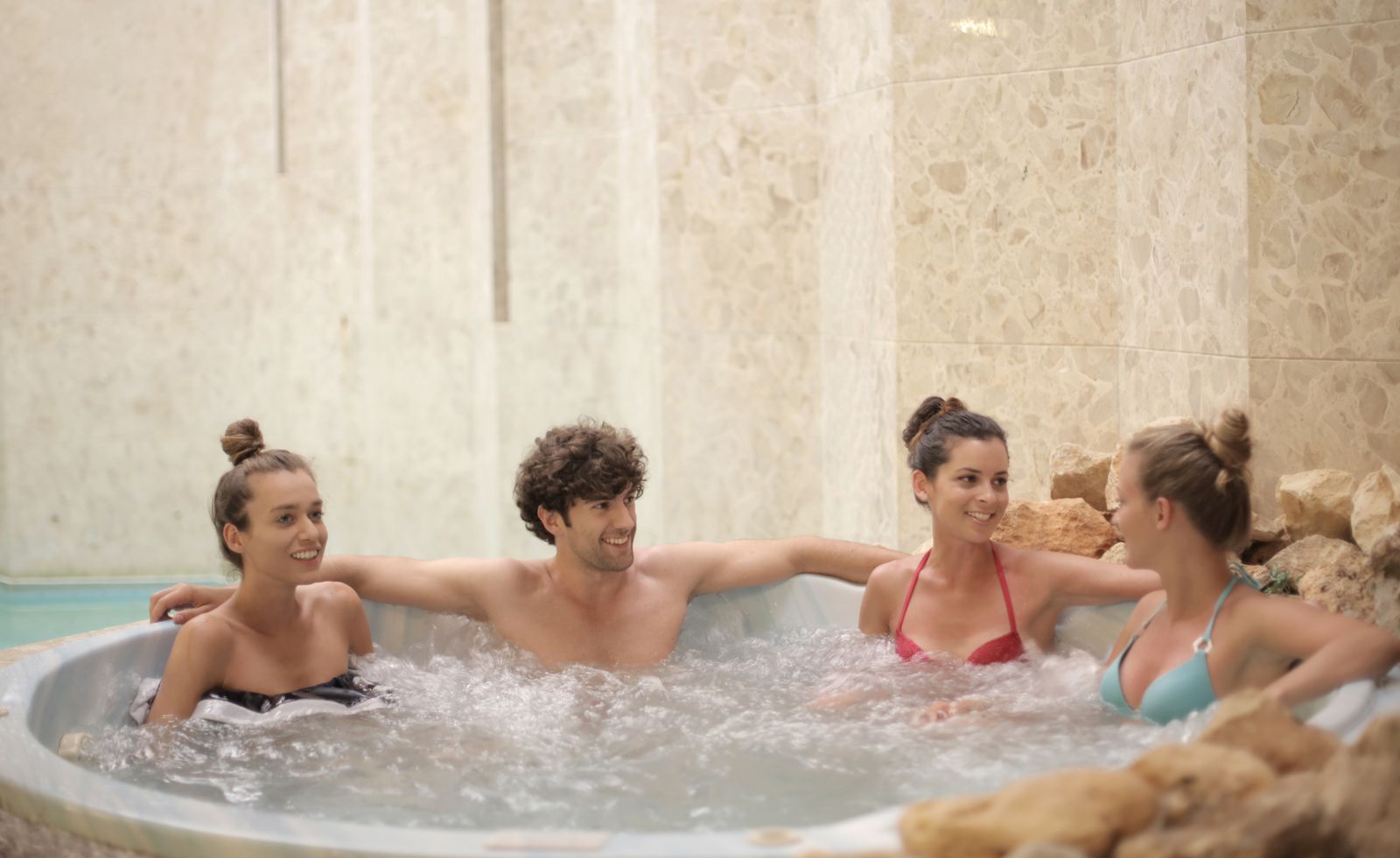
This is where the difference is biggest — and least visible in brochures. Inflatable hot tubs have a ring of small holes around the edge of the floor, through which the compressor blows air — creating a pleasant bubbling sound, but no targeted pressure on the muscles. Jacuzzi describes this type as a “bubble effect” with limited hydrotherapy capability.
An acrylic hot tub has hydromassage jets: a pump drives water (often mixed with air) into shaped jets aimed at the neck, back, lower back, and calves. Both pressure and direction can be adjusted, and the seats are anatomically shaped — each with a different set of jets, so you can move between positions like a massage program. In an inflatable tub, you sit on a flat floor; don’t expect back support or body positioning — at most you can buy an inflatable seat cushion.
Temperature also plays a role: inflatable models typically cap out at 40°C, but during full massage (cold air blown into the water) the temperature drops noticeably. In an acrylic hot tub, the heater and insulation hold the temperature even during a long soak in freezing weather.
Can an inflatable hot tub handle winter?
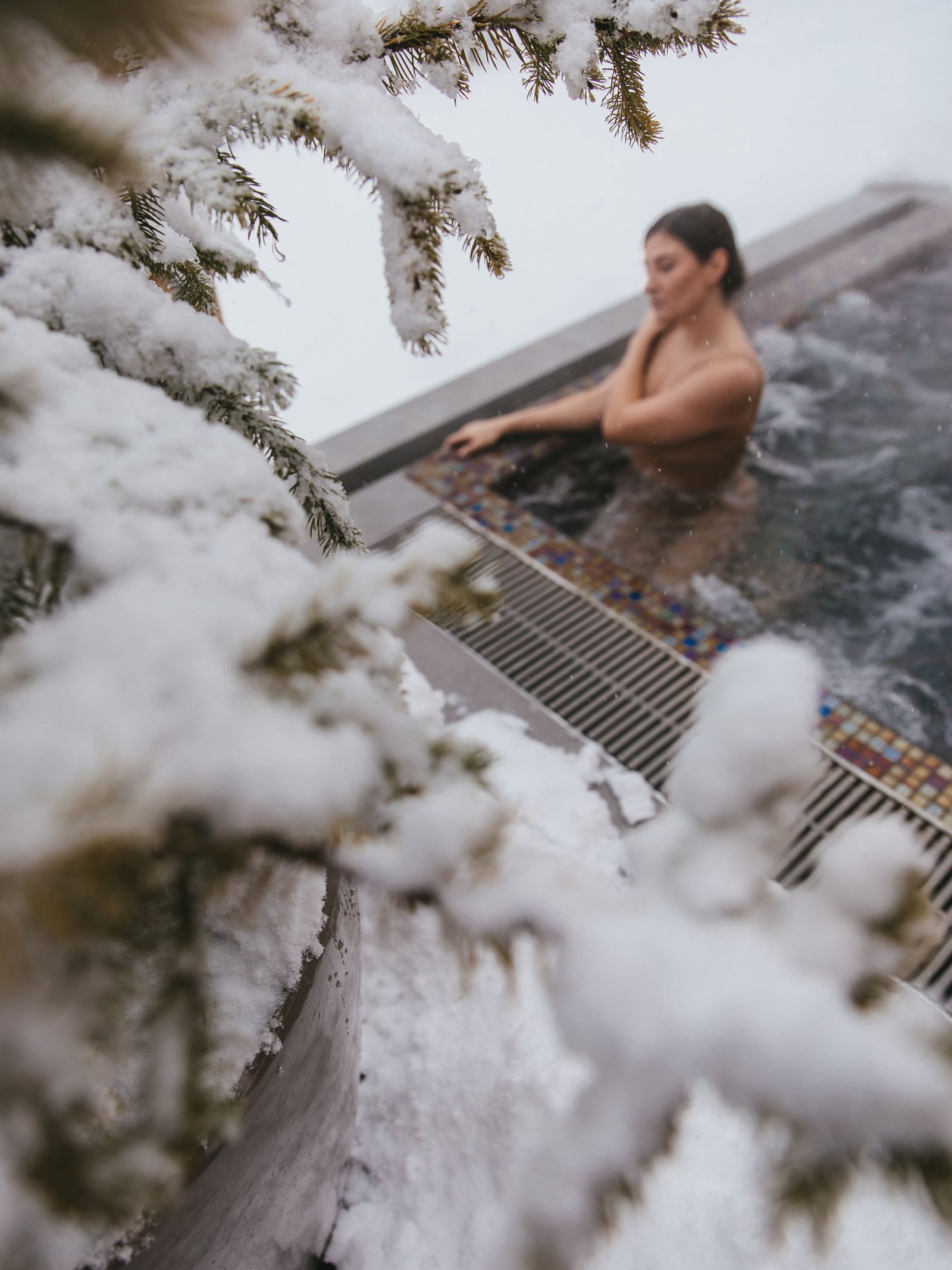
Most manufacturers of inflatable hot tubs state a minimum operating air temperature of around +4 to +6°C. Below that, there’s a risk of water freezing in the hoses and pump, which isn’t covered by warranty. The weak heater also can’t keep up in frost: at −5°C the water may never reach 38°C, and consumption rises to extreme levels. In practice this means a season running from May to September, with draining, drying, and storage for winter.
An acrylic hot tub is built for year-round use — and a winter soak in the snow is, for most owners, the main reason they bought one in the first place. Insulation, a strong thermal cover, and the control unit’s anti-freeze modes (automatic circulation, heating when the temperature drops) allow safe operation even at −20°C. If you mainly want a hot tub for winter evenings, an inflatable model simply isn’t for you.
What’s cheaper over 5 years? A sample calculation
Let’s compare total cost of ownership (TCO) over 5 years. Model assumptions: electricity at €0.26/kWh, bathing 3 times a week, temperature 38°C. The inflatable hot tub (4 people, about 800 l) runs seasonally for 5 months a year and is replaced with a new one after 3 years. The acrylic hot tub (5 people, about 1,200 l) runs year-round. Chemicals and water treatment are similar for both, though the inflatable tub needs more frequent water changes due to weaker filtration.
| Item (5 years) | Inflatable hot tub | Acrylic hot tub |
|---|---|---|
| Purchase | €480 + €480 (replacement after 3 years) | €8,800 |
| Electricity | approx. €300/year (5-month season) = €1,500 | approx. €580/year (year-round) = €2,900 |
| Chemicals and water | approx. €140/year = €700 | approx. €160/year = €800 |
| Service and parts | repairs are usually not worth it (a new unit is bought instead) | approx. €400 (filtration, minor parts) |
| Total over 5 years | approx. €3,160 | approx. €12,900 |
| Months of use | 25 (season only) | 60 (all year) |
| Cost per month of use | approx. €126 | approx. €215 |
| Residual value after 5 years | practically zero | significant (the hot tub keeps working for 10+ more years) |
At first glance, the inflatable hot tub wins. But we’re comparing 25 months of bubbles at 38°C with 60 months of year-round hydromassage — and the acrylic hot tub doesn’t end after five years, while you’ll have thrown out the inflatable one once already in the meantime. If you spread the acrylic hot tub’s cost over its realistic 12–15-year lifespan, its cost per month of use drops below €120 — below the inflatable’s level.
And here’s the key catch: if you ran an inflatable hot tub year-round (wherever the climate even allows it), consumption 2–3× higher than an insulated tub means €1,000–1,400 a year in electricity alone. That’s exactly the moment the cheap option costs the most — you’d be paying the running costs of a luxury hot tub while getting the comfort of an inflatable pool.
When is an inflatable hot tub a good choice?
We don’t want to write off inflatable hot tubs — they have their legitimate place. They make sense when:
- You’re testing the waters. Not sure if you’ll stick with hot tubbing? A season with an inflatable for €400 is the cheapest way to find out before investing tens of thousands.
- You just want a summer refresher. For the occasional evening soak from June to August, the running cost is bearable and the comfort is sufficient.
- You rent or move often. You can pack an inflatable hot tub into a box; an acrylic one needs a reinforced surface, a 400V supply, and a crane or trolley to move.
- Your budget is limited and your terrace can only take a light load. A filled acrylic hot tub weighs 1.5–2.5 tonnes, an inflatable one about half that.
But if you plan to bathe year-round, want real massage, or expect to keep the hot tub for more than 2–3 seasons, an acrylic one works out comparable or better per month of use — with incomparably greater comfort.
What to watch out for with cheap models
If you do decide on an inflatable hot tub, choose carefully — the market is full of models where the low price is paid for with a short lifespan:
- Wall strength and construction. Look for laminated multi-layer PVC (drop-stitch), not a smooth single-layer bladder. A thin wall bulges and the seams split.
- Heating power. A heater under 1.5 kW means, for 800 l of water, up to two days waiting to reach 38°C.
- Filtration. Tiny paper cartridges need replacing every one to two weeks; factor them into your running costs.
- Warranty and service. With unknown brands from marketplaces, there’s usually no one to turn to — a 12-month warranty on the heating unit says a lot.
- Real capacity. “6 people” for an inflatable hot tub means 6 people sitting on the floor with no back support; count on half that.
- Certification. Missing CE marking or a residual current device on the power supply is, for a device combining water and electricity, a reason to walk away immediately.
For acrylic hot tubs, the same applies in reverse: extremely cheap imported models without service backup can be a worse purchase than a quality inflatable one — you’ll find pointers on how to spot a solid product in the guide How to Choose a Hot Tub.
Frequently Asked Questions
How much does it cost to run an inflatable hot tub per month?
In summer, at 38°C and €0.26/kWh, expect €48–80 a month, and easily double that in spring and autumn. The British site TubWars states £35–60 a month, which matches. An insulated acrylic hot tub achieves the same comfort for roughly a third to a half of that.
Can an inflatable hot tub stay outside in winter?
Usually not. Manufacturers state a minimum air temperature of around +4 to +6°C; below that, there’s a risk of the pump and hoses freezing, without warranty coverage. For winter, the hot tub needs to be drained, dried, and stored in a temperature-controlled room.
How long does an inflatable hot tub last?
With normal use, 2–5 seasons. The heating unit or the bladder’s seams usually go first. An acrylic hot tub lasts 10–20 years, and individual components can be replaced along the way.
Does an inflatable hot tub have real massage jets?
The vast majority don’t — the massage comes from an air compressor blowing bubbles from the floor, with no targeted pressure. Real hydromassage jets driven by a water pump are only found in acrylic hot tubs, where they can be directed and adjusted.
Is it worth buying an inflatable hot tub just to try it out?
Yes, that’s precisely its strongest role. In a single season you’ll find out how often you actually bathe and what you’re missing. If you’re using the hot tub several times a week even in October, that’s a clear sign that investing in an acrylic one will pay off.
Whether you go for a first inflatable season or straight for a year-round acrylic hot tub, choosing the right model determines whether you end up paying for relaxation or for compromises. You’ll find the current range of acrylic hot tubs for year-round use in the hot tubs category.
