
An above-ground pool is the fastest route to summer swimming: no excavation, no building permit and a budget ranging from a few dozen euros to a couple of thousand. As a rule of thumb, an inflatable pool is the cheapest option for one to three seasons, a frame pool offers the best value for money, and a steel-wall pool comes closest to a “real” in-ground pool. In this guide we walk through all three types, sizes, ground preparation and the corners manufacturers most often cut in bundled sets.
If you are still weighing up whether to go for an above-ground pool at all or invest in an in-ground one instead, start with our comparison of above-ground vs. in-ground pools. This article assumes the choice has fallen on the above-ground option — and looks at which one to pick.
What types of above-ground pools are there?
Inflatable pool: the cheapest ticket into the water
An inflatable (self-supporting) pool holds its shape thanks to an inflated top ring — fill it with water and the walls rise on their own. You can set it up in half an hour without tools, and basic 3-metre models can be had for under €40.
The price you pay for the low cost is a short lifespan. The soft liner is prone to punctures, the top ring gradually loses air and the pool deforms. Realistically, expect one to three seasons. The depth is usually only 60–76 cm, so it is more about cooling off and playing with the kids than swimming.
Frame pool: the best price-performance ratio
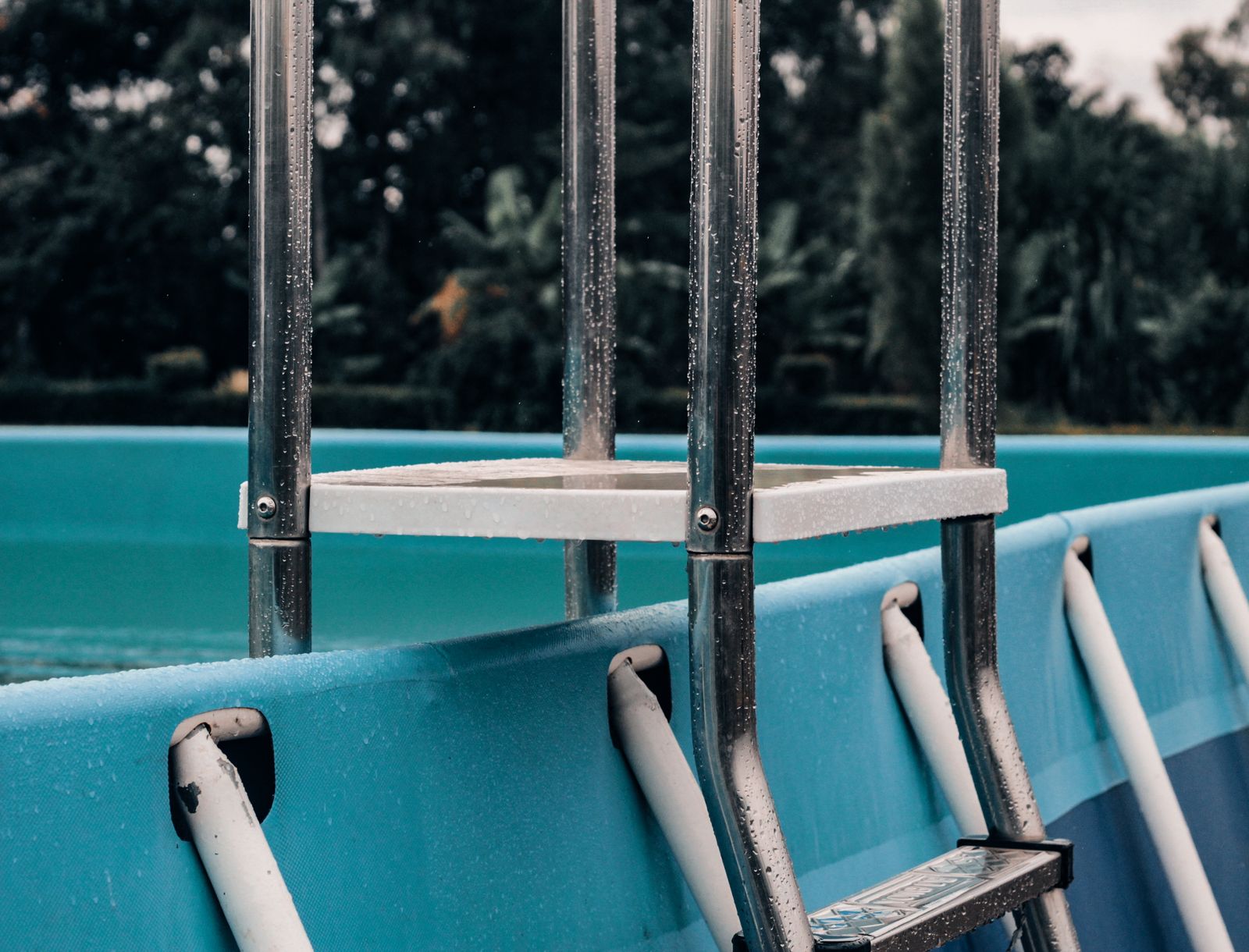
A frame pool consists of a basin made of multi-layer PVC fabric suspended in a structure of steel tubes. You can assemble it in an afternoon, it handles depths of 1.0–1.32 m and the larger models even allow short swims. Frame pools (Intex, Bestway, Marimex and others) are the best-selling category on the European market.
A good-quality frame pool lasts 5–10 seasons; the weakest point tends to be the liner, which on many models can be replaced separately. For winter it can be taken down and stored, or — with larger sizes — winterized outdoors.
Steel-wall pool: closest to a “real” pool
A steel-wall pool has a self-supporting shell of coiled galvanised (often coated) sheet steel and a separate inner liner. Structurally it works on the same principle as many in-ground liner pools, which is why it can be partially or fully sunk into the ground: all it takes is an excavation and concrete backfill or gravel surround according to the manufacturer’s instructions.
A depth of 1.2–1.5 m, a wall lifespan of 15 years or more (the liner is replaced after 8–12 years) and a proper connection to a skimmer and return jet make it the most serious choice among above-ground pools. Assembly is a weekend project, however, and the demands on a level, firm base are the highest.
| Criterion | Inflatable | Frame | Steel wall |
|---|---|---|---|
| Purchase price (2026) | from approx. €32 | approx. €120–1,000 | approx. €800–2,400+ |
| Lifespan | 1–3 seasons | 5–10 seasons | 15+ years (liner 8–12 years) |
| Water depth | 60–76 cm | 76–132 cm | 120–150 cm |
| Assembly | under 30 minutes | 1–3 hours | 1–2 days |
| Can be sunk in-ground | no | no | yes, partially or fully |
| Winterizing outdoors | no, always take down | larger models yes | yes, as standard |
| Best for | kids, a first trial season | families, recreational swimming | anyone who wants a pool “for good” |

Round or oval? And how big should the pool be
A round pool is structurally the simplest and cheapest: the water pressure is distributed evenly, so neither the wall nor the frame needs any extra support. If shape is not a decisive factor, round is always the best-value choice.
An oval pool suits narrow plots better and looks more elegant, but there is a technical catch: on steel-wall pools the straight side walls must be held by side braces, which are usually set in concrete or anchored into a hardened base. An oval is therefore more expensive to buy and to prepare for, and its assembly is noticeably more demanding. On oval frame pools the same role is played by the frame’s side supports — factor them in when planning the space.
A rough sizing guide: a diameter of 3.05–3.66 m is enough for children and cooling off, 4.57 m is a sensible family minimum, and from 5.49 m (or a 6–7 m oval) you can actually swim. Remember that volume grows quickly — a 4.57 × 1.22 m round pool holds roughly 17 m³ of water, which affects filling time, chemical consumption and the demands on filtration.
What to look at when choosing: liner, frame, joints and filtration
Pools that look similar on paper differ fundamentally in the details. Before buying, check:
- Liner thickness and construction: on frame pools look for multi-layer laminated material (three PVC layers with polyester reinforcement), not just plain film. On steel-wall pools a 0.4 mm liner is the standard; better ones have 0.6–0.8 mm.
- Frame and wall: galvanised tubes with a powder coating resist corrosion longer than painted steel alone. On a steel wall, what matters is the sheet thickness (0.4–0.7 mm) and the quality of the zinc layer.
- Quality of the joints: liner welds should be straight and free of creases, frame joints should have locking pins, and a steel wall should have a pressed interlocking or bolted joint with a cover strip.
- Service and spare parts: brands with readily available replacement liners, fittings and seals will extend your pool’s life by years.
And the main warning from practice: the filtration bundled with cheap sets tends to be undersized. A cartridge unit with a flow rate of 1.2–2 m³/h on a pool holding 17 m³ of water means the volume gets filtered once every many hours — so the water, especially in hot weeks, deteriorates faster than you can clean it. For pools from about 10 m³ it pays to plan for a sand filter with the right flow rate from the start (general rule: filter the entire volume in 4–6 hours). You will find a detailed comparison in our article on sand vs. cartridge filtration.
Ground preparation: the most common mistake that destroys a pool
The vast majority of above-ground pool claims and failures start not with the product but underneath it. A pool needs a perfectly level, compacted surface — even a slope of 2–3 cm across the pool’s diameter causes uneven loading of the wall, and with larger volumes there is a risk of collapse. Levelling the terrain by piling up soft soil is a recipe for disaster; the base must be dug down to level, not built up.
A proven build-up: a levelled and compacted subgrade (ideally a concrete slab or paving for steel-wall pools), then a geotextile against root growth and mechanical damage, and finally a pool ground mat — foam tiles or a felt mat that protect the liner’s floor from small stones and provide pleasant insulation. Avoid freshly laid turf, tree roots and spots crossed by irrigation lines.
Think about the surroundings too: position the pool so a cable can run safely to the filtration (ideally a socket with a residual-current device), and leave at least a metre of free space around it for maintenance.
What accessories should you buy right from the start?
Three items are worth buying together with the pool, not “at some point later”:
- Steps: essential for depths over 90 cm. Choose them according to wall height, with non-slip treads; double-sided steps with a lockable or removable outer section also keep children out of the water.
- Cover: a debris cover limits dirt and evaporation, while a solar cover additionally warms the water by 3–5 °C for free. We cover when each one pays off in our article on pool enclosures and solar covers.
- Vacuum: the floor starts getting dirty from day one. For smaller pools a manual vacuum connected to the filtration is enough; for larger ones a robot saves hours of work — see our guide on how to choose a pool vacuum and robot.
How to heat a small above-ground pool?
An above-ground pool loses heat through the entire wall surface as well as the water surface, so without extra heating it stays only a few degrees above night-time temperatures. The cheapest combination for smaller volumes: a solar cover overnight and solar heating (a panel or hose collector plumbed in after the filtration) during the day — it can raise the water temperature by 5 °C or more with zero running costs. Details, sizing and limits are covered in our article on solar pool heating. For a longer season (May–September) and a stable temperature, the solution is a small heat pump; for pools up to 10 m³ a suitable model can be had from roughly €1,000.
Winterizing a frame pool: take it down, or winterize it?
With frame pools you have two options. Taking it down suits smaller models (up to roughly 3.66 m): drain the pool, dry the liner completely (a damp liner will go mouldy in the cellar over winter), treat the frame and store everything in a temperature-controlled room — frost makes PVC film brittle and prone to cracking.
Winterizing outdoors makes sense for large frame pools, where dismantling is laborious and repeated folding damages the liner. The procedure is the same as for steel-wall pools: clean, treat the water with winterizing chemicals, lower the level below the return jet, drain and disconnect the filtration, insert expansion floats and cover with a winter cover. We describe it step by step in our guide to winterizing a pool step by step. Steel-wall pools must never be fully drained over winter — the water stabilises both the wall and the liner.
How much does an above-ground pool cost in 2026?
Approximate prices at European retailers (summer 2026), always including VAT:
| Type and size | Set price (€) | Note |
|---|---|---|
| Inflatable 3.05 m without filtration | from €32 | pool only, no accessories |
| Inflatable 3.05 m with cartridge filter | €48–140 | only basic filtration |
| Frame 3.05–3.66 m with cartridge filter | €120–360 | entry-level family size |
| Frame 4.57–5.49 m, set with filtration | €360–1,000 | higher ranges with sand filter |
| Steel wall 3.6 m (round), shell only | from approx. €600 | without filtration and accessories |
| Steel wall, complete set with sand filter | €1,000–2,400+ | ovals and 1.5 m depth cost more |
| Sand filter unit alone | €160–540 | depending on flow rate and pool volume |
Add to the budget a geotextile and ground mat (roughly €20–80), steps, a cover, a test kit and start-up chemicals — usually €80–320 in total depending on pool size.
Frequently asked questions
Do I need a building permit for an above-ground pool?
For ordinary seasonal above-ground pools, a permit or notification is generally not required. Exceptions may apply to permanently installed pools with a larger footprint or partially sunken steel-wall pools set in concrete — in that case, check the rules with your local building authority.
Can a frame pool be partially sunk into the ground?
No. Neither frame nor inflatable pools are designed to withstand soil pressure, and sinking them also voids the warranty. Partial or full in-ground installation is only possible with steel-wall pools, following the procedure prescribed by the manufacturer (excavation, drainage, gravel surround or concrete backfill).
Is the cartridge filter supplied in the set enough?
For pools up to roughly 6–8 m³, yes in the short term — provided you run the filtration long enough and replace the cartridges regularly. For larger volumes the bundled filtration tends to be undersized, and it pays to switch to a sand filter with a flow rate that filters the entire pool volume in 4–6 hours.
How long does a frame pool liner last?
A quality three-layer liner lasts 5–10 seasons with careful handling. Its lifespan is shortened most by a sharp or uneven base, overwintering small models outdoors, long-term low pH and folding the liner while damp. With many brands the liner can be bought separately and replaced.
Which type should we choose if we’re planning a pool for 10+ years?
A steel-wall pool. The wall lasts 15 years or more, the liner can be replaced, and you can partially sink the pool at any later point, turning it into a fully-fledged part of the garden. Choose a frame pool if you want flexibility and a lower initial investment.
Whether you go for an inflatable pool for a first season, a frame pool for the whole family, or a steel-wall pool “for decades to come”, the foundations are a quality shell, correctly sized filtration and a carefully prepared base. You will find the full range of above-ground pools, filtration systems and accessories in the pools category on poolspashop.eu — and more guides in our Advice Centre.
