
A sliding pool enclosure is chosen first and foremost by height — and that determines everything else: the look of your garden, bathing comfort, price and any obligations towards the building authority. The short answer: choose a low enclosure if you want a clean garden line and above all want to protect the water, a medium one if you want to swim even in the rain, and a high one when the pool is meant to be a year-round living space. In this guide we walk through all three heights, the construction, rails, snow, safety and indicative 2026 prices.
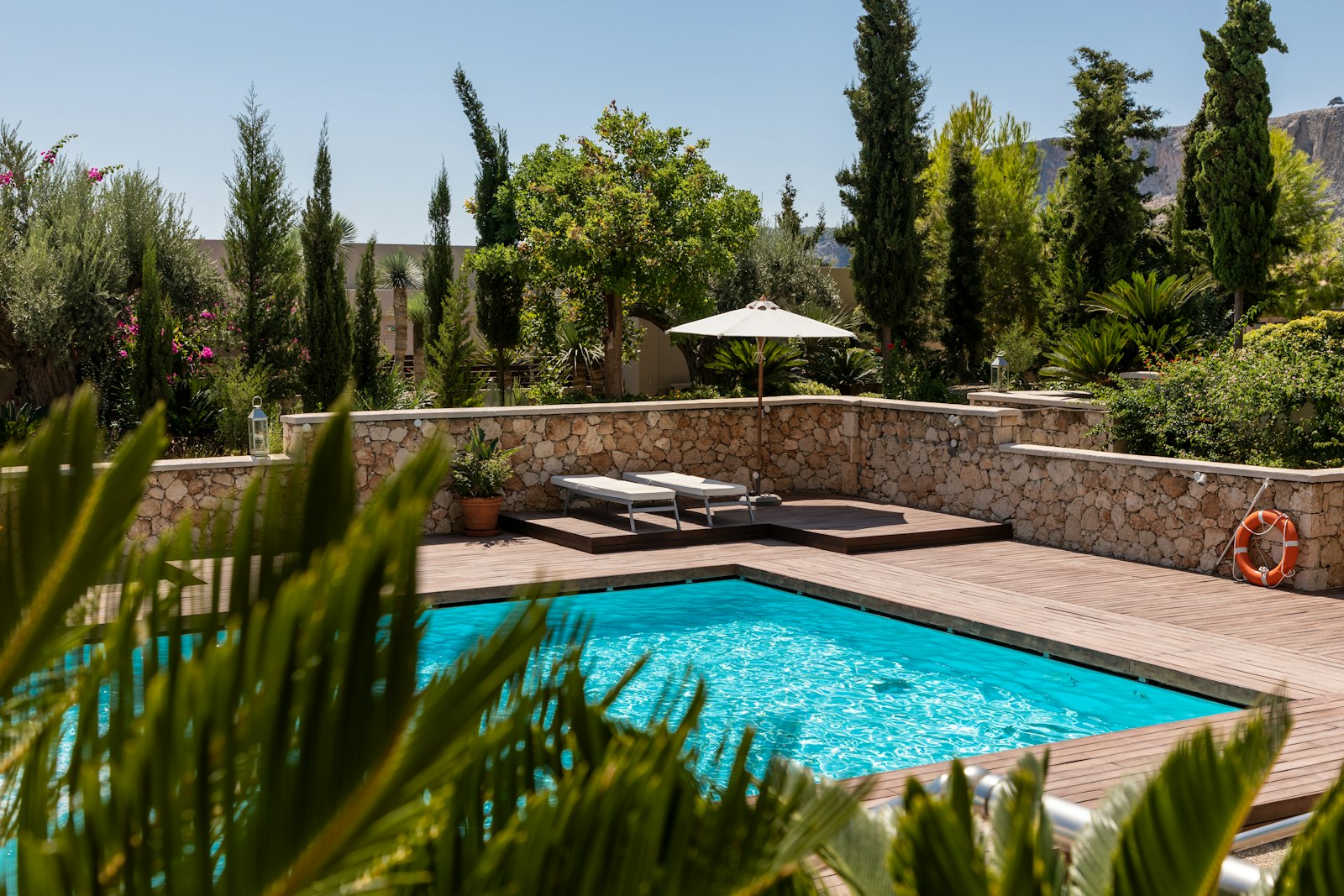
Why a sliding enclosure and not just a cover?
There are many ways to cover a pool — from a solar cover through slats to a fixed structure. You will find an overview of all cover types and calculations of energy and water savings in a separate article on enclosures and solar covers, so we will not repeat them here.
Among them, the sliding enclosure is the only solution that combines four functions at once: it retains heat, stops debris, acts as a safety barrier and at the same time creates a space where you can swim even in bad weather. It consists of aluminium arches with polycarbonate infill that slide telescopically into one another — so within a minute you can uncover the whole pool, or just part of it.
There is only one fundamental decision: how high should the structure reach. Manufacturers offer three categories, and each has its own philosophy.
Low enclosure: a clean look and maximum effect on the water
A low enclosure follows the water line — the lowest models are just 60 to 90 cm at the peak. From the garden it is almost invisible, does not spoil the view and does not read as a building. That is exactly why it is chosen by owners for whom the garden is an architectural whole and the pool a part of it, not the dominant feature.
The philosophy is simple: the enclosure serves the water, not the people. The small internal volume of air heats up quickly in the sun, so the greenhouse effect works best of all three heights. The water stays clean, warm and free of evaporation.
There is, however, one “but” that sellers like to gloss over: you cannot swim under a low enclosure. If you want to swim, you have to slide the segments away — so bathing “under the roof” really means the roof pushed aside next to the pool. In the rain or the evening chill a low enclosure does not let you swim, it only protects. Those who expect this tend to be satisfied; those who expected a covered pool tend to be disappointed.
Medium enclosure: the compromise most people choose
A medium (sometimes “mid-height”) enclosure is roughly 1.2 to 1.6 metres at the peak. It still looks relatively unobtrusive, but you can already move around inside — you can walk around the edge crouched over, get into the water and climb out again without sliding anything away.
In practice this means you can swim even in rain, wind or on a chilly evening: in the water itself you do not need standing height, your head is above the surface and the roof a metre above it. That is precisely why the medium height is the best-selling category — it offers 80% of the benefit of a high enclosure at a price closer to a low one.
The compromise has its costs too. Pool maintenance (vacuuming, cleaning the walls) is done bent over, or with the segments slid away. And you cannot sit on a poolside terrace under a medium enclosure — for that you need the third height category.
High enclosure: a walk-in conservatory over the pool
A high enclosure is 2 to 3 metres tall and is a fully fledged “conservatory”: you can walk upright around the whole pool, and there is room for a lounger, a small table and plants. The side walls usually have doors, and some models even sliding glazed panels.
The philosophy is the opposite of the low type: the enclosure does not serve just the water, it creates an extra living room. Combined with water heating, the pool becomes a year-round wellness area — swimming in December while it snows outside is, with a high enclosure and a heat pump, a realistic scenario, not an advertising promise.
The price of comfort: the highest cost, the biggest impact on the look of the garden and a larger volume of air that is harder to heat with sunshine — so with a high enclosure count on less passive water heating and more technology. And because it is visually and factually a building, checking the planning implications is most important here (see below).
Comparison: low vs. medium vs. high enclosure
| Criterion | Low (60–90 cm) | Medium (1.2–1.6 m) | High (2–3 m) |
|---|---|---|---|
| Main purpose | Water protection, clean look | Swimming even in bad weather | Year-round living space |
| Swimming under the roof | No (must be slid away) | Yes, moving crouched | Yes, free movement and seating |
| Passive solar water heating | Best | Very good | Weaker (large air volume) |
| Look of the garden | Almost invisible | Discreet | Prominent structure |
| Wind resistance during handling | Best (low profile) | Good | Larger area = more wind load |
| Indicative 2026 price (6–8 m pool) | from approx. €3,600 | from approx. €6,000 | from approx. €10,000 |
What are enclosures made of and what matters?
With all serious manufacturers the load-bearing frame consists of aluminium profiles — most often anodised or powder-coated (white, anthracite, wood-effect, bronze). Aluminium does not rust, does not warp and carries snow; with profiles, ask about the wall thickness and whether they are chambered (stiffer) or solid.
The infill is polycarbonate in two versions:
- Solid (compact) polycarbonate — clear as glass, usually 3–4 mm. It looks luxurious, does not distort the view and is practically unbreakable. However, it insulates less well and costs more. The typical choice for low “designer” enclosures.
- Multiwall (twin-wall) polycarbonate — 8–10 mm or more, with hollow chambers that act as an insulating layer. It retains heat significantly better and is lighter and cheaper, but it is milky translucent, not transparent. The standard for medium and high enclosures, where heat is the point.
In both cases insist on a co-extruded UV layer — without it, polycarbonate yellows and becomes brittle within a few years. Ask whether the UV protection is embedded in the sheet material or is only a coating, and what warranty the manufacturer gives on it (commonly 10 years against yellowing).
Rails, or a trackless system?
The enclosure segments slide either on rails anchored into the paving, or tracklessly on rubber wheels directly on the hard surface.
Rails guide the segments absolutely precisely, make it easy for one person to slide them and usually allow better locking. The downside is the intervention in the paving and the fact that you can trip over a rail — manufacturers solve this with low-edge walk-over ramp profiles. The rail track must be level; plan for it when the terrace is being built.
Trackless systems leave the paving clean and the segments can be wheeled away anywhere to the side. However, they need a genuinely flat and smooth surface, sliding is somewhat harder and the guidance less precise — for long enclosures over 8 metres, rails are almost always worth it.
Sliding and locking: what holds the enclosure in a gale?
An enclosure is a large, relatively light “sail” — and wind is its greatest enemy. So ask about two things: how the segments slide and how they are locked (secured against movement).
Quality systems have locking in every position, not just the end ones: pins or locks that anchor the segment to the rail or to ground sockets. Cheap enclosures often have only simple stops — and those are exactly what end up on the neighbour’s fence after a gale. A serious manufacturer will state up to what wind speed the structure is tested in the closed and locked state; ask for a specific number, not the reassurance that it “holds up well”.
For everyday handling: one adult can slide the segments of an enclosure for a pool up to 8 metres; for larger ones, count on two. In strong wind, do not slide the enclosure at all — a partially open segment acts like a wing.
Snow and structural strength: what to ask the manufacturer?
The second load that tests the structure is snow. Wet snow can easily weigh 200 kg per square metre — and the EN 1991-1-3 standard divides the Czech Republic into snow zones with markedly different design loads (from the lowlands to mountain areas). An enclosure that serves without problems in a lowland region may not survive a winter in the foothills.
Specific questions for the manufacturer:
- For what snow zone (design load in kg/m²) is the model rated, and do you have a structural calculation for it?
- Do I have to clear the snow off, or can the structure carry a whole winter’s layer?
- How does the arched profile behave — does snow slide off by itself?
- Does the warranty also cover snow damage, and under what conditions?
As a rule, an arch sheds snow better than a flat roof and lower arches are stiffer. With high enclosures and large spans the structural design is most sensitive — there, a structural report from the manufacturer is a necessity, not a premium extra.
How much does an enclosure really extend the season?
A realistic expectation: an enclosure alone, without heating, extends the swimming season by 6 to 8 weeks — you start roughly a month earlier in spring and finish a month later in autumn, because the greenhouse effect keeps the water several degrees warmer and, above all, stops night-time evaporation losses.
If you want more, you have to add technology: an enclosure plus a heat pump is the combination that lets you swim from March to November, and with a high enclosure practically all year round. At the same time the enclosure significantly reduces heating costs, because the pump is not reheating water chilled by wind and evaporation — you will find detailed savings figures in the aforementioned article on pool covers.
Safety: the enclosure as a barrier against a child falling in
A closed and locked enclosure is one of the most effective safety barriers for a pool: neither a child nor a pet can reach the water. Ask about lockable front doors and about securing the segments from the outside — on some cheap models the front can simply be lifted.
Important: the enclosure protects only when it is closed. In summer, when it is often slid open for weeks, child safety must rest on additional layers — supervision, rules and possibly an alarm. You will find a complete overview in the article on child safety around pools and hot tubs.
Do I need planning permission or notification?
In general, authorities usually do not treat low, terrain-hugging enclosures as structures requiring a special procedure, whereas with tall walk-in structures you may already fall under a notification regime — height, built-up area, distance from the property boundary and whether the site is in a heritage zone all play a role.
Moreover, the rules keep evolving (a new building act) and interpretation varies from office to office. The only reliable advice is therefore: before ordering a high enclosure, check with your local building authority — an informal enquiry with the dimensions and location is enough. Serious manufacturers are experienced with this and will prepare the documents (drawing, anchoring) for your discussions.
How much does a pool enclosure cost? (indicative 2026)
Prices depend on the height, length, span width, type of polycarbonate and the surface finish of the profiles. Indicative levels for 2026 based on the offers of Czech manufacturers:
- Low enclosure: economy ranges for smaller pools from approx. €2,000–2,400; a typical 6–8 m pool usually €3,600–7,200.
- Medium enclosure: most often €6,000–12,000 depending on the length and equipment (doors, compact end walls).
- High enclosure: from approx. €10,000; for large walk-in “conservatories” with glazed end walls commonly €16,000–28,000 or more.
Add installation (roughly from €320–400 upwards) and delivery; also check the VAT rate, which may differ for supply with installation. After the pool itself, the enclosure is usually the second largest item in the budget — how it fits into the overall costs is shown in the article on how much a pool costs.
So how to choose? A brief procedure
- Clarify your philosophy: are you protecting the water (low), do you want to swim in any weather (medium), or are you building a year-round wellness space (high)?
- Measure the space around the pool — where the segments will slide away to and whether the surface is level.
- Choose the infill: solid polycarbonate for looks, multiwall for heat. Always with the UV layer embedded in the material.
- Decide on rails vs. a trackless system based on your paving and the pool length.
- Request data on locking, tested wind speed and the snow load for your area.
- For medium and high types, check the building authority’s requirements in advance.
Frequently asked questions
Can you swim under a low enclosure?
No. A low enclosure is 60–90 cm at the peak and serves to protect the water; to swim, the segments are slid aside next to the pool. If you want to swim even in the rain, you need at least a medium height, where there is enough space above the surface for your head and movement.
Which polycarbonate is better — solid or multiwall?
It depends on your priority. Solid (compact) polycarbonate is clear and looks like glass, but insulates less well. Multiwall retains heat significantly better and is cheaper, but is only translucent. Compact prevails on low designer enclosures, multiwall on medium and high ones. Always require UV protection embedded in the sheet material.
Can the enclosure carry snow, or do I have to clear it?
It depends on the model and the snow zone. Ask the manufacturer for the design load in kg/m² and compare it with the snow zone of your site under EN 1991-1-3. Arched profiles partly shed snow by themselves; with heavy wet snow, however, careful sweeping is always safer — and read the warranty conditions.
Does an enclosure extend the season even without heating?
Yes, realistically by 6–8 weeks — the greenhouse effect warms the water by several degrees and stops night-time evaporation losses. Combined with a heat pump the season stretches from spring to late autumn, and with a high enclosure the pool can be run year-round.
Do I need planning permission for an enclosure?
For low types usually not; with tall walk-in structures you may fall under a notification regime — it depends on the height, area and position on the plot. Interpretation varies between authorities, so always check your specific situation with the local building authority in advance.
An enclosure makes the most sense when you plan it together with the pool — the dimensions, paving and rails then fit together without compromise. If you are still choosing a pool, browse our range in the pools category and further guides in the Advice centre; we will be happy to help you match the pool, enclosure and technology into one working whole.
