
A family pool doesn’t need to be deep – it needs to be well thought out. For a family with children, the proven formula is a rectangular pool with a flat bottom, a depth of 1.2–1.5 m, comfortable steps instead of a ladder, and water 1–2 °C warmer than adult swimmers are used to. A pool like that works for a toddler in the shallows, a school-age child learning to swim and a teenager who wants to swim properly – and you won’t have to rebuild it in five years.
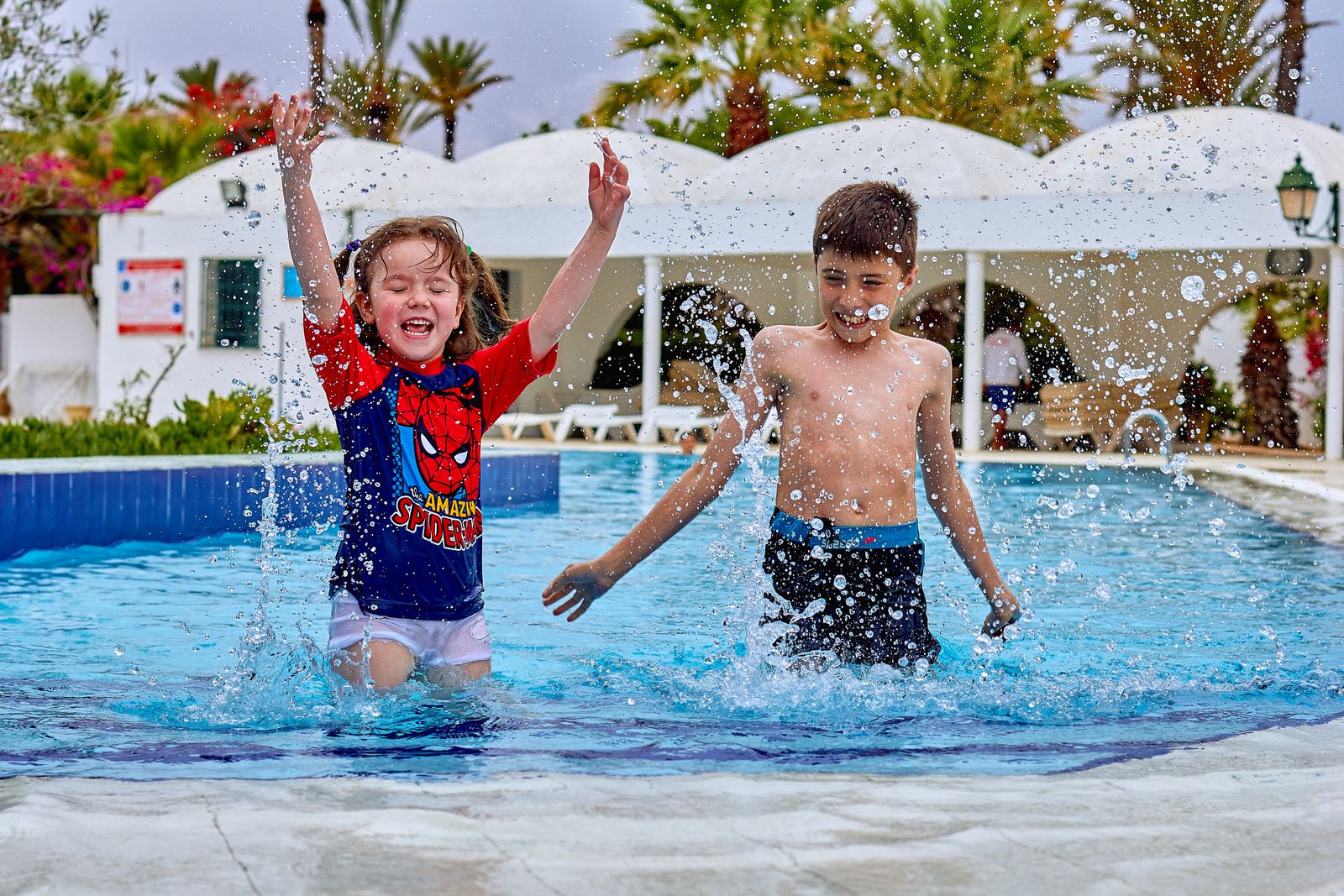
Why to choose a pool by family stages, not by the catalogue
You buy a pool for 15–25 years, but children grow far faster. The toddler splashing in the shallows today will be diving in head-first in three years and training front crawl in ten. Anyone who chooses a pool based only on their children’s current age usually discovers within a few seasons that the paddling pool is useless – or, conversely, that small children get nothing out of a deep swimming pool.
In practice, this means one thing: don’t choose a “kids’ pool”, choose a versatile family pool that handles each stage without remodelling. The stages look roughly like this:
- Toddler and preschooler (1–6 years): needs a shallow zone or a solid step surface where they can touch the bottom, warm water and constant adult supervision. They only use a few dozen centimetres of the pool’s depth.
- School-age child (6–12 years): learning to swim, jumping in, diving for rings, playing games. Ideal is a depth where they can stand – roughly shoulder height – and plenty of open space without obstacles.
- Teenager (12+): wants to swim continuously, perhaps train. They appreciate the pool’s length, a swim jet system and enough room for a group of friends.
The good news: one properly designed pool covers all three stages. How exactly, we break down below.
What pool depth is best for children?
The most common mistake is thinking in two extremes: either a shallow paddling pool “to be safe”, or a depth of 1.8 m and more “so we can jump in”. For a family, the sensible middle ground wins: a uniform depth of 1.2–1.5 m.
Why exactly that? In 130–140 cm of water, most children from around 8–9 years and practically all adults can stand. At the same time, it’s deep enough for swimming, games and aqua aerobics. An adult standing in the water always has the situation under control – which is priceless when playing with smaller children. And less water also means lower costs: an 8 × 4 m pool with a depth of 1.4 m holds about 45 m³, while the same pool at 1.8 m holds over 55 m³ – a difference you’ll notice in both heating and chemicals.
Flat bottom or a slope?
Classic public pools tend to have a bottom sloping from the shallow to the deep end. At home, that’s more of a drawback. A sloping bottom is treacherous for children – one step and suddenly they can’t stand. A flat bottom is predictable: a child knows that where they could stand a moment ago, they can stand now. A flat bottom is also easier to vacuum, a robotic cleaner works more reliably on it, and the pool structure is simpler and cheaper.
Is a separate shallow zone or paddling area worth it?
A built-in shallow zone (40–60 cm) looks lovely in the renderings, but in reality it serves for only two or three seasons – then even the youngest child outgrows it and you’re left with dead space you can’t swim across. A more practical solution is a wide staircase whose steps serve toddlers as a shallow area (see below), or an inexpensive inflatable paddling pool next to the main pool that simply disappears after a few years.
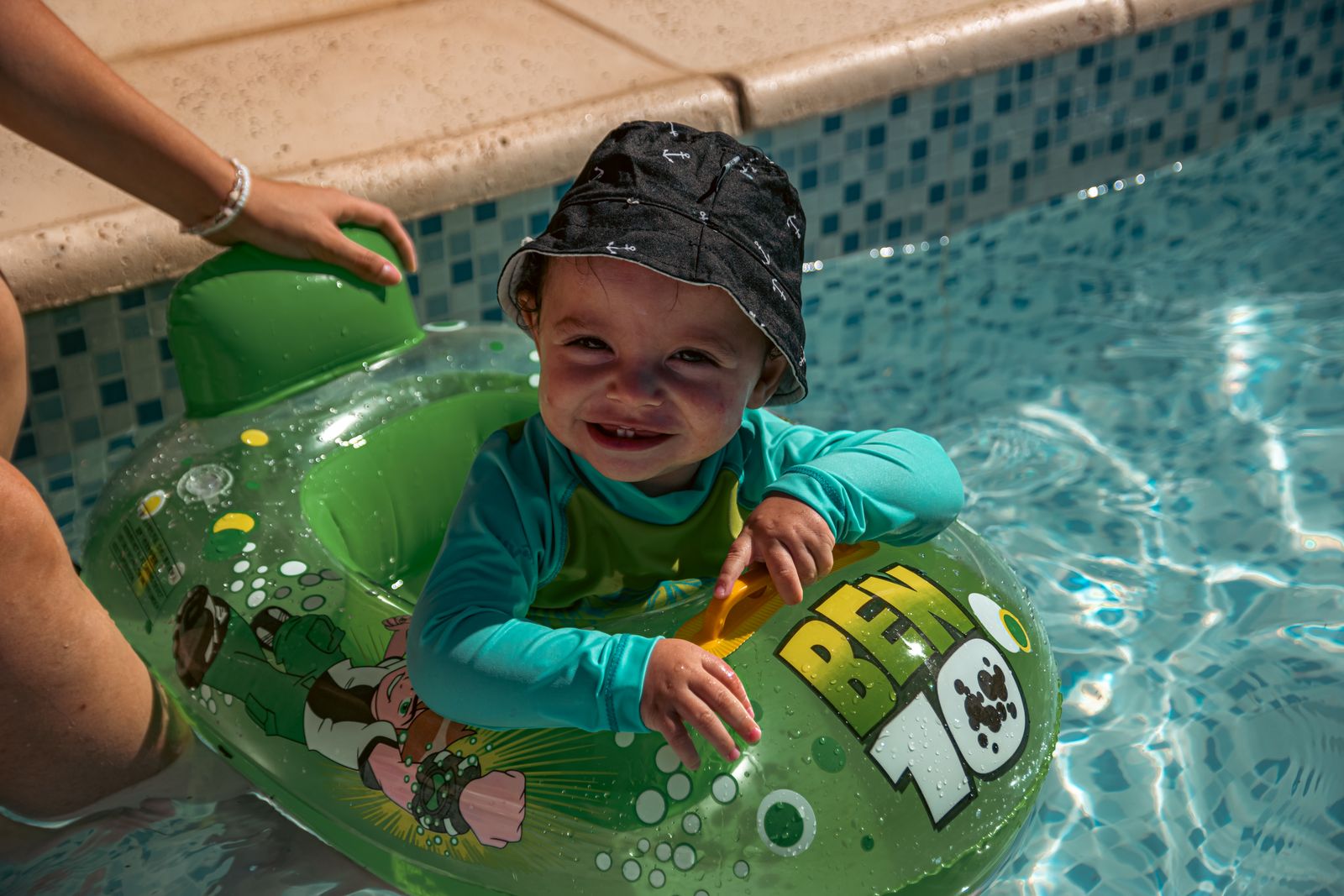
Size and shape: why the rectangle wins
Kidney shapes, lagoon designs and round pools have their charm, but for a family with children, a rectangle with a flat bottom is the most versatile choice. The reasons are prosaic:
- Swimming: only in a rectangle can you swim in a straight line and count lengths. Teenagers and parents alike will appreciate it; in a kidney shape you swim “into a bend”.
- Enclosures and covers: standard enclosures and solar covers exist for rectangles at reasonable prices; an atypical shape means custom manufacturing.
- Games: ball games, races, tug-of-war – everything works better on a regular surface without nooks.
- Maintenance: a regular shape without blind corners means better water circulation and easier vacuuming.
As for size: for a family of four, a sensible minimum is 6 × 3 m, with comfort starting at 7–8 × 3.5–4 m. In a pool like that, two children can play while a third person still swims. If your plot is smaller, don’t despair – even a smaller pool with a swim jet system can serve as a swimming pool.
What water temperature is right for children?
Children have a larger body surface relative to their weight than adults, so they cool down faster in the water. While a trained swimmer is comfortable at 24–26 °C, children playing – alternating between moving and standing still – need more. A practical rule: set the water 1–2 °C warmer than you would choose for yourself. For a family pool, that means roughly:
- 28–30 °C for toddlers and preschoolers,
- 27–29 °C for school-age children,
- 26–28 °C as a family compromise when everyone takes turns in the water.
You’ll spot it easily: blue lips and chattering teeth mean the water is too cold for the child, whatever the thermometer says. In our climate, however, you’ll only reach such temperatures without heating for a few weeks a year. The solution is a heat pump, which maintains a stable temperature from May to September at running costs of just a few euros a week – we covered them in detail in our article on heat pumps for pools and hot tubs. A solar cover, which keeps the heat in the water overnight, will also extend the season.
Getting into the pool: steps instead of a ladder
A stainless steel ladder is the cheapest pool entry – and the least suitable one for a family with children. A small child can’t climb it safely, a toddler not at all, and even adults find the slippery rungs uncomfortable. An investment in built-in steps or a Roman staircase pays off in a family pool every single day:
- Toddlers get a natural shallow area on the first and second step – they sit in 20–40 cm of water and play while a parent sits right beside them.
- Children get in and out by themselves, gradually and facing the steps, not backwards down a ladder.
- The steps double as a bench for resting between swims – grandparents will appreciate them too.
- A wide corner or Roman staircase takes up part of the swimming length, so place it in a corner or along a side wall.
For above-ground pools, where built-in steps aren’t possible, at least choose safety steps with a platform and handrails on both sides instead of a simple ladder.
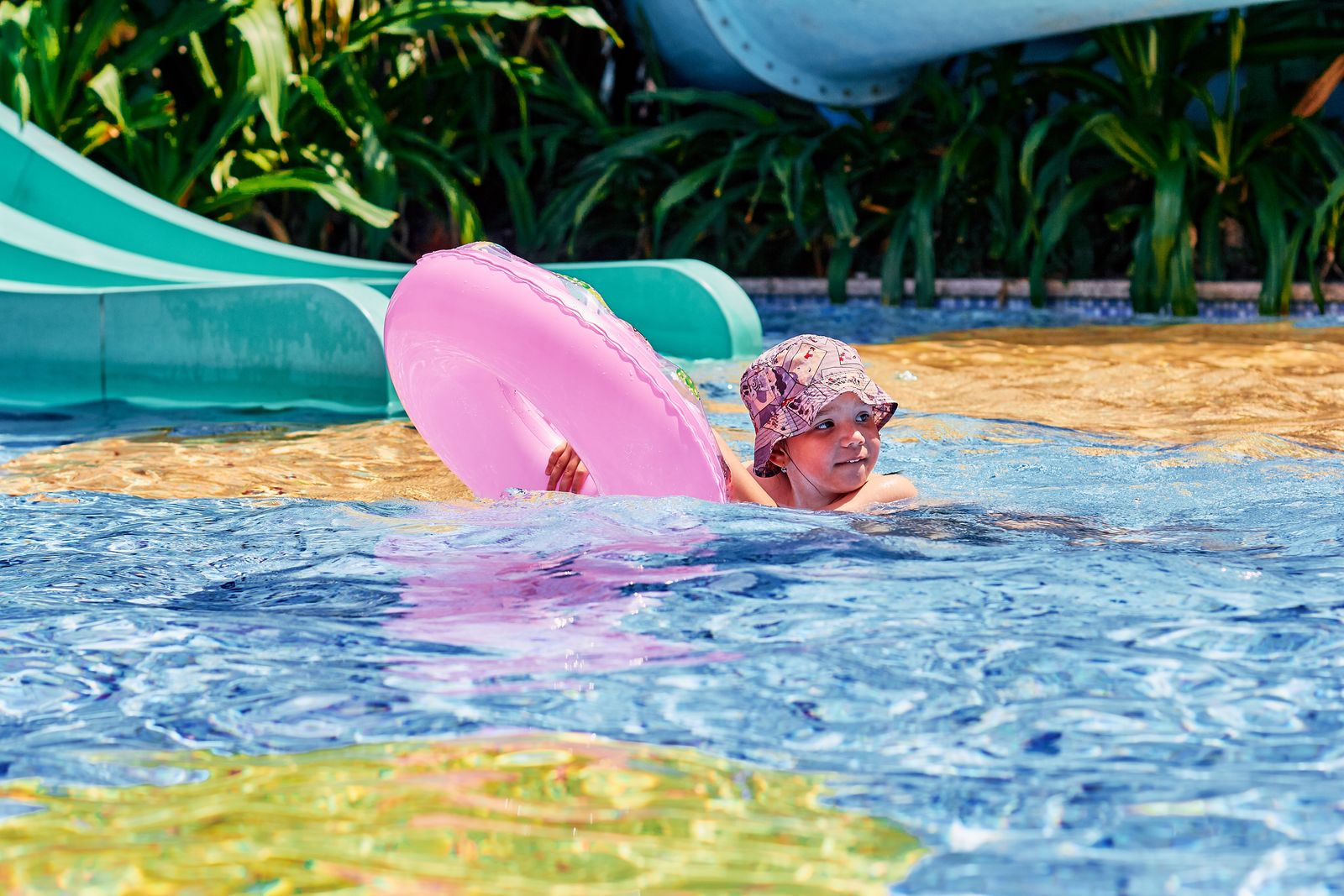
Features kids genuinely love (and those that are just for photos)
Catalogues offer waterfalls, LED fountains and air loungers. Families’ experience, however, is fairly unanimous – three things win in the long run:
Water spouts and water curtains
A simple stream of water falling into the pool is endless fun for children: they swim under it, hold their hands, heads and cups in it. A spout is technically undemanding – it just needs a connection to the filtration circuit or a small separate pump. Bonus: the sound of running water pleasantly masks surrounding noise.
A swim jet as a “wave machine”
Parents buy a counter-current system for stationary swimming, but children claim it as an attraction – the water stream creates waves, you can “battle” against it and surf it with floats. One device thus serves a teenager in training and an eight-year-old at play. More in our guide to choosing a pool swim jet system.
A slide – yes, but with forethought
A slide is a magnet for children, but consider three things before buying. First, the landing depth – manufacturers usually require at least 1 m of water in the splash-down area, which the universal depth of 1.2–1.4 m satisfies. Second, space – a slide needs solid anchoring outside the pool and a clear landing zone, so it doesn’t suit a small pool. Third, the lifespan of interest – while a spout entertains all age groups, children outgrow a slide around age twelve. Smaller polyester slides start at around €1,000; quality anchored models cost several times more.
What to rather avoid: massage benches and hydromassage jets in the pool (children won’t use them and adults prefer them in a hot tub) and an excess of built-in LED effects, which raise the build cost and become a service item over time.
Water treatment gentle on children’s skin
Children’s skin is thinner and more sensitive than adults’, and the same goes for the conjunctiva of the eyes. Classic chlorine chemistry at higher doses therefore more often causes red eyes and dry skin in children. The solution is not to skip chlorine – there’s no way around disinfection – but to reduce the concentration needed:
- A UV lamp in the filtration circuit destroys most microorganisms physically, so free chlorine can be kept at the lower end of the recommended range of 0.3–0.6 mg/l. How UV and ozone work is covered in our article on UV lamps and ozone in water disinfection.
- Consistently monitored pH of 7.0–7.4 – most “stinging eyes” are caused not by chlorine but by incorrect pH. With a pool full of children, test twice a week to be safe.
- A shower before swimming – rinsing off sweat and creams means less organic contamination, and therefore less combined chlorine, which is the main source of odour and irritation.
An alternative is mildly salted water with electrolysis, which is gentler on the skin than manually dosed chlorine – with salt water, the generated chlorine is dosed continuously and evenly.
An above-ground pool: a smart starter solution for a young family
You don’t have to start with an in-ground pool costing a fortune. A quality 4–6 m above-ground pool including filtration costs from roughly €800–2,400, you can assemble it over a weekend, and the family can find out how intensively they’ll actually use a pool. For families with small children, an above-ground pool has a safety bonus too: the 1.2 m high wall acts as a natural barrier – a toddler can’t fall into the water on their own if you remove the steps.
Once the children have grown and you’re clear about your requirements, you can move on to an in-ground pool – you’ll find a comparison of both routes in our article on above-ground vs. in-ground pools and a complete buying guide in how to choose an above-ground pool.
Children’s age and recommended pool parameters: a handy table
| Children’s age | Depth they’ll actually use | Recommended temperature | Key equipment | What to watch out for |
|---|---|---|---|---|
| 1–3 years (toddler) | 20–40 cm (steps, paddling pool) | 29–30 °C | Wide steps, sun shading | Constant supervision within arm’s reach, barrier to pool access |
| 3–6 years (preschooler) | 40–80 cm | 28–30 °C | Staircase, water spout, small swimming aids | Never alone, even with flotation aids; shallow area with a flat bottom |
| 6–12 years (school age) | 80–130 cm | 27–29 °C | Open play area, water spout, possibly a slide | No jumping into water shallower than 1.5 m, rules for games |
| 12+ years (teenager) | 120–150 cm, length for swimming | 26–28 °C | Swim jet system, length ideally 7 m or more | Friends visiting = clear rules for other people’s children too |
| Whole family (universal) | Uniform 1.2–1.4 m, flat bottom | 27–29 °C | Rectangle, Roman staircase, heating, enclosure | Gentler disinfection (UV + low chlorine), stable pH |
The table confirms the article’s main idea: the stages differ in the depth and temperature used, but one rectangular pool with a flat bottom of 1.2–1.4 m, steps and heating covers them all.
And what about safety?
This article is about selection and equipment – safety rules, barriers, alarms, certified enclosures and supervision principles are covered in detail in our separate guide to child safety around pools and hot tubs. Consider it required reading for every family pool: no shallow zone or steps, however good, can replace an access barrier and an adult’s watchful eyes.
Frequently asked questions
Is a depth of 1.2–1.5 m really enough for a family that wants to swim?
Yes. For swimming – including sports swimming – it’s enough that your body doesn’t touch the bottom during a stroke, which around 1.2 m already satisfies. Swimmers are bothered by a short pool, not a shallow one. Greater depth only makes sense for head-first diving, which isn’t recommended in a home pool anyway.
What water temperature should we set when both children and adults swim?
The compromise is 27–29 °C. Adults will find it warmer than they’re used to from a swimming pool, but children can stay in the water longer without getting chilled. If adults swim in the morning and children in the afternoon, let the heat pump hold the lower end of the range and the afternoon sun will help.
Is a separate paddling pool or a shallow zone in the pool better for small children?
For toddlers, the most practical combination is wide steps in the pool (which act as a supervised shallow area) plus an inexpensive portable paddling pool next to the pool. A built-in shallow zone occupies space permanently but serves for only a few seasons.
Doesn’t pool chemistry irritate children’s skin?
Not when set up correctly. The key is a pH of 7.0–7.4 and the lowest effective chlorine dose – with a UV lamp in the filtration circuit, 0.3–0.6 mg/l of free chlorine is enough. Most eye irritation is caused by incorrect pH or combined chlorine, not by the disinfection itself.
Is starting with an above-ground pool worth it?
For a young family, often yes. For a fraction of the price of an in-ground pool, you’ll find out how much you’ll really use it, and the high wall of an above-ground pool also acts as a barrier against a toddler falling into the water. You can then plan the move to an in-ground pool with real experience behind you.
In conclusion: a pool that grows with your children
A family pool is a compromise in which nobody may lose: a 7–8 × 3.5 m rectangle, a flat bottom at 1.2–1.4 m, a Roman staircase, heating to 27–29 °C and gentle water treatment with a UV lamp will serve a toddler, a school-age child, a teenager and the parents alike – without remodelling or pointless dead zones. Choose features sparingly: a water spout and a swim jet system will hold children’s interest longer than anything else. You’ll find specific pools, staircases and complete sets with filtration in our pool category on poolspashop.eu – and if you’re unsure about the size or technology, we’ll gladly help you choose the right fit for your garden and your children’s age.
