
An indoor pool is the pinnacle of home wellness: you swim in 28 °C water in February while it snows outside, and the pool never closes. It is also the most technically demanding structure you can add to a house — a water surface of 20–30 m² continuously evaporates dozens of litres of water a day, and without professional ventilation this moisture will destroy the fabric of the building. The success of the whole project stands or falls on a handful of decisions that must be made before the first spade hits the ground. This article walks through them one by one.
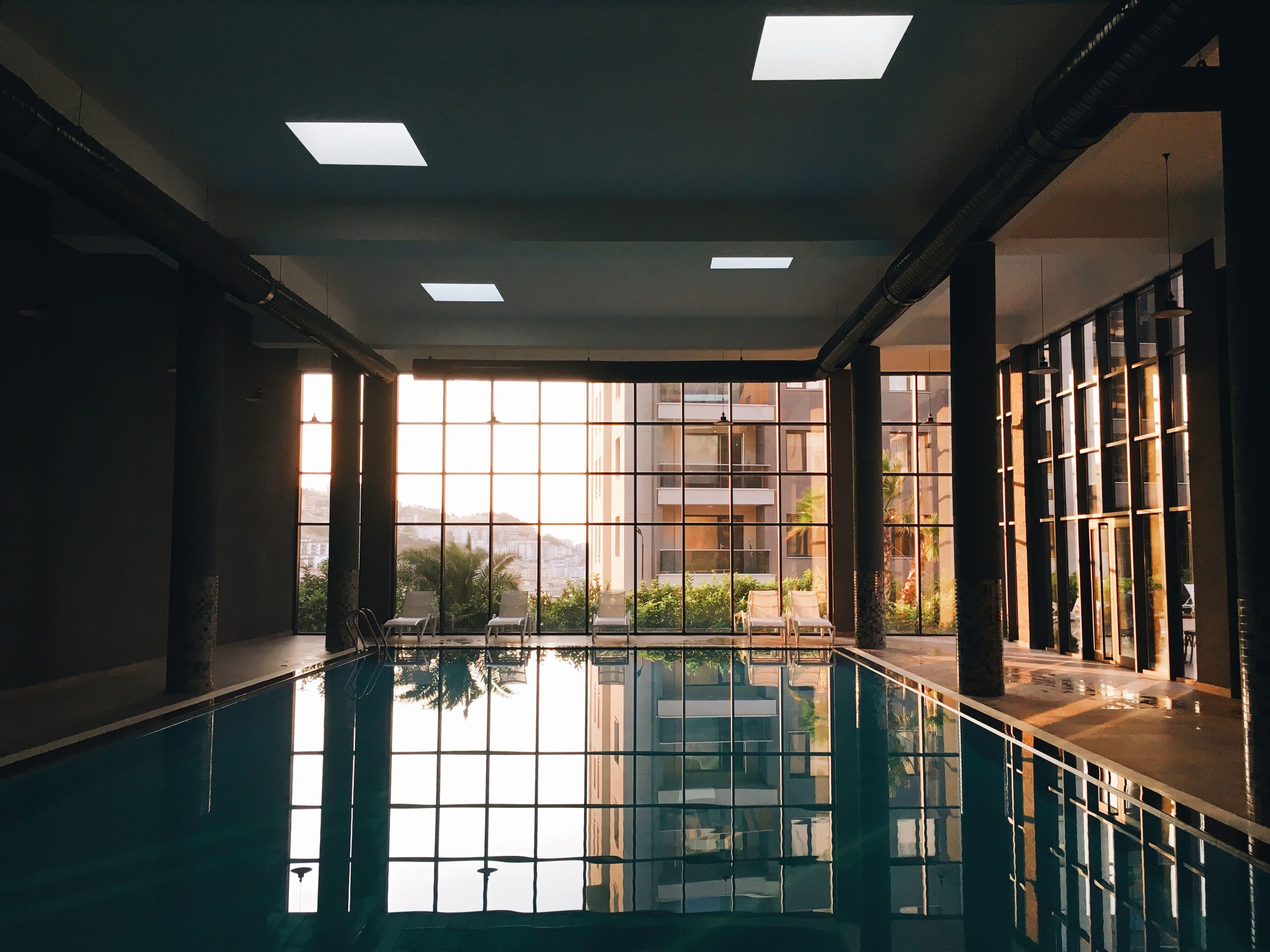
The dream versus reality: what an indoor pool really offers
First, the good part. An indoor pool means 365 days of swimming a year regardless of weather, pollen, insects and leaves. No spring start-up, no winterizing, no battle with green water after a storm. Water and air stay at a constant temperature, you swim in the morning before work and in the evening after dark, in complete privacy. For families with children it is a year-round alternative to swimming lessons; for athletes, a training lane just beyond the bedroom door.
And now the reality. An indoor pool is not “a pool with a more expensive roof” but a stand-alone technical building: the pool hall needs its own ventilation system with dehumidification, special wall and ceiling build-ups, different water treatment and continuously running equipment. The investment runs into hundreds of thousands of euros, and operating costs into hundreds per month even with a good design. Those who face up to these numbers in advance gain a luxury that lasts for decades. Those who underestimate them acquire the most expensive source of mould in Central Europe.
Decision no. 1: ventilation with dehumidification — a necessity, not a luxury
If you take away a single thing from this article, let it be this: the success of an indoor pool is decided not by the pool, but by the air above it.
A 20–30 m² water surface at 28 °C evaporates on the order of 50–150 litres of water a day — the exact amount depends on air temperature and humidity, water movement and whether the pool is covered. For comparison: a hot tub has a surface of around 4 m² and is protected by a thermal cover for most of the day. Evaporation from a swimming pool is therefore an order of magnitude higher, and a portable dehumidifier from a DIY store does not stand a chance. We covered the general principles of indoor humidity in the article Indoor Hot Tub — with a full-size pool the same applies, only on a much larger scale.
The solution is a dedicated swimming pool air handling unit with dehumidification and heat recovery. It does three things at once: it condenses moisture out of the air, supplies fresh air and, via a heat recovery exchanger, returns heat — both from the extracted air and from the condensing vapour — back into the hall, or into the pool water. A quality unit keeps relative humidity in the hall at around 50–60 %, and no indoor pool can do without one, whatever the budget.
What happens without it? Warm, vapour-saturated air travels to every cooler surface — windows, corners, reveals, structural elements inside the wall build-up — and condenses there. What follows is fogged glass, wet walls, mould, corrosion of metal components and, with timber structures, gradual destruction. The ventilation must therefore be designed by an engineer specializing in pool halls, with an evaporation calculation for the specific water surface and temperatures. It is a line item costing a few thousand euros in the design phase that protects an investment worth hundreds of thousands.
Building physics: the hall must be built differently from a living room
A pool hall has a year-round indoor climate like a tropical greenhouse: 28–32 °C and high absolute humidity. Water vapour pressure drives moisture into every gap in the structure, which is why the usual construction details of a family house do not apply here.
- A vapour barrier without compromise. The walls and ceiling of the hall need a continuous, taped vapour barrier on the warm side of the structure — every leak means condensation inside the build-up that you cannot see from outside until it is too late.
- Above-standard insulation. The warmer the interior surfaces, the lower the risk of condensation. The hall is insulated well beyond the requirements of an ordinary living space, with no thermal bridges.
- Windows with thermally broken frames. Large glazing belongs with a pool, but only with triple glazing and thermally broken frames; otherwise they become the first condensation surface in the house. The warm supply air from the ventilation system is routed along the glass precisely so that it washes over it and keeps it dry.
- Sloped floors with drains. The walkways around the pool must have anti-slip tiling sloped towards floor drains — water from swimmers’ bodies and from cleaning must have somewhere to run off, not seep into the structure.
The practical consequence: an indoor pool is easiest to build into a new house, where the hall is designed in from the start. Retrofitting one into an existing room is possible, but it means completely rebuilding the wall, ceiling and floor build-ups — not just “putting a pool in a room”.
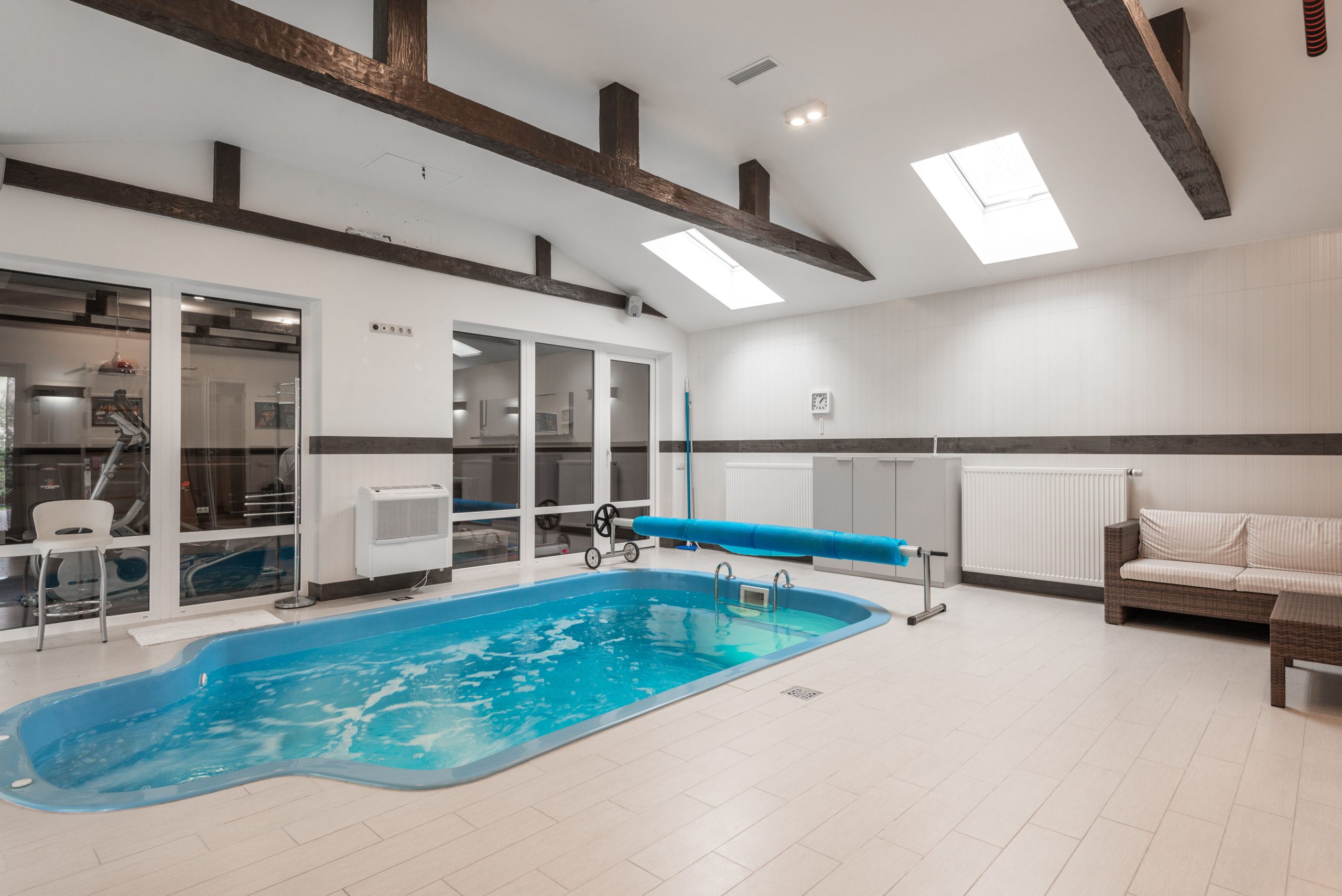
What temperatures to set? Water 26–30 °C, air 2 °C warmer
For indoor pools a proven rule applies: the air temperature in the hall should be 1–3 °C higher than the water temperature. For recreational swimming that means water at 27–29 °C and air around 30 °C; sporty swimmers choose cooler water, 26–28 °C.
Why air warmer than water? For two reasons. First, evaporation: the warmer the air, the more moisture it can hold and the smaller the vapour pressure difference between the water surface and the air — so evaporation (and with it the cost of dehumidification and water reheating) drops. The opposite setting, cold air above warm water, increases evaporation dramatically. Second, comfort: a wet person stepping out of the water into air cooler than the water immediately shivers with cold, even if the hall is at 26 °C.
The setting is therefore always a pair of numbers, not one: for example water 28 °C + air 30 °C at 55 % humidity. Modern pool air handling units maintain both values automatically.
How much does an indoor pool cost to run?
Operating costs consist of three main items: water heating, running the ventilation system (dehumidification + heating the hall) and filtration with water treatment. For an 8 × 4 m pool, budget very roughly €1,000–2,400 per year depending on energy prices, the quality of the hall envelope, the heat source and — above all — whether you cover the pool.
Covering the water surface is a key money-saver even inside the house. A slatted cover or a foil sheet stops evaporation, cutting heat loss from the water, dehumidification demand and air reheating all at once — outside operating hours, that is most of the day. The physics is the same as with outdoor pools; we described it in the article Pool Enclosure and Solar Cover; indoors, instead of a solar cover, a more elegant slatted cover is used, often recessed under the walkway. A pool run all day with an uncovered surface can consume twice as much energy as the same pool that is covered.
The economics also benefit from linking the technologies: heat recovery from the ventilation preheats the water, the house’s heat pump can also heat the pool, and the hall can be ventilated more cheaply in summer. But all of this has to be in the design from the start.
Water treatment indoors: chloramines have nowhere to escape
Outdoors, the wind carries away the by-products of chlorination. Indoors, they stay. Chloramines — compounds of chlorine with sweat and organic matter — cause the typical “pool” smell, stinging eyes and irritated airways; in a closed hall their concentration keeps rising unless addressed, and on top of that they corrode metal parts of the structure and the ventilation system.
Stricter rules therefore apply to an indoor pool than outdoors: a lower target level of free chlorine, consistent showering before swimming and, above all, supplementary disinfection that breaks chloramines down. A UV lamp is almost mandatory for an indoor pool — it destroys microorganisms and at the same time breaks down combined chlorine by photolysis, so the hall does not smell and less chlorine is needed. We covered the technology in detail in the article UV Lamp and Ozone in Disinfection. The ventilation design must also include a sufficient share of fresh air to carry residual chloramines out of the hall.
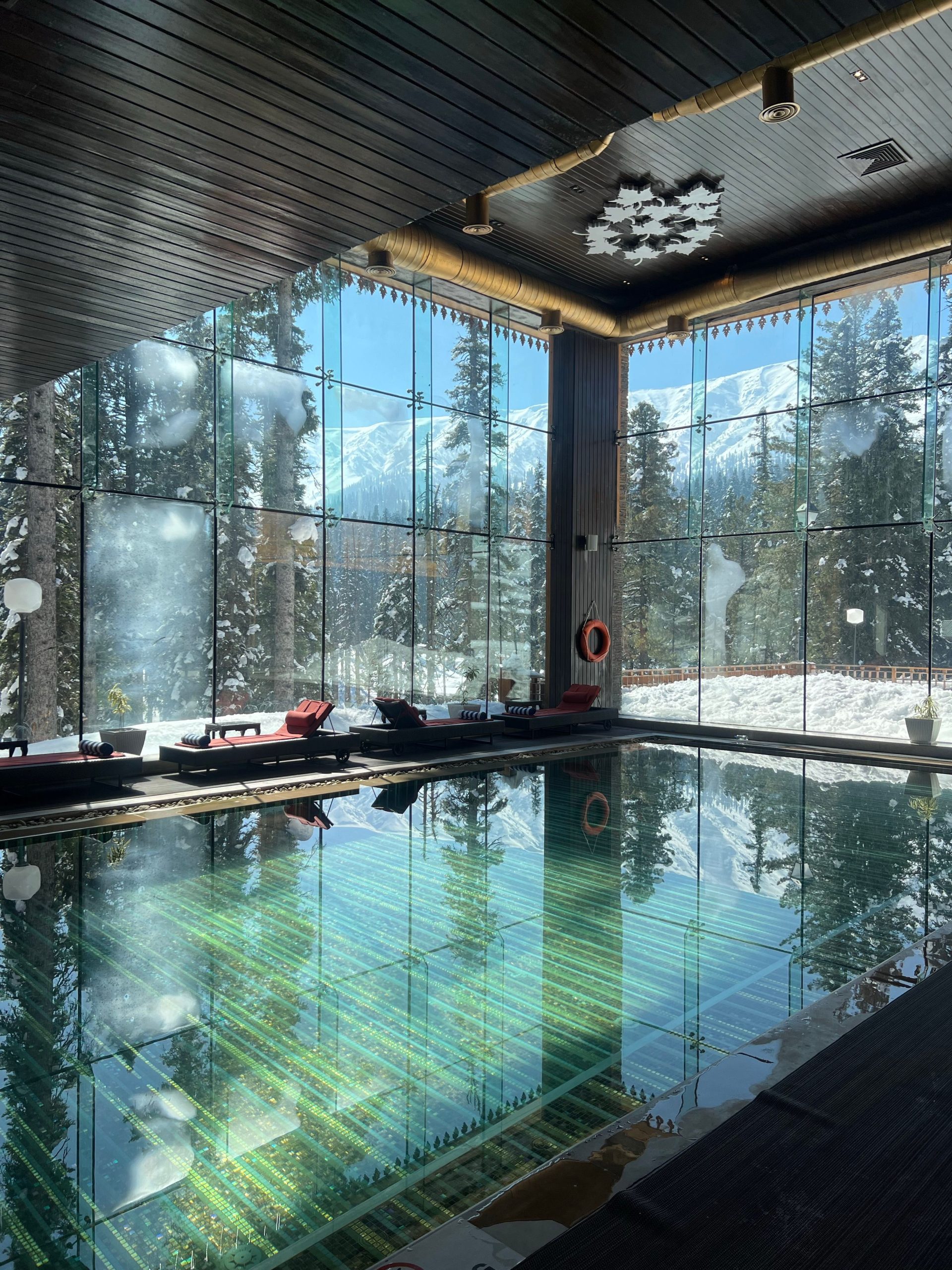
How much does an indoor pool cost to build?
Very roughly, for a pool hall attached to a new family house with a concrete or frame-built 8 × 4 m pool (assumptions: hall of approx. 50–60 m², standard technology, 2026 prices):
- Pool shell with technology (filtration, heating, features, slatted cover): roughly €60,000–120,000.
- Building the hall (envelope, glazing, finishes, insulation): roughly €80,000–200,000 depending on the standard — often a more expensive item than the pool itself.
- Ventilation with dehumidification and heat recovery including ductwork: roughly €16,000–40,000.
In total, a realistic project starts at roughly €160,000 and up; luxury builds easily exceed €400,000. Take these figures as an order-of-magnitude orientation for a first assessment, not as a quote — the spread by location, standard and layout is enormous. How a pool budget is put together in general is described in the article How Much Does a Pool Cost.
Indoor pool vs. outdoor pool with an enclosure
| Criterion | Indoor pool | Outdoor pool with enclosure |
|---|---|---|
| Season | 365 days a year, regardless of weather | Realistically 5–8 months, longer with an enclosure and heating |
| Investment (8 × 4 m) | Very roughly €160,000–400,000+ | Very roughly €40,000–100,000 incl. enclosure |
| Annual running costs | €1,000–2,400 (heating + ventilation + dehumidification) | €600–1,400 (seasonal operation) |
| Key technology | Pool air handling with dehumidification and heat recovery | Enclosure, heating, surface cover |
| Construction demands | High: vapour barriers, insulation, hall design | Medium: ordinary outdoor construction + anchoring the enclosure |
| Water treatment | Stricter, UV almost mandatory (chloramines) | Standard, UV an optional comfort |
| Surroundings maintenance | Minimal (no leaves, pollen, insects) | Seasonal cleaning, winterizing and spring start-up |
| Impact on the house | Part of the house — adds value as well as moisture risk | Independent of the house structure |
Put simply: an outdoor pool with a quality enclosure offers six to eight months of comfortable swimming for a third of the money. An indoor pool offers the remaining four months — and those are the most expensive in the world. How to choose an enclosure that extends the outdoor season as far as possible is covered in the article How to Choose a Pool Enclosure.
Alternatives for a smaller budget
Year-round swimming at home does not have to mean a pool hall costing hundreds of thousands.
A swim spa indoors or in a conservatory. A swim spa with a counter-current system offers a full swimming workout on a water surface of 4–6 m² — with far less evaporation, which a properly sized dehumidifier can handle without a large pool ventilation system. What is more, it is a product, not a construction project: it is delivered, connected, and you swim. What to consider is covered in the articles How to Choose a Swim Spa and Indoor Hot Tub (floor load capacity, the route inside and humidity apply in much the same way).
An extension or conservatory with an outdoor pool and enclosure. The compromise route: an outdoor pool right next to the house with a tall enclosure or a light glazed extension stretches the season to 8–10 months at a fraction of the cost of a hall. It is not a tropical 30 °C in January, but the value for money is unbeatable.
FAQ: the most common questions about indoor pools
Can I retrofit an indoor pool into an existing room?
Technically often yes, but expect a complete rebuild: a new floor build-up with falls and waterproofing, vapour barriers in the walls and ceiling, window replacement, ventilation ductwork and a structural assessment. With existing houses it is therefore usually simpler and cheaper to build a separate extension designed from the outset as a pool hall.
Is a powerful dehumidifier enough instead of pool ventilation?
For very small pools and swim spas that are consistently covered, a wall-mounted pool dehumidifier may suffice. For a swimming surface of 20 m² and more, it is not — you need a unit that, besides dehumidification, also handles fresh air supply, heat recovery and airflow across the glazing. Without it the hall does not work in the long run.
Why should the air in the hall be warmer than the water?
Warmer air holds more moisture and reduces the vapour pressure difference above the surface, so the water evaporates less — cutting the cost of both dehumidification and heating. It is also more comfortable: a wet body in air cooler than the water chills instantly. The standard is air 1–3 °C warmer than the water, typically 30 °C above 28 °C water.
Do I have to cover an indoor pool when it is inside the house?
Emphatically yes. Covering the surface (slatted cover, foil sheet) outside operating hours stops evaporation and thereby significantly reduces dehumidification demand, water reheating and hall heating. For an indoor pool run year-round it is the fastest-payback investment in the whole project.
Is chlorine or salt water better for an indoor pool?
Both are forms of chlorination — chlorine produced by a salt system also forms chloramines in a closed hall. What matters is therefore supplementary disinfection: a UV lamp (or ozone) breaks down combined chlorine, keeps the air in the hall odour-free and allows lower dosing. Combined with plenty of fresh air from the ventilation system, it is the standard for modern indoor pools.
An indoor pool is a decision for decades — and when the four key decisions come out right (ventilation, building physics, surface covering and water treatment with UV), it is the most luxurious room a house can have. Whether you are aiming for a full-scale hall or a smarter compromise, you will find pool shells, technology and complete packages in the pools category — and more planning guides in the Guide.
