
Where you put the pool equipment is a decision made in a few minutes and lived with for twenty years. The short answer: choose a space about a third larger than today’s equipment dimensions suggest, put it as close to the pool as possible and below water level — and never build a pit without drainage and ventilation. Everything else can be fine-tuned later, this cannot. The following text sums up the placement options, the real space requirements and the mistakes that only show up at the moment you need to replace the pump.
Why a design mistake only shows up years later
For the first few seasons the pool just runs and nobody has to go into the pit. The problem comes later and always in the same order. After five to eight years the pump reaches the end of its life — and you find out it cannot be pulled out without cutting through part of the pipework. At the same time you want to add a heat pump or chemical dosing and there is nowhere to put it. And somewhere during that period everything metal in the pit starts to corrode, because it was never ventilated.
The common denominator: at the design stage nobody thinks about what will happen during servicing and expansion. The only question asked is whether the filter and pump fit in there today. But that is the smallest part of a pool’s life.
Four ways to site the equipment and what they really mean
In practice four solutions are used. They differ in price, but above all in what it is like to live with the equipment.
| Option | Indicative price of the space alone | Accessibility | Noise | Frost protection | Pipe run length |
|---|---|---|---|---|---|
| Plastic pit next to the pool | approx. €330–600 for the pit + concreting and excavation | Worst — working on your knees from above, limited room to manoeuvre | Very low, the ground dampens it | The ground protects it, but above the frost line there is only the lid — draining is essential | Shortest, 2–5 m |
| Custom-built masonry pit | approx. €1,000–2,500 depending on size | Good, if it has steps and a clear height of at least 150 cm | Low | Good if the lid is insulated | Short, 3–8 m |
| Plant room in the house or garage | Free if the space already exists; otherwise considerably more expensive | Best — standing up, with light and sockets | Risk of transmission into the house, insulation needed | Best, no freezing | Longest, often 10–20 m |
| Technical shed in the garden | approx. €800–2,900 | Very good | Audible outdoors, distances from neighbours are key | Heating or winterising required | Medium, 5–15 m |
The prices are indicative, based on the usual offering from suppliers of equipment pits in 2026, and do not include the equipment itself, the electrics or the pipework. Treat them as an order-of-magnitude guide, not a budget.
When each one makes sense
A plastic pit is the standard for most garden pools: it is cheap, quick and the equipment sits right next to the pool. But if you are planning a heat pump, dosing, a counter-current unit or automation, you will run out of space very quickly.
A masonry pit is a compromise that pays off with more expensive pools. You build it exactly as big as you need and add steps and shelves.
A plant room in the house or garage is the most comfortable option in terms of servicing, but you pay for it with pipe run length and noise. If the room adjoins a bedroom, acoustic measures have to be allowed for — this is covered in detail in the article on pool equipment noise.
How big does the pit really need to be
This is where most mistakes are made, because people only count what they are buying right now. A realistic footprint estimate works out as follows:
- Sand filter — a vessel 40–60 cm in diameter; with room to operate the six-way valve it needs around 70×70 cm.
- Pump — 50×25 cm in itself, but you must have room to take the pre-filter lid off and lift the whole body out upwards.
- Heating — a heat exchanger takes up roughly 80×20 cm on the wall; a heat pump stands outdoors and does not belong in the pit.
- Dosing — a dosing station with probes and a canister needs about 50×50 cm plus the height for the canister; see automatic chlorine dosing.
- Control panel and automation — 40×40 cm on the wall, ideally in the upper, driest part.
- Reserve — at least 30 % free floor area and one free metre of pipe for fitting another component in the future.
In practical terms this means that the common pits of around 105×95 cm are enough for a filter and a pump, but nothing more. As soon as you want heating, dosing and pool automation, you are looking at a footprint closer to 150×120 cm and a clear height of at least 120 cm. German sources recommend an internal dimension from 200×125 cm for larger set-ups and an access opening of at least 80×80 cm — anything less simply cannot be worked in.
Ergonomics: can you actually work in there?
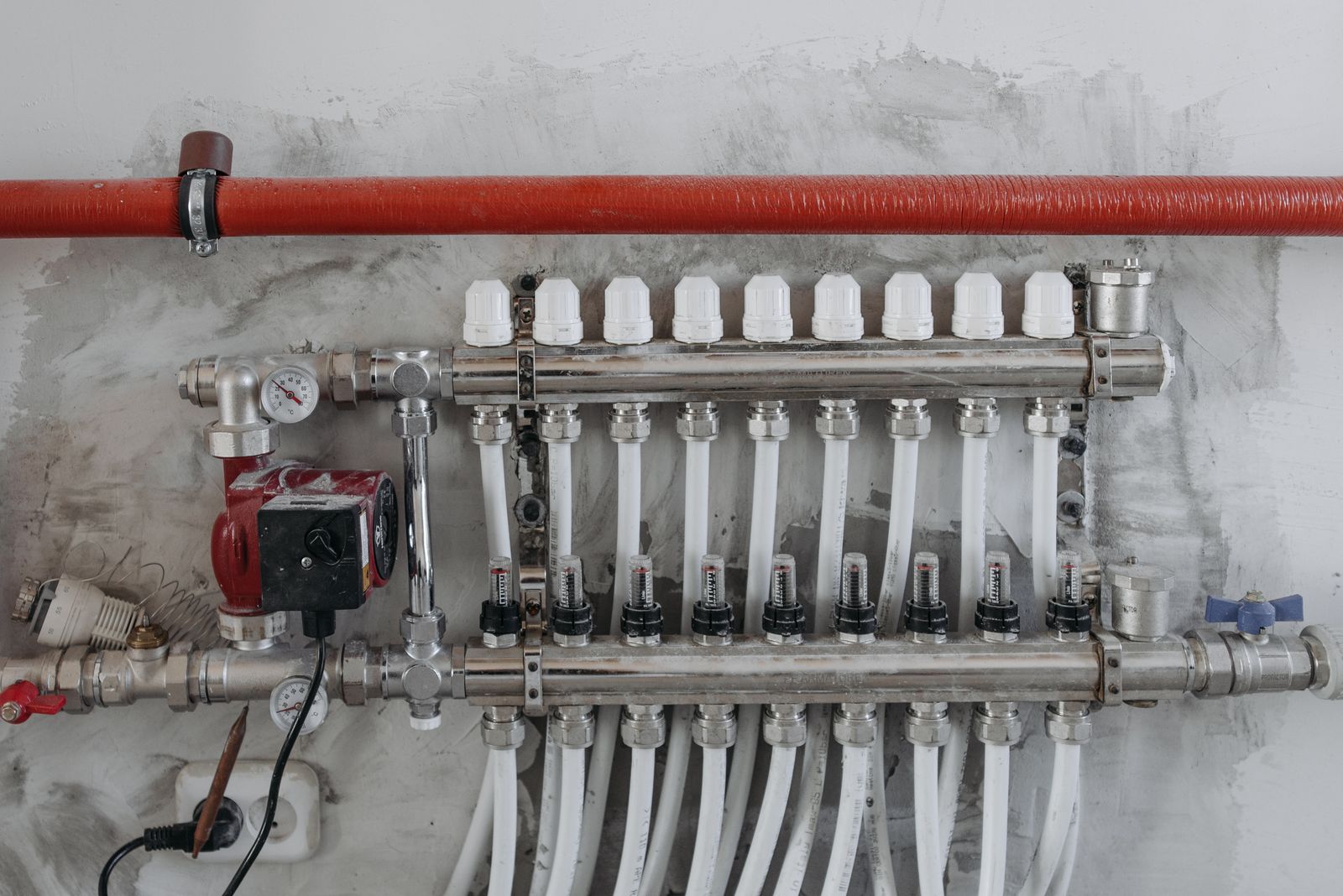
At the design stage, try answering four questions. Can I get to every piece of equipment so that I can reach it with both hands? Can I lift the pump out without dismantling the pipework? Is there anywhere to kneel or sit? And can I see what I am doing?
The last point is the most underrated. A pit needs one fixed light fitting with a protection rating suitable for damp locations and one socket — without them every service job is done with a head torch in your mouth. Design the unions and connectors so that every device can be disconnected at two releasable joints; solvent-welded permanently is a one-off job you will pay for next time with a saw.
Drainage and ventilation: the most commonly omitted part
A pit without drainage is a time bomb, no matter how well it is built otherwise. Water always gets into a sunken space: by condensation on cold pipework, through leaking unions, from rain around the lid, during filter backwashing and during ordinary handling.
The solution is simple. The floor of the pit needs a sump (Pumpensumpf) with a graded floor and either soakaway into a gravel bed or a small submersible pump with a float switch. German companies routinely build pits with a double floor, where dripped water runs away without the pump coming into contact with water.
Ventilation solves the other half of the problem — humid air. Without air exchange, water condenses on everything cold, the electrics and metal parts corrode and mould develops in the pit. Two vent openings with grilles placed in opposite corners are enough (one low, one high); on larger pits a small fan is also used. The pump is usually rated IP54, i.e. resistant to splashing water, but that is not the same as standing permanently in damp.
Electrics and safety
Pool equipment is always an electrical installation in a damp environment with conductive parts, and it is to be handled exclusively by a qualified electrician with an inspection certificate. But the pit design has to allow for these things now: a supply sized generously enough for future heating, a separate circuit breaker, a residual current device and the connection of all conductive parts into the equipotential bonding. The principles are described in the article on pool bonding and grounding; the supply requirements are dealt with analogously in hot tub electrical requirements.
A practical design note: place the control panel and all electronics as high as possible, never on the floor of the pit. If it does flood, you want to lose a litre of water, not the control unit.
Distance from the pool, suction and cavitation
The longer the pipe run, the greater the pressure losses and the more energy the pump uses to move the same amount of water. To give an idea: at a flow rate of 8 m³/h and DN50 pipework, 26 metres of length means roughly 80 mbar of pressure loss, i.e. about 80 cm of water column extra. This is analysed in detail in the text on pool hydraulics, pipework and jets.
More critical than the total length, though, is the suction side. A simple rule applies: ideally place the pump below the pool water level. Water then flows to it by gravity, there is no risk of air locks or dry running and the pump does not suffer. If for any reason you site the equipment higher than the water level, it has to be a self-priming pump and manufacturers usually recommend not exceeding roughly 50 cm above the water level.
A long or undersized suction line also leads to cavitation — under negative pressure, bubbles form in the water and implode in the impeller. You recognise it by the sound, as if the pump were pumping gravel. Cavitation destroys the impeller and is almost always the result of a design error, not a fault in the equipment.
Noise, neighbours and winter operation
A sunken pit is the best option from a noise point of view — the ground absorbs practically everything. A technical shed on the boundary of the plot is the worst, especially if a heat pump stands in it too. When designing, therefore allow for the distance from your neighbour’s bedroom and for the fact that the filtration will run at night as well if you use a cheaper tariff.
Winter operation is the second thing the pit design affects. If you do not heat the equipment space, all the lowest points must have drain plugs and the pipework must be graded so that the water actually runs out of it. Ideally, design the pit so that everything can be drained without taking unions apart. The procedure is described in the article pool winterizing step by step.
Typical mistakes that keep recurring
- Too small a pit. The most common mistake of all. There is no reserve for adding equipment and every expansion then means a second pit next to the first.
- Equipment above water level without a self-priming pump. The system will not prime, the pump runs dry and the mechanical seal is destroyed within a few weeks.
- Missing drainage. At the first leak the pit floods and the equipment and electrics are under water.
- Everything solvent-welded permanently. Without releasable unions, replacing the pump means cutting and re-gluing half the pipework.
- Forgotten reserve in the electrical supply. A supply sized exactly for the filtration means a new trench across the whole garden when you buy heating.
- Inaccessible lid. A pit sunk into the paving so that the lid cannot be opened without a jack, or placed right under the sun loungers.
Checklist before you build
- Is the equipment below the pool water level, or do I have a self-priming pump?
- Will the filter, pump, heating, dosing and control panel fit into the space — and is at least 30 % of the room left over?
- Can I lift the pump out without dismantling the pipework?
- Does the pit have a sump and drainage, or a submersible pump?
- Are there at least two vent openings in opposite corners?
- Is there a light fitting and a socket inside?
- Is the electrical supply sized for future heating as well, and protected by an RCD?
- Can everything be drained before winter without taking things apart?
- Is the lid walk-on, safe for children and easy to open?
- Is the pipework routed so that a future intervention would not mean digging up the terrace?
Frequently asked questions
How far from the pool can the equipment be?
In practice up to 10 metres without major complications, provided the pipework is adequately sized. Beyond that distance the pressure loss rises significantly and the pipe diameter has to be increased and the pump output recalculated. The decisive factor is the length of the suction pipe — keep that as short as possible.
Does the pit have to be surrounded with concrete?
A plastic pit is normally bedded on a concrete slab and encased in concrete, because otherwise earth pressure or groundwater buoyancy can deform or push it out. Always follow the specific manufacturer’s instructions.
Can a heat pump go in the pit?
No. A heat pump needs a large volume of air flowing through it and in an enclosed space it would immediately chill its own intake. It belongs outdoors, with free space in front of and behind the outlet. Only a heat exchanger connected to another source can go in the pit.
Is it worth making the pit bigger than I need today?
Yes, and it is the cheapest decision of the whole project. The difference between a smaller and a larger pit is on the order of a few hundred euros at the construction stage. Extending it after five years means a new excavation, reconnecting the pipework and often cutting into finished paving.
Is a surface-mounted plastic equipment box enough instead of a pit?
For smaller above-ground pools, yes — it is cheap and easily accessible. The downsides are noise, poorer frost protection and the fact that the equipment stands above water level, so a self-priming pump is required. For an in-ground pool intended to last for decades it is more of a temporary fix.
In conclusion
The equipment pit is the one part of a pool you never show visitors, and yet it decides whether servicing will be a matter of an hour or of a whole day with an angle grinder. It pays to invest more space in it at the start than seems reasonable — every other compromise can be put right later, this one cannot.
When you come to put the set-up itself together, you will find pumps, filters, heating and dosing equipment in the pool equipment category. And if you are interested in more of the background to building and running a pool, take a look at the Guide.
