
A pool in a small garden isn’t a compromise — it’s a matter of smart planning. On a plot of around 300 m², you can comfortably fit a plunge pool, a swim spa, or a classic 6 × 3 m rectangle with a counter-current unit, as long as you correctly calculate the total footprint, including the equipment pit and the paved surround. In this article, you’ll find concrete figures, placement principles, and design tricks that make even a compact body of water feel like a private wellness retreat, not a tank squeezed between the fence and the terrace.
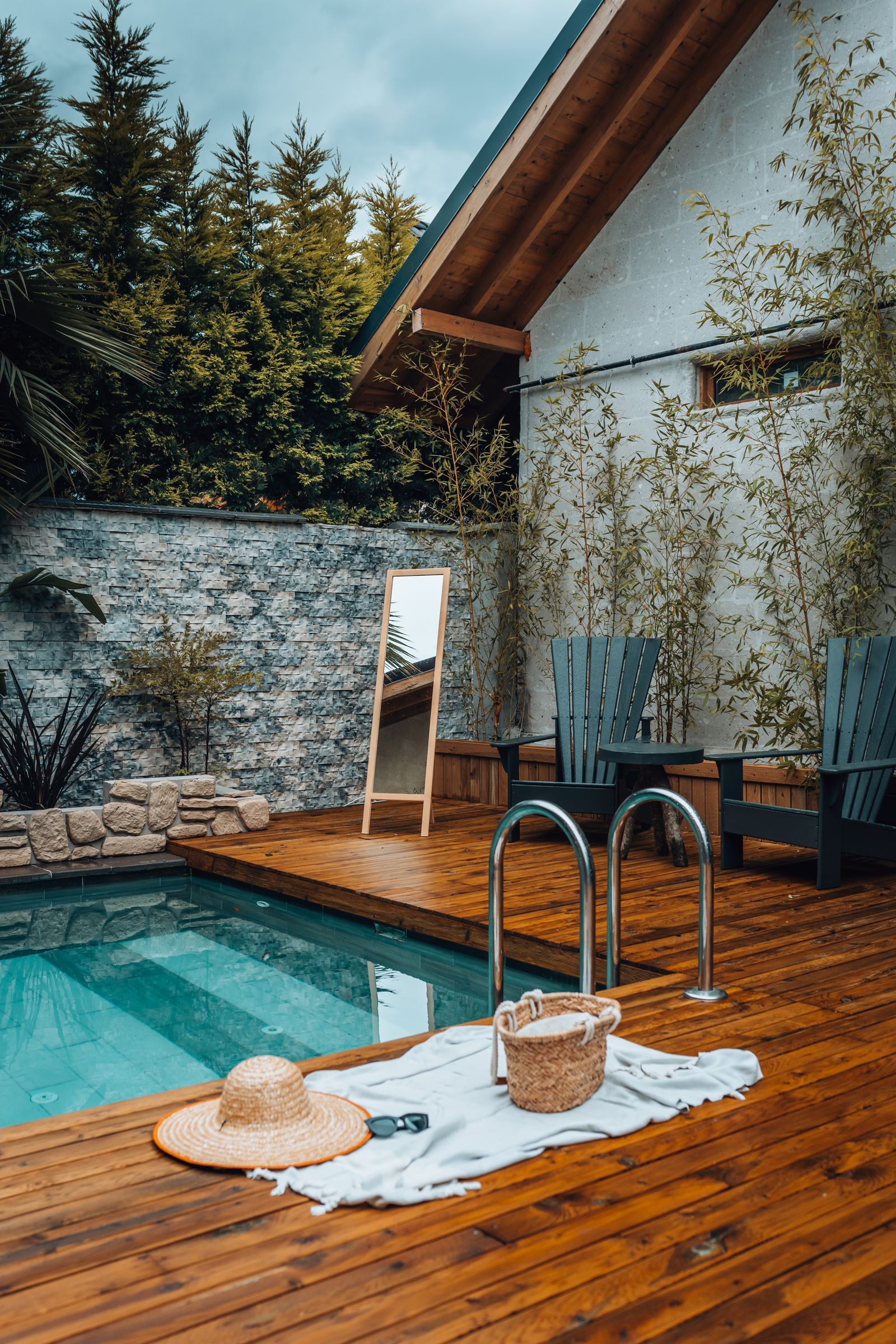
How much space does a pool actually need?
The most common planning mistake is accounting only for the water surface itself. A pool’s real footprint consists of four elements: the pool shell, the equipment pit, the setback from the property boundary, and the paved area around it. Only once you add these together will you know whether the project actually fits on the plot.
Practical figures for a 6 × 3 m rectangle: the water surface takes up 18 m². The equipment pit with filtration needs at least 1.5 × 1.5 m; with a heat pump and some margin, more like 2 × 2 m. Around the pool, allow for a walkway of at least 0.9 to 1.2 m on each side — a narrower strip is hard to maintain and unsafe to walk on. Altogether, you end up with roughly 40 to 50 m², about a sixth of a 300 m² plot.
Add to that the setback from the property boundary. For minor structures — which a pool up to 40 m² next to a single-family house typically qualifies as — the standard rule is at least 2 m from the neighbor’s fence. For smaller formats, such as a 3 × 2 m plunge pool or a swim spa, the total footprint can drop below 20 m², opening up possibilities even for the front gardens of terraced houses.
Which type of pool suits a small plot?
A small garden doesn’t mean a miniature paddling pool. Today’s range of compact formats covers everything from a cooling plunge to full-fledged swimming:
- Plunge pool / cocktail pool (approx. 2 × 3 to 3 × 4 m) — a deep basin for a quick refresh, cooling off after a sauna, and relaxing in the water. The smallest footprint, the fastest heating, the cheapest to run. We covered this trend in detail in the article Plunge Pool: Small Pools as a Big Trend.
- Swim spa (4 to 6 m) — a combination of a hot tub and a pool with a counter-current unit that lets you genuinely train your swimming year-round. It doesn’t need a full-depth excavation and can even be installed on a paved surface. You’ll find a comparison with an in-ground pool in the article Swim Spa vs. Pool.
- Compact 6 × 3 m rectangle — the smallest format that still feels like a “real” pool. It’s too short for fitness swimming on its own, but a counter-current unit turns it into an endless swim lane — we explain how to choose the right output and type in the article Counter-Current Units for Pools.
Table: pool type by garden size
| Garden size | Recommended type | Typical dimensions | Total footprint incl. surround |
|---|---|---|---|
| up to 150 m² | plunge / cocktail pool | 2 × 3 m | 12–18 m² |
| 150–250 m² | swim spa or plunge pool | 4–5 × 2.3 m | 18–25 m² |
| 250–400 m² | 6 × 3 m rectangle with counter-current unit | 6 × 3 m | 40–50 m² |
| 400–600 m² | 7 × 3.5 m rectangle | 7 × 3.5 m | 55–70 m² |
| over 600 m² | swimming format 8 × 4 m and larger | 8 × 4 m | 75–95 m² |
Treat these figures as guidance, not dogma: it depends on the shape of the plot, the position of the house, and how much garden you want to keep for lawn, flower beds, or kids. On narrow plots, an elongated swim spa along the fence often wins out; on square gardens, a square cocktail pool in the corner of the terrace tends to work best.
Where to place a pool in a small garden?
On a large plot, space “absorbs” a placement mistake; on a small one, you’ll have it in view every single day. Four principles that matter most:
Sun vs. shade. The pool belongs on the sunniest spot on the plot — every hour of direct sunlight per day means free water heating and less work for the heat pump. A south to southwest orientation with at least 6 hours of sun a day in season is ideal.
Distance from trees. A leafy tree over the water looks romantic — until you start fishing out leaves, blossoms, and insects every day. Falling organic matter also eats into your disinfectant and feeds algae. Keep the water surface clear of tree canopies, and factor in where the prevailing wind will carry the leaves.
Privacy. On 300 m², your neighbors have a clear view of you. Think through the sightlines from their windows and terrace before you break ground — shifting the pool by a few meters or rotating its axis often solves more than an added wall. A pergola, a mature hornbeam hedge, or a trellis with climbing plants can take care of the rest.
Utility connections. The closer the pool is to the house, the shorter and cheaper the runs for electricity, water, and possibly drainage. Short piping between the pool and the filtration system also means lower pressure losses, so a smaller, lower-consumption pump is enough.
What tricks visually enlarge a small pool and garden?
Pool by the terrace as part of the living zone. Instead of letting the water “eat into” the lawn somewhere at the back, bring it right up to the terrace. One continuous paving surface flows into the pool surround, sun loungers and the dining table share the same area — and the garden suddenly gains a room instead of losing one. This is the principle behind Mediterranean patio houses on plots far smaller than 300 m².
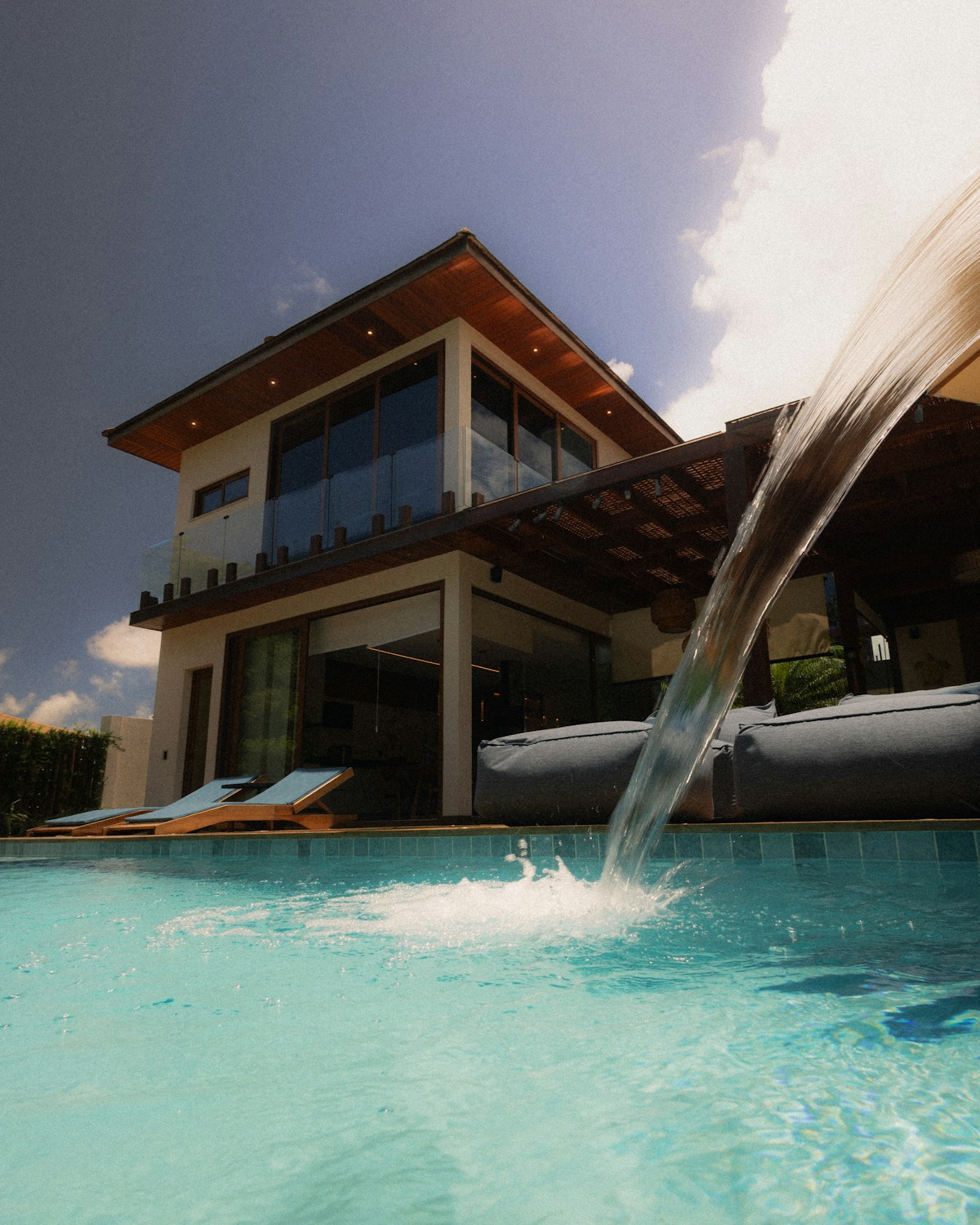
An overflow edge instead of a skimmer. A water level flush with the surrounding paving visually merges with the terrace, making even a small pool feel like a generous expanse of water. We break down the differences between the two systems, including the balance tank requirements and cost, in the article Skimmer vs. Overflow Pool.
A recessed cover instead of a bulky enclosure. A classic arched enclosure is visually dominant in a small garden and takes up a strip of space next to the pool. A slatted cover hidden in a pit beneath the deck or in a recess under the waterline keeps both heat and safety in check — without you ever seeing it.
Vertical greenery. When there’s no floor area to spare, plant upward: a green wall, trellises with climbing vines, or tall ornamental grasses around the pool create the backdrop of a private resort on the footprint of a single flower bed. A dark pool liner and the reflection of greenery on the water deepen the illusion even further.
What shouldn’t you forget when planning?
Where to put the equipment. The filtration unit, control panel, and possibly a heat pump need somewhere to hide. The most economical solution is a prefabricated equipment pit right next to the pool; a more elegant option is a technical “house” combined with a garden shed or outdoor kitchen. A heat pump needs free airflow, and it’s worth thinking about noise too — 45 to 55 dB isn’t something you want under a bedroom window, yours or your neighbor’s.
Storage for chemicals. Water treatment products belong in a lockable, ventilated, dry cabinet out of children’s reach — not under the sink or in the garage next to the bikes. In a small garden, where the pool is just a few steps from the house and any play areas, that’s all the more reason; we summarize the full guidelines in the article Child Safety Around Pools and Hot Tubs.
Room for maintenance. Keep access to every side of the pool and to the equipment pit — a pit cover you can’t reach the valve through because a planter is sitting on top of it can ruin every spring.
Do I need a building permit for a small pool?
The good news: in the Czech Republic, small pools are the simplest category administratively. A pool up to 40 m² of built-up area on the plot of a single-family house counts as a minor structure and generally requires neither a permit nor a notification — which covers every format in the table above, up to the 8 × 4 m rectangle. The usual conditions are that it’s placed on the plot next to the house and that the boundary setback is respected.
Watch out for exceptions: heritage zones, protected areas, and conservation areas have their own rules, and a quick check with the local building authority is worth it. For above-ground and portable pools, the situation is even more relaxed — the article Above-Ground vs. In-Ground Pool summarizes the legal and practical differences between the two solutions.
Frequently Asked Questions
How small can a pool be and still allow swimming?
With a counter-current unit, a length of around 4 to 5 m is enough — you swim in place against the flow of water. Without one, it makes sense to think in terms of at least 7 to 8 m, which is already pushing the limits for a 300 m² garden. For fitness swimming on a small plot, a counter-current unit or a swim spa is therefore almost always a better choice than chasing the longest possible pool.
How much space does the equipment pit take up?
For filtration alone with a sand filter, plan on an interior space of roughly 1.5 × 1.5 m; if you’re also fitting a heat pump and water treatment unit, closer to 2 × 2 m. The pit can be recessed next to the pool with a walkable cover, so you’ll see practically nothing of it on the surface.
How far from the fence does a pool need to be?
For minor structures, the standard is a minimum setback of 2 m from the boundary of the neighboring property. Specific conditions can vary depending on the local zoning plan, though, so for an atypical plot it’s worth checking with the building authority before ordering your pool.
Won’t a pool reduce a small garden’s value for kids and gathering?
With the right design, it’s the opposite. A pool built up against the terrace shares its paved area with the seating zone, so it eats into the lawn only minimally. A 6 × 3 m format with its surround takes up about a sixth of a 300 m² plot — and adds a function to the garden that no flower bed could replace.
Is running a small pool significantly cheaper?
Yes — costs rise roughly in proportion to the volume of water. A 6 × 3 m rectangle holds about 25 m³, while a 3 × 2 m plunge pool holds only around 8 m³, so heating, disinfection, and water changes for compact formats will cost you a fraction of what a large swimming pool does.
Small plot, big wellness
A 300 m² garden is plenty for private wellness — what decides it isn’t size but a well-thought-out design: the right pool format, a sunny position by the terrace, equipment tucked away in a pit, and greenery planted upward. You’ll find compact in-ground pools, swim spas, and counter-current units, complete with all the equipment, in our pools category; for more planning and maintenance guides, check out the Advice Center.
