
At an electricity price of around €0.24/kWh, running a swim spa typically costs about €48–80 a month in summer and €120–180 in winter — more than a hot tub, but less than a heated pool. The exact figure depends mainly on the water temperature you set, the quality of the insulation, and whether you heat with an electric heating element or a heat pump. In this article, we break down what makes up that consumption and work out a sample budget for year-round swimming.
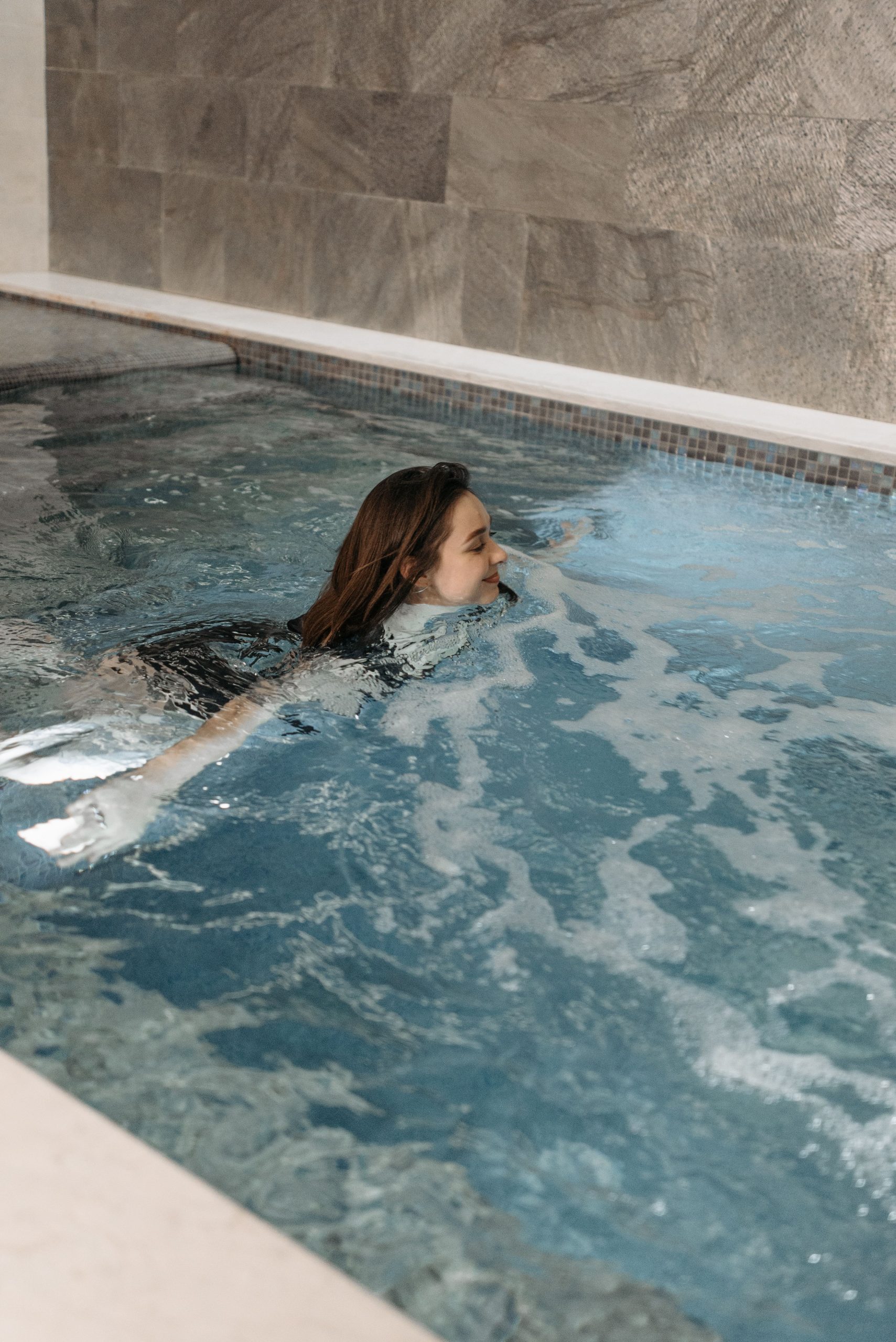
Why does a swim spa cost differently than a hot tub or a pool?
In energy terms, a swim spa sits somewhere between a hot tub and a pool — and water volume is the main reason why. A typical hot tub for 5–6 people holds around 1.5 m³, a swim spa 6 to 10 m³ depending on its length, and a family pool measuring 8 × 4 m roughly 30 m³. Every extra cubic metre of water you keep at a constant temperature means extra kilowatt-hours.
A swim spa has two key advantages over a pool, though. First, it’s an insulated acrylic shell with a solid thermal cover — heat escapes far more slowly than from a pool’s open water surface. Second, you swim on the spot against a current, so a tenth of a pool’s volume is enough for a full workout. You’ll find a detailed comparison of the two options in our article Swim Spa vs. Pool.
Compared with a hot tub, though, you’re heating 4–7 times more water. The lower swimming temperature offsets this to some extent, but you should still expect a higher bill than the one we calculated in our article How Much Does It Cost to Run a Hot Tub.
What makes up a swim spa’s energy consumption?
A swim spa’s electricity bill is made up of three components that add together — and each behaves differently.
1. Maintaining water temperature — the biggest cost
Heating typically accounts for 60 to 80% of total consumption. A swim spa runs year-round in maintenance mode: the electronics reheat the water whenever the temperature drops below the set point. How much energy that takes depends on the gap between water and outdoor air temperature, how well the shell and cover are insulated, and how exposed the installation site is to wind. That’s why winter running costs are 2–3 times higher than in summer.
2. Filtration — small, but constant
A circulation pump rated at roughly 150–250 W runs 8 to 24 hours a day, depending on how it’s set, to push water through the filter and disinfection system. That adds up to around 40 to 90 kWh a month — about €10–20 on your bill. On top of that, factor in occasional running of an ozonator or UV lamp, though their power draw is negligible.
3. Swim jets — powerful, but only while you swim
The swim jet pumps have a combined output of typically 3 to 6 kW — the most powerful component in the whole system. The key point, though, is that they only run while you’re actually swimming. Half an hour of swimming a day works out to roughly 1.5–3 kWh, or about €0.35–0.70. Even with daily swimming, this remains a smaller item than heating. We explain how swim jets work and what types are available in our article Swim Jets for Pools.
How much difference does the set temperature make?
Water temperature is the single biggest lever you control. For swimming, 26 to 28°C is ideal — warm enough for comfort, cool enough for performance. If you also want to use the swim spa as a hot tub for relaxation, you’ll be aiming for 34 to 36°C, and that’s a completely different energy game: every extra degree increases heat loss and heating consumption by roughly 5–10%.
A neat solution is a dual-zone swim spa: the large swimming section stays at 26–28°C, while a separate hot-tub-sized section (about 1–1.5 m³) runs at 36°C or higher. That way you only heat a small volume to a high temperature and keep the swimming section in an economical mode. If you’re really only after relaxation, read how to choose a hot tub first — it might be all you need.
Sample calculation: what does a swim spa cost per month in summer and winter?
The table below is a sample calculation, not a guarantee. Assumptions: an 8 m³ swim spa with good insulation and a thermal cover, a swimming temperature of 27°C, outdoor installation in a temperate climate, filtration running 12 hours a day, 30 minutes of swimming a day, heating via an electric element, and an electricity price of €0.24/kWh including distribution charges. The ranges quoted by manufacturers (Sundance Spas and Hydropool, for example, cite total consumption of roughly 150–500 kWh a month in mild-to-cold climates) line up well with this model — a Central European winter falls in the upper half of that range.
| Item | Summer (June–August) | Winter (December–February) |
|---|---|---|
| Maintaining 27°C | approx. 120–180 kWh / €29–43 | approx. 400–550 kWh / €96–132 |
| Filtration (12 h/day) | approx. 60 kWh / €14 | approx. 60 kWh / €14 |
| Swim jets (30 min/day) | approx. 45–60 kWh / €11–14 | approx. 45–60 kWh / €11–14 |
| Total per month | approx. 225–300 kWh / €54–72 | approx. 505–670 kWh / €121–161 |
Spring and autumn fall between these two columns, typically around €80–100 a month. Under this model, that puts annual running costs at roughly €1,000–1,400 with electric-element heating — and considerably less with a heat pump, as you’ll see below. A poorly insulated swim spa without a good thermal cover can easily double these figures; manufacturers claim that full-foam insulation cuts heating consumption by up to 40%.
How can you cut swim spa running costs?
The difference between running the same swim spa efficiently or wastefully can be as much as 50%. Here are the measures with the biggest impact, ranked by effect:
- A heat pump instead of an electric element. This is the biggest win: a heat pump turns 1 kWh of electricity into 3–5 kWh of heat, cutting heating costs by 60–75%. In the winter model above, that’s a saving of over €60–80 a month. We cover payback times and how to choose one in our article Heat Pumps for Pools and Hot Tubs.
- A good thermal cover, used consistently. Most heat is lost through the water surface. An undamaged, well-fitting thermal cover is a prerequisite for the figures in the table above to hold true at all — replace an old, waterlogged cover.
- Lowering the temperature. Dropping from 30 to 27°C saves roughly 15–30% on heating costs. For swimming, 26–28°C is actually more pleasant than warmer water.
- A winter economy mode. When you’re not swimming during frosty spells, lower the temperature to 15–20°C and cut filtration to the minimum needed to prevent freezing — reheating an 8 m³ spa before the weekend takes just a few hours. We explain how to run a spa safely through frosty weather in our article Hot Tub in Winter.
- A sheltered installation. Wind cools both the shell and the cover; a wall, pergola or windbreak reduces heat loss at no running cost at all.
How much do water and the initial heat-up cost?
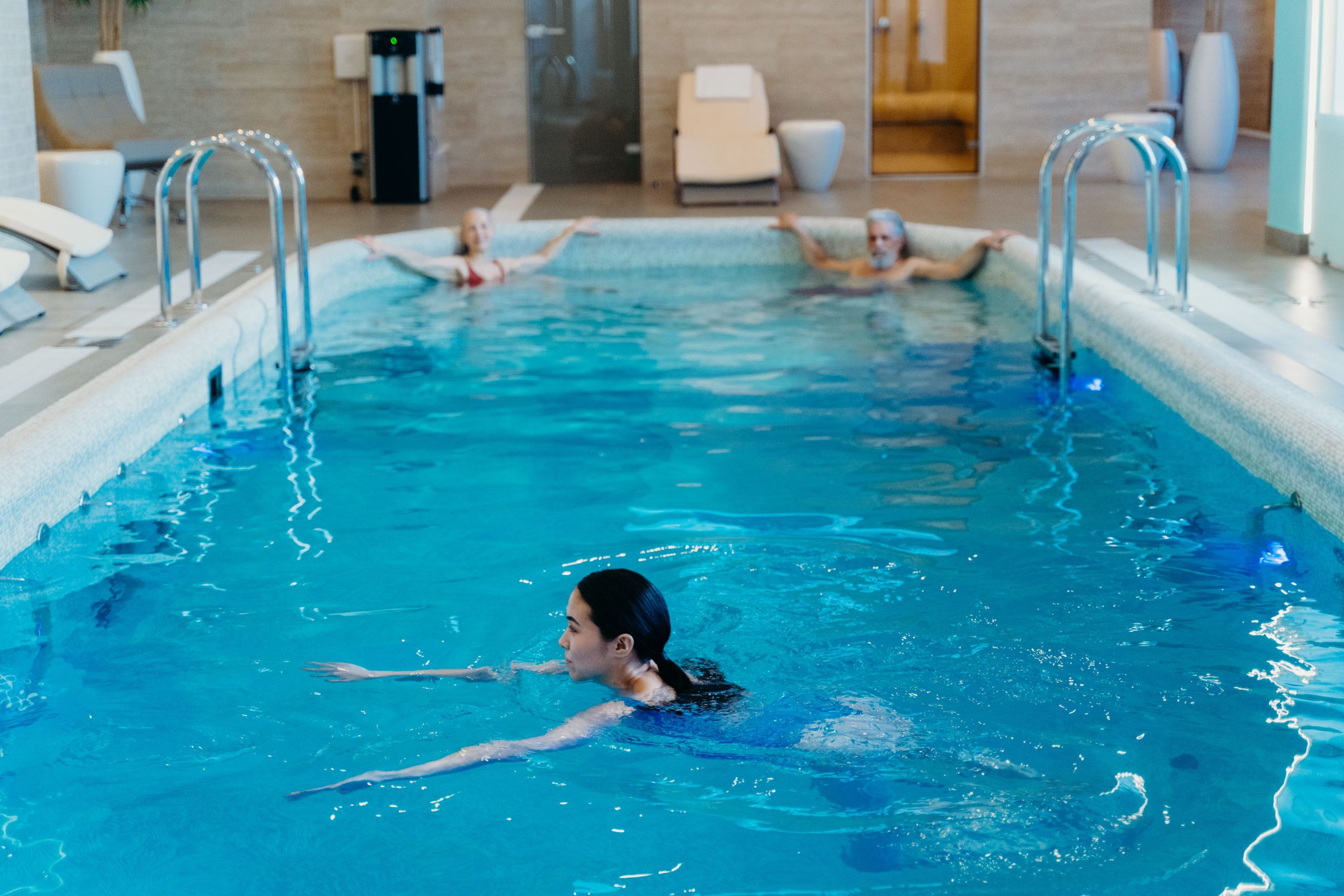
Besides electricity, don’t forget about water. Filling an 8 m³ swim spa at typical water and sewage rates of €4–5/m³ costs around €32–42. Thanks to the small volume and intensive filtration, the water in a swim spa is usually changed 2–3 times a year, so the annual water bill stays under €120. You’ll notice it’s time for a change from the same signs as with a hot tub — see our detailed article How Often to Change Hot Tub Water.
The first heat-up after filling is a one-off hit to your budget. Sample calculation: physically heating 8 m³ from 10 to 27°C takes about 158 kWh (1.163 kWh per m³ per °C); allowing for losses, budget for roughly 170–190 kWh, or €40–46 at €0.24/kWh. A 3 kW heating element handles this in two to three days; a heat pump speeds up the heat-up and cuts its cost to a quarter or a third. That’s another reason it pays not to change the water more often than necessary, and to keep it in good condition with quality water treatment.
Is running a swim spa more expensive than running a pool?
It depends what you’re comparing it to. An unheated outdoor pool run from May to September is cheaper — you’re only paying for filtration and chemicals. But as soon as you want a heated pool with a longer season, the tables turn: heating 30 m³ of water with a large open surface, even with a cover and a heat pump, costs more in the shoulder months than running an insulated swim spa year-round. And running a pool outdoors all year in a temperate climate simply doesn’t add up economically.
A swim spa is therefore the cheapest way to swim 12 months a year. On top of the electricity costs, add chemicals and maintenance — thanks to the small water volume, that’s a low double-digit euro amount per month, less than for a pool. You’ll find a full comparison of both purchase and running costs in our article Swim Spa vs. Pool.
Frequently asked questions
How much does it cost to run a swim spa per year?
In our sample calculation (8 m³, 27°C, good insulation, electricity at €0.24/kWh, heating element), annual running costs come to roughly €1,000–1,400 for electricity plus a couple of hundred euros for chemicals. With a heat pump, total annual costs can be pushed down to around €600–800.
Is it worth shutting a swim spa down for winter?
Fully draining and winterizing only makes sense if you won’t use the spa at all over winter. If you swim even occasionally, it’s better to drop the temperature into an economy mode — repeated draining and refilling puts strain on the equipment, and you’d lose the ability to swim year-round.
How much electricity do the swim jets use?
Swim jet pumps rated at 3–6 kW use roughly 1.5–3 kWh for half an hour of swimming, or about €0.35–0.70 a day at €0.24/kWh. Since they only run during your workout, swim jets usually make up less than 15% of total consumption.
Which water temperature is most economical for a swim spa?
For regular swimming, 26–28°C is optimal — every extra degree raises heating costs by roughly 5–10%. It only makes sense to maintain a hot-tub temperature of 36°C in a separate, small zone on dual-zone models, not across the whole swimming volume.
Can solar panels help power a swim spa?
Yes, partly. Filtration and summer top-up heating run during the day, when panels are generating, so solar can cover a large share of summer running costs. In winter, however, when consumption is highest, panel output is minimal — treat it as a supplement, not a replacement.
Want to keep your swim spa’s running costs low from day one? The foundation is correctly sized heating and filtration — you’ll find heat pumps, pumps and filtration technology in our pool technology category, and our full range of swim spas and hot tubs in the wellness category. For more guides, visit our Guides.
