
Water is an exceptionally kind environment for an older body: buoyancy takes most of the load off the joints, warmth releases stiff muscles, and movement suddenly becomes possible without the fear of falling. But for a hot tub or pool at home to genuinely help, it has to be chosen with entry, support and simple operation in mind — and used with good judgement. This guide sums up what water gives seniors, where the limits lie, what to ask your doctor and which specific features to look for when choosing.
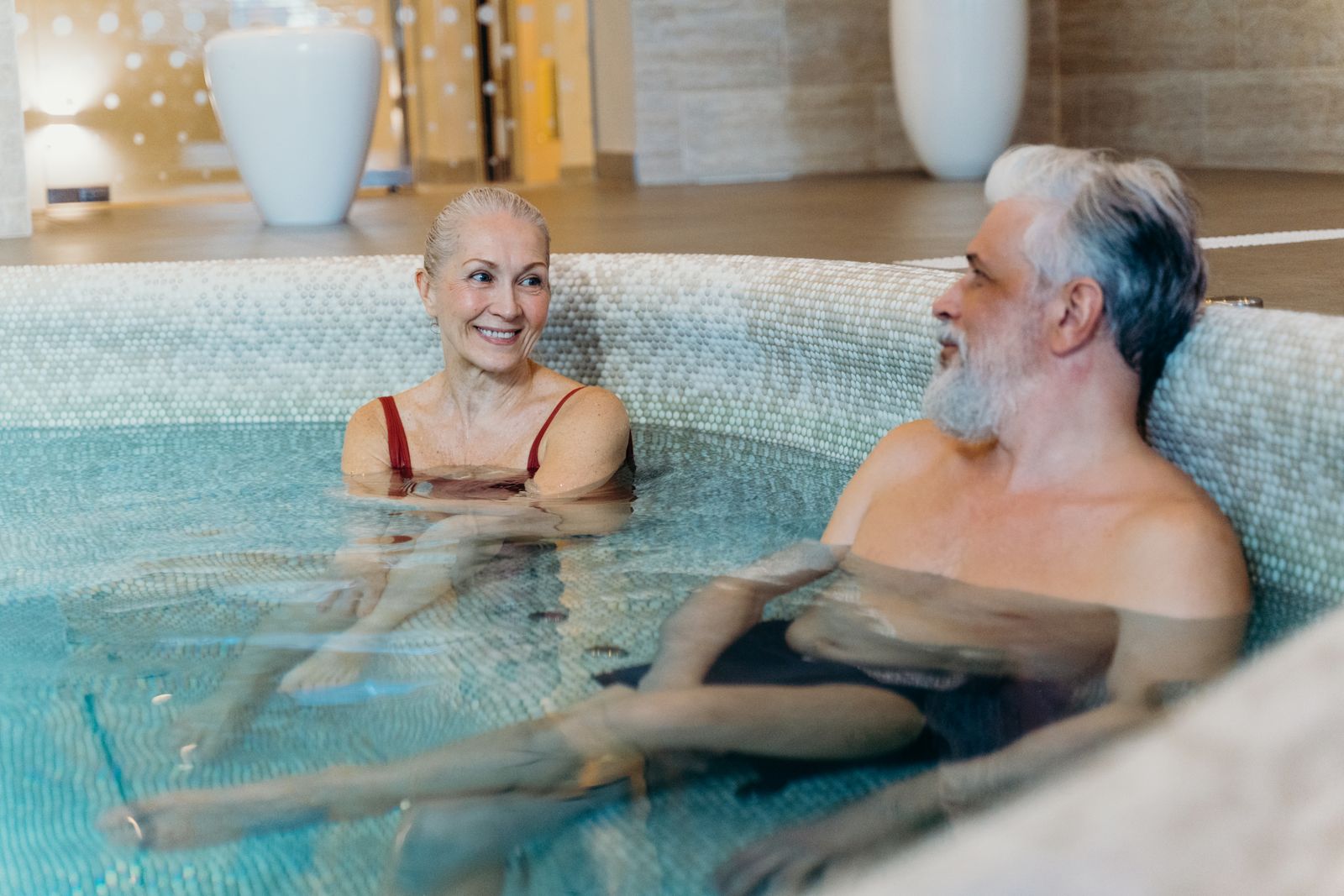
An important note up front: this text is a general overview, not medical advice. Time spent in hot water affects circulation and thermoregulation. If a senior takes medication, has heart or vascular disease, diabetes, blood pressure problems or has recently undergone a procedure, the decision “yes, and for how long” belongs exclusively to their treating physician.
Why water suits seniors so well
Buoyancy: relief for joints and spine
In chest-deep water the body carries only a fraction of its weight — depending on how deeply you are submerged, roughly 25–50 % of the usual load. Hips, knees and the lumbar spine get a break they do not even get sitting down on dry land. That is exactly why a range of motion that would hurt in the gym works comfortably in water.
It is also the reason swimming and water exercise are so often recommended to people who are overweight or recovering from joint surgery: the movement is smooth, without impact and without peak loads on the cartilage. We cover water-based routines in more detail in our article on water aerobics and exercise in the pool.
Warmth releases the muscles
Warm water heats muscles and fascia to a depth that hands-on massage cannot reach. The stiffness in the shoulders, back and neck that almost everyone carries after sixty eases noticeably after twenty minutes in a hot tub. The American Arthritis Foundation has long listed warm water therapy among the recommended ways to reduce stiffness and maintain mobility in osteoarthritis — with the caveat that it is a complement to treatment, not a replacement for it.
A hot tub adds hydromassage on top of that: a jet of water directed at the lower back or calves acts as gentle mechanical stimulation. What warm water does for evening fatigue and falling asleep is discussed in our article on hot tubs, health, sleep and recovery.
Safe movement without the risk of falling
For seniors, the fear of falling is often a bigger brake than the pain itself. In water, movement is slower, the resistance of the medium slows down even a misplaced step, and a stumble does not end with an impact on a hard floor. Water therefore makes it possible to train balance and leg strength in conditions where a mistake costs nothing.
The effect is psychological too. A regular ritual — fifteen minutes in the hot tub in the morning, three quarters of an hour of walking in the pool in the afternoon — gives the day structure and appetite. For people who live alone, that is no small thing.
What to watch out for: temperature, medication and circulation
Temperature and length of the session
The usual recommendation for a hot tub is 37–38 °C. For seniors it makes more sense to stay at the lower end or below it — 36–37 °C — and to shorten the session to 10–15 minutes instead of the usual 20. A higher temperature dilates the blood vessels, blood pressure drops and there is a risk of dizziness when standing up. A lower temperature delivers most of the relief without that strain.
With a pool the logic is reversed: cool water tires seniors quickly and leaves them shivering. A comfortable range for longer exercise is roughly 29–31 °C, that is two or three degrees higher than for sports swimming. The links between temperature, comfort and energy consumption are summed up in our article on the ideal water temperature in a pool and hot tub.
Medications that change the rules of the game
A number of commonly prescribed medicines affect the body’s ability to regulate temperature or maintain blood pressure. These include diuretics, beta blockers and other blood pressure drugs, some antidepressants, antihistamines and medication for incontinence. The effect of hot water can add up with them into unpleasant dizziness.
A practical approach: take the list of medications to the doctor or pharmacist and ask specifically about hot water and saunas. The answer tends to be individual — sometimes it is enough to shorten the session, sometimes to lower the temperature, and occasionally the recommendation is “better not”.
Heart, blood vessels and blood pressure
Time spent in hot water puts a strain on circulation similar to brisk walking. For a healthy person that is mostly a benefit; for someone with ischaemic heart disease, arrhythmia, heart failure or a history of heart attack it is a situation that has to be assessed by a cardiologist. The same applies to poorly controlled high or, conversely, low blood pressure, and to diabetes with nerve damage (reduced temperature perception in the feet).
Signs that call for leaving the water immediately: pressure or pain in the chest, palpitations, breathlessness, dizziness, nausea, tingling. None of that is worth “breathing through” in the tub.
Dehydration
The sensation of thirst weakens with age, so a senior in a hot tub becomes dehydrated before noticing it. A glass of water before getting in and another after getting out are the bare minimum; for longer sessions a bottle of water belongs beside the tub. Alcohol has no place in hot water at any age, and doubly so for seniors — it combines vasodilation, reduced attention and impaired balance when climbing out.
Going from hot water into the cold
A cold shower or plunge after the hot tub sharply constricts the blood vessels and raises blood pressure. For a well-trained forty-year-old that is refreshing; for a seventy-year-old with hypertension it is an unnecessary risk. That is why we recommend contrast therapy, which we describe in our article on contrast therapy: hot tub and cold plunge, to seniors only with the explicit approval of their doctor — and even then in a very mild form: a lukewarm shower instead of an icy one, limbs first, never the head and chest abruptly.
Getting out in winter calls for the same care. The walk from the hot tub back into the house across a frozen terrace is the riskiest part of the whole wellness ritual — more on winter operation in our article on hot tubs in winter.
Safety and comfort features that decide the choice
With a hot tub or pool for a senior, the main criterion is not the jets or the design, but how easily they can get into the water and how confidently they can get out. We recommend treating the following features as mandatory equipment, not as an optional extra.
Grab rails and handrails
A solid grab rail at the hot tub entry and a handrail beside the pool steps turn the riskiest moment into a routine. Ideally the rail is anchored into the structure or into concrete, not suction-mounted. With a pool, a handrail on both sides of the steps works best, so that a person can hold on with both hands.
Anti-slip floor and steps
Wet acrylic and wet paving are both slippery. Look for hot tubs with an anti-slip finish on the floor and seats, and steps with a textured surface rather than smooth wood. Around the pool, use paving with an anti-slip rating of R11 or higher.
Low entry
The lower the edge a leg has to step over, the better. With an above-ground hot tub it helps to recess it into a deck or to build steps with low risers around it. For pools, the most suitable option for seniors is wide Roman steps with a tread depth of at least 30 cm — you will find a comparison of entry types in our article on pool entry: steps, ladder or beach entry. A vertical ladder with rungs is the worst choice for seniors.
Seats with back support and varying depths
A hot tub with a deep lounger may look tempting, but getting up out of it with painful knees is hard work. Upright seats with a contoured backrest and at least one shallower spot that is easy to rise from are more practical. A good test before buying: sit down in a dry hot tub in the showroom and try to stand up from every seat without using your hands.
A legible control panel
A small touchscreen with icons is unusable for a seventy-year-old without their glasses. Look for a panel with large characters, high-contrast backlighting and physical buttons. Better still is to leave the temperature and filtration set permanently, so that there is no need to enter the menu at all — and to handle any fine tuning through a mobile app operated by a family member. For remote control options, see smart pools and automation.
Step-free access and lighting
Place the hot tub so that it can be reached on the level — without steps, thresholds or a route across a lawn that gets slippery after rain. The path should be at least 90 cm wide to allow for a walking stick or a walker.
Evening lighting is a safety feature, not decoration. Eyesight adapts to darkness less well with age and edge recognition deteriorates. A lit path, lit steps and a lit water surface substantially reduce the risk of a misplaced step — we describe the options in our article on LED pool lighting.
Overview: which feature helps and why
| Feature | Why it helps seniors | What to watch when choosing |
|---|---|---|
| Solid grab rail at the entry | Confidence at the riskiest moment — getting in and out | Anchored into the structure, not suction-mounted; at waist height |
| Handrail beside the steps | Allows support with both hands, reduces the risk of falling | On both sides; matt-finish stainless steel is less slippery |
| Anti-slip floor and steps | Wet acrylic and paving are the main cause of slips | Textured surface; R11+ paving around the pool |
| Low entry / wide steps | Less demand on hip and knee range of motion | Tread depth from 30 cm; avoid a vertical ladder |
| Seat with back support | Stable position without sliding, easy to stand up | Test standing up while dry; deep loungers rather not |
| Legible control panel | No mis-set temperature and no needless frustration | Large characters, contrast, physical buttons |
| Lower temperature (36–37 °C) | Less strain on circulation, lower risk of dizziness | A settings lock so nobody raises the temperature by mistake |
| Step-free access | A route without steps and thresholds, room for a stick or walker | At least 90 cm wide, a firm non-slip surface |
| Lighting for the path and the water | Compensates for poorer adaptation of the eyes to darkness | Warm, not shining into the eyes; controls at the door and at the tub |
| Thermal cover that opens easily | Handling manageable by one person | A lifting mechanism or a sliding cover instead of a heavy tarpaulin |
Maintenance an older person can manage
The most common reason a senior’s hot tub ends up drained is not health — it is maintenance. Test strips, dosing chemicals by the spoonful and vacuuming the floor quickly become an obstacle. The solution is to automate precisely those tasks that demand accuracy or physical effort.
Automatic dosing
A chlorine dispenser or a salt water system reduces water care to a weekly check instead of daily guesswork. With a pool it makes sense to go a step further — an automatic station measuring pH and chlorine handles the chemistry on its own. You will find an overview of the options in our article on automatic chlorine dosing systems.
Robotic cleaner
Vacuuming a pool by hand means an hour of standing work with a long pole — exactly the kind of activity that painful shoulders cannot tolerate. A robot is placed in the water, switched on and pulled out two hours later. How to choose a specific model is covered in our guide to pool cleaners and robots.
Simple chemistry and servicing
Instead of five products, three are enough: a disinfectant, pH minus and a flocculant or filter cleaner. Tablets and dosing floats are better for seniors than loose products that have to be weighed out. With a hot tub, consider bromine instead of chlorine — it is more stable and more forgiving of irregular care.
And then there is an option worth doing the maths on: a regular service contract. Two or three technician visits a year plus a water change work out cheaper than a hot tub that does not work. What servicing involves and how long a hot tub lasts is summed up in our article on hot tub lifespan and servicing.
Living alone and safety
If a senior lives alone, a few rules apply that have no exceptions.
- Never get into the water alone when not feeling well. Weakness, dizziness, palpitations or nausea mean there is no going into the water today — not even “just for a moment”.
- A phone or emergency button within arm’s reach. Ideally in a holder at the edge of the hot tub, not in a bathrobe pocket on a chair three metres away. A waterproof wearable emergency button is the ideal.
- Somebody knows you are in the water. A short message to family or a neighbour before getting in and after getting out. It sounds anxious, but it is the same logic as a hiker reporting their route.
- A lockable cover. It protects not only against children, but also against the spontaneous night-time idea of “I’ll just hop in for a while” that nobody is supervising. See hot tub thermal covers.
- An emergency pump shut-off within reach, so the hydromassage can be switched off without standing up.
With a pool it makes sense to add a surface alarm or a motion sensor — technology we describe in our article on pool alarms. It was originally developed for children, but for a senior living alone it serves exactly the same purpose.
Frequently asked questions
What is a safe hot tub temperature for a senior?
As an initial guide, 36–37 °C and a session of up to 15 minutes, that is less than the usual recommendation of 37–38 °C. The specific figure must, however, be assessed by a doctor who knows the person’s health status and medication — especially in the case of heart and vascular disease and blood pressure problems.
Can someone with high blood pressure use a hot tub?
It is not an automatic obstacle, but it is a question exclusively for the treating physician. What matters is how well the blood pressure is controlled and which medications are being taken — many of them affect how blood vessels respond to heat. We do not recommend getting into hot water without a consultation.
Does a hot tub help with osteoarthritis?
Warm water and buoyancy reduce stiffness and make movement easier — which is why the American Arthritis Foundation includes warm water therapy among its recommendations. It is not a treatment, though: it will neither halt nor reverse the disease. Treat a hot tub as a complement to what your doctor or physiotherapist has prescribed.
Is a pool or a hot tub better?
It depends on the goal. A hot tub is about warming up, relief and relaxation, it takes up little space and can be used all year round. A pool allows genuine movement — walking in water, exercise, swimming. The ideal combination tends to be a smaller pool or a swim spa complemented by a hot tub; where space and budget are limited, the hot tub usually wins for seniors with joint pain.
How often per day or week?
Three to four shorter sessions a week is commonly cited as a sensible rhythm, but there is no universal number. What decides is how the body responds — if a person is tired, listless or dizzy after the hot tub, the session was too long or the water too hot. Here too the rule holds: discuss your daily routine with a doctor.
In conclusion
Neither a hot tub nor a pool is a medical device and neither cures anything. What they can do is provide what becomes harder and harder to find with age: an environment where you can move without pain and without the fear of falling, and a ritual you look forward to. And the difference between “it stands in the garden unused” and “it gets used every other day” comes down to details — a grab rail, low entry, anti-slip surfaces, a legible panel and maintenance that requires neither strength nor precision.
Get these features right when choosing and you end up with equipment that will still be serving you in ten years. You will find models with comfortable entry, back support and simple controls in the hot tubs category, and accessories for comfort and safety in the wellness section. And before you order anything, whether a hot tub or a pool, discuss the plan with a doctor — it is the cheapest and most useful step of the whole purchase. You will find more texts on similar topics in our Guide.
