
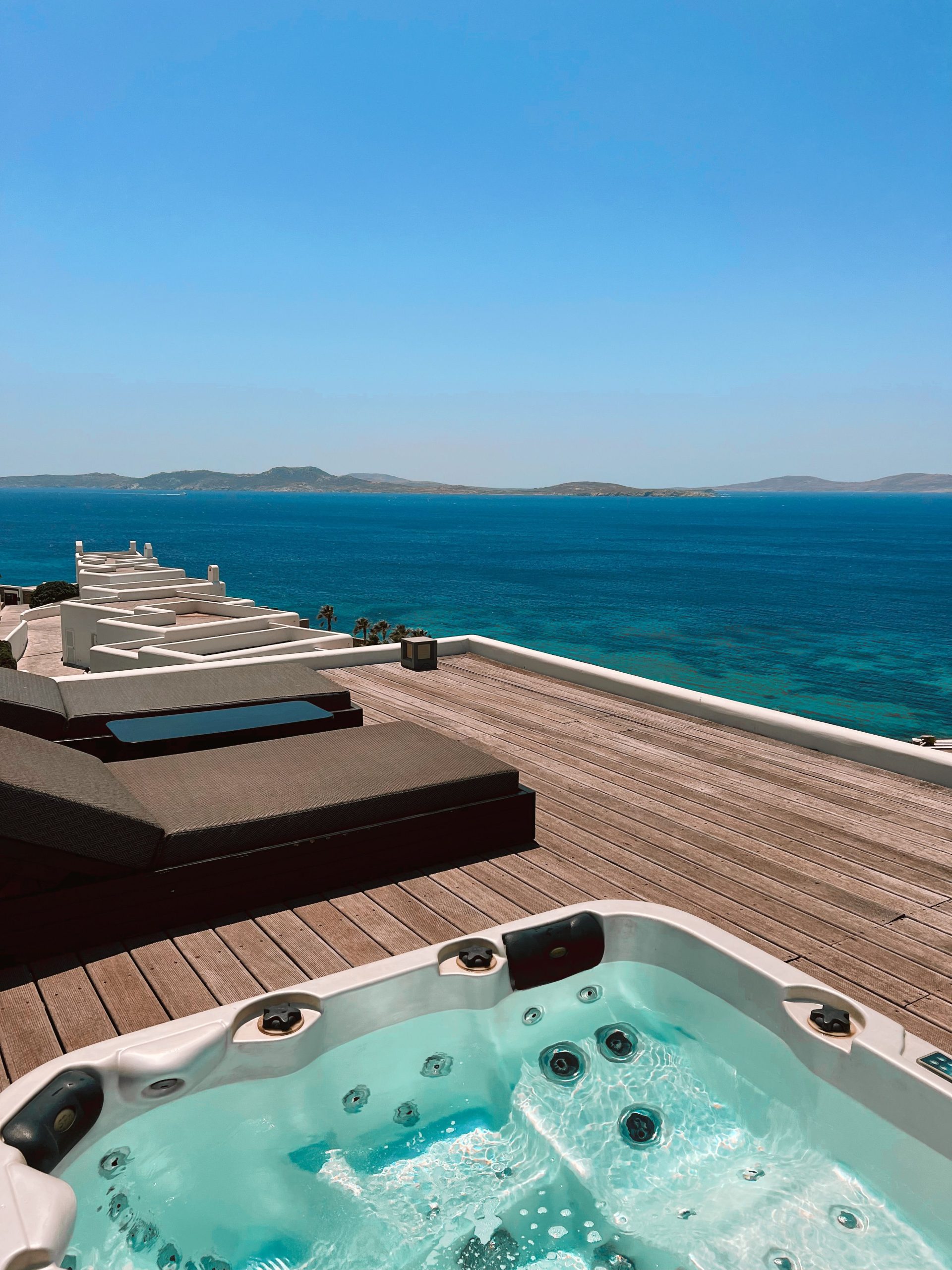
An acrylic hot tub shell will last for decades, but only if it is treated gently. It is not time that kills the shine — it is abrasive cleaners, unbalanced water chemistry and UV exposure on an uncovered shell. A soft sponge, the right product at every water change and polishing twice a year are enough — and after ten years the surface will still look like it has been in use for five months.
Why acrylic loses its shine
Acrylic (more precisely, sanitary acrylic reinforced with a layer of fibreglass laminate) is a smooth, non-porous material. That smoothness is its main line of defence: on a perfectly even surface there is nothing for limescale or biofilm to grab onto. But once the surface picks up microscopic grooves, the defence disappears and dirt settles into them faster than you can remove it.
Aggressive cleaners and abrasives
The most common cause of dulling is not wear — it is cleaning. Grit in a liquid scouring cream, a steel wool pad, the rough side of a sponge or an all-purpose cleaner containing solvents all leave behind a network of micro-scratches. You cannot see them individually, but they scatter light — the surface stops reflecting and turns grey.
The banned list is short and admits no exceptions: acetone, thinners, white spirit, scouring powders, steel wool, scrapers, oven cleaners and concentrated chlorine-based cleaners. None of these belong anywhere near acrylic, not even “just once and carefully”.
Unbalanced water chemistry
Water with a pH below 7.0 gradually dulls both the acrylic and the bonded joints around the jets, while highly alkaline water precipitates limescale along the waterline. Both are slow processes — you will not notice them in a week, you will notice them in two seasons. The cheapest way to protect the surface is therefore disciplined testing: the article on testing pool and hot tub water explains how.
The ideal range for a hot tub is pH 7.2–7.6 and total alkalinity of 80–120 mg/l. Staying inside that band protects the surface, the jets and the pump all at once.
UV exposure on an uncovered hot tub
Acrylic is UV-stabilised, but not immortal. A shell left uncovered all summer on a south-facing terrace loses colour saturation after a few seasons — most noticeably in dark shades and in anthracite. A thermal cover is therefore not only a way to save heat, but also a way to protect the surface; you will find the details in the article on hot tub covers.
If you do not routinely cover your hot tub, expect to need polishing with a UV filter twice a year rather than once.
The greasy “tide line” at the waterline
Creams, sun lotion, soap residue and body oils build up exactly where the water surface ends. The result is a dull band that is hard to wipe away and traps further dirt. Regular use of an absorbent sponge in the skimmer and a quick wipe of the waterline once a week eliminate the problem before it ever becomes visible.
How to clean acrylic at a water change, step by step
The main clean makes sense when the shell is empty — in other words, at every water change. The interval and the reasons behind it are covered in the article on how often to change hot tub water; for a normally used family hot tub it works out at roughly every three to four months.
- Drain the water and disconnect the power. Working in an empty shell with a live pump is an unnecessary risk. Switch off the breaker first, and only then climb inside.
- Wash the surface with a soft sponge. Use a dedicated acrylic cleaner or — if you do not have one — a very weak solution of ordinary washing-up liquid (a few drops in 5 litres of lukewarm water). Work from top to bottom, in circular strokes, without pressure.
- Tackle limescale with a gentle spa descaler. A descaler intended for hot tubs works on the white film along the waterline. Let it act as directed and never scrape it off. Vinegar or household limescale acid are far too aggressive and can damage the silicone seals.
- Rinse thoroughly. Detergent residue is the main cause of foam in fresh water. Rinse the whole shell with clean water and drain it again. The related article on foam and odour in a hot tub covers this topic.
- Dry with microfibre. Letting the shell air-dry means watermarks from every droplet. A dry microfibre cloth is a five-minute job.
- Treat with acrylic polish. Once or twice a year, apply an acrylic polish or wax with a UV filter. It creates a thin hydrophobic layer that limescale and oils find harder to cling to. Never apply it to seating areas or steps — the surface would become slippery.
Seats, jets and pipework
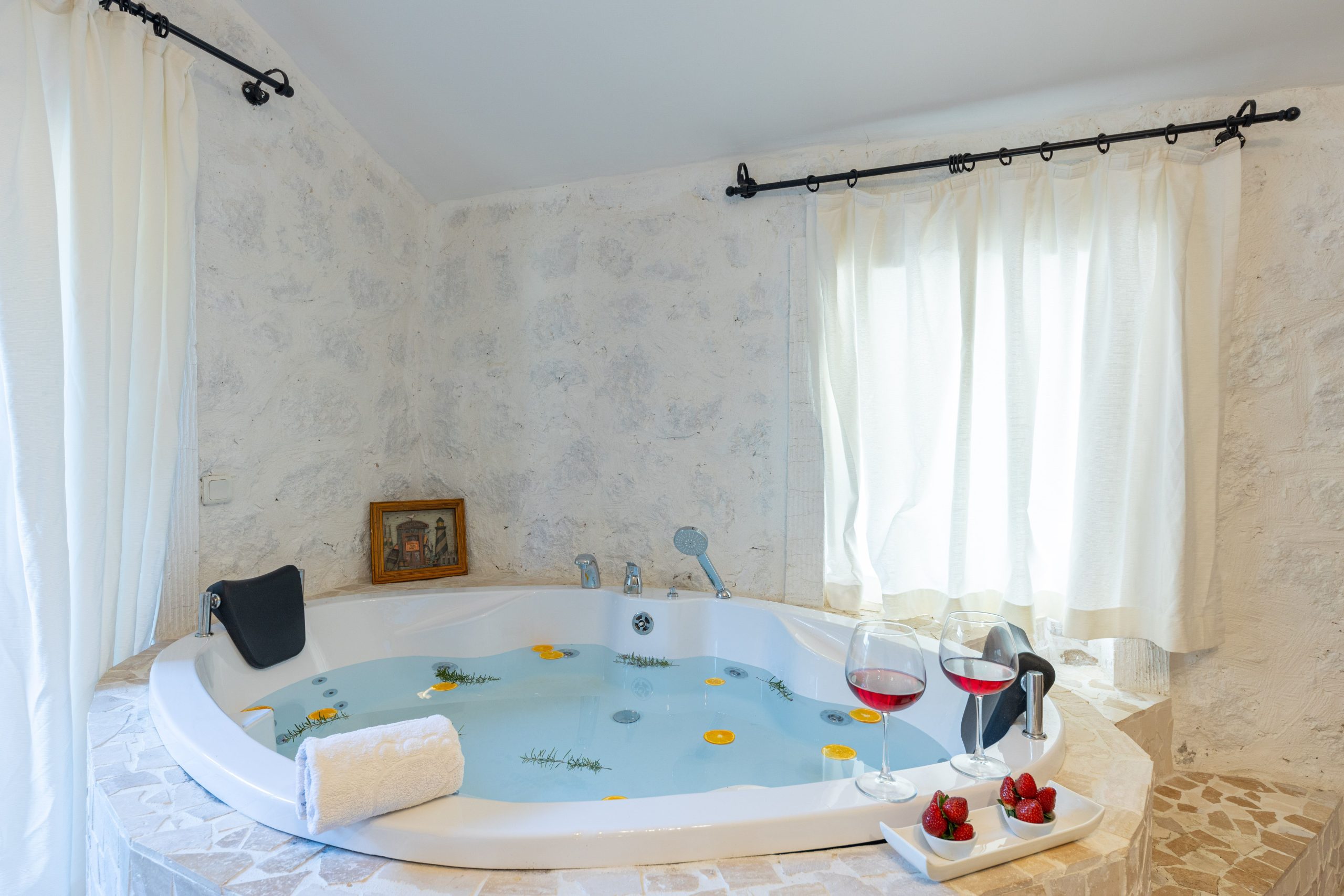
Jets are the most commonly overlooked part of the clean. Most types can be removed by turning them anticlockwise and rinsed under running water — inside there is usually limescale that stops the rotating head from spinning. The article on types of hydromassage jets summarises what types exist and what to expect from them.
Clean the jet openings in the acrylic with a soft brush only — a toothbrush, for example. A metal tip will scratch the rim, and that groove will never be hidden again.
The pipework itself is cleaned from the inside, using a biofilm remover. It is added to a full shell, left to circulate for an hour, and only then is the water drained — which is why it is always done immediately before a water change. The article on hot tub hygiene and legionella explains why biofilm is more than an aesthetic issue. Draining should always be followed by cleaning the filter, otherwise the released dirt ends up straight back in the system.
How to care for the hot tub cabinet
The cabinet is what the neighbours see, and at the same time what holds the insulation in place and protects the equipment. Care depends on the material.
Wooden cabinet
Solid wood (most often cedar or thermally modified pine) needs an oil or wood stain with a UV filter once a year. The ideal time is spring, after winter and before the main season. The procedure: wash with water and a drop of detergent, leave to dry for a day, sand only where the grain has lifted (180–220 grit paper), and apply two thin coats of oil.
Without treatment, wood turns grey, starts to crack and after four or five years looks old — no matter how well the equipment inside is still working.
Synthetic cabinet
Composite panels (WPC, ASA, polymer wood imitations) need no impregnation, and oil would leave a sticky film on them. Washing them once a season with lukewarm water, a neutral detergent and a soft brush is enough. Do not use a pressure washer — it forces water into the insulation behind the panel.
Equipment bay and ventilation
Every time you take off the service panel, check three things: whether the ventilation openings are blocked with leaves, whether there are traces of water leaking under the pump, and whether mice or insects have settled into the insulation. Rodents in the equipment bay are a real problem with garden hot tubs — chewed cables are one of the most expensive unplanned repairs. The article on hot tub lifespan and servicing describes how this ties into planned maintenance.

Trim strips, stainless steel and salt water
The top trim strip that covers the gap between the acrylic and the cabinet is usually plastic or aluminium and needs nothing more than a damp cloth. Stainless steel parts — handrails, jet bezels, headrests, step grab rails — require more attention.
Stainless steel is cleaned with a non-abrasive stainless steel polish, always in the direction of the grain. Rust spots on stainless steel are usually not corrosion of the material itself but iron deposited from the water; a rust remover intended for pools will help.
With salt water hot tubs (electrolysis systems) the load is higher. As droplets evaporate, salts settle on metal parts and accelerate pitting corrosion. The recommendation is simple: wipe metal parts above the waterline with a damp cloth every week and treat them with a protective wax once a quarter. The article on salt water vs. chlorinated water summarises the differences between the systems.
Scratches and minor damage: what you can handle yourself
Acrylic has the advantage that the colour runs through the entire layer of material — a surface scratch can therefore be polished out without leaving a pale patch.
| Type of damage | Solution | Can you do it at home? |
|---|---|---|
| Dull surface with no grooves | Acrylic polish, soft cloth | Yes |
| Fine micro-scratches (fingernail does not catch) | Acrylic polishing compound, hand polishing | Yes |
| Deeper scratch (fingernail catches) | Wet sanding with 1500–2500 grit, then compound | Carefully — risk of a “wave” in the surface |
| Crack, flexing underfoot, cracks around a jet | Professional acrylic and laminate repair | No — call a service technician |
| Blister or delaminated acrylic | Lamination defect, resolved via warranty claim or service | No |
| Faded colour over a large area | Polishing with UV wax, cannot be fully restored | Partly |
The rule for deciding: as long as it is about shine, it is cleaning. As soon as it is about the structure of the material — cracks, bowing, soft spots underfoot — it is a service job, and putting it off only makes it more expensive.
Yearly care plan for the surface and cabinet
The table below assumes a normally used family hot tub in the garden, running all year round.
| Interval | What to do | Time |
|---|---|---|
| Weekly | Wipe the waterline, check pH and disinfectant, replace the absorbent sponge | 10 min |
| Monthly | Wash the outside of the cover and cabinet, wipe stainless steel parts, check around the cabinet | 20 min |
| At every water change (3–4× a year) | Pipework cleaning, full wash of the shell, descaling, rinsing the jets, drying | 2–3 h |
| 2× a year | Acrylic polish with UV filter, treating the underside of the cover | 45 min |
| 1× a year (spring) | Oil or stain on the wooden cabinet, check of ventilation and the equipment bay | 3–4 h |
| 1× a year | Check of seals, grab rails, steps and the condition of the cover (replace a waterlogged cover) | 30 min |
The total comes to roughly fifteen to twenty hours a year. Compared with the price of an acrylic shell, it is the cheapest investment in the look of a hot tub you can possibly make.
The most common mistakes that age the surface
- Leaving the shell empty in direct sunlight. Empty acrylic heats up in the sun far more than it does with water in it, and can deform. Do your water changes in the early evening, or shade the shell.
- Using shampoo and soap in the hot tub. Oils and surfactants do not just create foam — they also dull the surface along the waterline.
- Topping up with untreated hard water. High hardness means faster scale build-up — see the article on water hardness and limescale.
- Using a waterlogged, sagging thermal cover. Not only does it fail to seal, but condensation underneath runs down onto the acrylic and leaves watermarks.
- Standing planters and lamps on the rim of the shell. Point loading and abrasion from ceramics are the fastest route to a deep scratch.
Frequently asked questions
Can I use ordinary bathroom cleaner on hot tub acrylic?
No. Bathroom cleaners contain limescale acids and often a fine abrasive as well. Both dull acrylic. Use a product intended for acrylic surfaces, or a very weak solution of washing-up liquid and a soft sponge.
How often should acrylic be polished?
Once a year is enough for a covered hot tub in the shade, twice a year for a shell in full sun. Always apply polish to a dry, clean surface, and never to areas where people stand or sit.
Can a scratch that catches your fingernail be polished out?
Usually yes, but the process is more demanding: wet sanding with fine grit, then polishing compound and finally wax. If you are not confident, do not try it in a visible spot — uneven sanding creates a wave in the reflection that ends up more noticeable than the original groove.
Does a wooden cabinet really need oiling every year?
For a hot tub on a south-facing side with no shade, yes. In partial shade or under a pergola, a treatment usually lasts two seasons. There is a simple test: when water stops beading on the wood and soaks in instead, it is time for a fresh coat.
What should I do if the whole surface has already gone dull?
Start with a full polish using acrylic compound — with micro-scratches this usually brings most of the shine back. If the shine does not return, you are dealing with degradation caused by UV or long-term low pH, and only professional machine polishing can fully restore it.
In conclusion
Acrylic is not a fragile material — it is simply sensitive to what you touch it with. A soft sponge, the right product, balanced chemistry and a cover against the sun will keep a shell in original condition considerably longer than most owners expect. And a well-maintained wooden cabinet keeps a ten-year-old hot tub looking like a presentable part of the garden.
You will find acrylic care products, spa descalers and products for maintaining the right pH in the water treatment category. If you are considering replacing a shell whose shine is long gone, take a look at our range of hot tubs — and more practical guides are waiting in the Guide section.
