
Yes, you can swim in a swim spa in January at minus ten — the water is at 28–30 °C, steam hangs above the surface and the only unpleasant part of the day is the walk from the house to the water. And yes, winter is the most expensive part of the year: with a well-insulated swim spa reckon on roughly 20–35 kWh a day in a freezing month, so in the order of €120–210 a month at a price of around €0.20/kWh. With a poorly insulated model of the same volume it can be double that. The difference is not made by the badge on the cabinet, but by the insulation, the cover and the way you run the swim spa.

What is it actually like to swim in a swim spa in winter?
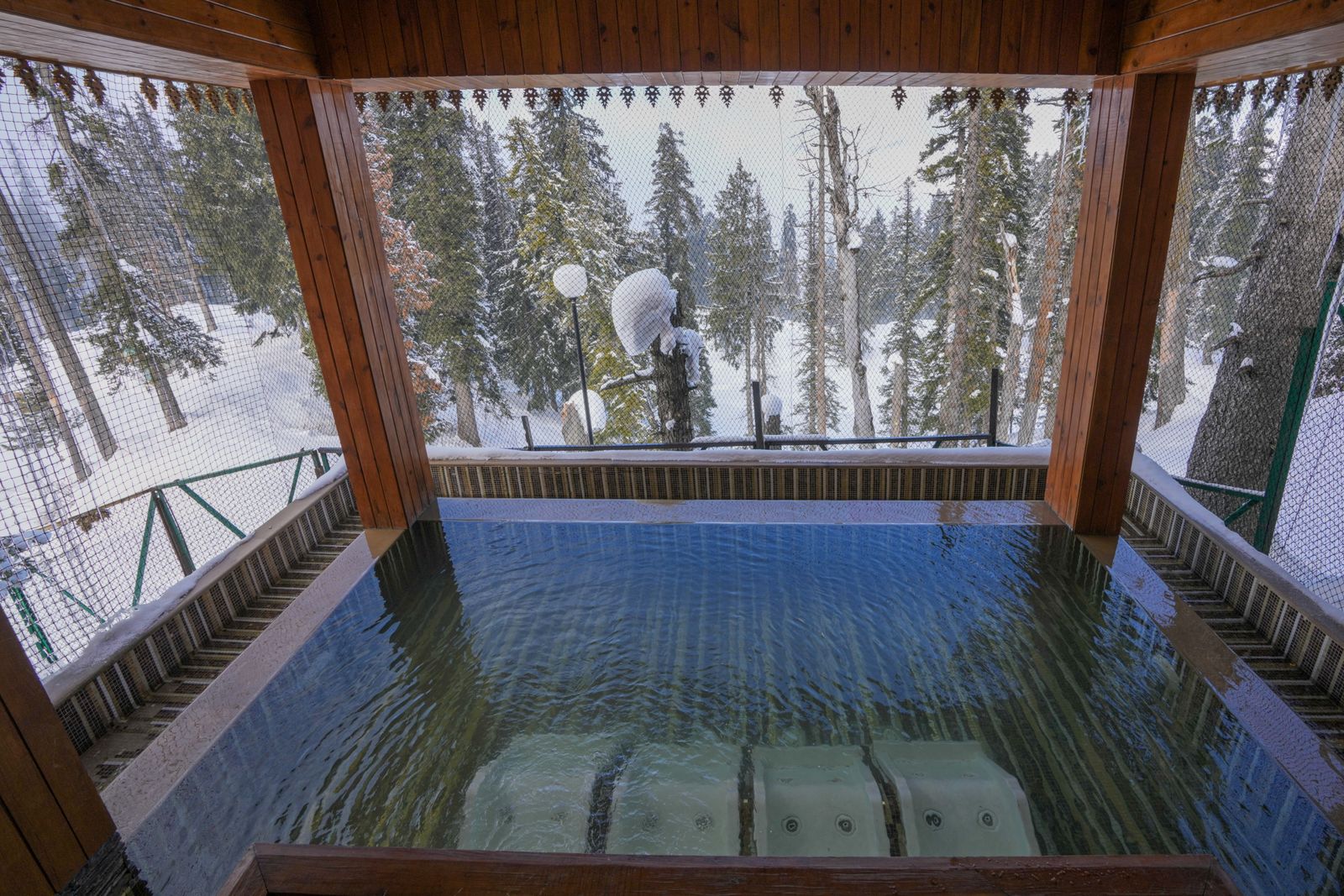
The experience is different from summer, and for many owners it is the main reason they bought a swim spa in the first place. In training mode the water is usually held at 28–30 °C — cooler than in a hot tub, because swimming against the current makes the body produce heat and exercising at 37 °C would be impossible. In a hard frost the 30–40 K difference is visible: a continuous cloud of steam sits above the surface while your head is in freezing air and your body is in the warm.
Practical lessons that only show up after the first winter:
- Hair and hats. Wet hair freezes in the frost. Most people swim in winter wearing a hat or a swimming cap, and pin longer hair up above the waterline.
- Steam blocks the view. In a hard frost there is so much steam above the water that you cannot see the far end of the swim spa.
- The walk to the water is critical, not the water. What is unpleasant is five metres of bare wet feet on frozen paving. A heated strip of decking, or at least a non-slip mat that drains, transforms the whole experience — we go through the options in the article Patio heating around a hot tub.
- Handrails ice up and a cover without a lifter is misery in the cold. A grab rail with a plastic grip and a cover lifter are the best money you can spend for winter.
The fundamental difference from a conventional hot tub is that you use a swim spa differently in winter: not for a two-hour soak, but for a twenty-minute workout. The temperature setting follows from that. How running a small 350-litre hot tub differs is described in the article Hot tub in winter — with a swim spa the volumes and time constants are an order of magnitude apart.
What actually drives winter consumption?
The winter bill is not made by the initial heat-up, but by holding the temperature against heat loss. A swim spa holds 5,500–20,000 litres of water with a surface of 10–20 m². Heat escapes from it by five routes:
- Insulation of the shell and the cabinet. The most important item, and also the one you cannot change after purchase. The difference between full foam insulation of the shell and a “sound-box” build with a single layer on the base can easily amount to 40 % of winter consumption.
- Quality and condition of the cover. By far the most energy leaves through an uncovered surface in the frost — evaporation plus radiation. The cover is the only protection you have for 23 hours a day.
- How many hours the swim spa is uncovered. An hour with the swim spa open in the frost costs more energy than a whole night under a good cover.
- Outdoor temperature and wind. Loss grows with the temperature difference, but wind can raise it dramatically — moving air carries heat away far faster than still frost.
- The water temperature you set. Every extra degree means roughly 8–10 % more loss.
On top of that come filtration and circulation (usually 3–6 kWh a day in winter) and, briefly, the swim jet, which draws 2–4 kW. That last one is negligible, though — twenty minutes of swimming a day works out at around 1 kWh.

A model calculation: what does January cost?
The figures below are a model estimate, not a measurement. They are there so you can see the order of magnitude and the influence of the individual parameters. The model assumes:
- a swim spa with a volume of 7,000 litres, a surface of roughly 12 m², installed outdoors on a sheltered terrace,
- a water temperature of 30 °C and an average outdoor temperature over a freezing month of 0 °C (a difference of 30 K),
- a cover in good condition, with the swim spa uncovered for about 30 minutes a day,
- an electricity price of €0.20/kWh including distribution.
On these assumptions the average continuous power needed to hold the temperature works out at around 1.0–1.4 kW, which corresponds to 24–34 kWh a day including filtration. Over a month that is roughly 720–1,000 kWh, i.e. €144–200. In November and March, when the average outdoor temperature is around 5 °C, consumption drops to about two thirds of that.
| Situation (7,000 l, cover in good order) | Estimated kWh/day | Estimated €/month |
|---|---|---|
| December–February, water 30 °C, good insulation | 24–34 | 144–204 |
| December–February, water 30 °C, poor insulation or an old cover | 40–60 | 240–360 |
| December–February, water lowered to 26 °C between workouts | 18–26 | 108–156 |
| November and March, water 30 °C, good insulation | 15–22 | 90–132 |
| Winterised (drained) swim spa | 0 | 0 |
The spread is deliberately wide — without knowing the specific model and location, a single figure would be misleading. For a year-round view of running costs including chemicals, water and servicing see the article How much a swim spa costs to run; here we stick to the most expensive part of the year.
How do you genuinely cut winter consumption?
The cover: the cheapest measure with the biggest impact
In winter the thermal cover matters more than anything else you can influence. A cover that is waterlogged stops insulating. A practical test: a cover in good order can be lifted with one hand and sits down all the way round with no gap. If it is heavy, sagging in the middle, or if light shows between it and the rim, you are paying for its condition every single day. What to look for when choosing a replacement is summed up in the article Hot tub thermal cover.
With a swim spa there are usually two sections because of the length of the shell. The critical point is the seam between them — good covers bridge it with a thermal wedge, cheap ones do not. That is exactly where the steam you then see condensing escapes in the frost.
A thermal blanket under the cover
A floating thermal blanket laid directly on the water under the rigid cover reduces evaporation and adds another layer of air. On the large surface of a swim spa the effect is noticeable and the cost is low. The drawback: one more task before and after every swim.
Lowering the temperature between workouts — yes, but with a caveat
This is the most common question and the answer is: it only pays off over longer breaks. Heating 7,000 litres by 4 °C means supplying roughly 33 kWh, which with a 3 kW heating element takes over 11 hours. A simplified rule:
- You swim every day or every other day — hold a constant temperature. Cyclical heating does not save any of the energy supplied and only makes planning harder.
- You swim once a week — dropping by 3–5 °C between workouts makes sense, and loss falls by roughly 25–35 %.
- You are going away for two weeks or more — drop to an economy setting, but never below 10 °C and never switch off (why, see below).
Shelter, screening, siting
Wind is an underrated enemy. A screen, a fence or the wall of the house on the windward side will cut loss by anything from a few per cent to the low tens of per cent, and it makes the walk to the water pleasanter at the same time. If you are still choosing a swim spa, allow for this at the design stage; we cover the connections in the article How to choose a swim spa.
Scheduling heating for cheap hours
Thanks to its volume, a swim spa is an excellent heat store. With a spot tariff or a two-rate tariff you can shift reheating into the cheapest hours and block it during peaks — the water cools by tenths of a degree in the meantime. How to do it in practice is described in the article Hot tub and pool on spot-priced electricity.
Do not, on the other hand, count on your own photovoltaic generation in winter — December yield is a fraction of the summer figure. With a swim spa it mainly makes sense from March to October, see the article Photovoltaics for a pool and hot tub.
Frost and safety: why you must never switch a swim spa off
This is the most important paragraph in the whole article. A filled swim spa must not be disconnected from the electricity supply in winter. This is not a manufacturer’s recommendation for the sake of tidiness, but protection of an asset worth tens of thousands.
Control units (Balboa, Gecko and others) have a freeze protection function: a sensor watches the water temperature and, when it falls to the set threshold (typically 5–7 °C), starts the pumps on its own and the heater as required. Water flowing through the pipework does not freeze. Without power this protection does not work.
The risk with a swim spa is not the shell itself — a large volume of water cools slowly and takes days to freeze through. What is at risk is the pipework, the pumps and the filtration circuit: the thin pipes inside the cabinet hold little water and freeze sooner. A crack only shows up at the spring start-up, when water begins to escape into the insulation.
What to do in a power cut
The procedure is the same as for a hot tub — you simply have more time, because 7,000 litres of warm water hold heat far longer than 1,500 litres. You will find the detailed scenario in the article Hot tub in winter; for a swim spa adjust it like this:
- Up to about 24 hours in a mild frost there is usually nothing to fear. Leave the cover closed, do not open it and do not check the temperature with your hand in the water — every opening costs heat.
- Beyond 24 hours or in a hard frost, add thermal insulation on top: blankets, polystyrene, a tarpaulin. The aim is to slow the cooling until the power comes back.
- A longer outage likely to run into days — contact a service engineer and consider an emergency drain-down of the pipework. Draining the shell without blowing out the circuits does not solve the problem; the water stays in exactly the places that crack.
- A backup supply. In areas with frequent outages a generator that can at least run the circulation pump makes sense. Arrange the connection with an electrician — the background on protection and wiring is in the article Hot tub and the electrical connection.
Winterising a swim spa: when it makes sense
Full winterisation is a legitimate choice, but with a swim spa it is rather the exception — you buy one precisely for year-round use. Draining it makes sense in three situations: at a holiday property you do not visit over the winter, before a lengthy renovation, and where the electricity supply is not reliable.
Winterising is not “drain it and cover it”. At a minimum you need to drain the shell, blow out all the circuits with compressed air (jets, swim jet, filtration, heating), drain the pump bodies, remove the filter cartridges, dry the inside, top up residual sumps with antifreeze intended for pool equipment, and cover the shell securely against rain. On a large swim spa with several pumps it is sensible to hand the job to a service engineer — a mistake in one circuit costs more than the whole operation. And be warned: even a drained swim spa carries risk. Residual water at the lowest points of the pipework is exactly what cracks.
Maintenance in winter: what changes
Both the chemistry and the mechanical maintenance work differently from summer, mainly because of the temperature and the lighter load on the water:
- Lower disinfectant consumption. Water at around 28–30 °C and fewer bathers mean chlorine or bromine is used up more slowly. Dose according to a test, not according to summer habit.
- Do not leave test strips outdoors — frost and damp ruin them (see How to test your water).
- Clean the filter indoors. Rinsing the cartridge outside in a frost ends with a frozen cartridge and cracked pleats. The procedure is described in Cleaning a hot tub filter.
- Snow on the cover. Up to about ten centimetres, snow actually insulates. A thicker layer is a load that will bow the cover over time, and wet heavy snow soaks into the vinyl. Sweep it off with a soft brush, never a shovel.
- Ice around the rim. Water that runs off the cover and freezes on the paving is the biggest safety risk of the whole winter. Do not use salt near acrylic and stainless steel; reach for a chloride-free grit instead.
- Do not let the water level drop — a lower level means air in the circuit and poorer cooling of the pumps.
Table: each measure and its impact on consumption
| Measure | Estimated impact on winter consumption | Effort |
|---|---|---|
| Replacing a waterlogged cover with a new thermal cover | −15 to −30 % | one-off purchase |
| Floating thermal blanket under the rigid cover | −5 to −10 % | low, one extra task |
| Lowering the temperature by 2 °C | −15 to −20 % | none |
| A screen, or siting in a sheltered spot | −5 to −15 % | building work |
| Cutting the uncovered time by 30 minutes a day | −3 to −8 % | none |
| Optimising filtration cycles (without losing water quality) | −3 to −7 % | control unit setting |
| Shifting reheating into cheap hours | 0 % of consumption, −10 to −25 % of cost | tariff and control |
| Lowering the temperature to 26 °C between weekly workouts | −25 to −35 % | planning |
The values are indicative and do not add up linearly.
Frequently asked questions
Can you swim in a swim spa even at minus fifteen?
You can, and plenty of owners do. The water holds its temperature because the heater works continuously. The limit is comfort out of the water — the walk to the shell, handling the cover and an iced-up terrace.
How much does it cost to heat a swim spa from cold in winter?
Heating 7,000 litres from 10 to 30 °C means supplying roughly 165 kWh, or with losses more like 190–220 kWh, so around €40. With an ordinary 3 kW element it takes several days — which is exactly why a swim spa is not switched off in winter.
Does a heat pump help even in the frost?
Yes, but with declining efficiency. Modern units work, depending on the model, down to −7 to −15 °C, though the coefficient of performance falls from summer values of around 5 to roughly 2 in the frost — still double that of direct electric heating. The decisive factor is the declared operation down to low temperatures; in detail in the article Heat pump for a pool and hot tub.
Do I have to filter for as long in winter as in summer?
Usually not — at a lower temperature and with a lighter load, shorter cycles are enough. But they must not drop below the threshold for mixing the water adequately, and in the frost circulation is also the protection against freezing, so never stop filtration altogether.
Is a sunken swim spa more economical in winter than a freestanding one?
As a rule yes — the soil around the pit damps out the swings and shields the sides of the shell from the wind. The condition is a drained and insulated pit with accessible equipment. Details in the article Installing and sinking a swim spa.
In conclusion
Winter operation is a swim spa’s strongest argument and its biggest budget item at the same time. The difference between expensive and sensible running comes down to a few specific things: the insulation you choose at the time of purchase, the cover you can replace at any time, and a handful of free habits. The most important rule, though, is not about money — a filled swim spa is never switched off in winter.
If you are still weighing up a swim spa and want to go through the insulation, cover and control unit specifications beforehand, take a look at the range in the hot tubs and swim spas category, or read more in the Guide section.
