
A pool built from permanent formwork is created by dry-stacking hollow blocks of expanded polystyrene (EPS) on a concrete slab. Steel reinforcement is placed into the cavities and concrete is poured in — the result is a reinforced concrete wall around which the polystyrene remains permanently as thermal insulation. In German-speaking countries this solution is known as a Styroporpool, and it is currently the fastest-growing segment of self-build pool construction. Almost nobody writes about it in the Czech market, even though the material is readily available.
Before you get into the detail, we suggest first comparing the basic options in our article Pool construction types compared. Permanent formwork is a subset of the concrete pool — simply with a different formwork technology and insulation included.
How it works: formwork that is never stripped
A conventional concrete pool is formed with boards or system formwork; once the concrete has cured the formwork is removed and the wall then has to be insulated separately from the outside. Permanent formwork reverses this process: the formwork is made of polystyrene, it stays in place and performs a second function — it insulates.
A standard block typically measures 1000 × 250 × 250 mm, that is one metre long, 250 mm high and 250 mm total wall width. In the basic versions the inner and outer faces of the block are around 50 mm of polystyrene, with a hollow chamber between them that the concrete fills. The blocks are dry-stacked with tongue-and-groove joints, without mortar — laying them feels more like assembling a construction kit than bricklaying.
One key point that people often overlook: the base slab and the walls should form a single monolith. Vertical starter bars are set into the slab before it is poured, and these then run up through the block chambers to the top. So the wall does not merely stand on the slab, it is tied into it with steel. Without that, water or soil pressure could shear it off at the base.
Why the Germans and Austrians are so keen on it
Three reasons come up most often in German instruction manuals and product listings.
1. The insulation is part of the structure
Concrete is an excellent structural material but a poor insulator — it draws heat out of the water into the ground all year round. With permanent formwork the polystyrene stays in the structure for good. Suppliers also offer thick-walled versions in EPS 40 with a declared integrated thermal insulation of around 95 mm; for these they quote a reduction in heat loss of 20 to 30 per cent and a swimming season extended by four to six weeks compared with uninsulated concrete.
A caveat is needed here: these are manufacturer and retailer figures, not independent measurements. The real benefit depends on ground temperature, the groundwater level, whether you have a cover, and above all on how much heat escapes from the water surface — which is by far the largest loss on an outdoor pool. Wall insulation helps, but a surface cover on its own usually has a greater effect on consumption. We examine this in detail in our article Pool enclosures and solar covers.
2. A build within reach of a competent DIYer
The blocks weigh a fraction of concrete formwork blocks — roughly a third of the weight of a comparable concrete unit is the figure quoted. They can be cut with an ordinary saw or a hot wire, so awkward corners, steps or benches can be made by one person without a crane and without carpentry skills. That is precisely why the segment has taken off in the DACH region: a third way has opened up for the DIYer, between “buy a ready-made shell” and “hire a firm to build a monolith”. We look at where sensible self-building ends in our article Turnkey pool vs DIY.
3. Any dimensions you like, at no surcharge
A fibreglass shell is a catalogue product — either the shape suits you or it does not. Blocks are stacked by the metre and cut to size, so a 6.4 × 2.9 m pool dictated by the shape of your plot is neither a problem nor a price premium. Steps, a paddling area or a bench are built up from the same material.
The build in brief
The base slab
The slab must be level, load-bearing and have starter bars projecting from it. The flatness of the first course of blocks follows directly from it — an error in the slab will keep coming back at you all the way to the top. We describe the subsoil, slab thickness and reinforcement in a separate article, The pool base slab. The slab is usually 200–300 mm larger than the pool footprint on each side.
Laying the blocks
The first course is the only one worth spending half a day on. It is laid on a mortar bed or a levelling screed and must be accurate to the millimetre — both level and on the diagonal. Subsequent courses are dry-stacked, the bond is staggered as in brickwork, and corners are cut to size. The finished wall is usually propped from the outside before pouring so that the pressure of the fresh concrete does not bow it.
Reinforcement
Vertical reinforcement goes into the chambers — German manuals quote 8 to 10 mm diameter in every chamber, lapped into the slab starter bars and carried up to the topmost course. Horizontal bars are laid into the grooves after every course or every second course. Reinforcement is not the place to economise: it is the one thing holding the wall against soil pressure from outside when the pool is empty.
Concreting
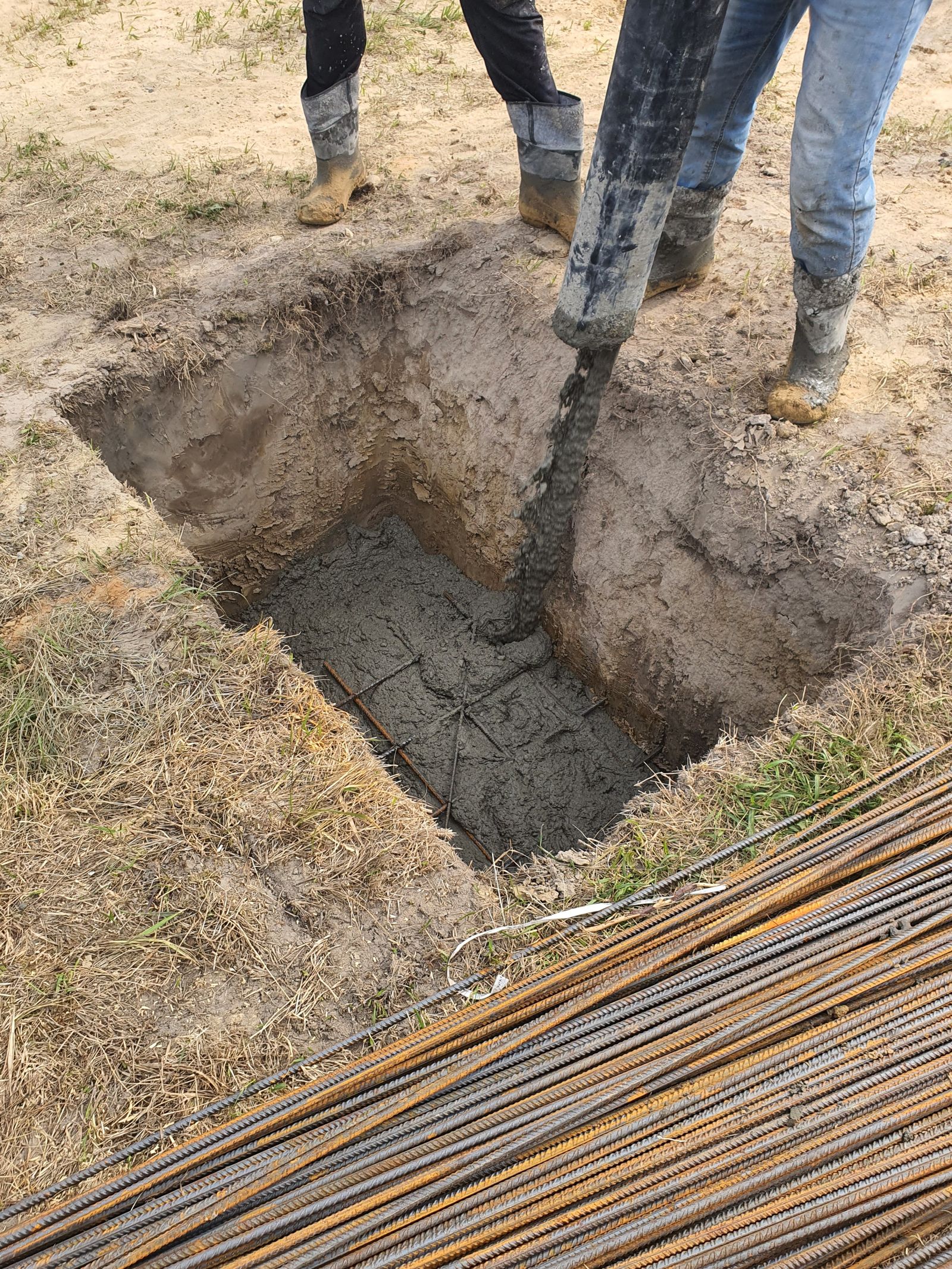
Ready-mixed concrete is used, typically class C20/25, exposure class XC2, with aggregate up to 16 mm and a softer consistency (Austrian documentation quotes class F45, F52 at most). The concrete has to flow through the chambers by itself — a poker vibrator is prohibited, it would tear the polystyrene apart. Compaction is limited to careful rodding.
It is poured through a hose with a drop brake (a restriction to around 60 mm), never in free fall from a height. Concreting proceeds in two or three perimeter layers all the way round, not one wall at a time. According to manufacturers, walls up to 1500 mm high can be poured in a single working day. Allow roughly three weeks of curing before further work.
Penetrations and equipment
The skimmer, inlets, light and main drain must be fitted and the pipework completed before concreting. The polystyrene is cut out at each penetration, the fitting is fixed in place and the concrete is poured around it. Drilling into a reinforced concrete wall afterwards is possible, but unpleasant and expensive — plan your hydraulics in advance following our article Pool hydraulics.
Waterproofing and finish
The concrete core is not watertight in itself. Either a liquid-applied waterproofing membrane is used beneath tiling — the procedure is covered in our article Concrete pool waterproofing — or, and this is the most common choice for this type of build, a reinforced liner. The inner face of the blocks is skimmed with a levelling coat and backed with geotextile before the liner goes in, so that the texture of the polystyrene does not telegraph through it.
Finish: liner or tiles?
The cheaper and quicker option is a bag liner, usually 0.8 mm thick, made to measure and simply hung from a top rail — it comes in kits and two people can fit it. The catch is that a thin bag liner follows every irregularity in the substrate and its service life is shorter.
The better solution is a 1.5 mm reinforced membrane welded on site. It is more robust, copes better with mechanical loading and can be repaired by welding. Tiles or mosaic are also possible, but they demand perfect waterproofing and movement joints — on a self-build they are the riskiest choice. Choosing a liner is covered in our article How to choose a pool liner.
Compared: EPS blocks, fibreglass shell, conventional concrete
The table compares three routes to an in-ground pool of roughly 6 × 3 m. Prices are indicative for 2026 and cover materials plus the usual construction work, not a specific quotation.
| Criterion | EPS blocks (permanent formwork) | Fibreglass shell | Conventional concrete (system formwork) |
|---|---|---|---|
| Material cost | lowest of the concrete routes — the blocks alone for 6 × 3 m sell in the DACH region from around €2,000, a complete package with liner kit and ladder from about €3,500 | the shell is a finished product, the price for the structure is considerably higher | formwork, reinforcement and concrete comparable, plus insulation separately |
| DIY difficulty | highly achievable — dry stacking, cutting with a saw, no crane | the shell itself yes, but setting it needs a crane and precise preparation | the most demanding — formwork, structural design and concreting are jobs for a contractor |
| Build time | weeks, of which about 3 weeks is a curing pause after concreting | the fastest — the shell is set in a day | the longest, with more curing breaks |
| Wall insulation | part of the structure, around 95 mm of EPS declared on thick-walled versions | the laminate sandwich insulates reasonably well | none — it has to be added separately on the outside |
| Freedom of shape | high — length by the metre, cut to size, steps and benches from the same material | none — catalogue shapes only | unlimited |
| Repairability | the finish (liner) easily, the concrete core is permanent | gelcoat and laminating need a specialist | liner replaceable, tiling more demanding |
| Where the weakness lies | everything rests on the accuracy of the first course and honest reinforcement | sensitivity to groundwater and precision of setting | cost and dependence on a contractor |
The figures for block dimensions, concrete class and reinforcement diameters are drawn from the installation manuals and technical pages of German and Austrian suppliers (among others pooldoktor.at and richter-garten.de), and the price ranges from current German online retailer offers in 2026.
Risks and common mistakes
- An inaccurate first course. The most common and least correctable mistake. A deviation of a few millimetres turns into centimetres by the sixth course, and the liner coping rail will end up crooked too. For the first course use a level instrument, not a spirit level.
- Concrete that is too wet. Trying to “make it flow better” leads to watering it down. The result is concrete of lower strength with segregated aggregate — exactly what you do not want in a thin wall. Consistency is the concrete plant’s business, not a bucket of water on site.
- A vibrator in the chamber. It tears the polystyrene from the inside, the concrete then leaks out and the wall bows. Pour in layers all the way round, not one wall to full height at once.
- Underestimated reinforcement. Vertical bars omitted from some chambers, or no connection to the slab. The wall is then a hollow shell with no way of transferring soil pressure.
- Groundwater. The most serious risk, and it has nothing to do with the material. An empty or filling pool can be lifted by buoyancy and a monolithic structure can crack. Drainage and a sump are essential before excavation — the procedure is described in our article Groundwater and your pool.
- No external protection for the polystyrene. EPS in contact with soil needs protecting against mechanical damage and rodents. This is handled with a dimpled membrane or a protective layer during backfilling.
What the materials cost for a 6 × 3 m pool
The breakdown below is an indicative estimate for 2026 for a 6 × 3 × 1.5 m pool built by the owner, excluding groundworks, landscaping around the pool and any cover. Material prices vary over time and between suppliers, so treat this as an order of magnitude for a first assessment, not a quotation.
| Item | Quantity (approximate) | Indicative price 2026 |
|---|---|---|
| EPS blocks plus corner and connecting pieces | 18 m perimeter, 1.5 m high | €1,800–2,600 |
| Reinforcement (8–10 mm vertical bars, mesh for the slab) | — | €500–900 |
| Ready-mixed concrete (slab plus walls) | approx. 4–5 m³ slab, approx. 3.5–4.5 m³ walls | €1,100–1,600 |
| Concrete delivery and pump | 2 deliveries | €300–700 |
| Liner: 0.8 mm bag / 1.5 mm reinforced, welded | approx. 45 m² of surface | €700–1,200 / €1,800–3,000 |
| Penetrations — skimmer, inlets, light, main drain, pipework | — | €700–1,200 |
| Filtration, pump, basic equipment | — | €1,000–1,800 |
The total for the bag liner version comes to roughly €6,200–10,000, and for the version with a reinforced membrane and better equipment more like €8,000–12,000. To compare this with other construction types and with a turnkey build, take a look at our article What a pool costs. Groundworks, spoil removal, the electrical supply and the surroundings of the pool are not in the estimate — and they tend to be the items that decide the budget in the end.
Who it makes sense for — and who it does not
Yes, if you are a skilled builder or DIYer, have time spread across several weekends, a plot free of groundwater, access for a concrete mixer truck, and you want a non-standard size with insulation built into the structure. You will come in well below the cost of a turnkey build and you will have a structure that will be there for decades.
No, if you need a pool “by the end of the season”, have no experience with setting out and levelling, have a high groundwater table on your plot, or sloping ground that requires a structural assessment. In such cases a ready-made shell or a turnkey contractor is clearly the better choice — a mistake in a monolith is not repaired, it is demolished.
Frequently asked questions
Will polystyrene last for decades in the ground?
EPS is a stable material in soil; it does not rot and does not change volume, provided it is protected against mechanical damage and UV radiation. Backfilling is normally done with a dimpled membrane or a protective geotextile. The structural function is carried by the reinforced concrete core; once the concrete has cured the polystyrene does nothing but insulate.
Do I need planning permission for a pool like this?
It depends on the size, the location and local rules — the same as for any other in-ground pool; the material of the structure makes no difference. We cover the details in our article Pools and planning permission. Always check with your local authority before you excavate.
Can I fill the blocks with concrete from a site mixer instead of a mixer truck?
Technically yes, in practice it is not recommended. The wall should be monolithic from a single pour; mixing bucket by bucket leads to construction joints, uneven consistency and lower strength. Ordering ready-mixed concrete is one of the best places to spend your money on this kind of build.
Do you really save as much on heating as they claim?
The figures of 20–30 per cent lower heat loss come from the manufacturers and retailers of the blocks, not from an independent study. An insulated wall undoubtedly helps, but the greatest loss on an outdoor pool leaves through the water surface by evaporation. Without a cover, the difference against uninsulated concrete will show up on your bill far less than the catalogue numbers promise.
Can steps and benches also be built from permanent formwork?
Yes, and it is one of the main advantages. Steps are built up from the same blocks, reinforced and concreted together with the walls — you just need to allow for higher concrete consumption, of the order of several cubic metres more than for bare walls.
A pool made from EPS blocks is not a miracle technology; it is a clever combination of things that work perfectly well on their own: reinforced concrete, insulation and a liner. Its strength is that it shifts the work from an expensive building contractor to a capable owner — while leaving insulation in the structure that with conventional concrete somebody would have to add separately. If, having read this, you conclude that you do not want to build but you do want a pool, take a look at the ready-made solutions in our pools category, or browse the other articles in our Guide.
