
The pool liner is the only layer separating thousands of litres of water from the pool structure — and at the same time the only part of the pool you actually see. For in-ground pools, go for a welded 1.5 mm liner with an acrylic coating; for above-ground frame pools, a prefabricated 0.6–0.8 mm bag liner is sufficient. Choose the colour carefully: it determines the shade of the water, how visible dirt will be, and to some extent even the water temperature.
What role does the liner actually play in a pool?
The liner performs two functions at once. The first is waterproofing: neither concrete nor a steel shell can hold water reliably on its own, so the liner forms a continuous watertight membrane across the entire floor and walls. The second is appearance — the colour and texture of the liner determine the final shade of the water more than anything else.
That is exactly why it pays to take your time choosing. A liner is not something you swap in an afternoon like a filter cartridge; a quality installation is an investment for 10–15 years, and a wrong choice of thickness or colour will stay with you for all of that time.
What types of pool liners are there?
The vast majority of pools here use liners made of plasticised PVC. They differ, however, in thickness, construction and installation method — and these are the parameters that determine lifespan more than any brand name.
0.6 mm liners: lightweight above-ground pools
The thinnest common variant comes as a prefabricated bag liner for round and oval frame pools. The bag is simply hung into the top rail of the shell and tensioned by the pressure of the water. It is the cheapest solution, but also the least durable — expect a lifespan of around 5–8 years and sensitivity to mechanical damage as well as frost.
0.8 mm liners: sturdier frame pools
A thicker bag liner for larger above-ground and partially sunken frame pools. Compared with 0.6 mm it copes better with mechanical stress and more intensive use, and it tends to be available in more colours and patterns. For a family frame pool that is meant to last more than ten seasons, 0.8 mm is a sensible minimum.
1.5 mm liners: welded to measure for in-ground pools
The premium category. A liner with a load-bearing polyester scrim between two layers of PVC is supplied on rolls, and a specialist company hot-air welds it directly in the pool — tailored precisely to the floor, walls, steps and recesses. The result is a membrane that follows any shape, tolerates movement of the structure and, with proper care, lasts 12–15 years or more. For concrete and masonry pools it is the standard today.
Are there alternatives to PVC?
Marginally, yes. Polypropylene sheets (5–8 mm) are not welded like a liner but form a self-supporting shell — they compete with a complete plastic pool rather than serving as a lining. Fibreglass (glass-fibre layers with a gelcoat) is used for prefabricated shells and for renovating old concrete pools. Both solutions have their place, but for retrofitting waterproofing to an existing pool, a welded PVC liner remains the most flexible and most affordable route.
Which liner thickness suits your pool?
| Thickness | Type | Pool type | Approximate lifespan |
|---|---|---|---|
| 0.4–0.6 mm | prefabricated bag liner | seasonal and smaller round above-ground pools | 5–8 years |
| 0.8 mm | prefabricated bag liner | larger frame and partially sunken pools | 8–12 years |
| 1.5 mm | welded to measure, with reinforcing scrim | in-ground concrete, masonry and panel pools | 12–15+ years |
| 1.5–2.0 mm textured | welded to measure, embossed surface | steps, floors, commercial facilities | 12–15+ years |
A simple rule applies: the thicker the liner, the greater its resistance to puncture, abrasion and UV radiation — but also the higher the price and the need for professional installation. Skimping on thickness with an in-ground pool does not pay off; the difference in material cost is negligible compared with the cost of repeated replacement.
How does the liner colour affect the water, temperature and maintenance?
The colour of the liner is not just aesthetics. Pool water acts as a light filter, so the final shade is created by a combination of the liner colour, the water depth and the sky above the pool.
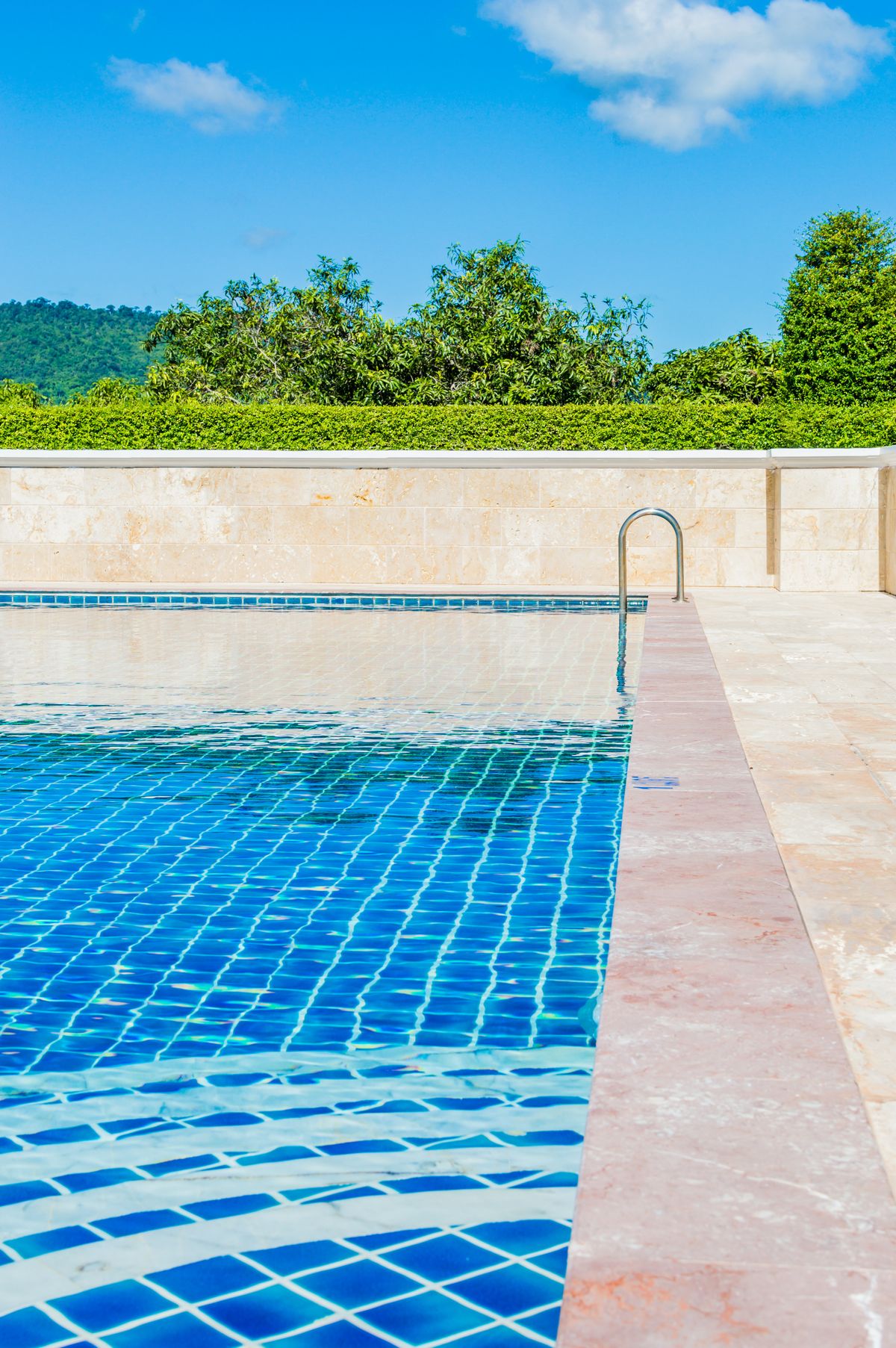
Light blue is the classic: it gives brilliantly azure water, visually brightens the pool, and on a light background you can easily spot every bit of dirt on the floor — which is an advantage for maintenance. White looks luxurious and lends the water a subtly turquoise tint, but it is the most demanding to keep clean. Sand and beige create a natural, lagoon-like look that harmonises with stone paving.
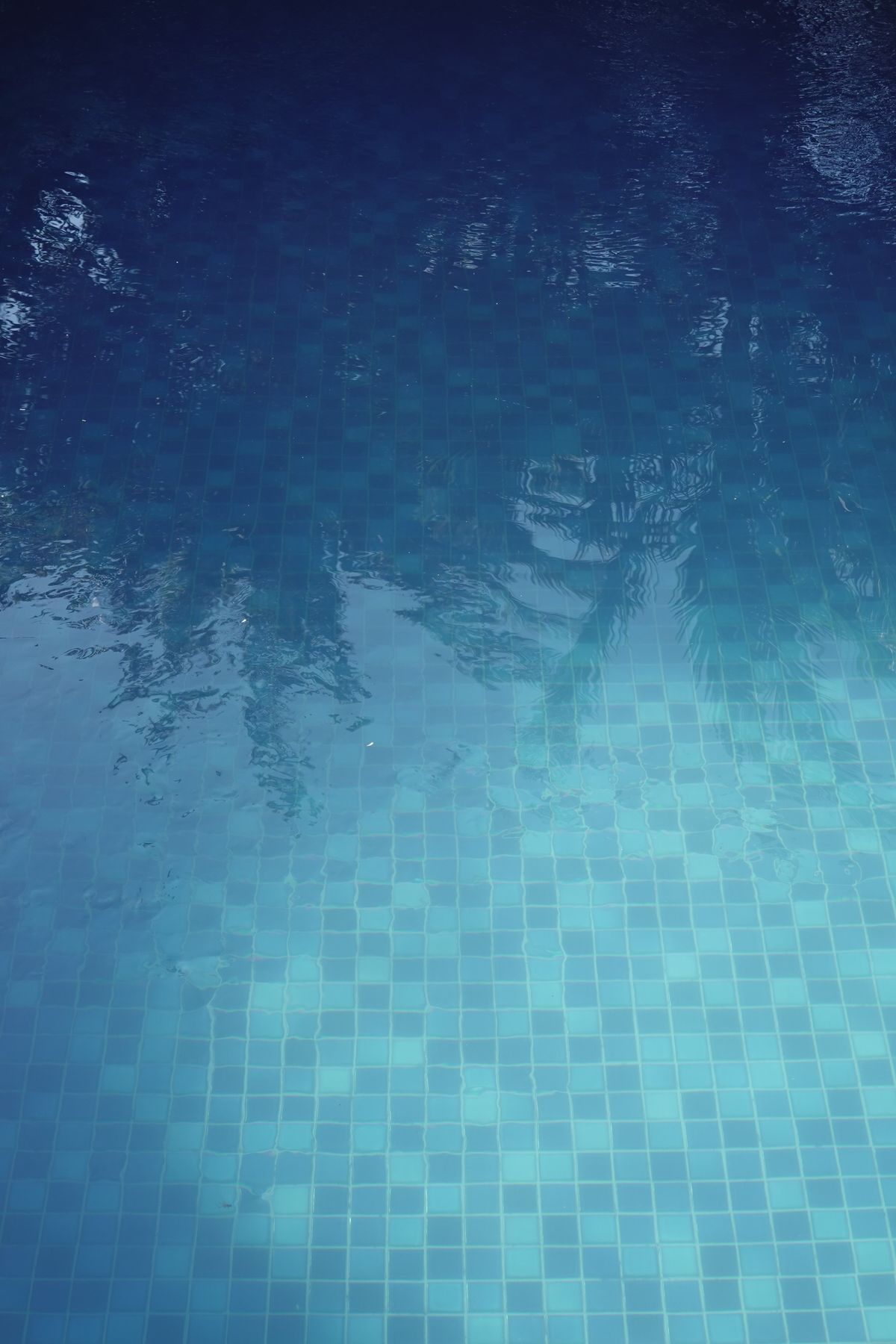
Dark shades — grey, anthracite, dark blue, black — have been the trend of recent years. The water above them looks like a natural lake, the surface mirrors the surroundings more, and the pool appears deeper than it really is. A dark surface also absorbs more solar radiation, so the water can warm up by 1–2 °C more than above a light liner. The price you pay is poorer visibility of the floor (a safety consideration with children), less noticeable dirt that you then underestimate, and more visible limescale and fading.
With all colours, bear in mind that UV radiation and chlorine gradually lighten the liner. Quality liners with UV stabilisation fade slowly and evenly; cheap ones shine for the first two seasons and then lose their colour quickly, especially on the sunny side and at the waterline.
When should you choose an anti-slip liner and textured surfaces?
Steps, Roman staircases, relaxation benches and children’s paddling areas call for an anti-slip liner with an embossed surface. It is produced in the same colours as the smooth versions, so the transition need not be visible at all, and it significantly reduces the risk of slipping in places where people enter the water. It tends to be somewhat more expensive and harder to clean, which is why it is used selectively only where it makes sense — you would not cover the entire floor with it.
Alongside single-colour liners there are also patterned ones: mosaic, marble, stone, or premium ranges with a 3D texture imitating ceramic tiles or a stone floor. A pattern has a practical advantage too — small bits of dirt and occasional stains are far less visible on it than on a uniform surface.
What should you look at besides thickness and colour?
- Acrylic coating. Quality liners have a surface finished with a layer of acrylic lacquer. It seals the pores of the PVC, so algae and limescale find it harder to take hold, the liner is easier to clean and it fades more slowly. For a liner meant to last 15 years, this is a parameter that genuinely pays off.
- UV stabilisation and chemical resistance. The manufacturer should declare resistance to UV radiation and common pool chemicals. With no-name liners without a technical data sheet, you are buying a pig in a poke.
- Approvals and certification. A liner in contact with pool water should have a hygiene certificate; with reputable European manufacturers this is a matter of course, with nameless imports it is not.
- Reinforcing scrim. With welded 1.5 mm liners, the polyester mesh ensures dimensional stability — the liner does not stretch or ripple even after years.
- Warranty. Serious manufacturers give a 10-year watertightness warranty on welded liners; the warranty on colour fastness tends to be shorter.
What shortens a liner’s lifespan — and how do you prevent it?
The declared 10–15 years only holds with sensible care. Paradoxically, the liner’s greatest enemy is poorly balanced water chemistry, not mechanical damage.
Low pH (below 7.0) makes the water aggressive: the liner hardens, becomes brittle and loses its plasticisers. Persistently high chlorine, on the other hand, bleaches the colour and breaks down the surface layer — typically after repeated shock chlorination without a follow-up check. Keep the pH between 7.0–7.4 and free chlorine around 0.3–0.6 mg/l; we cover regular testing in our article on water testing.
The second risk is frost. Ice in a pool that has not been winterised presses on the walls and the liner and can cut through it at the waterline; a drained pool, in turn, exposes the liner to frost without the protective layer of water. The correct procedure — lowering the water level, winterising chemicals and floats — can be found in our guide to winterizing your pool.
Faster ageing is also encouraged by constant strong sunlight without a cover, sharp objects (toys, unsuitable brushes, metal vacuum poles without protective caps) and leaving the pool drained for long periods in summer, when the liner works and shrinks without the load of the water.
When is it time to replace the liner?
A liner signals the end of its life gradually: pronounced fading and chalking of the surface, a network of fine cracks (especially above the waterline), wrinkling and stretching in the corners, repeated small water leaks or stains that cannot be cleaned off. A single small hole can be patched even underwater, but once a liner is turning brittle after 12–15 years, patching will no longer save it.
Replacing the liner is also the ideal opportunity for an overall modernisation — new jets, a new skimmer, lighting or a change of colour. We describe how to approach such a project in detail in our article on renovating an old pool.
How much do a pool liner and its installation cost?
Guide prices (approximate for 2026, including VAT):
- Prefabricated 0.6–0.8 mm bag liner for a round pool of 3.6–4.6 m: roughly 160–480 € apiece, and you can manage the replacement yourself.
- Material for a welded 1.5 mm liner: approximately 20–28 €/m² for single-colour versions, 32–48 €/m² for textured and patterned premium ranges.
- Complete turnkey lining (material + geotextile + PVC-coated profiles + labour): most often 56–80 €/m² depending on the chosen liner range; for simpler pools and basic liners from roughly 32–36 €/m².
For a typical 8 × 4 m pool with a depth of 1.5 m, the area to be lined works out at around 65–70 m², so a complete replacement comes to roughly 3 600–5 600 €. The spread is wide — the pool shape, steps, the number of wall penetrations and the installer’s travel distance all play a role, so have a tailored quote drawn up.
DIY or professional installation?
With frame pools using a bag liner, DIY is the way to go: you remove the old bag, check the base and geotextile, hang the new bag into the rails and smooth out the folds as the pool fills. All you need is care and one sunny day — warmth makes the liner more pliable.
A welded 1.5 mm liner is a different discipline. It requires a hot-air welder, experience with welds in corners and on steps, PVC-coated anchoring profiles and a sealing compound for the joints. A failed weld means a water leak that is hard to trace and expensive to repair. Here we unequivocally recommend a specialist company — for an investment running into thousands of euros, a workmanship warranty is a substantial argument.
Frequently asked questions
How do I tell the pool is leaking through the liner and not elsewhere?
Use the bucket test: place a container of water on a pool step so that the levels inside and outside are the same. If the pool level drops noticeably more than the level in the bucket over 24–48 hours, water really is escaping. If the drop stops at a certain height, look for damage at exactly that level — often around jet and light penetrations.
Can a cracked liner be repaired underwater?
Yes. For small holes there are patches with a special adhesive that cures underwater. It is only a temporary solution, though — if cracks keep appearing and the liner is more than ten years old, that is a signal of an approaching replacement, not a reason for further patching.
Will a dark liner really raise the water temperature?
Yes, but only slightly — a dark floor absorbs more solar radiation and, in an uncovered pool, can add in the order of 1–2 °C. A solar cover or an enclosure has a considerably greater effect on water temperature than the liner colour; choose a dark shade primarily for its looks.
Does geotextile have to go under the liner?
With welded liners, emphatically yes. Non-woven geotextile (300–500 g/m²) protects the liner from abrasion against rough concrete, evens out minor irregularities and prevents condensation between the liner and the structure. Its cost is negligible compared with the cost of the liner.
How long does a liner replacement take?
For a bag liner in an above-ground pool, one day plus filling. For a welded liner, allow 2–4 days of work depending on the size and complexity of the pool — plus time for draining, preparing the base and refilling, usually one to two weeks in total.
A new liner transforms a pool beyond recognition — and along with it, the profiles, flanges, jets and other penetrations are often replaced too, as it makes sense to renew them all at once. You will find structural components, flanges and seals in our category of pool structural parts, and further guides in our Advice centre.
