
How often you actually use your pool is decided not only by the water temperature, but also by how easily you can get into it. A stainless steel ladder is the cheapest yet least comfortable solution; Roman or corner steps offer comfort for the whole family, and a gentle beach entry is a luxury that children and seniors will appreciate alike. In this guide we compare all the options, including prices, safety details and retrofit possibilities.
Why does the pool entry determine how often you will use it?
A pool typically serves for 20 to 30 years — and over that time its users change too. The toddler who needs a gentle, supervised entry today will be diving head-first in ten years. Parents who climb down a ladder without a second thought today will one day appreciate a step with a handrail.
Experience is unequivocal: a pool that is hard to get into gets used less. A ladder requires a certain amount of arm strength and stability — for seniors, people with painful knees or limited mobility it is often a barrier that makes them give up swimming altogether. Comfortable steps, by contrast, turn the pool into a place where you sit down, cool off and stay longer.
Choose your entry for the entire lifetime of the pool, not according to the current state of your family. The difference in purchase price between a ladder and steps is small in the context of the whole build — the difference in everyday use is enormous.
What pool entry options are there?
Stainless steel ladder — cheapest, but least comfortable
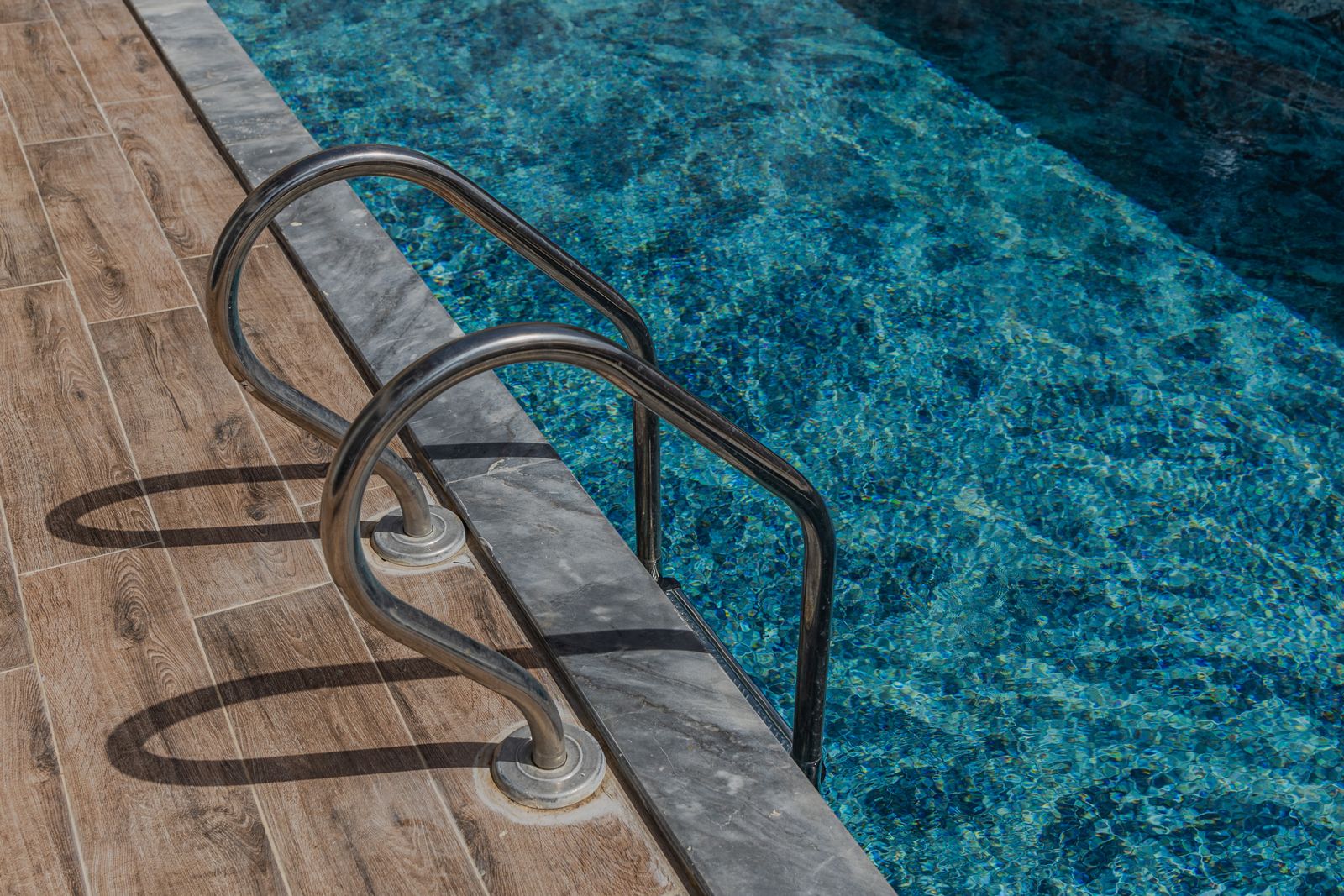
A classic stainless steel ladder with two handrails and three to five rungs costs roughly €120–320. It takes up no pool volume and suits sporty swimming and narrow pools where steps would eat into the swimming lane.
The drawbacks are obvious: narrow rungs press into the soles of your feet, you descend with your back to the water, and it demands both strength and coordination. For small children, seniors and anyone with limited mobility, a ladder is unsuitable as the only entry.
Roman and full-width internal steps — comfort at the cost of volume
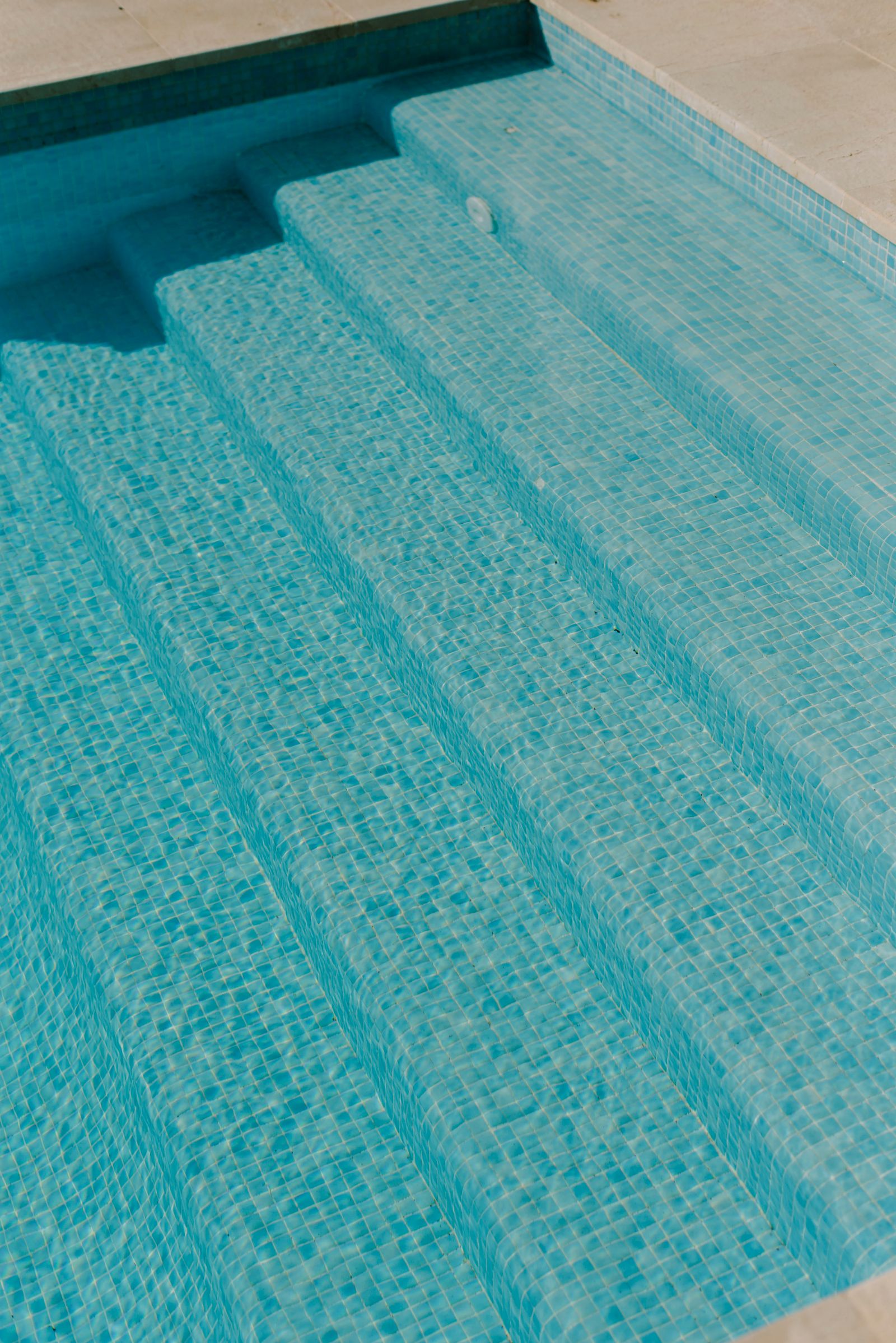
Roman steps are semi-circular, project out from the rectangular footprint and look distinctly elegant. Internal (full-width) steps run along the shorter wall of the pool. Both options offer a comfortable descent facing the water, a natural place to sit and easy supervision of children in the shallows.
The price of that comfort: steps eat into the swimming length and volume of the pool — in smaller pools up to 6 metres this means a noticeable loss of swimming space. In fibreglass and liner pools the steps are usually part of the shell; in concrete pools they are a structural element that must be planned in advance.
Corner and bench steps — a clever compromise with seating
Corner steps occupy only a segment in one corner of the pool, so the swimming lane stays clear. A bench solution combines two or three steps with a continuous bench along the wall — creating a relaxation zone where you can sit waist-deep in the water, children use it as a shallow area and seniors as a resting halfway point.
The corner-plus-bench combination is today the most common recommendation for family pools: the comfort of steps without a significant loss of volume.
Gentle beach entry — luxury for every age
A beach entry mimics a gently sloping shore: the floor rises to the surface at a slight gradient, and you walk into the water as you would into the sea. It is the friendliest entry of all — for toddlers, seniors, people with disabilities, and even the dog. It is also the most demanding option: it requires a significantly longer footprint (the ramp typically consumes 2–4 metres of length), a bespoke concrete build with a liner or waterproof render, and a budget that for this part of the pool runs from a few thousand euros well into five figures.
Beach entry makes sense for generously sized family pools and wellness gardens; for a standard 8 × 4 m pool, corner steps with a bench are more practical.
Above-ground pools — safety steps with a platform
With above-ground pools you enter over the top edge, so you need double-sided steps with a platform. Buy only safety designs: with a lockable or removable outer section, or a fold-up platform, so that children cannot reach the water unsupervised. A good set of steps costs roughly €160–480. You will find more on choosing the whole setup in our article How to choose an above-ground pool.
| Entry option | Comfort | Space taken | Approximate price | Best suited to |
|---|---|---|---|---|
| Stainless steel ladder | Low — descent with your back to the water | None | €120–320 | Sporty swimmers, adults without limitations |
| Roman / internal steps | High, facing the water | Considerable — eats into length and volume | from €600, in concrete pools depending on the build | Families, showcase pools |
| Corner / bench steps | High + seating | Small — just a corner or a strip along the wall | from €480 depending on design | Family pools, the universal choice |
| Beach entry (gentle slope) | Highest, barrier-free | Large — a ramp 2–4 m long | bespoke, from a few thousand € upwards | Large plots, small children, seniors |
| Safety steps (above-ground) | Medium | None inside the pool | €160–480 | Above-ground pools, households with children |
Which safety details should you watch out for?
Whichever option you choose, real safety comes down to the details:
- Non-slip surface — step treads and ladder rungs must have a non-slip finish (textured liner, anti-slip strips, grooved stainless steel treads). A wet, smooth liner on a step is the most common place to slip.
- Contrasting step edge — under water, edges blend together. A colour-differentiated strip on the edge of each step (darker mosaic, contrasting liner) significantly reduces the risk of a misstep, especially for seniors and the visually impaired.
- Handrails and grab rails — the anchoring is what matters. A rail must be anchored into a solid base (concrete, a flange with a chemical anchor), not just into glued-down paving. On ladders, check that the flanges are tight every season.
- Entry lighting — evening swimming without lit steps is a gamble. A spot LED light aimed at the steps, or a light strip beneath the edge of the treads, solves both safety and atmosphere; we cover the options in our article Pool LED lighting.
How do you solve pool entry for seniors and people with limited mobility?
A comfortable entry for less mobile users rests on three principles: low risers (ideally 15–18 cm per step, not 25 cm or more), deep treads for the whole foot, and handrails on both sides, so you can support yourself with both hands along the entire descent.
For people who cannot manage steps at all, there are pool hoists — mobile or anchored hydraulic or battery-powered lifts with a seat that lower the user directly into the water. Prices start at roughly €2,400 and up; for a home pool it is a worthwhile investment wherever swimming is part of rehabilitation.
With hot tubs the situation is simpler: stable non-slip entry steps placed against the shell and an additional grab rail anchored to the edge of the cabinet are enough. Easy entry is one of the reasons seniors often choose a hot tub over a pool — more in our guide How to choose a hot tub.
What does the pool entry mean for child safety?
For children there are two sides to the coin. A gentle entry, a shallow area on the steps or a bench are places where small children learn to be comfortable in the water and where you can see them. At the same time, however, the entry is also the route by which a child can reach the water unsupervised.
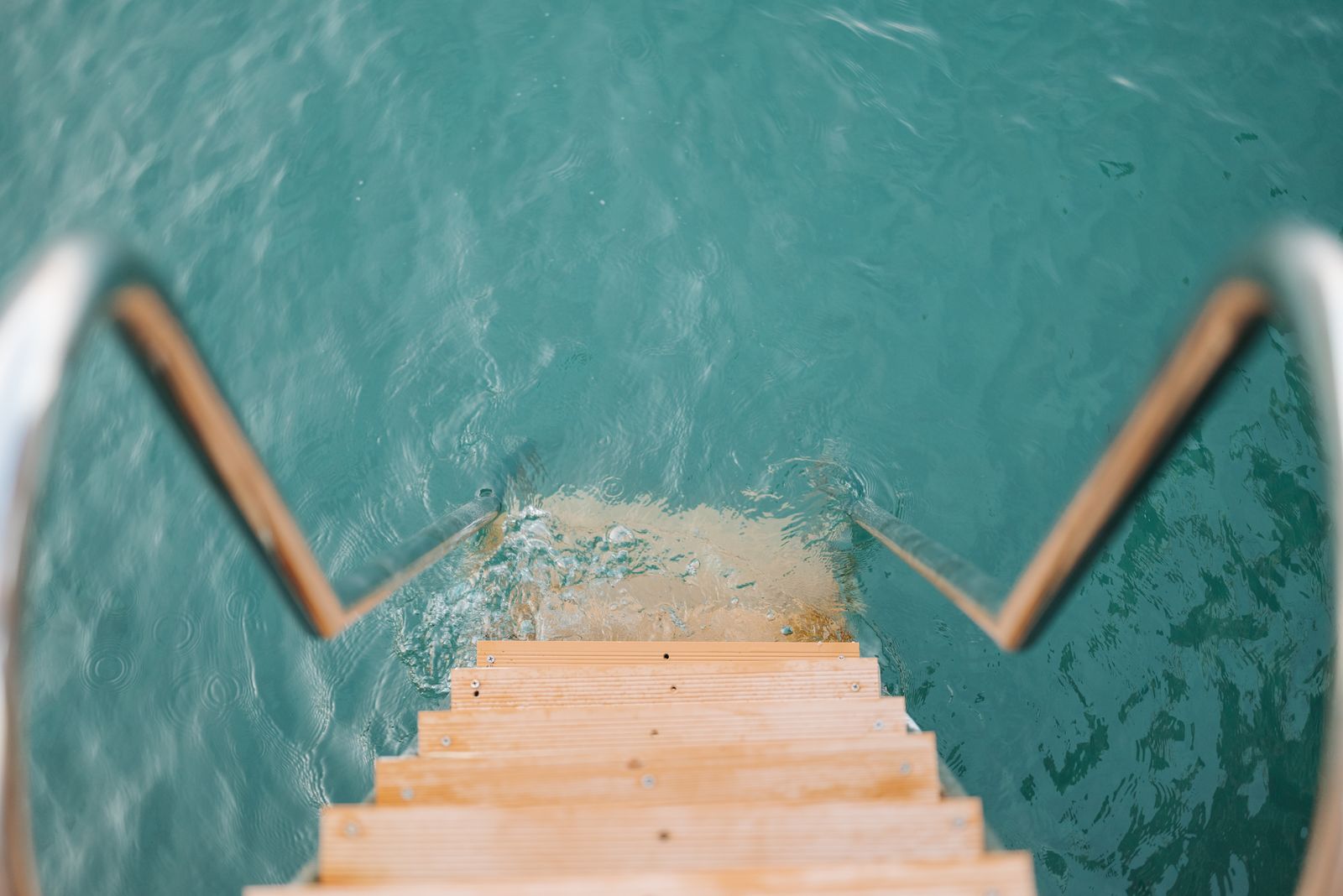
With above-ground pools, therefore, always choose removable or lockable steps and remove or secure them after every swim — it is the simplest and most effective child safeguard. With in-ground pools you cannot guard the entry itself; that is where an enclosure, a cover with sufficient load-bearing capacity or fencing must take over. You will find a complete overview of measures in our article Child safety around pools and hot tubs.
Can steps be retrofitted into an existing pool?
Yes — and it is a common request with older liner and concrete pools that only have a ladder. The simplest route is self-supporting stainless steel steps lowered into the pool and hung on the coping, or anchored into the surround; they require no intervention in the shell.
Building masonry or prefabricated steps inside an existing pool is a bigger job: it means draining the pool, anchoring into the floor and walls, and laying a new liner at the entry area. All anchors and penetrations are critical — every screw through the liner is a potential leak and must be sealed with a gasketed flange. The most sensible approach is to combine such a modification with a liner replacement; we describe the wider context in our article Renovating an old pool.
How do you look after your pool entry?
Stainless steel ladders and rails suffer above all from limescale: in hard water, a whitish deposit builds up on the shiny surface, trapping dirt and worsening grip. Remove it with an acid-based product designed for pool surfaces, never with a wire scourer — that scratches the stainless steel and opens the door to corrosion. Prevention means keeping an eye on water hardness and pH; details in our article Water hardness and scale buildup.
Fine sediment settles on the steps, and algae grow in shaded corners — when vacuuming regularly, pay special attention to the treads and corners of the steps. Once a season, check that the rail anchors are tight and inspect the condition of the non-slip elements.
Frequently asked questions
Is a pool ladder suitable for seniors?
Not as the only entry. Descending a ladder means facing away from the water and requires arm strength and stability on narrow rungs. For seniors, choose steps with low risers and handrails on both sides, or a pool hoist.
How much space do steps take up in a pool?
Full-width internal steps usually consume 1–1.5 m of the pool’s length, Roman steps extend about 1.5–2 m into the pool area, and corner steps take up only a segment in one corner. A gentle beach entry needs a ramp 2–4 metres long. For pools under 6 m in length, the corner option is therefore the better choice.
Can steps be added to an older liner pool?
Yes. Self-supporting stainless steel steps hung on the coping solve it without touching the shell. Masonry steps inside the pool require draining, anchoring and a new liner at the entry area — every penetration must be sealed with a flange, otherwise water leakage is a risk.
Which above-ground pool steps are safe for children?
Double-sided steps with a platform whose outer section is removable, fold-up or lockable. After every swim, remove or secure the outer steps so that a child cannot reach the water unsupervised.
How do I remove limescale from a stainless steel ladder?
Use an acidic cleaning product designed for pool surfaces and a soft sponge; a wire scourer will scratch the stainless steel. In the long run, keeping the pH balanced and watching the water hardness helps stop scale forming in the first place.
Conclusion: choose your entry with the next twenty years in mind
A well-chosen entry is an investment in a pool that truly serves everyone — the children today, the grandparents one day. If you are building or renovating, give preference to steps with handrails and a non-slip finish; keep the ladder as an extra for swimmers. You will find ladders, rails, steps and other structural parts for pools in the pool structural parts category at poolspashop.eu — and more buying and care guides in our Advice centre.
