
An overflow pool is not “a skimmer pool with a prettier edge”. It is a different hydraulic system, and it needs components that simply do not exist on a skimmer pool — above all a balance tank (surge tank) holding thousands of litres, an overflow channel with an edge levelled to the millimetre, and a pump sized for the full circulating flow. This article is not a decision-making comparison (you will find that in Skimmer vs overflow pool), but a technical description of everything an overflow system involves and what you need to allow for in the design and in daily running.

How does an overflow system actually work?
It all comes down to where the water level sits. In a skimmer pool the level lies roughly 10–15 cm below the coping and water is drawn off through a side opening. In an overflow pool the level is exactly flush with the coping and water spills over it continuously around the whole perimeter (or over one or two sides) into the channel.
The circuit works like this:
- Water spills over the overflow edge into the channel running around the pool.
- The channel carries it by gravity through pipework into the balance tank, which sits lower than the pool water level.
- The filtration pump draws from the tank — never directly from the pool.
- The water passes through filtration, and where fitted through heating and chemical dosing.
- It returns to the pool through floor inlets evenly distributed across the base.
The difference from a skimmer is fundamental: an overflow takes water off the entire surface, which is exactly where pollen, dust, sun creams and the oily film collect. Water also returns from below, so no stagnant zones form in the pool. The price for that is a circuit with an extra tank, top-up water, level monitoring and a precisely levelled edge — and every one of those elements makes itself felt in service.
The balance tank: why an overflow cannot work without one
The most common question buyers ask is why the tank has to be there at all. The answer is simple. When people get into the pool they displace a volume of water roughly equal to their body mass — a 75 kg person displaces about 75 litres. That water has to go somewhere. When they get out, the level would drop below the edge and the overflow would stop. So the tank acts as a reservoir that absorbs this movement of volume.
The second function is operational: the tank forms a suction reserve for the pump, which would otherwise draw air from the channel at every fluctuation. The third: it also takes the volume displaced by a submerged slatted cover.
How big should the balance tank be?
German and Austrian pool-industry sources agree on an indicative minimum of around 5 % of the pool volume. A more practical calculation based on surface area is also used: water surface area (m²) × 5 to 7 cm is the volume the tank has to hold for level compensation alone.
To that you add an allowance for bathers. Reckon on roughly 60–80 litres per person who will be in the pool at the same time. Then the volume of the slatted cover if it is submerged, plus a reserve for filter backwashing.
A worked example for an 8 × 4 m pool 1.5 m deep (volume 48 m³, water surface 32 m²):
| Item | Calculation | Volume |
|---|---|---|
| Level compensation | 32 m² × 6 cm | approx. 1,900 l |
| Allowance for 6 bathers | 6 × 70 l | approx. 420 l |
| Submerged slatted cover | depends on slat type | approx. 200–400 l |
| Operating reserve and dead volume | — | approx. 500 l |
| Recommended usable volume | — | approx. 3,000–3,500 l |
Checking against the 5 % rule gives 2,400 litres as a bare minimum — so the real requirement tends to sit above it. An undersized tank is the most common defect in overflow pools. The exact volume must be calculated by the designer according to the shape and equipment of the pool; the figures above are a guide for sense-checking a quotation.
Where the tank goes and what it is made of
The tank must sit lower than the pool water level so that water flows into it by gravity. In practice there are three options:
- A separate concrete chamber next to the pool, usually with a waterproofing membrane or a liner or GRP lining. The most durable and most adaptable solution, but the most expensive.
- A plastic tank (polypropylene, GRP) set into an excavation. Quick to install, but watch out for buoyancy — an empty tank in waterlogged ground can “float up”, which is why it is anchored to a concrete slab.
- A tank integrated into the equipment pit or plant room. Elegant in terms of access, but it needs more space and thorough ventilation because of the humidity. We cover the design principles in Pool equipment pit and plant room.
Whatever the material, three requirements are non-negotiable: its own drain for complete emptying, a safety overflow to the sewer and an access opening large enough. The last one is the one most often underestimated — an adult cannot get into the tank through a 40 × 40 cm opening.
Sludge settles at the bottom of the tank
Everything that ends up on the water surface drops into the channel. A strainer or pre-filter catches the coarser debris, but fine sediment travels on into the tank and settles on the bottom, where the pump cannot pick it up. Over a season a layer of sludge builds up there, and it is a breeding ground for biofilm.
The practical minimum is to drain, flush out and mechanically clean the tank once or twice a year — typically at winterising and at spring opening. A skimmer pool has no such item in its maintenance calendar.
Automatic top-up and level monitoring
The level in the balance tank changes constantly — through evaporation, bathers getting in, filter backwashing. Topping up by hand with a hose is unworkable on an overflow pool, so automatic top-up is part of the system.
The simplest version is a mechanical float valve, much like the one in a cistern. It is cheap and needs no electricity, but it has no protection whatsoever: if it sticks open, water runs until somebody notices. Better is electronic level monitoring — level probes or float switches in the tank operate a solenoid valve on the supply. Good units also offer:
- A time limit on top-up — if the valve runs longer than the set limit (typically 15–30 minutes), the system closes it and reports a fault. This is the main safeguard against water loss.
- Dry-run protection for the pump — the pump shuts down when the minimum level is reached.
- App notifications on controllers linked to a smart home.
Why insist on this: if a skimmer pool system leaks or a valve sticks, at worst the water spills over the edge and you see it straight away. On an overflow pool the water quietly passes into the sewer through the tank’s safety overflow, and the only thing you notice is the water bill. To tell a genuine leak from normal evaporation, use the method in Pool losing water: leak vs evaporation.
The overflow channel and edge levelness
The channel is the visible part of the system and comes in several versions that differ in appearance, cost and maintenance demands.
Types of overflow channel
- Finnish (Scandinavian) channel with a grating. The most widespread solution: the channel around the pool is covered by a plastic or timber grating flush with the paving. The grating can be walked on and lifts out easily, so the channel is readily accessible.
- Swedish (concealed) channel. The edge is separated from the terrace by a narrow slot and the channel is hidden under the paving. It looks cleaner but is harder to clean and harder to inspect.
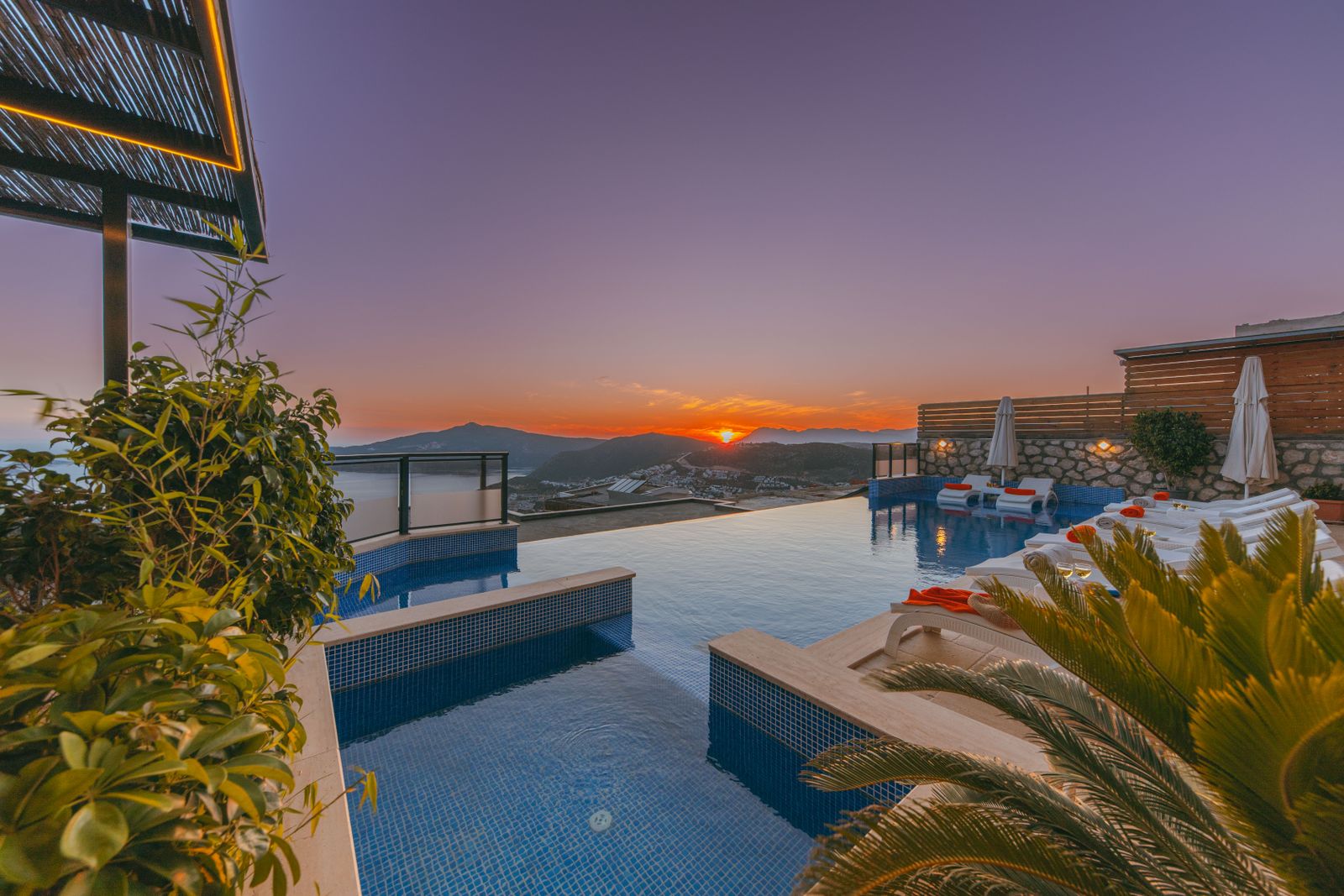
- Infinity edge. Water spills freely over one side into a lower channel or straight into the tank. Visually the most striking, technically the most demanding and the most sensitive to wind, which carries the falling water beyond the catchment area.
- Combinations. A common solution: an infinity edge on the side with the view, and a classic grated channel around the rest of the perimeter.
Levelness is a matter of millimetres
This is the most important sentence in the whole article: the overflow edge must be level to within a few millimetres over its entire length. The German standard DIN 19643 for pool water treatment gives a maximum deviation of the overflow edge from horizontal of ±2 mm; manufacturers of channel systems routinely work to an even stricter requirement of ±1 to 1.5 mm.
The reason is physical and unforgiving. Water spills over the edge in a layer a few millimetres thick. If one corner is 5 mm lower, the water will flow only there and the rest of the perimeter will stay dry. It cannot be corrected by adjusting the pump or by adding water — there is only one water level, and putting it right means taking the edge apart and re-bedding it.
For the buyer this means that on an overflow pool the quality of the installation company matters more than on any other type of pool and the cheapest quotation is the riskiest item in the budget. We look at how to approach the budget as a whole in How much a pool costs.
The edge has to be cleaned by hand
The overflow edge is where water runs down in a thin film and evaporates — in other words, ideal conditions for limescale and an oily film. On mosaic tiles or a polished edge this shows up as a visible band, which additionally makes the overflow less even. Cleaning the edge and the channel is hand work with a sponge or brush and a suitable product, typically once every two to four weeks depending on water hardness. A pool robot cannot handle this area — it moves along the floor and walls below the water line and cannot reach the edge at water level or the channel behind it. What a robot really can do and what types exist is summarised in How to choose a robotic pool cleaner.
Greater demands on hydraulics and the pump
An overflow changes the whole pipework design. The pump has to handle the full volume of spilling water, not just the flow needed for filtration — and that means a higher flow rate, larger pipe diameters and a matching filter.
- Gravity pipework from the channel to the tank must be oversized and laid to a fall. Undersized downpipes cause the channel to fill and water to run back into the pool.
- Suction from the tank is short, straight and with a minimum of bends, to avoid cavitation.
- Floor inlets must be positioned so that they cover the whole floor area — otherwise zones of stagnant water form despite a clean surface.
- A variable-speed pump makes even more sense on an overflow than on a skimmer: it can run most of the day in economy mode and step up the speed only during bathing or backwashing.
The principles of sizing pipework and positioning inlets are in Pool hydraulics: pipework and jets.
The operating reality buyers do not expect
Higher water consumption
An overflow almost always loses more water than a skimmer: the water in the channel and the tank increases the evaporating area, the spilling layer splashes, and with a pool full of people some of the water runs off through the tank overflow. Practical estimates and how to work out your own consumption are in Pool water consumption.
Higher energy consumption
The pump works at a higher flow rate, so for the same running time it uses more electricity. And the water in the tank and the channel cools faster than the water in the pool, so the heating has to supply more heat — with an uninsulated chamber outdoors the loss rises noticeably.
More demanding winterising
On a skimmer pool the level is dropped below the inlets and the system is drained. On an overflow there are more steps: besides the pool you have to completely empty and drain the channel and the balance tank including all the downpipes, because frozen water in the gravity pipework or in the tank means burst pipes and, at worst, damaged structure. On top of that comes shutting down the automatic top-up and draining the valve. The general procedure is described in Winterising a pool step by step; on an overflow it is sensible to leave it to the company that built the system, at least for the first season.
What an overflow requires on top: an overview
| Area | What is extra compared with a skimmer | When it comes up |
|---|---|---|
| Construction | Overflow channel around the perimeter, precise edge levelling (±1–2 mm) | Build stage, cannot be added later |
| Groundworks | Excavation and anchoring of the balance tank below water level | Build stage |
| Water volume | An extra tank, typically 5–10 % of the pool volume | Initial filling and every top-up |
| Pipework | Gravity downpipes from the channel, larger diameters, falls | Design and build |
| Pump and filter | Higher flow, larger filter, ideally variable-speed control | Design, replacement after years |
| Automation | Level monitoring, solenoid valve, dry-run protection | Build stage, annual service |
| Plant space | Larger pit or room, access into the tank | Design |
| Maintenance | Hand cleaning of the edge and channel, annual tank cleaning | Ongoing, a robot cannot do it |
| Running | Higher evaporation, higher electricity consumption | Every season |
| Winterising | Draining the channel, downpipes, tank and top-up line | Autumn |
How much extra does an overflow cost?
Industry sources abroad (Austrian and German pool companies) quote a premium of roughly 20–30 % over a comparable skimmer pool, with some sources mentioning up to 30 % as an average. The range is wide because it depends on the shape of the pool, the length of the edge and how awkward the tank position is. But the budget also has to include what turns up later: the annual check of the automation, hand cleaning of the edge and higher running costs. More specific figures for local conditions are given in Skimmer vs overflow pool.
Frequently asked questions
Does the balance tank always have to be separate from the pool?
Yes, it is a self-contained space below the pool water level. On smaller installations it is occasionally built as a separate chamber within the pool structure, but even then it is a self-contained volume with its own drain, overflow and access for cleaning. Without it an overflow cannot work, because there would be nowhere for the water displaced by bathers to go.
How do I tell that the tank is undersized?
The most typical symptom: when four people get into the pool, water starts running from the tank overflow into the sewer, and when they get out the system has to top it back up. The second symptom is the opposite — the pump draws air while running and is noisy. Either one means the usable volume is not enough. The remedy is usually adjusting the working level, or in worse cases enlarging the tank.
Can an overflow channel be added to a finished skimmer pool?
In practice, no. It would mean raising the water level to the coping, building a channel around the perimeter, excavating a tank, laying new pipework and levelling the edge precisely — in other words work comparable to building a new pool. This decision belongs in the design, not in a refurbishment.
Can a robot clean the overflow channel too?
No. A pool robot works below the water line on the floor and walls. It will not clean the overflow edge, the channel behind it or the inside of the balance tank — those parts remain hand work. A robot is still useful on an overflow pool, but it does not replace edge maintenance.
How much extra water does an overflow hold?
On top of the pool volume, allow for the volume of the channel and the usable volume of the tank. On a family pool of around 50 m³ that is usually some 3,000–4,000 litres extra, that is roughly 6–8 % of the total volume. This affects both the first fill and chemical dosing — the total volume of the system is greater than the volume of the pool.
In conclusion
An overflow pool gives the best result where looks and a clean water surface are the priority — and where both the owner and the design are prepared for a system with more components that need maintaining. The key is to specify three things correctly: sufficient balance tank volume with access for cleaning, reliable level monitoring with a time limit on top-up, and a company that can level the edge to the millimetre.
If you are putting together the equipment package — a variable-speed pump, filtration matched to the higher flow or level-monitoring automation — you will find the components in our pool equipment category. And more articles on pool design and operation are in the Guide section.
